
What if choosing the right family counsellor matters as much as deciding to seek support? If sibling arguments, parent-child tension or feeling unheard have become part of daily life, searching for family counselling Calgary can raise an important question: who will understand your family’s particular needs?
It makes sense to want support that takes your family’s concerns into account. Every family has its own ways of communicating, sources of conflict and priorities. If ADHD or neurodivergence is part of the picture, those differences may be important to discuss, too.
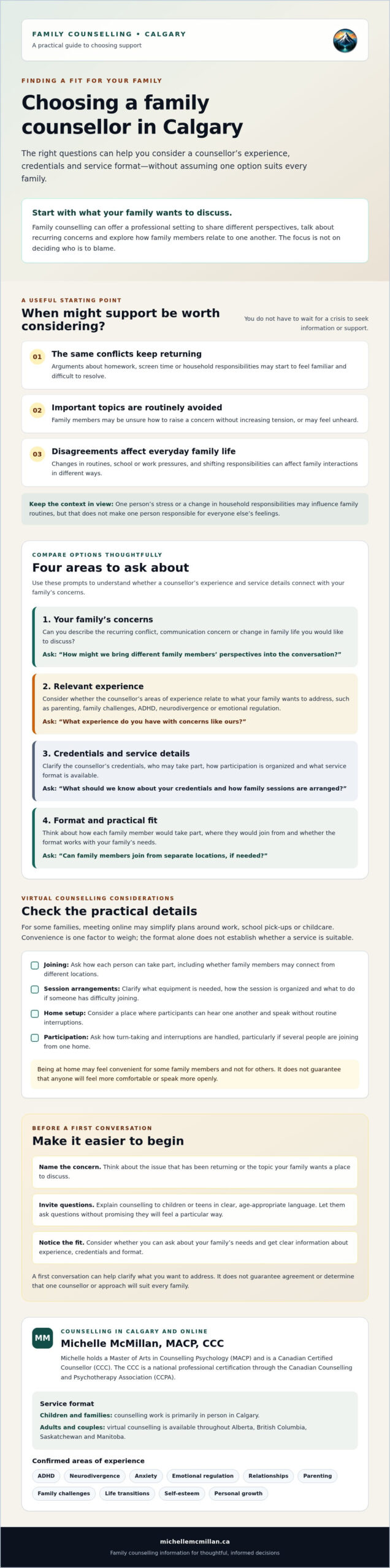
This article covers what to consider when choosing family counselling, including relevant experience, credentials and service format. Counselling is offered in person in Calgary and virtually across Alberta, British Columbia, Saskatchewan and Manitoba. It also offers practical questions to help you compare options and prepare for a first conversation. The aim is to help you make an informed choice, without assuming one counsellor or approach will suit every family.
Key Takeaways
- Family counselling Calgary can provide a professional setting to discuss recurring conflict, communication concerns and each family member’s perspective.
- Counselling is available in person in Calgary and virtually across Alberta, British Columbia, Saskatchewan and Manitoba, so consider which format suits your family.
- Ask about a counsellor’s credentials, relevant experience and service structure before deciding whether the fit feels right.
- If a first conversation feels daunting, explain counselling to children or teens in clear, age-appropriate language and invite their questions.
- Consider whether the counsellor’s areas of focus connect with your family’s concerns, such as ADHD, emotional regulation, parenting or family dynamics.
Understanding the Need for Family Counselling in Calgary
Family counselling is a collaborative process where family members can discuss concerns, explore how they relate to one another and consider ways to address conflict with professional support. The focus is not on deciding who is to blame. It is on making space for different perspectives and understanding patterns that affect family life.
Family dynamics are connected. A child’s stress, a parent’s work pressures or a change in household responsibilities can influence routines and interactions across the family. That does not mean one person is responsible for everyone else’s feelings. It means a difficulty affecting one family member may also shape how others communicate and respond.
Families in Calgary may be managing work and home responsibilities, school transitions or changes in routines. These pressures affect each household differently. Seeking support can be a proactive choice, giving family members a place to discuss concerns before familiar tensions become harder to address.
Common Challenges Calgary Families Face
A conversation about homework, screen time or household responsibilities can turn into a familiar argument. When the same disagreement repeats, family members may feel unheard or unsure how to raise the issue without increasing tension.
Parenting decisions and life transitions can add strain, too. A new school year, a career change or shifting responsibilities may affect routines and time for family connection. School pressures can also carry into home life. Talking about these wider influences can help family members consider the situation beyond one person’s actions.
When to Consider Professional Support
Family conversations, books and household agreements can be useful starting points. You might consider professional support if the same conflicts keep returning, important topics are routinely avoided or disagreements are affecting daily family life. You do not have to wait until a crisis to seek information or support.
A counsellor can offer an outside perspective and a setting where family members can describe their concerns and hear how others understand the situation. This does not guarantee agreement, but it may help clarify where misunderstandings occur and what each person wants to address.
For families navigating ADHD or neurodivergence, experiences and support needs vary between individuals. Routines, communication or emotional regulation may be concerns a family wants to explore, without assuming they affect everyone in the same way. You can review areas of counselling focus as you consider relevant experience. Searching for family counselling Calgary can also help you identify questions to ask and decide whether professional support may suit your family’s concerns.
In-Person and Virtual Family Counselling: Comparing Your Options
Michelle McMillan Counselling offers family counselling Calgary families can attend in person, as well as virtual sessions for clients across Alberta, British Columbia, Saskatchewan and Manitoba. Neither format is inherently better; each suits different circumstances. In-person sessions may appeal to families who want a dedicated space away from home distractions, while virtual sessions may suit families balancing work, school or transportation constraints. Consider what matters most to your family when comparing the two.
Comparing In-Person and Virtual Sessions
In-person counselling in Calgary offers a consistent, private setting and may make it easier to read body language across several family members at once. Virtual counselling can reduce travel time and may help families join from different locations when needed. Ask Michelle McMillan Counselling which format is available and appropriate for your family’s circumstances before deciding.
Whichever format you choose, ask how turn-taking, interruptions and participation are handled during sessions. The format alone does not establish whether a service is suitable for your family. For background on the broader field, this overview of the goals of family therapy offers additional reading.
If you are considering family counselling Calgary, compare practical details and ask whether in-person or virtual counselling is more appropriate for your family. Michelle McMillan offers both, including services for families. Discuss your circumstances with the practice when considering the format.
Choosing Between Calgary Family Counsellors and Large Clinics
There is no single service model that suits every family. A private practice may involve working with one counsellor, while a larger clinic may have several practitioners or different ways of organizing care. Neither setting is automatically more attentive or more appropriate. Ask how the service is structured and whether it matches the concerns your family wants to discuss.
Fit matters, too. Family members should have room to describe what is happening, and the counsellor should be able to explain how your concerns and goals will be considered. You can ask questions before deciding, including how the counsellor’s relevant experience connects to your family’s needs.
Ask About Continuity, Goals and Service Structure
If having a consistent practitioner is important to your family, ask who would provide the counselling and whether that person is expected to remain involved. If a clinic works with students or interns, ask what their role is and how supervision is arranged. These are neutral questions to help you understand the service, not signs that one model is inherently better than another.
It is also reasonable to ask whether counselling follows a defined programme or can be shaped around your family’s concerns. Some families may want to discuss a specific recurring conflict; others may be facing several connected challenges. Ask how goals are identified and revisited, and what to expect if your family’s priorities change. If access is a concern, ask about current availability directly rather than assuming a particular wait time.
Understanding the CCC and MACP Credentials
Credentials can help you learn about a counsellor’s professional background. Michelle McMillan holds a Master of Arts in Counselling Psychology (MACP) and is a Canadian Certified Counsellor (CCC). The MACP is her master’s degree, while the CCC is a professional certification through the Canadian Counselling and Psychotherapy Association (CCPA).
A credential alone cannot tell you whether a counsellor is the right fit for your family. Consider it alongside experience with concerns relevant to you, how the counsellor explains their role and whether their answers help you make an informed choice. Reviewing a counsellor’s credentials is one part of your research.
As you compare options for family counselling Calgary, focus on clear answers rather than assumptions about private practices or larger clinics. A useful first step is to ask how the counsellor will understand your family’s priorities and whether the service structure feels suitable.
How to Prepare for Your Family’s First Counselling Session
A first family counselling session can bring up nerves, uncertainty or scepticism. That is understandable, especially if family members have different views about getting support. You do not need to arrive with everything figured out. The first meeting can be an opportunity to talk about what brought your family to counselling, ask questions and begin getting to know the counsellor.
Before the session, consider naming one or two concerns you would like to discuss. For example, you might want to talk about recurring arguments around routines or how family members can raise difficult topics. Treat these as starting points, not a checklist everyone must agree on. Each person may describe the same situation differently, and hearing those perspectives is part of understanding the family’s concerns.
Set Manageable Goals for Your Family
It can help to focus on a small, observable change rather than expecting to resolve every concern at once. You might hope to have calmer conversations about a particular household issue, or to better understand what happens before an argument escalates. These are discussion goals, not guaranteed outcomes. Counselling can provide a setting to explore what feels workable for your family and revisit priorities as circumstances change.
Talk with children or teens beforehand in clear, low-pressure language. You could explain that the family will meet with a counsellor to discuss what has been feeling difficult and that they can ask questions. Avoid promising they will enjoy the experience or that everyone will agree. A little honesty can make the plan easier to understand.
Make Room for Different Experiences of ADHD and Neurodivergence
If ADHD or neurodivergence is part of your family’s experience, make a note of the specific situations you would like to discuss. These might include routines, communication during moments of frustration or how different family members understand emotional regulation. Experiences vary, so avoid assuming one person’s needs or reactions represent everyone’s. Family counselling can be an opportunity to talk about these differences and consider what forms of support may be useful to explore.
Michelle McMillan’s areas of focus include ADHD, neurodivergence, emotional regulation and family challenges. You can review her counselling areas of focus as you consider whether they relate to your family’s concerns.
There is no need to prepare a perfect explanation. A few notes about what feels difficult, what you have already tried and what each person hopes to discuss can be enough to begin. The first conversation about family counselling Calgary can be a chance to share those concerns and learn whether the service feels like a suitable fit.
Professional Family Support with Michelle McMillan
When looking for family counselling Calgary families can consider, weigh what kind of support your family needs, the counsellor’s relevant experience and whether the service format suits you. Michelle McMillan is a Canadian Certified Counsellor (CCC) with a Master of Arts in Counselling Psychology (MACP). Her areas of focus include family challenges, relationships, parenting, ADHD, neurodivergence and emotional regulation.
Family counselling gives relatives a professional setting to discuss conflict, communication concerns and changes in family life. Each family member may see the same situation differently. Bringing those perspectives into the conversation can help clarify which concerns your family wants to focus on, without assuming that one person is to blame or promising a particular result.
Consider Experience Relevant to Your Family
Families may seek support for recurring disagreements, parenting concerns or transitions that are changing household routines. If ADHD or neurodivergence is part of your family’s experience, it may be useful to ask how a counsellor’s background relates to the specific concerns you want to discuss. Experiences vary, so describe your family’s situation rather than assuming one set of strategies will fit everyone.
You can review Michelle’s areas of counselling focus to see whether the listed topics connect with your family’s needs. Use that information as a starting point for deciding what questions to ask and what matters most in a counsellor-client fit.
Ask About Service Format and Next Steps
Michelle McMillan Counselling offers in-person family counselling in Calgary, as well as virtual counselling to clients across Alberta, British Columbia, Saskatchewan and Manitoba. Since format can affect practical arrangements for your household, ask which options are appropriate for your family and clarify the details before making plans.
There is no need to have every concern organized before reaching out. You might briefly describe what prompted your search, who in the family may be involved and what you would like to clarify about the service. You can use the contact page for counselling enquiries to ask questions and learn more.
Family Counselling Calgary: Choosing Support That Fits
Choosing family counselling Calgary families can consider is about more than comparing service formats. Look for a counsellor whose relevant experience, credentials and way of discussing your concerns feel appropriate for your family. It can also help to arrive with one or two topics you would like to explore, while leaving room for each family member’s perspective.
Michelle McMillan holds a Master of Arts in Counselling Psychology (MACP) and is a Canadian Certified Counsellor (CCC), a professional certification through the Canadian Counselling and Psychotherapy Association. Her areas of focus include ADHD, neurodivergence and family dynamics. Consider whether in-person or virtual counselling fits your family’s needs, and ask the practice about the service details.
You can review rates and booking options for family counselling as you decide what questions to ask and whether the service may be a suitable fit.
Frequently Asked Questions
Is family counselling effective if done virtually?
Family counselling may be appropriate whether delivered virtually or in person, depending on your circumstances and needs. No particular result can be promised, and it is best not to assume one format is superior to the other. Consider whether everyone can participate, communicate comfortably and find a suitable place to join. Ask Michelle McMillan Counselling, which offers both in-person sessions in Calgary and virtual sessions across Alberta, British Columbia, Saskatchewan and Manitoba, whether a particular format fits your family’s situation.
How long does family counselling usually take?
There is no single timeline for family counselling. The time involved depends on what your family wants to discuss, the concerns involved and how your priorities develop. Rather than relying on a general estimate, ask how goals are discussed and how you can review whether the support remains suitable. You can also ask what happens if your family’s needs change.
Can we do family counselling if one member is reluctant to join?
You can ask a counsellor about options even if a family member is reluctant to participate. Start by listening to what concerns them, then explain why you are considering support without pressuring them to agree. Ask how differing levels of readiness are handled and whether everyone needs to participate in the service being considered. The answer may depend on your family’s circumstances, so clarify this before making plans.
What is the difference between a counsellor and a psychologist in Calgary?
Counsellor and psychologist are distinct professional titles. Check a provider’s exact title, education, credentials and professional affiliation rather than inferring qualifications from a general label. Michelle McMillan holds a Master of Arts in Counselling Psychology (MACP) and a Canadian Certified Counsellor (CCC) designation through the Canadian Counselling and Psychotherapy Association.
How do I know if we need family therapy or individual therapy for my child?
Consider whether your main concern centres on your child’s individual experience, family interactions or both. Individual counselling gives a child space to discuss their own concerns, while family counselling provides a setting to explore shared relationships and concerns. These descriptions can help you frame questions, but they do not determine which service is right. Share what you have noticed, what your child says they need and what you hope counselling could help you explore.
What should we look for when choosing a family counsellor in Calgary?
Look for relevant education, clearly described credentials and experience connected to the concerns your family wants to discuss. Ask how the counsellor’s service works, whether the format is suitable and how you can raise questions if family members have different priorities. It can also help to notice whether explanations are clear and whether you understand the counsellor’s role. Comparing these points can make your search for family counselling Calgary more informed and focused.
Is virtual family therapy private and secure?
Privacy and security arrangements vary, so ask the provider directly about the platform and applicable privacy practices. You can also consider whether other people might overhear from the places family members plan to join. Confirm any questions about the virtual service with the practice before booking.
To discuss whether virtual family counselling may suit your family, contact Michelle McMillan Counselling with your questions.

Article by
Michelle McMillan, MACP, CCC
Michelle McMillan is a Canadian Certified Counsellor (CCC) with a Master of Arts in Counselling Psychology (MACP). She has extensive experience working with children and supporting clients with ADHD, neurodivergence, anxiety, emotional regulation, relationships and family challenges. Michelle offers both virtual and in-person counselling, with virtual counselling available throughout Alberta, British Columbia, Saskatchewan and Manitoba and in-person appointments available in Calgary.
Important Information
This article is provided for general educational and informational purposes only and is not a substitute for professional counselling, psychological, medical or emergency services. Information shared here should not be considered a diagnosis or individualized treatment advice. If you are experiencing a mental health emergency or are in immediate danger, please contact appropriate emergency services in your area.