
What if your child’s emotional outbursts are a sign they need support, not a sign that you’ve failed as a parent? When big feelings begin affecting family life, school, or friendships, it’s understandable to feel unsure where to turn. Searching for child counselling Calgary families can access may bring practical questions, too: what happens in counselling, how to choose a qualified counsellor, and how to include your child without making them feel blamed or singled out.
Child counselling offers an opportunity to discuss a child’s concerns and consider support that takes their age, experiences, and individual needs into account. It isn’t about labelling a child or expecting change overnight. It can help families explore what has been difficult, including ADHD-related challenges, anxiety, emotional regulation, and major life changes.
This article covers signs that professional support may be worth considering, questions to ask when choosing a counsellor, and what to consider when exploring virtual counselling. It also explains Michelle McMillan’s credentials and areas of focus, including ADHD, neurodivergence, and emotional regulation, to help you make a more informed decision for your family.
Key Takeaways
- Child counselling can give children a developmentally appropriate space to explore feelings and concerns without judgement.
- Notice changes such as withdrawal, irritability, school-related anxiety, or peer difficulties, and consider whether extra support may be helpful.
- When exploring child counselling Calgary options, ask about a counsellor’s experience with your child’s concerns and the service formats available.
- ADHD experiences vary from child to child. Learning more about your child’s individual challenges can help guide conversations about support at home and school.
- Consider how counselling could include family concerns, communication, and emotional regulation.
What is Child Counselling and How Can it Help Your Family?
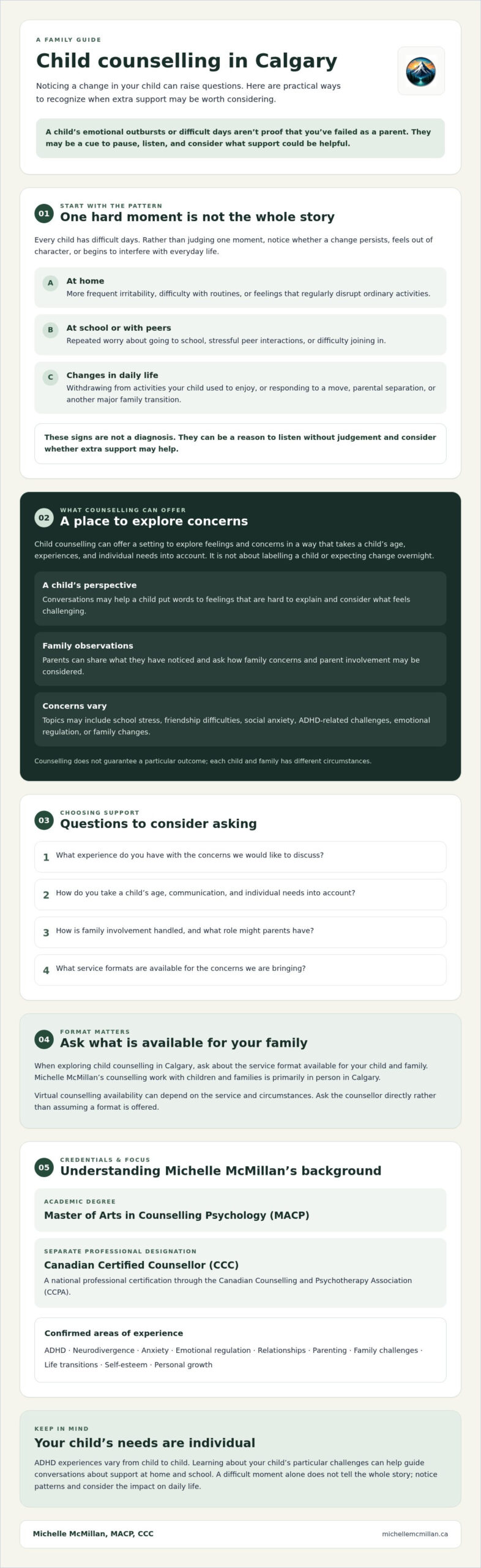
When a child is having a hard time, it can be difficult to know what’s behind the tears, anger, withdrawal, or reluctance to go to school. Child counselling offers a setting where a child can explore feelings and concerns with support suited to their age and communication level. The aim is to make it easier to talk without judgement, not to expect a child to explain everything perfectly.
Concerns might include school stress, a family change, friendship difficulties, or social anxiety. Counselling can give a child space to put words to feelings that are hard to explain and explore what they find challenging. Parents may also have an opportunity to share what they’ve noticed and discuss their concerns. Each child’s needs are different, and counselling doesn’t guarantee a particular outcome.
For families exploring child counselling Calgary options, it may help to look for a counsellor whose background and areas of focus relate to the concerns you’d like to discuss. You can learn more about Michelle McMillan’s areas of focus, including ADHD, neurodivergence, and emotional regulation, on the counselling areas of focus page.
The Role of a Canadian Certified Counsellor
Credentials can help you understand a counsellor’s education and professional designation. Michelle McMillan holds a Master of Arts in Counselling Psychology (MACP) and is a Canadian Certified Counsellor (CCC). The MACP is her academic degree, while the CCC is a separate national professional certification through the Canadian Counselling and Psychotherapy Association (CCPA). When considering child counselling, you can ask a prospective counsellor about their relevant experience, professional affiliation, and approach to professional practice.
A child’s concerns can also affect family life. Counselling may provide an opportunity to consider the child’s perspective alongside parents’ questions, while recognizing that every family’s circumstances are different. You can ask how family involvement is handled and what role, if any, parents may have.
Common Goals of Counselling for Kids
Goals depend on the child and the concerns bringing the family to counselling. They may include building a vocabulary for difficult feelings, discussing ways to manage stress, or thinking through social situations such as joining a group or handling a disagreement. A child might also explore what feels manageable and what support they would like from adults.
These conversations can create opportunities for self-understanding and agency, but they aren’t a promise of specific changes. Parents can share observations and ask questions, helping ensure the concerns discussed reflect the child’s daily life at home, school, and with peers.
Recognizing When Your Child Might Benefit from Professional Support
Every child has difficult days. A burst of frustration, a quiet afternoon, or nerves before a new experience doesn’t automatically mean something is wrong. What may be worth noticing is a change that persists, feels out of character, or begins to interfere with everyday life. You might see your child withdraw from activities they used to enjoy, become irritable more often, or struggle with routines at home.
School and friendships can offer useful clues, too. A child may repeatedly worry about going to school, find peer interactions stressful, or have difficulty joining in. Changes such as moving, parental separation, or another major family transition can also bring feelings a child may not yet know how to explain. These signs aren’t a diagnosis. They can be a reason to listen without judgement and consider whether extra support could be helpful.
Parents sometimes wonder whether they should wait and see. There’s no single timeline that fits every child, but seeking advice when a concern is affecting daily life can help you explore what might be contributing and what options are available. The Mental Health Commission of Canada offers information about children’s and youth mental health, which can provide broader context as you consider your family’s needs.
Emotional Regulation and “Big Feelings”
Children develop at different rates, and strong feelings can be part of growing up. Consider the pattern rather than judging one difficult moment: how often does it happen, how long does it last, and does it make it harder for your child to take part in ordinary routines? If feelings regularly disrupt sleep, getting ready, family interactions, or activities, discussing what you’ve noticed with a qualified professional may help you consider what support makes sense.
Some children have trouble describing what’s happening inside. They may show distress through irritability, silence, or conflict instead of saying, “I’m worried” or “I feel left out.” Counselling can offer a setting to explore these experiences and consider how to talk about them at home.
Supporting Neurodivergent Youth
For a child with ADHD, stress may show up in different ways, such as frustration with repeated reminders, difficulty shifting between tasks, or feeling overwhelmed by school demands. These examples aren’t proof of ADHD, and children’s experiences vary. Discipline alone may not address every difficulty. Understanding the situation and the child’s needs can be part of deciding what support to consider.
If ADHD-related concerns are part of what you’re noticing, explore ADHD and neurodivergence counselling information as one resource while considering the child counselling Calgary families may be looking for.
Navigating Options: In-Person vs. Virtual Child Therapy in Alberta
Families may compare in-person and virtual counselling when deciding what could suit their child. Michelle McMillan provides in-person counselling in Calgary and virtual sessions for clients across Alberta, British Columbia, Saskatchewan, and Manitoba. The most suitable format may depend on a child’s age, preferences, comfort, concerns, and family circumstances.
Think about what helps your child take part in a conversation. Would they feel comfortable speaking from a familiar room, or might they find it difficult to focus on a video call? Consider practical needs too, including interruptions, access to a suitable device, and whether your child can remain engaged on screen. You can ask a counsellor how virtual counselling works and whether it may suit your child’s age and concerns.
Making Virtual Counselling Work for Kids
A calm setup can make it easier for a child to focus, though it can’t guarantee that every appointment will hold their attention. Before a virtual appointment, consider choosing a quiet space, checking the device and connection, and letting other household members know the room is in use. If your child needs your help with technology or settling in, ask the counsellor how you can support the arrangements. Explain simply that this is time to talk with a counsellor, without promising a particular result.
Home may feel familiar, but it isn’t automatically private. Think about who might overhear, whether the door can be closed, and what your child would prefer about a parent’s presence. Discuss any privacy concerns with the counsellor before deciding whether virtual counselling is suitable.
Access and Fit for Alberta Families
Virtual counselling may reduce travel, which can be useful for families managing work, school, or distance from services. Michelle McMillan provides in-person counselling in Calgary and virtual sessions across Alberta, British Columbia, Saskatchewan, and Manitoba. Families can consider which format and support best suit their child’s circumstances. The Alberta child and youth mental health services page is another place to review provincial information and support options.
A strong working relationship matters, but it shouldn’t be presumed based on the format alone. Ask how a counsellor supports a child’s participation and how family involvement is handled. If you’re exploring child counselling Calgary, review Michelle McMillan’s counselling services to learn more about available formats.
Specialized Support for ADHD and Emotional Regulation
ADHD and neurodivergence can shape how a child experiences tasks, relationships, and strong emotions, but no two children have exactly the same needs. A child might find it hard to pause before acting, shift between activities, or keep track of several steps. These challenges aren’t signs of laziness or a lack of care. Understanding what’s difficult for your child can help your family decide what support to explore.
Support can look beyond managing visible behaviours. It may include helping a child describe what feels frustrating, notice situations that tend to be difficult, and think about what kinds of help they can ask for. The aim isn’t to promise confidence or change, but to make room for a fuller understanding of the child’s experiences, strengths, and needs.
Tools for ADHD-Related Challenges
Practical strategies are most useful when they fit the child and the situation. Families might discuss ways to break a multi-step task into smaller parts, make transitions clearer, or pause and consider choices during an impulsive moment. These are examples to explore, not universal solutions. What helps one child may not suit another.
Language matters, too. Talking about ADHD without blame can help children understand that a challenge isn’t a character flaw. A child may also need support with peer situations, such as repairing a misunderstanding or asking for a turn. Counselling can provide space to consider these experiences and what the child would find helpful.
Parenting Support and Family Dynamics
Repeated reminders, unfinished tasks, or emotional outbursts can strain family interactions. Parents may feel worn down, while a child may feel criticized or misunderstood. A family-focused conversation can help clarify what each person is experiencing and identify practical topics to address, such as expectations, routines, and how family members communicate during tense moments. The purpose isn’t to assign blame. It’s to understand the challenge together.
Parents can bring specific examples, such as a difficult morning routine or a recurring disagreement about homework, and describe what they’ve already tried. A counsellor can discuss possible supports with the family while keeping the child’s perspective in view. Any strategies should be considered in light of the individual child and family, rather than assumed to work for everyone.
Michelle McMillan, MACP, CCC, has areas of focus that include ADHD, neurodivergence, emotional regulation, and parenting challenges. For families considering child counselling Calgary, the child, family, and ADHD counselling services page offers more information about the support available.
Finding the Right Path with Michelle McMillan Counselling
Choosing a counsellor is a personal decision. You may want to understand who will work with your child, what concerns they have experience with, and how family involvement is handled. If you’re comparing child counselling Calgary options, these questions can help you assess fit without feeling that you need every answer before reaching out.
Michelle McMillan holds a Master of Arts in Counselling Psychology (MACP) and is a Canadian Certified Counsellor (CCC), a national professional certification through the Canadian Counselling and Psychotherapy Association (CCPA). Her areas of focus include ADHD, neurodivergence, anxiety and stress, emotional regulation, parenting challenges, and family dynamics. You can read more about her background on the About Michelle McMillan page.
Michelle McMillan Counselling provides in-person counselling in Calgary and virtual sessions across Alberta, British Columbia, Saskatchewan, and Manitoba. As you consider whether the service may suit your family, it’s reasonable to ask how the counsellor communicates with parents, how your child’s needs will be considered, and what happens if your child feels unsure about taking part. A respectful working relationship matters, but no provider can promise a particular fit or outcome.
Choosing Support That Fits Your Family
Some families value knowing who they’ll meet and having a direct conversation about their concerns. If that matters to you, ask about the counsellor’s role and how family participation is considered. You can also share what your child enjoys, what tends to be difficult, and what you hope to understand better. These details can help make an initial conversation more useful without requiring you to prepare a perfect summary.
Preparing for a First Appointment
Keep the explanation simple and age-appropriate. You might tell your child that counselling is a chance to talk with someone about what’s been feeling hard, and that they can ask questions. Avoid presenting it as a punishment or promising that it will solve a particular problem. Before booking, review the available information about service format and arrangements so you know what to expect. Details can vary, so check them directly rather than assuming what an initial appointment or later sessions will involve.
Taking time to explore support doesn’t commit your family to a particular plan. If you’d like to review booking information for child and family counselling with Michelle McMillan, MACP, CCC, visit the booking page.
Take a Thoughtful Next Step for Your Family
Big feelings, school stress, ADHD-related challenges, and family changes can leave you wondering how best to support your child. Counselling offers an opportunity to discuss what’s happening and consider what may fit your child’s needs. As you explore child counselling Calgary options, think about the concerns you want to raise, your child’s preferences, and whether virtual counselling suits your family.
Michelle McMillan holds a Master of Arts in Counselling Psychology (MACP) and is a Canadian Certified Counsellor (CCC) with the Canadian Counselling and Psychotherapy Association (CCPA). Her areas of focus include ADHD, neurodivergence, and emotional regulation. She provides in-person counselling in Calgary and virtual sessions across Alberta, British Columbia, Saskatchewan, and Manitoba.
If you’re ready to explore support, visit the booking page for Michelle McMillan, MACP, CCC. You don’t need to have everything figured out before taking a first step. Your questions are a place to begin.
Frequently Asked Questions
How do I know if my child is ready for counselling?
Your child doesn’t need to ask for counselling or fully understand what it involves before you explore support. Consider whether a concern is continuing, affecting everyday routines, or creating distress at home, school, or with peers. You can explain the idea in simple terms and invite questions without pressure. A counsellor can help you discuss whether the service may suit your child’s needs, even if your child feels unsure at first.
Does Michelle McMillan offer in-person sessions in Calgary?
Yes. Michelle McMillan provides in-person counselling in Calgary and virtual sessions across Alberta, British Columbia, Saskatchewan, and Manitoba. If you’re looking for child counselling Calgary families can access, consider which format may suit your child and family.
What is the difference between a Canadian Certified Counsellor and a Psychologist?
A Canadian Certified Counsellor (CCC) and a psychologist are distinct professional designations. Michelle McMillan holds a Master of Arts in Counselling Psychology (MACP) and the CCC, a national professional certification through the Canadian Counselling and Psychotherapy Association (CCPA). She is not a psychologist. If you’re comparing providers, check their stated qualifications and professional designation, and choose someone whose background fits the support you’re seeking.
Can virtual counselling be a fit for a child with ADHD?
Virtual counselling isn’t automatically the right fit for every child with ADHD, and outcomes shouldn’t be assumed based on format. A child’s age, preferences, ability to engage by video, privacy, and the concerns they want to discuss may all matter. Michelle offers virtual counselling for clients in Alberta. Ask whether the format may suit your child’s circumstances.
Will I be involved in my child’s counselling sessions?
Parent involvement can vary with the child’s age, concerns, and family circumstances, so it’s best to ask the counsellor how this is handled. You can share observations about what you notice at home or school and discuss what role may be appropriate for you. Before starting, ask how parent participation is considered and how questions about privacy and communication are addressed, so you and your child know what to expect.
How do I explain the idea of a “counsellor” to my young child?
Use clear, reassuring language that fits your child’s age. You might say, “A counsellor is someone you can talk with about things that feel hard, and you can ask them questions.” Let your child know counselling isn’t a punishment and avoid promising that it will fix a specific problem. Give them space to share worries or curiosity, and answer honestly when you know. If you’re unsure what to say, ask the counsellor for guidance.

Article by
Michelle McMillan, MACP, CCC
Michelle McMillan is a Canadian Certified Counsellor (CCC) with a Master of Arts in Counselling Psychology (MACP). She has extensive experience working with children and supporting clients with ADHD, neurodivergence, anxiety, emotional regulation, relationships and family challenges. Michelle offers both virtual and in-person counselling, with virtual counselling available throughout Alberta, British Columbia, Saskatchewan and Manitoba and in-person appointments available in Calgary.
Important Information
This article is provided for general educational and informational purposes only and is not a substitute for professional counselling, psychological, medical or emergency services. Information shared here should not be considered a diagnosis or individualized treatment advice. If you are experiencing a mental health emergency or are in immediate danger, please contact appropriate emergency services in your area.