
What if your teen’s first conversation with a counsellor didn’t have to happen in an office? If attending an appointment in person feels like a barrier, it can be hard to know where to turn. Searching for teen counselling Calgary families can access may bring up more questions than answers, such as what kind of support is available and how to choose a counsellor who feels like a good fit.
Michelle McMillan provides in-person counselling in Calgary and virtual counselling across Alberta, British Columbia, Saskatchewan and Manitoba. For Calgary youth, either format may offer a way to discuss concerns such as anxiety, ADHD and the pressures of adolescence with a professional counsellor. The most suitable option depends on your teen’s preferences, circumstances and comfort with the setting.
This article explains what to consider when looking for teen counselling, how in-person and virtual counselling may fit your family’s needs, and what topics a counsellor can help your teen explore. You’ll also find practical questions about ADHD support, emotional regulation and communication within the family. Michelle McMillan holds a Master of Arts in Counselling Psychology and is a Canadian Certified Counsellor (CCC).
Key Takeaways
- Learn how to notice when changes in your teen’s mood, routines or relationships may be worth discussing with a professional.
- Explore how teen counselling Calgary can provide a space to talk about anxiety, ADHD and the pressures of adolescence.
- Consider practical questions about ADHD support, including what may help with focus and organization at school or home.
- Compare in-person counselling in Calgary with virtual counselling across Alberta, British Columbia, Saskatchewan and Manitoba.
- Get ideas for discussing counselling with your teen and learn what the CCC designation means when choosing a counsellor.
Understanding the Need for Teen Counselling in Calgary
Adolescence can bring several changes at once: heavier school demands, shifting friendships, more independence and questions about identity. For Calgary teens, these pressures may feel harder to manage when expectations at school, home and among peers seem to pull in different directions. Seeking teen counselling in Calgary can offer a way to explore what’s going on with a qualified professional, without assuming that every difficult period means a teen has a mental health condition.
Common Challenges for Calgary Youth
Social life can continue long after the school day ends. Messages, group chats and social media may create opportunities for connection, but they can also leave teens worrying about being left out, judged or expected to respond immediately. Academic stress may involve fear of falling behind, difficulty balancing assignments and activities, or tension around grades and future plans. Puberty and other life changes can also affect self-esteem as teens adjust to their changing bodies, relationships and sense of who they are.
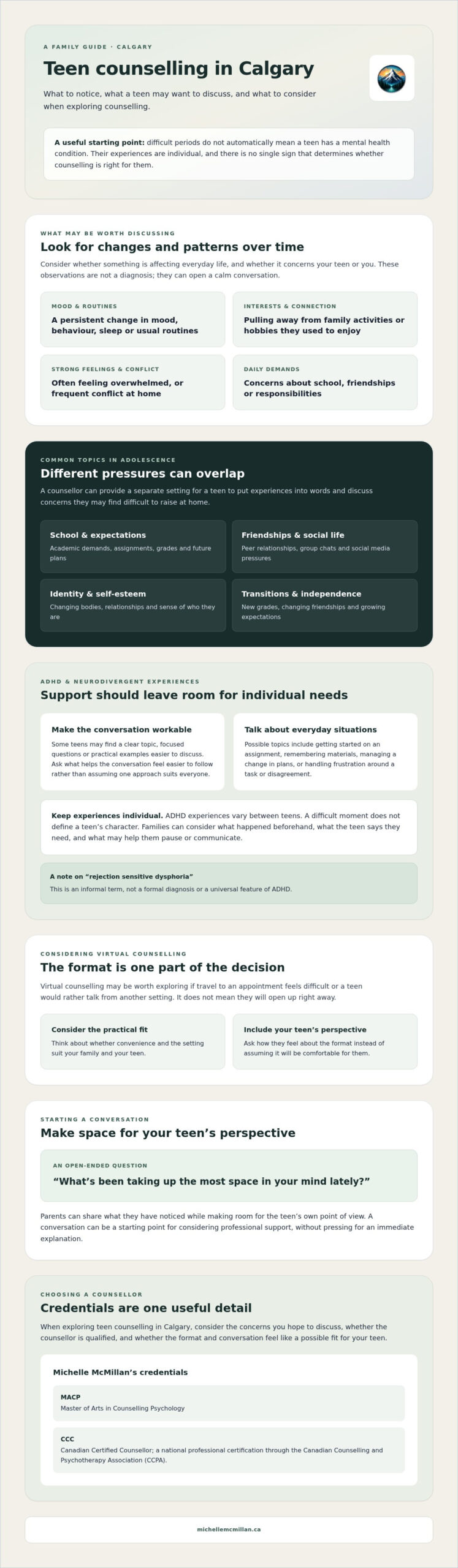
Each teen’s experience is different. An open question, such as “What’s been taking up the most space in your mind lately?”, can invite a conversation without pressing for an immediate explanation.
When to Seek Professional Support
There’s no single sign that determines whether counselling is right for a teen. Instead, notice patterns and changes over time, especially when they affect everyday life. You might consider seeking professional support if your teen:
- Has a persistent change in mood, behaviour, sleep or usual routines.
- Pulls away from family activities or hobbies they used to enjoy.
- Often feels overwhelmed by strong emotions, or conflict at home is becoming frequent.
- Seems to be struggling with school, friendships or responsibilities in a way that concerns them or you.
These observations aren’t a diagnosis. They can be a starting point for a calm conversation with your teen and, if appropriate, a qualified professional.
Emotional Regulation and a Space to Talk
Emotional regulation means noticing feelings and finding ways to respond to them. It may be relevant during transitions or when school, social or family demands feel difficult to manage. Counselling can provide a separate setting for a teen to put experiences into words, consider what matters to them and discuss concerns they may find difficult to raise at home. Parents can share what they’ve noticed while making room for the teen’s own perspective.
To learn more about the concerns Michelle McMillan works with, explore her areas of focus.
Specialized Support for ADHD and Neurodivergent Teens
For a teen with ADHD or other neurodivergent experiences, an open-ended conversation may not always be the easiest way to explore a concern. Some teens may find it easier to discuss a clear topic, respond to focused questions or talk through practical examples. Needs differ from person to person, so ask what makes a conversation easier to follow rather than assuming one approach works for everyone. Counselling can include room to talk about feelings and everyday situations, such as getting started on an assignment, remembering materials or managing a change in plans.
Life transitions can make existing demands feel different. A move to a new grade, changing friendships or growing expectations for independence may raise new questions about identity and self-worth. A missed deadline or misunderstanding doesn’t define a teen’s character. Counselling can offer space to consider what happened and what might be useful next. For general information about children and youth mental health, see the Mental Health Commission of Canada’s youth mental health resources.
ADHD and Emotional Regulation
Emotional regulation in the context of ADHD means noticing and responding to feelings in ways that fit the situation, while recognizing that experiences vary between teens. Frustration can build around a difficult task or disagreement, but not every teen with ADHD experiences emotions in the same way. Rather than treating a “meltdown” as deliberate misbehaviour, families can consider what happened beforehand, what the teen says they need, and what may help them pause or communicate. “Rejection sensitive dysphoria” is an informal term, not a formal diagnosis or a universal feature of ADHD. A teen’s experience deserves to be understood on its own terms.
Practical Tools for Daily Life
Useful supports are often concrete and chosen with the teen, rather than imposed as another test to pass. For example, a family might try putting assignment deadlines in one shared calendar, breaking a large project into smaller steps or agreeing on a reminder routine. If a system isn’t working, that’s information to review, not proof that the teen hasn’t tried hard enough.
Communication matters too. Parents can describe a concern without blame, then ask what the teen sees differently. Together, they can decide which reminders feel helpful and which feel intrusive. Michelle McMillan’s areas of experience include ADHD and neurodivergence. She provides in-person counselling in Calgary and virtual counselling across Alberta, British Columbia, Saskatchewan and Manitoba. Explore her areas of focus to learn more.
Comparing In-Person and Virtual Teen Counselling
For families considering teen counselling Calgary, in-person counselling may suit a teen who prefers meeting face to face or finds an office setting easier to engage with. Virtual counselling may be more convenient when travel is difficult or a teen prefers speaking from another suitable setting. Neither format is automatically better; the choice depends on your teen’s preferences, needs and circumstances.
Ask your teen what would help them take part comfortably. Some young people may appreciate the familiarity of a virtual appointment, while others may find it distracting or prefer in-person conversation. The goal is to choose a format that seems appropriate, without promising a particular experience or outcome.
Service Availability
Michelle McMillan provides in-person counselling in Calgary and virtual counselling across Alberta, British Columbia, Saskatchewan and Manitoba, where she is eligible to practise. Confirm the service details directly when considering which format fits your family. If your teen is neurodivergent, the Child Mind Institute’s overview of neurodiversity offers context for the term and its different perspectives.
Practical Considerations for Virtual Appointments
For a virtual appointment, plan for a private space where your teen is unlikely to be overheard. Check the device and internet connection beforehand, and ask what to do if a technical issue occurs. Headphones may help with privacy. Discuss confidentiality and its limits with the counsellor rather than assuming every room or device is suitable.
A professional, non-judgmental setting matters whether counselling is virtual or in person. The format itself doesn’t guarantee greater comfort or openness. A teen may find it easier to talk virtually, or may prefer another option. Their preferences are useful to discuss rather than predict.
To learn more about the counselling services available, visit the services page.
What to Look for in a Calgary Teen Counsellor
Choosing a counsellor is about more than finding an appointment. Your teen needs room to decide whether they feel heard, respected and able to speak in their own way. As you compare options for teen counselling in Calgary, look for relevant experience, clear answers about credentials and a communication style your teen can understand. A good fit matters, and it may take time to work out whether the fit feels right.
Designations and Education
Michelle McMillan holds a Master of Arts in Counselling Psychology (MACP) and is a Canadian Certified Counsellor (CCC). These are separate qualifications. The CCC is a national professional certification through the Canadian Counselling and Psychotherapy Association (CCPA), not a provincial licence or regulation. A Canadian Certified Counsellor provides counselling within their education and professional qualifications. When considering a counsellor in Alberta, ask what their designation means and how their education and experience relate to your teen’s concerns.
Experience is another useful point to explore. If ADHD or neurodivergence is relevant to your family, ask about the counsellor’s experience with those topics and how they make information accessible. Notice whether they explain unfamiliar terms plainly, invite questions and avoid treating one teen’s needs as a template for everyone.
Questions to Ask a Potential Counsellor
It’s reasonable to ask practical questions before deciding. For example:
- “How do you engage teens who are reluctant to participate?”
- “What experience do you have working with neurodivergent youth?”
- “How do you explain confidentiality and its limits to both teens and parents?”
- “How can my teen let you know if something doesn’t feel like a good fit?”
Listen for answers that are thoughtful, understandable and open to your teen’s perspective. A credential can’t guarantee rapport, and a teenager may need time to form their own view. If they’re hesitant, ask what would make an initial conversation feel more manageable rather than expecting them to agree immediately.
Michelle McMillan’s areas of experience include ADHD, neurodivergence, anxiety and emotional regulation. To learn more about her education and professional background, read about Michelle McMillan.
Starting the Journey: Next Steps for Your Family
Raising the idea of counselling can feel delicate, especially if your teen is unsure or worries that something is “wrong” with them. Choose a calm moment and describe what you’ve noticed without labelling or blaming: “You’ve seemed overwhelmed lately, and I’m wondering if talking with someone could help you sort through it.” Make room for their response. They may have questions, hesitate or need time to think. A conversation about teen counselling in Calgary doesn’t need to become a decision on the spot.
It can help to invite your teen to have a say in what support looks like. Ask what they’d want a counsellor to understand, what would make talking feel less awkward, and whether they’d like to help review possible counsellors. The aim isn’t to “fix” them. It’s to consider whether professional support could give them room to discuss what’s happening and identify concerns that matter to them.
Preparing for a First Appointment
Before an in-person or virtual appointment, confirm the format and practical details with the counsellor. Your teen can think about what they would like the counsellor to understand and choose clothing or a setting that feels suitable for the appointment. For virtual counselling, briefly check the device, connection and privacy of the space, and ask what to do if a technical issue occurs.
Let your teen know they don’t need to prepare a perfect explanation or cover everything at once. They might start with one concern, such as school stress or conflict at home, and take the conversation at a pace that feels manageable. Ask the counsellor ahead of time how confidentiality works, including its limits and how parent involvement is handled. This can help everyone understand what to expect without making assumptions about what will be shared.
Keeping Support Collaborative
Counselling isn’t a guaranteed route to a particular outcome, and each teen’s needs are different. A collaborative process can include listening to the teen’s perspective, identifying what they’d like to discuss and considering what role, if any, parents may have. Families can revisit what is or isn’t feeling useful and raise questions with the counsellor as they arise.
Michelle McMillan provides in-person counselling in Calgary and virtual counselling across Alberta, British Columbia, Saskatchewan and Manitoba. If you’re considering support, contact Michelle to ask about the options that may fit your situation. The Contact Michelle McMillan page is a place to begin that conversation.
Consider a Supportive Next Step
Finding the right support starts with noticing what your teen is experiencing and making room for their perspective. A counsellor can offer a professional space to discuss anxiety, ADHD, changing relationships and other adolescent concerns. It’s also worth considering practical fit, including your teen’s comfort with the counsellor and whether in-person counselling in Calgary or virtual counselling across Alberta, British Columbia, Saskatchewan and Manitoba suits your family.
If you’re exploring teen counselling in Calgary, Michelle McMillan holds a Master of Arts in Counselling Psychology and is a Canadian Certified Counsellor (CCC), a national certification through the Canadian Counselling and Psychotherapy Association. Her areas of experience include ADHD and neurodivergence, anxiety and emotional regulation. Counselling can support discussion and exploration without promising a particular outcome or timeline.
To ask about booking and next steps, visit the Rates and Booking page.
Frequently Asked Questions
Is virtual teen counselling as effective as in-person therapy?
There isn’t a blanket answer that virtual counselling is as effective as, or more effective than, in-person therapy for every teen. The right format depends on the young person’s needs, preferences and circumstances. Consider whether your teen can access a private space and feels comfortable with the virtual format. You can ask a counsellor about format and fit before deciding what may work for your family.
How long does a typical teen counselling session last?
Session length can vary, and a typical duration hasn’t been specified for Michelle McMillan’s counselling services. Before booking, ask about session length, what to expect and whether a parent is involved. These details can help you plan around school and family commitments and explain the appointment clearly to your teen. Don’t assume a standard duration applies to every counsellor or service.
What if my teen refuses to talk during the virtual session?
A teen who’s quiet or reluctant shouldn’t be pressured to share more than they’re ready to. You can acknowledge their hesitation and ask what concerns them about counselling, then discuss those concerns with the counsellor. It may help to clarify expectations beforehand, including how the first conversation works and what choices your teen has. Your teen doesn’t need to arrive with a prepared explanation.
Do you provide ADHD assessments or medication recommendations?
No. Michelle McMillan provides counselling, not ADHD assessments, diagnoses or medication recommendations. If you’re seeking an assessment or have questions about medication, speak with an appropriate health professional. Counselling can provide a space to discuss experiences and concerns related to ADHD, but it doesn’t replace medical assessment. ADHD experiences vary, so a concern or behaviour alone can’t confirm a diagnosis.
Can you help with parenting challenges related to my teen?
Michelle offers parenting support, and her areas of experience include parenting challenges, family dynamics, ADHD, anxiety and emotional regulation. You can ask whether your concern fits the counselling services available and how parent involvement may work. For example, you might want support discussing a recurring disagreement or understanding your teen’s perspective. Counselling doesn’t guarantee a particular change in family communication or behaviour.
Is virtual counselling available to families outside of Calgary?
Yes. Michelle McMillan provides in-person counselling in Calgary and virtual counselling across Alberta, British Columbia, Saskatchewan and Manitoba, where she is eligible to practise. Ask directly whether the service and format fit your teen’s needs. Families searching for teen counselling in Calgary can also confirm relevant service details before deciding.
How do I know if my teen needs a counsellor or a psychiatrist?
A counsellor can offer professional support to discuss emotional, behavioural or relationship concerns. A psychiatrist is a medical doctor who specializes in mental health and can assess medical concerns and discuss medication. If you’re unsure what kind of help is appropriate, consider speaking with your family doctor or another qualified health professional. Michelle provides counselling, not psychiatric assessment or medication recommendations.
How is a CCC different from a coach?
A Canadian Certified Counsellor (CCC) holds a national professional certification through the Canadian Counselling and Psychotherapy Association (CCPA). It’s separate from Michelle McMillan’s Master of Arts in Counselling Psychology (MACP). Coaching is a different type of service, and the title alone doesn’t indicate CCC certification. When choosing support, ask about the person’s credentials, training and the kind of service they provide.

Article by
Michelle McMillan, MACP, CCC
Michelle McMillan is a Canadian Certified Counsellor (CCC) with a Master of Arts in Counselling Psychology (MACP). She has extensive experience working with children and supporting clients with ADHD, neurodivergence, anxiety, emotional regulation, relationships and family challenges. Michelle offers both virtual and in-person counselling, with virtual counselling available throughout Alberta, British Columbia, Saskatchewan and Manitoba and in-person appointments available in Calgary.
Important Information
This article is provided for general educational and informational purposes only and is not a substitute for professional counselling, psychological, medical or emergency services. Information shared here should not be considered a diagnosis or individualized treatment advice. If you are experiencing a mental health emergency or are in immediate danger, please contact appropriate emergency services in your area.