
What if counselling began with your priorities, rather than assumptions about how you should think, feel, or function? If you’re exploring neurodivergent counselling Calgary, you may be wondering whether support is relevant without a formal diagnosis, or whether your differences will be treated as problems to fix.
Those are understandable concerns. Counselling offers a place to discuss your experiences, concerns, and priorities. It is distinct from assessment and diagnosis: counselling does not determine whether diagnostic criteria are met, provide a formal diagnosis, or offer medication guidance. In this article, you’ll learn what neurodivergent counselling may involve and what to consider when choosing support.
Michelle McMillan, MACP, CCC, works primarily with ADHD-related concerns and also supports people exploring neurodivergence. She provides both virtual and in-person counselling, with in-person sessions located in Calgary. Virtual counselling is preferred and available across Alberta, British Columbia, Saskatchewan, and Manitoba. She works with adults, couples, children, teens, and families.
Key Takeaways
- You can seek counselling to discuss concerns and priorities without arriving with a formal diagnosis.
- Neurodivergence can encompass different ways of thinking, learning, communicating, and experiencing the world, including ADHD and other forms of neurodivergence.
- Counselling may provide space to explore ADHD-related concerns, relationships, emotional regulation, parenting, family life, and transitions.
- Michelle offers preferred virtual counselling across Alberta, British Columbia, Saskatchewan, and Manitoba, as well as in-person counselling in Calgary.
- Michelle works with adults, couples, children, teens, and families.
What Neurodivergent Counselling in Calgary Can Mean for You
You may be considering counselling while still unsure whether a diagnosis applies or whether your experiences fit under the word “neurodivergent.” You don’t need to arrive with a label or a complete explanation of what has been difficult. You can begin with the concerns you want to discuss.
Neurodivergence is an umbrella term that may encompass ADHD, autism, dyslexia, dyspraxia, and other differences in how people think, learn, communicate, or process experiences. It is not one uniform experience. People may understand their neurodivergence in different ways and may seek support for different concerns.
Useful counselling starts with what matters to the individual, not assumptions attached to a diagnosis or identity. If you’re looking for neurodivergent counselling in Calgary, consider whether you want to explore a current concern, make sense of an experience, or talk about priorities in everyday life. Michelle’s areas of counselling focus include ADHD and neurodivergence-related challenges.
What concerns might someone bring to counselling?
Someone might seek counselling to discuss ADHD-related concerns, anxiety, emotional regulation, relationships, parenting, family challenges, or a life transition. Counselling may offer a supportive space to make sense of what is happening, identify priorities, communicate with others, and consider practical ways forward. A person can bring one concern or several, whether or not they use a diagnostic label.
If ADHD or neurodivergence-related concerns are part of what you’d like to discuss, Michelle offers counselling in these areas. Whether or not you have a diagnosis, you can start by identifying what you want to talk about and what questions you have about the support you’re seeking.
What Neurodivergent Counselling Can and Cannot Provide
Counselling can provide professional support and a place to discuss the experiences, concerns, and priorities you choose to bring forward. You might explore how a challenge affects daily life, relationships, parenting, or decisions, and consider what support feels relevant to your circumstances. The conversation can centre on your account of what is happening rather than assumptions based on a label.
An affirming counselling conversation can make room for different ways of thinking, communicating, learning, and experiencing the world without treating one way of functioning as the only standard. A practical starting point is to identify what you want support with and whether counselling is the kind of support you’re seeking.
Why individualized discussion matters
The same concern can have different meanings for different people. For example, difficulty staying organized might be connected to a particular demand, a change in routine, stress, or another part of someone’s circumstances. One experience does not point to a single explanation on its own. Rather than trying to fit yourself into a label, you can describe what concerns you, when it comes up, and what you hope to discuss.
If ADHD-related concerns are part of what you’d like to talk about, Michelle offers counselling related to ADHD and neurodivergence. You can read about Michelle’s counselling services to explore the types of support available.
How to Consider Whether a Calgary Counsellor Fits Your Needs
You don’t need to know exactly what you need from counselling before you begin considering your options. A few points can help you describe what matters and understand whether a service’s scope and format align with your priorities. Use them as prompts for reflection, not as a test you have to pass.
- Name the concerns. Identify what you’d like to discuss, such as a relationship concern, parenting challenge, emotional regulation, or life transition. You can begin with one issue or several. They do not need to fit a particular label.
- Identify your priorities. Consider what feels most important to talk about now. You might want space to describe an experience, explore how it affects daily life, or discuss a decision.
- Clarify the scope. Be clear about whether you’re seeking counselling to discuss concerns or a separate assessment service. A credential can tell you about a counsellor’s education or professional certification.
- Consider the format. Think about whether virtual or in-person counselling better suits your circumstances and preferences. Format is a practical consideration, not a measure of how serious or valid your concerns are.
What do you want space to discuss?
You might jot down what has been difficult or important lately, in your own words. For example, you could be thinking about a change in family life, a relationship, or a concern about emotional regulation. There’s no need to prepare a full history or explain everything at once. Michelle’s counselling areas of focus include ADHD, neurodivergence, anxiety, emotional regulation, relationships, parenting, family challenges, life transitions, self-esteem, and personal growth.
Neurodivergence can be understood in varied ways, and no single description represents everyone’s experience. The Mental Health Commission of Canada offers background on the topic. When considering neurodivergent counselling in Calgary, your own concern is a useful starting point, rather than an assumption about what you should want based on a label.
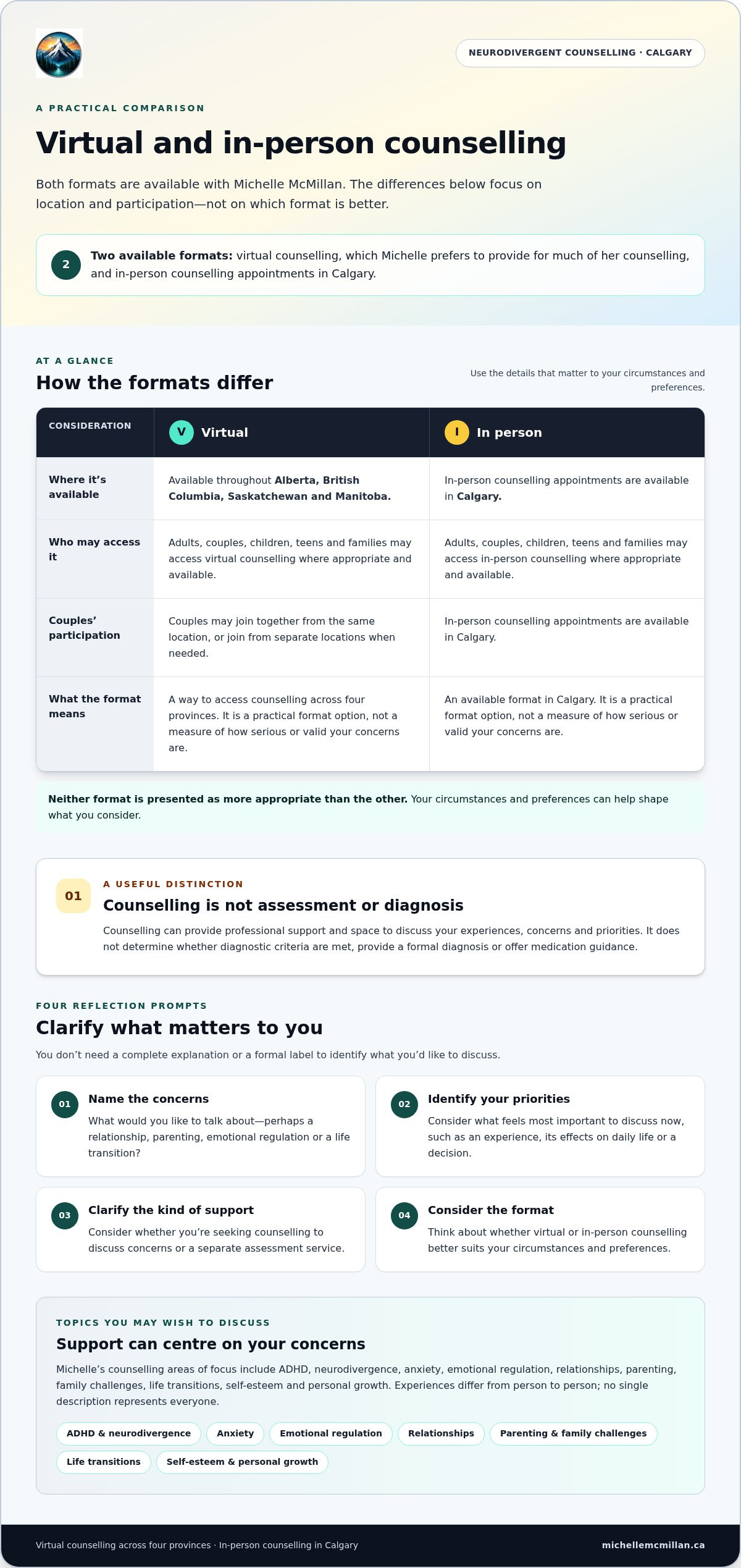
Virtual or In-Person Counselling in Calgary: Key Factors
Choosing a counselling format is a practical decision shaped by your preferences and circumstances. If you’re considering neurodivergent counselling in Calgary, think about what fits into your life while keeping the focus on the topics you want to discuss.
Michelle provides both virtual and in-person counselling. In-person sessions are located in Calgary. Virtual counselling is preferred and available across Alberta, British Columbia, Saskatchewan, and Manitoba.
What is useful to consider about virtual counselling?
Virtual counselling can be a flexible and accessible option, including for people who live outside Calgary but within the provinces where it is available. Consider whether meeting remotely fits your schedule and circumstances. The practical setup can be simple: you’ll need a way to join and a place where you can take part. The focus is the counselling conversation, not the technology.
Adults, couples, children, teens, and families may access virtual or in-person counselling where appropriate. Virtual couples counselling can accommodate partners joining from different locations or households, including separated couples. Partners may also join from the same location.
When might in-person counselling be an option in Calgary?
If you prefer to meet face to face, in-person counselling appointments are available in Calgary. You can factor this preference into your decision without needing to justify it or assume it will be more suitable than virtual counselling. The format is one part of considering what works for you.
Michelle offers both options, and neither format determines the concerns you can bring to counselling. For an overview, explore Michelle’s counselling services and consider which format aligns with your circumstances.
Exploring Neurodivergent Counselling with Michelle McMillan
Michelle’s primary area of focus is ADHD, alongside counselling for concerns involving neurodivergence, anxiety, emotional regulation, relationships, parenting, family challenges, life transitions, self-esteem, and personal growth. She brings 16 years of background in education, specifically in specialized mental-health and intensive behavioural-support environments.
Michelle works with adults, couples, children, teens, and families. She provides both virtual and in-person counselling, with in-person sessions located in Calgary and preferred virtual counselling available across Alberta, British Columbia, Saskatchewan, and Manitoba. For an overview of her services, visit the counselling services page.
Michelle McMillan’s relevant credentials and service scope
Michelle McMillan, MACP, CCC, holds a Master of Arts in Counselling Psychology (MACP) and separately holds the Canadian Certified Counsellor (CCC) designation. The CCC is a national professional certification through the Canadian Counselling and Psychotherapy Association (CCPA), not provincial licensure. Michelle is not a psychologist, psychiatrist, or physician and does not provide ADHD assessments, formal diagnoses, or medication guidance.
If you’d like to learn more about Michelle’s professional background, visit the About Michelle page. Reading about her credentials and service scope can help you understand what kind of professional support is offered, while your own priorities remain central to deciding what you want to discuss.
A low-pressure next step
You don’t need to have every question answered before exploring counselling. You might begin by identifying one concern you’d like to discuss or by clarifying whether you’re looking for counselling or a formal assessment. It’s reasonable to take time to understand the service and consider whether it aligns with what you’re seeking.
You can review the Rates and Booking information when you’re ready to explore counselling with Michelle.
Explore Counselling at Your Own Pace
Neurodivergent counselling in Calgary can begin with your concerns and priorities. Counselling offers professional support for discussing what matters to you, while assessment, diagnosis, and medication guidance are separate services. This article is intended as an informational resource to complement Michelle’s counselling services information.
If you’re considering whether counselling may suit what you want to discuss, take your time. You don’t need to have every answer before beginning.
Frequently Asked Questions
Is neurodivergent counselling only for people with a formal diagnosis?
No. You can seek counselling to discuss experiences or concerns without having a formal diagnosis. You can focus on what you’d like support discussing, whether or not you use a diagnostic label to describe your experience.
Can counselling help with ADHD-related challenges?
Counselling can provide professional support and a setting to discuss ADHD-related concerns, daily life, relationships, or other priorities. ADHD is Michelle’s primary area of focus, and you can learn more about her counselling services.
Is in-person neurodivergent counselling available in Calgary?
Yes. Michelle offers in-person counselling sessions in Calgary, as well as preferred virtual counselling across Alberta, British Columbia, Saskatchewan, and Manitoba.
Can I choose virtual counselling if I live outside Calgary?
Yes. Michelle offers preferred virtual counselling across Alberta, British Columbia, Saskatchewan, and Manitoba. In-person counselling sessions are located in Calgary.
How can I tell what I want to discuss in counselling?
Start by naming a concern or situation that feels important to you. It might involve ADHD-related challenges, a relationship, parenting, emotional regulation, or a life transition. You don’t need to decide whether you have a diagnosis before describing what’s on your mind. Even a broad starting point can help you explain what you’re hoping to discuss, without needing to arrive with a complete account or a specific outcome in mind. If you’re ready to explore counselling with Michelle, review Rates and Booking information at your own pace.

Article by
Michelle McMillan, MACP, CCC
Michelle McMillan is a Canadian Certified Counsellor (CCC) with a Master of Arts in Counselling Psychology (MACP). She has extensive experience working with children and supporting clients with ADHD, neurodivergence, anxiety, emotional regulation, relationships and family challenges. Michelle offers both virtual and in-person counselling, with virtual counselling available throughout Alberta, British Columbia, Saskatchewan and Manitoba and in-person appointments available in Calgary.
Important Information
This article is provided for general educational and informational purposes only and is not a substitute for professional counselling, psychological, medical or emergency services. Information shared here should not be considered a diagnosis or individualized treatment advice. If you are experiencing a mental health emergency or are in immediate danger, please contact appropriate emergency services in your area.