
Separation can bring grief, uncertainty, relief and difficult conversations—sometimes all in the same week. If you’re wondering whether counselling means trying to save your relationship, you can set that worry aside. Separation and divorce counselling Calgary can offer a calm place to understand what you’re experiencing and consider what matters to you next.
Counselling can support reflection, communication and adjustment during a major family change. It does not decide whether you should reconcile, separate or divorce, guarantee an outcome, or replace legal advice. Michelle McMillan offers individual, couples and family counselling, with virtual appointments and in-person appointments in Calgary.
Key Takeaways
- Separation can bring mixed feelings and practical strain. You do not need to have every answer before seeking support.
- Individual, couples and family counselling have different focuses. Consider what you want to discuss and who you want involved.
- Virtual counselling can be practical for couples in different locations, while in-person appointments are available in Calgary.
- Michelle McMillan offers individual, couples and family counselling virtually across Alberta, British Columbia, Saskatchewan and Manitoba.
What can separation and divorce counselling in Calgary help you explore?
Separation can change your routines, finances, living arrangements, parenting responsibilities and sense of identity. You may feel clear about one decision and uncertain about another. Counselling can be considered whether you are newly separated, thinking about separation or adjusting after divorce. You do not need to arrive with a settled plan.
Separation and divorce counselling is professional support for discussing concerns as a relationship changes or ends. You can attend alone, with your partner or with family members, depending on the concern you want to explore. For example, you might want to understand your own reactions, prepare for a difficult conversation or talk about changing family roles.
Your starting point may be very practical: “I need to talk with my former partner about parenting schedules,” or more personal: “I’m not sure how to move forward.” Counselling can make room for both. You can bring one pressing concern even when the wider situation still feels confusing.
It’s useful to distinguish emotional support from other forms of help. Counselling isn’t legal advice, legal representation or mediation, and a counsellor doesn’t determine your relationship status or make legal decisions. Questions about your rights, legal options or documents are separate from exploring your personal experience. You may seek counselling while also getting legal advice, since each serves a different purpose.
People consider counselling when emotions, communication or decisions feel difficult to sort through alone. There is no single threshold for seeking support. You might want help with an upcoming conversation, changing family roles, loneliness, anger or the challenge of making everyday decisions while your relationship is in transition.
A useful first step is to name what feels most pressing. It could be a conversation with your former partner, uncertainty about the future or concern about how a child is responding. You do not need to know exactly where counselling will lead before you begin.
Emotional and family concerns counselling can address during divorce
Separation may bring grief, anger, relief, guilt, fear or several feelings at once. There is no single emotional sequence that everyone follows, and people in the same family may respond differently. A person who seems calm may still be struggling, while someone who is upset may be adapting in their own way.
Counselling can provide room to slow down and notice what is happening for you. You might explore conflicting feelings, changing boundaries, contact with an ex-partner or the effect of new routines. For example, a change in school pick-up arrangements may bring up both practical questions and sadness about how family life has changed.
Navigating difficult conversations and changing relationships
Conversations about plans, responsibilities and ongoing contact can feel emotionally loaded, even when the subject appears practical. Counselling can help you identify what feels difficult, what you want to communicate and where your boundaries are changing. You can also bring the impact of these conversations on your sleep, concentration or daily routine.
Supporting children and family relationships through change
Parents may wonder how to explain changes at home, respond to a child’s questions or support children through new routines. Children and teens can show their feelings through sadness, anger, withdrawal, questions or changes in behaviour. A reaction on its own does not establish that something is wrong, but it can be a reason to pay attention and offer support. Family counselling can provide a setting to discuss concerns together. Michelle’s counselling areas of focus include relationships, parenting and family challenges.
Try to keep children out of adult decision-making while giving them age-appropriate information and predictable routines. A child may need reassurance that they can continue loving both parents; a teenager may need space to express frustration without being asked to take sides. Counselling can focus on your own experience, a shared family concern or how family members are relating to one another.
Individual, couples, or family counselling: which focus fits your situation?
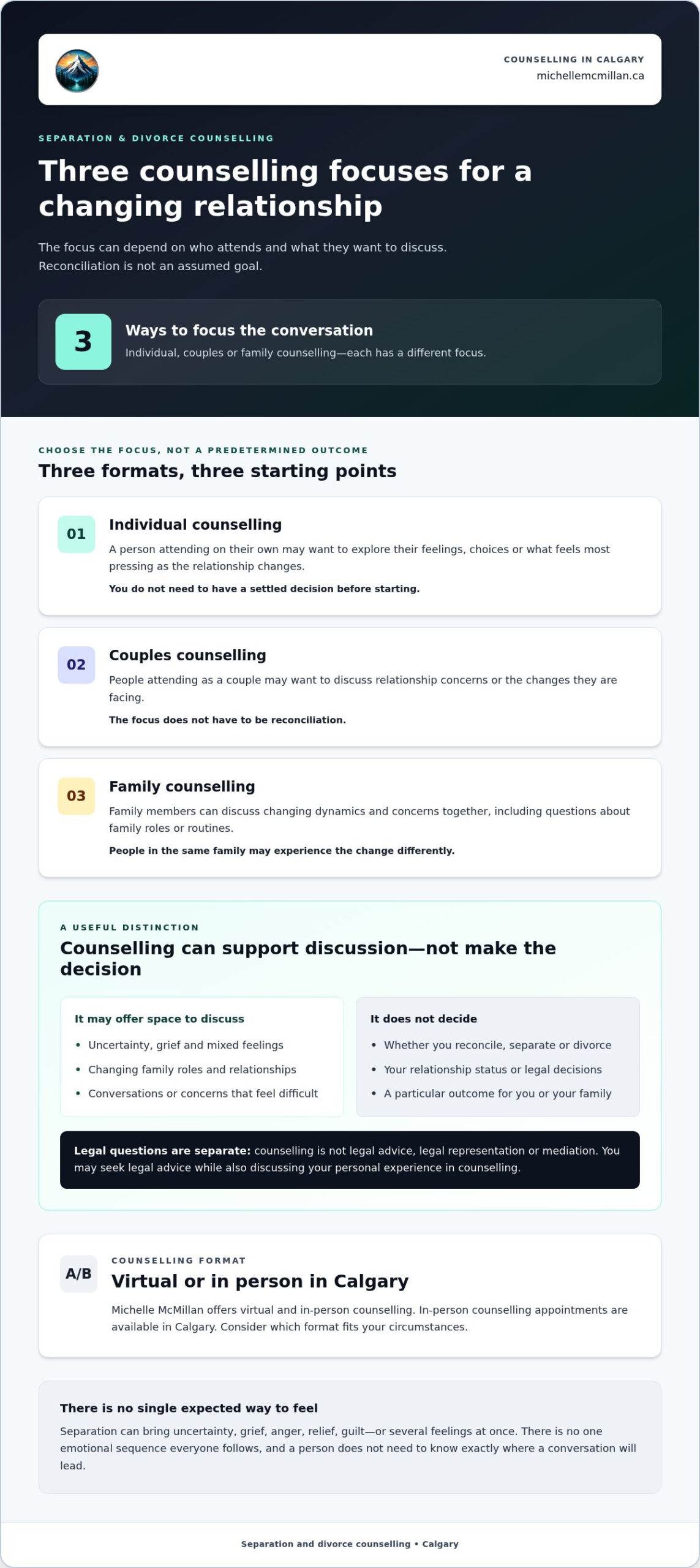
The right format depends on the concern and who you want involved. Individual counselling centres on one person’s experience. Couples counselling brings partners together to discuss relationship concerns. Family counselling focuses on dynamics or challenges affecting several family members. These formats are flexible, and your focus may change as circumstances develop.
The table below offers a starting point rather than a rule. For example, one parent might begin with individual counselling and later consider family counselling if a shared concern emerges.
| Format | Who attends | Possible focus or concerns |
|---|---|---|
| Individual counselling | One person | Personal feelings, decisions, concerns and adjustment during separation |
| Couples counselling | Both partners | Relationship difficulties, communication and questions about the relationship |
| Family counselling | Family members | Changing family dynamics, conflict or concerns about how family members relate |
The format describes who attends and the broad focus, not a promised result. Michelle offers all three options, so you can consider the type of conversation that would feel most useful at this stage.
When might individual counselling be a consideration?
Individual counselling centres on your concerns and experiences. You might want space to process the end of a relationship, think through a decision, adjust to new responsibilities or prepare for a difficult conversation. You can focus on your own needs without having to coordinate another person’s attendance.
When might couples or family counselling be considered?
Couples counselling may provide space to discuss communication, relationship difficulties and the changes you are facing together. Family counselling may help explore conflict, changing roles or concerns about how family members are relating. Each person may experience the same separation differently, and the conversation can make room for those differences.
Couples can attend virtually from the same location or join from separate locations. This can be useful when partners live in different homes, cities or provinces but both want to participate. Each person can join from a private, reliable space with a stable internet connection.
To compare the options, ask: is the main concern about your own adjustment, something happening between you and your partner, or a change affecting family relationships? You do not need a perfect answer. Identifying what feels most pressing can help you choose a starting point.
Choosing counselling in Calgary: format, credentials, and practical questions
Choosing counselling during separation does not require a settled view of what should happen next. Start with the concern you want to discuss, then consider who you want involved and whether virtual or in-person appointments fit your circumstances. These are practical choices about support, not decisions about your relationship.
A simple framework:
1. Identify the concern. Is your focus your own experience, a relationship issue or a family dynamic? One clear example—such as preparing for a parenting conversation—is enough to begin.
2. Consider who may attend. Individual counselling involves one person. Couples or family counselling includes other participants whose perspectives may be important to the concern.
3. Consider the format. Michelle offers virtual counselling and in-person appointments in Calgary. Virtual counselling is available across Alberta, British Columbia, Saskatchewan and Manitoba. Choose the format that best fits your location, privacy and routine.
It can also help to consider what you want from the conversation. You might want to understand your own reactions, improve communication around a shared responsibility or support a child through a family change. Counselling is separate from legal advice, so questions about rights, agreements or legal steps should be directed to a qualified legal professional.
What credentials should Calgary counselling readers understand?
How can someone consider virtual or in-person counselling?
Michelle offers both virtual counselling and in-person appointments in Calgary, and prefers to provide much of her counselling virtually. Virtual services are available throughout Alberta, British Columbia, Saskatchewan and Manitoba. If you are attending with a partner from another location, discuss practical arrangements such as privacy, timing and a dependable internet connection.
Think about where you would feel comfortable talking, whether another person will attend and how appointments could fit alongside work, parenting and other responsibilities. A simple starting concern is enough; you do not have to resolve every question before reaching out.
Separation and divorce counselling with Michelle McMillan in Calgary
Michelle McMillan offers individual, couples and family counselling for people navigating separation, divorce and changing family relationships. You may want to discuss your own adjustment, communication with a former partner or the effect of changing routines on your family.
Michelle holds a Master of Arts in Counselling Psychology (MACP) and is a Canadian Certified Counsellor (CCC), a national professional certification through the Canadian Counselling and Psychotherapy Association (CCPA). She also has 16 years of education experience, including work in specialized mental-health and intensive behavioural-support settings with children, teens and families.
What counselling services are available?
Individual counselling can offer space to discuss how you are experiencing change, think through personal decisions and find ways to manage day-to-day pressures. You might bring a specific situation, such as an upcoming conversation, or begin with a general feeling of being overwhelmed.
Couples counselling may centre on relationship difficulties and communication, while family counselling may explore conflict, roles and routines as circumstances change. Couples can attend from the same or separate locations. Michelle’s relationship and family areas of focus offer further context about these concerns.
Before choosing a focus, try putting the main concern into words: “I need support with my own adjustment,” “We need to discuss communication,” or “Our family is struggling with the new routine.” You can refine the focus as you go.
Considering separation and divorce counselling Calgary as a next step?
If you’re considering separation and divorce counselling Calgary, begin by identifying one concern and deciding who, if anyone, you want involved. Michelle offers virtual counselling across Alberta, British Columbia, Saskatchewan and Manitoba, as well as in-person appointments in Calgary.
To learn more about the available options, visit Michelle’s Individual, Couples, or Family Counselling services. You can review practical details before deciding whether counselling feels like the right next step.
When you’re ready, visit the Rates & Booking page to review appointment information and consider booking at your own pace.
Take the next step at your own pace
You do not have to settle every question about your relationship before seeking support. A first appointment can begin with one concern, whether that is your own adjustment, a difficult conversation or a change affecting your family. Michelle’s Individual, Couples, or Family Counselling services offer ways to choose the focus that fits your situation.
For couples who are separated and living in different locations, virtual counselling can make it possible to participate together without being in the same room. For Calgary clients who prefer to meet in person, appointments are available locally. Consider the option that works with your privacy, schedule and responsibilities.
When you’re ready to take the next step, review the Rates & Booking page or explore the counselling services first. You can reach out with questions about which format may fit your concern.

Article by
Michelle McMillan, MACP, CCC
Michelle McMillan is a Canadian Certified Counsellor (CCC) with a Master of Arts in Counselling Psychology (MACP). She has extensive experience working with children and supporting clients with ADHD, neurodivergence, anxiety, emotional regulation, relationships and family challenges. Michelle offers both virtual and in-person counselling, with virtual counselling available throughout Alberta, British Columbia, Saskatchewan and Manitoba and in-person appointments available in Calgary.
Important Information
This article is provided for general educational and informational purposes only and is not a substitute for professional counselling, psychological, medical or emergency services. Information shared here should not be considered a diagnosis or individualized treatment advice. If you are experiencing a mental health emergency or are in immediate danger, please contact appropriate emergency services in your area.