
What if your child’s worry deserves attention before you know whether it’s more than an everyday fear? It can be hard to tell when to wait, when to offer reassurance, and when to consider child anxiety counselling Calgary families can access. Wanting to understand what’s going on doesn’t mean you’re labelling your child. It means you’re paying attention.
Childhood worries can come and go, and they look different from one child to another. Counselling offers professional support to discuss a child’s concerns and what may be happening in their life. You don’t need to have everything figured out before considering a conversation.
This article explores signs that may prompt families to seek support, what child counselling can offer, and questions to consider when thinking about your child’s comfort with counselling. It also explains the virtual and in-person options available through Michelle McMillan Counselling, including in-person appointments in Calgary and virtual counselling across Alberta. The aim is to help you consider what may fit your family, without pressure or assumptions.
Key Takeaways
- Consider whether worries are affecting your child’s everyday life, while remembering that behaviour alone doesn’t establish a diagnosis.
- Child anxiety counselling offers professional support to discuss concerns. It is not an anxiety assessment or diagnosis.
- When considering child anxiety counselling Calgary families can access, weigh virtual or in-person options alongside your family’s routines and your child’s preferences.
- Prepare for a conversation by explaining counselling simply and honestly, without promising a particular result.
- Michelle McMillan offers child and youth counselling and holds an MACP and CCC. Her education experience includes work with children, teens and families.
When might child anxiety counselling in Calgary be worth considering?
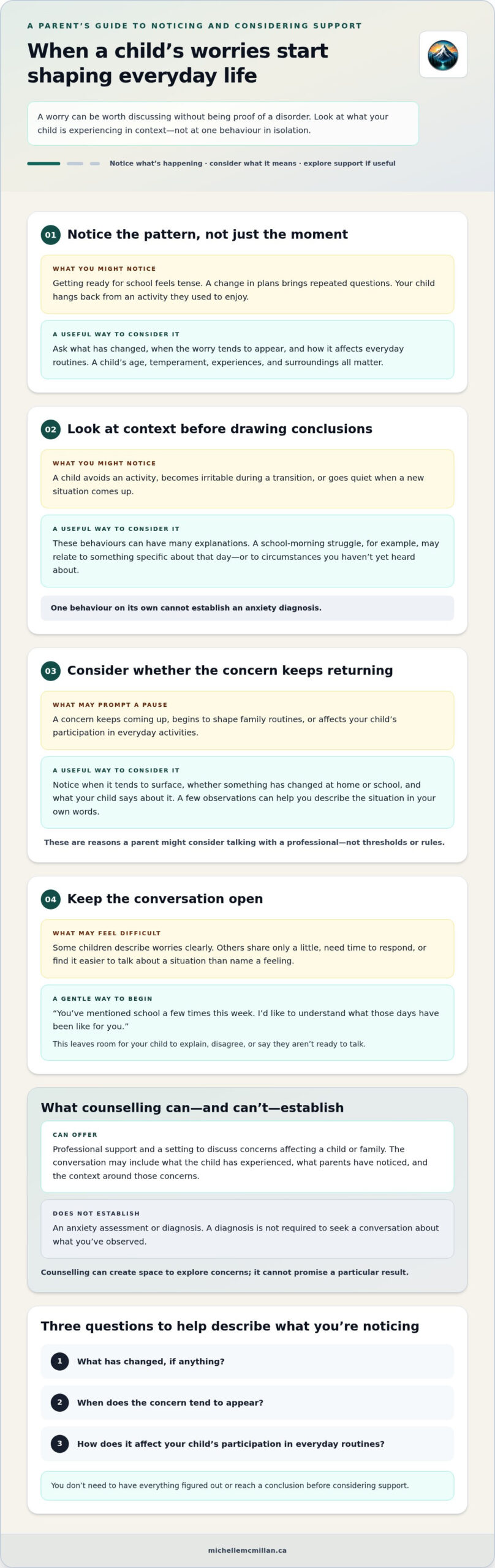
It can be hard to see your child struggling with worries and not know what kind of support, if any, would help. You might notice that getting ready for school has become tense, a change in plans leads to repeated questions, or your child hangs back from an activity they used to enjoy. It’s understandable to wonder whether child anxiety counselling Calgary families can access could be worth exploring.
There isn’t one behaviour or checklist that can answer that question. A child’s age, temperament, recent experiences and surroundings all shape what a worry means to them. Rather than counting behaviours, consider how the concern fits into your child’s life and what may be happening around it.
How anxiety-related concerns can show up differently in children
Children may express worry in many ways. One might say they’re concerned about being away from a parent; another may ask the same question about a school event several times or become quiet when a new activity comes up. A change in routine, an unfamiliar social setting or a difficult moment with a friend may also be relevant context. The same situation can feel different to different children.
Some children describe their feelings clearly. Others communicate through behaviour, such as avoiding an activity, becoming irritable during a transition or withdrawing from a conversation. These examples can have many explanations. A child who resists a school morning, for instance, may be reacting to something specific about that day or to circumstances a parent hasn’t yet heard about. A single behaviour cannot establish an anxiety diagnosis.
A concern can be worth discussing without being proof of a disorder. Look at the broader picture: what has changed, when does the worry tend to appear, and how does it affect your child’s participation in everyday routines? The goal isn’t to interpret every reaction. It’s to understand your child’s experience in context.
When a parent may want to explore professional support
You may want to consider professional support if a concern keeps coming up or begins to shape family routines and your child’s daily activities. Perhaps your child increasingly avoids a club they once looked forward to, or a worry about an upcoming change takes up a lot of family conversation. These examples aren’t thresholds or rules. They’re reasons a parent might pause and consider whether talking with a professional could be useful.
Notice the context, not scores. You might remember when a concern tends to surface, whether anything has changed at home or school, and what your child says about it. You don’t need to monitor every reaction or reach a conclusion before seeking support. A few observations can help you describe the situation in your own words.
If you’re unsure whether to explore child anxiety counselling in Calgary, start with what your family is noticing now. You can consider support without deciding that your child has a particular condition or that one explanation accounts for every behaviour.
What child anxiety counselling can offer: and what it does not establish
Once you’re considering support, it’s natural to wonder what counselling would mean for your child. Child counselling can provide professional support and a setting to discuss concerns affecting a child or family. A conversation may include what the child has been experiencing, what parents have noticed and the context around those concerns. What matters will vary from one family to another.
Counselling can create space to explore concerns; it can’t promise a particular result. For a parent, that may mean having a place to talk through questions such as how a child is experiencing a difficult situation or what changes the family has observed. You don’t need to arrive with a complete explanation.
Counselling, assessment, and diagnosis are different
Child anxiety counselling is not an anxiety assessment and does not establish an anxiety diagnosis. Counselling can still provide professional support to discuss concerns and how they affect a child or family. A diagnosis isn’t required to seek a conversation about what you’ve observed.
This distinction can help counselling feel less like a test your child must pass or a label they need to earn. You can start with an open question rather than a conclusion: “I’m noticing some worries, and I’d like to talk about what might be helpful.” For general background, the Child Mind Institute offers information on understanding child anxiety and treatment.
Making space for the child’s own experience
Children differ in how readily they talk about what is on their minds. One child may describe a worry in detail; another may share only a few words, need time to respond or find it easier to talk about a particular situation than to name a feeling. Language suited to the child’s age and communication style can make a conversation easier to understand. There’s no single way a child must express themselves.
Parents can describe an observation without deciding what it means. For example: “You’ve mentioned school a few times this week. I’d like to understand what those days have been like for you.” That leaves room for the child to explain, disagree or say they aren’t ready to talk. Their response is part of the conversation, not a test of whether they are suitable for counselling.
It can also help to separate what a parent has observed from what they are wondering about. “She asks about the schedule each morning” is an observation; “she must be afraid of school” is an interpretation. Sharing both clearly, while distinguishing between them, gives context without treating an assumption as fact.
Families considering child anxiety counselling Calgary can explore child and youth counselling services as an option for professional support. The purpose is to discuss what the child and family are experiencing, without assuming in advance what it means or what the outcome will be.
Choosing child anxiety counselling in Calgary: questions of fit and format
Once you’re considering counselling, format is one practical part of the decision. Think about what may fit your child’s preferences and your family’s circumstances, rather than looking for a format that is automatically right for every child. Travel, school hours, caregiver schedules and the time needed to get to an appointment can all shape what feels manageable.
Michelle McMillan offers both virtual and in-person counselling and prefers to provide much of her counselling virtually. In-person counselling appointments are available in Calgary. Virtual counselling is available across Alberta, British Columbia, Saskatchewan and Manitoba. Both formats are options for children and families; neither is reserved for a particular age group.
Virtual and in-person counselling options in Calgary
Virtual counselling may be convenient when coordinating travel around school, work or other family responsibilities is difficult. A practical consideration is whether your household can set aside a suitable time and place to take part. The online setup doesn’t need to dominate your decision.
In-person counselling is another option for Calgary families. Travel time and appointment logistics may matter, as might a child’s preference about meeting in person or online. Your child may have a view, or may not yet know which they prefer. The format doesn’t measure how serious a concern is or establish which option will be more effective for that child.
For families outside Calgary, virtual counselling is available in Alberta, British Columbia, Saskatchewan and Manitoba. This gives families in those provinces an option to explore counselling without travelling to Calgary, while still considering the practical details of participating from home.
What matters when considering fit for your child
Fit is personal. A younger child may communicate differently from a teenager; one child may readily share preferences, while another may need time to think about what feels comfortable. Consider your child’s age and communication style alongside family routines. These details can inform a choice without deciding it on their own.
It may also help to think about why you’re exploring support and what you hope to discuss. Is there a recent change, a concern connected with school or a family routine you’d like to talk through? You don’t need to interpret the concern before discussing it. Sharing the context can make the conversation more specific to your family.
Practical fit includes more than the appointment itself. Consider who will manage transportation or help your child connect virtually, how the timing sits alongside other commitments, and whether your child has questions about either format. A workable arrangement for one family may not suit another, and preferences can change as circumstances do.
To learn more about the available support, explore child and youth counselling services. When weighing child anxiety counselling Calgary options, consider the format alongside your child’s preferences and family logistics, rather than searching for one answer that applies to every family.
How parents can prepare to explore counselling for a child
Considering counselling can bring up questions of its own: how to explain it, what to share and how your child might react. You don’t need a perfect plan before exploring support. A few calm, practical steps can help you approach the conversation without turning it into a big announcement or promising that everything will change.
Start with what you’ve noticed, then consider how to talk about it in a way your child can understand. Leave room for their questions and your own uncertainty. Exploring child anxiety counselling Calgary families can access doesn’t require you to know exactly what your child needs before you begin.
Talking with your child about counselling
Use straightforward language suited to your child’s age and understanding. You might say, “I’ve noticed school has felt worrying for you lately. I’m thinking about talking with a counsellor so we can better understand what’s going on.” This shares your reason without suggesting that counselling is a punishment, a test or proof that something is wrong.
Be honest about what you know and what you don’t. You can explain that a counsellor is someone a child or family can talk with about concerns, while avoiding promises such as “you’ll feel better right away” or “this will fix it.” Your child may feel curious, unsure, relieved or resistant. Mixed feelings don’t necessarily mean you’ve explained it poorly. Listen to their questions and respond as simply as you can.
If your child asks what will happen, you don’t have to describe details you haven’t been given. You can say that you’re learning about the support and will share what you know as you go. This keeps the conversation open without creating expectations about a particular process or result.
What parents can bring to an initial conversation
Before speaking with a counsellor, you might think through a few observations: situations where a concern tends to arise, changes you’ve noticed in family or school routines, and what your child has said in their own words. These details offer context. They aren’t a checklist, and there’s no need to interpret them as symptoms.
For example, you might share, “My child said, ‘I don’t want to go on presentation day,’ and I’ve noticed they’ve brought it up several times.” That describes what you heard and observed without deciding what it means. You can also mention what your child enjoys, what feels manageable and what questions your family hopes to discuss. There’s no need to create a complete record or have every answer ready.
Child and youth counselling provides professional support to discuss a child’s concerns and family context. You can review the service information to consider whether this kind of support fits what your family is looking for.
Child anxiety counselling with Michelle McMillan in Calgary
It can take time to decide whether professional support feels like a useful next step for your child. If you’re exploring child anxiety counselling Calgary families can access, it may help to know who provides the counselling, which concerns are within the practice’s areas of focus and what formats are available. This information can help you consider options without assuming a particular outcome.
Michelle McMillan offers child and youth counselling, including support related to anxiety and stress. Her work with children and families is informed by 16 years of education experience, including work in specialized mental-health and intensive behavioural-support settings with children, teens and families.
Relevant experience and professional credentials
Michelle holds a Master of Arts in Counselling Psychology (MACP). Separately, she holds the Canadian Certified Counsellor (CCC) designation, a national professional certification through the Canadian Counselling and Psychotherapy Association (CCPA).
Her education experience includes work with children, teens and families in settings focused on mental health and intensive behavioural support. This is relevant context for parents considering counselling, but it doesn’t guarantee a particular experience or result for any child. Each child and family brings their own circumstances and concerns.
Michelle’s areas of focus include child and youth counselling, anxiety and stress. Counselling offers professional support for discussing a child’s concerns. Families can explore what they’re noticing and consider whether counselling is a suitable kind of support for them.
Explore counselling options and next steps
Michelle offers both virtual and in-person counselling. In-person counselling appointments are available in Calgary, and virtual counselling is available across Alberta, British Columbia, Saskatchewan and Manitoba. She prefers to provide much of her counselling virtually, while keeping both formats available. Neither option is limited to a particular age group or presented as more effective than the other.
As you consider next steps, think about what would be manageable for your child and family, including preferences, routines and the practicalities of attending. You don’t need to have every question resolved before reviewing the available child and youth counselling support.
If you’d like to explore counselling with Michelle McMillan, MACP, CCC, you can review the Rates and Booking page at your own pace.
Take a considered next step for your family
You don’t have to be certain about what your child’s worries mean before deciding whether to explore support. You can take time to consider what would feel manageable for your family and what questions you’d want to bring to a conversation.
Choosing child anxiety counselling Calgary families can access is a personal decision, not a verdict on your child or your parenting. Let your observations guide your thinking, while leaving room for your child’s perspective and for circumstances to change. There’s no need to turn uncertainty into pressure.
If you’re ready to explore counselling options, review rates and booking information for child counselling at your own pace. This can be a way to learn more and consider what feels right for your family.
Frequently Asked Questions
How do I know if my child may benefit from anxiety counselling?
You might consider discussing counselling if worry is taking up a lot of space in your child’s day or affecting activities that matter to them. For instance, a child may repeatedly seek reassurance before a class trip or find it hard to take part in a familiar activity. These situations don’t establish a diagnosis, but they can help you decide whether a conversation with a counsellor could be useful.
Can a child start counselling without an anxiety diagnosis?
Yes. A formal anxiety diagnosis isn’t a prerequisite for exploring counselling. Parents can bring a question rather than a conclusion, such as, “My child seems worried about an upcoming change, and I’m unsure how to support them.” Counselling can provide a professional setting to discuss that concern and its context. Your child’s experience can be taken seriously without a label.
What happens in child anxiety counselling?
Child anxiety counselling offers professional support to discuss concerns affecting a child or family. What’s discussed can depend on the child’s circumstances, age and way of communicating, so there isn’t one script that applies to every family. If you’re unsure what to raise, your observations and questions are a reasonable place to begin.
Is virtual counselling available for children in Calgary?
Yes, virtual counselling is available to children and families in Calgary. Michelle McMillan also offers in-person counselling appointments in Calgary, so families have both formats available. Travel and family routines may be practical considerations when choosing a format. Families can consider their circumstances and preferences when exploring options.
Can parents attend child counselling?
Parent involvement can be part of child counselling, but whether a parent joins a particular conversation depends on the child and the counselling arrangement. Parents can offer useful context by sharing what they’ve noticed at home or in daily routines. A child may also have their own perspective or questions to bring forward. It’s reasonable to consider both the child’s voice and the family’s observations.
Does Michelle McMillan provide child anxiety counselling in Calgary?
Yes. Michelle McMillan offers child and youth counselling, including support related to anxiety and stress. Families considering child anxiety counselling Calgary can explore professional support for discussing a child’s concerns and circumstances. Michelle holds a Master of Arts in Counselling Psychology and is a Canadian Certified Counsellor through the Canadian Counselling and Psychotherapy Association. Her education experience includes work with children, teens and families.
How can I explain counselling to my child?
Explain counselling in plain, age-appropriate words, and be honest about what you know. You might say, “A counsellor is someone we can talk with about things that have been on our minds.” Avoid presenting it as a consequence, a test or a way to prove something is wrong. Your child may ask questions or feel uncertain; you can acknowledge that and keep the conversation open without promising a particular outcome.

Article by
Michelle McMillan, MACP, CCC
Michelle McMillan is a Canadian Certified Counsellor (CCC) with a Master of Arts in Counselling Psychology (MACP). She has extensive experience working with children and supporting clients with ADHD, neurodivergence, anxiety, emotional regulation, relationships and family challenges. Michelle offers both virtual and in-person counselling, with virtual counselling available throughout Alberta, British Columbia, Saskatchewan and Manitoba and in-person appointments available in Calgary.
Important Information
This article is provided for general educational and informational purposes only and is not a substitute for professional counselling, psychological, medical or emergency services. Information shared here should not be considered a diagnosis or individualized treatment advice. If you are experiencing a mental health emergency or are in immediate danger, please contact appropriate emergency services in your area.