
What if useful ADHD counselling starts not with assumptions about women, but with what you want support with? You might be weighing work demands, family responsibilities, relationship stress or self-doubt, and wondering whether counselling can address the parts of daily life that feel difficult. If you’re exploring ADHD counselling for women Calgary, it’s reasonable to want clear information before deciding what kind of support may fit.
Counselling can offer space to discuss your concerns and explore how ADHD-related challenges affect your life, but it isn’t an ADHD assessment or diagnosis, and it doesn’t include medication recommendations. In this article, you’ll learn what counselling can and cannot offer, what personal priorities may help guide your decision, and how counselling differs from assessment and medication care. We’ll also cover virtual and in-person options in Calgary, relevant credentials, and questions to consider as you explore support. ADHD experiences vary, so the focus is on your circumstances rather than a one-size-fits-all picture.
Key Takeaways
- ADHD experiences differ from person to person, so support should reflect your concerns rather than assumptions about women.
- ADHD counselling for women Calgary can provide professional support to discuss everyday, emotional or relationship concerns; it is distinct from assessment and diagnosis.
- To clarify what you want from counselling, consider the situation you’re facing, its impact and what you’d like to explore, even if you’re still unsure.
- Michelle McMillan offers virtual counselling across Alberta, British Columbia, Saskatchewan and Manitoba, as well as in-person appointments in Calgary.
- Learn how Michelle’s Master of Arts in Counselling Psychology and separate Canadian Certified Counsellor certification through the CCPA relate to her counselling practice.
ADHD counselling for women in Calgary: start with your experience, not a stereotype
It can be difficult to know whether counselling fits when you’re still trying to understand what’s behind a concern. You might be managing a full schedule yet feel that some ordinary responsibilities take more effort than expected. Or perhaps a conversation with someone close to you has left you wondering why the same difficulty keeps coming up. Those questions are worth exploring, but no single experience proves that you have ADHD.
ADHD counselling is professional support for discussing ADHD-related concerns and how they intersect with your life. The starting point can be what you’re noticing, not a checklist or a fixed idea of how women with ADHD are expected to act.
ADHD-related experiences vary between people. Gender alone can’t explain what someone finds difficult, how those difficulties feel, or what support they may want. A person’s circumstances matter too. The demands of a particular job, a change in family life, or an important relationship may shape which concerns feel most pressing at a given time.
Why women may look for ADHD-related counselling
There’s no single reason someone might consider support. You may want to talk about work demands that are taking up more attention than you’d like, tension in a relationship, parenting responsibilities, or a transition that has changed your routines. You might be reflecting on self-esteem after a period of feeling unable to meet expectations you set for yourself. These are examples of concerns, not signs to use for self-diagnosis.
It can also be useful to describe the specific effect a concern has on your life. For instance, are you spending time worrying about a task after work, or finding it hard to explain to someone close to you what you’re experiencing? That detail gives shape to the conversation without requiring you to decide in advance whether ADHD is the explanation. Another person might focus on a different part of life entirely.
When an ADHD label does not capture the whole concern
You can want to discuss a difficulty without making a diagnosis the centre of the conversation. Perhaps you’re concerned about how you’re feeling at work, or want to describe a pattern in a relationship, but aren’t sure what words fit. Counselling can make space for the concern you bring and your questions about it; those questions don’t need to settle on a label before they can be discussed.
For broader educational context, the article ADHD in Women: Calgary Support & Therapy Guide explores the topic further. You can also see ADHD and neurodivergence counselling among the areas of focus. Your account remains your own: you can talk about what feels clear, what feels uncertain, and what you’d like understood, without treating anyone else’s story as a template.
What ADHD counselling can address, and where assessment fits
Understanding the purpose of counselling can help you decide what kind of support you’re looking for. Counselling offers professional support to discuss concerns and explore experiences in the context of your life. You might want to put words to something that feels difficult, look at how it affects different parts of your week, or consider what questions you want to keep exploring. The conversation can be about your concerns, whether or not you have a diagnosis.
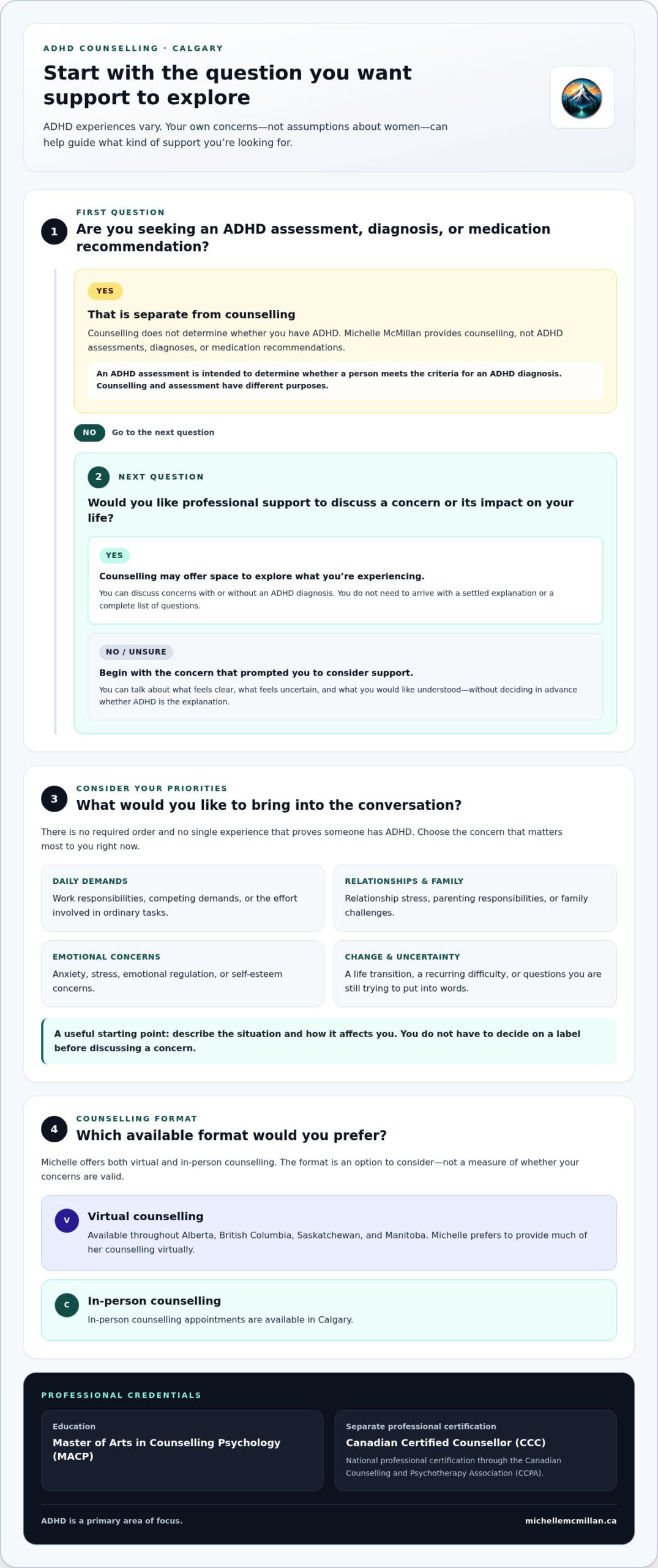
Counselling provides a place to explore ADHD-related concerns; it does not determine whether you have ADHD. Knowing that boundary can help you choose the kind of support that matches the question you have today, without expecting counselling to provide an assessment.
Counselling and ADHD assessment are different services
An ADHD assessment is intended to determine whether a person meets the criteria for an ADHD diagnosis. Counselling has a different purpose: it provides professional support for discussing experiences and concerns. One does not replace the other, and considering counselling doesn’t mean that you must pursue an assessment.
Michelle McMillan provides counselling, not ADHD assessments, diagnoses or medication recommendations. If you’re uncertain about what you want, you can start with the concern that prompted you to consider support. You don’t need to arrive with a diagnosis, a settled explanation or a complete list of questions. If questions about assessment matter to you, they can remain separate from what you choose to discuss in counselling.
Concerns counselling may make room to discuss
ADHD is a primary area of focus, alongside neurodivergence, anxiety, stress and emotional regulation. These are areas for discussion, not conclusions about what you’re experiencing. For example, you might want to talk about the strain of managing competing responsibilities, or how stress is affecting your interactions with others. Another person may have different concerns, even if they use similar language to describe them.
Rather than trying to explain everything at once, you could choose one issue and describe why it matters to you. A question like “What part of this situation would I most like to understand?” may help you decide where to begin. You could discuss what feels difficult, what you’ve already been wondering about, and what remains unclear. There’s no required order for raising concerns, and they don’t need to fit into a single category.
If you’re considering ADHD counselling for women Calgary, the topics you bring can reflect your own circumstances, including concerns that don’t seem directly related to ADHD. Michelle’s ADHD and neurodivergence counselling focus includes further information about these areas. It may be helpful to keep the distinction in mind: counselling gives you a setting to discuss what matters to you, while assessment addresses the separate question of diagnosis.
How to decide whether ADHD counselling fits your priorities
You don’t need to arrive with a polished goal. A useful way to consider counselling is to look at one situation, its impact, and what you might want to discuss about it. These prompts aren’t a test of whether counselling is right for you. They can simply help you notice what feels important enough to bring into a conversation.
For example, a new responsibility at work might be taking up more of your attention outside work hours. You could name the change, describe what it’s been like for you, and consider what you’d want to explore: the pressure itself, how it’s affecting your confidence, or how to talk about it with someone close to you. You don’t have to settle on just one concern.
Name the situations that feel most important
Consider where you notice the concern most: at work, at home, in a relationship, while parenting, or during a significant transition. Then consider what impact it has. Does it take up time, create tension, affect how you see yourself, or leave you unsure what to do next? These are ways to describe your experience, not clues that establish a diagnosis.
Concerns can overlap. A change in your schedule, for example, might affect both your ability to meet work expectations and the time you have for social commitments. That doesn’t mean there’s a single cause, or that one concern is more important than another. You might simply choose the part you most want to talk about first. If choosing feels difficult, it’s also useful to note what makes each concern matter to you, such as its effect on daily responsibilities or relationships.
Consider what you want counselling to help you explore
Next, ask what kind of conversation would feel useful. You might want to discuss emotional regulation, self-esteem, stress, or the way a concern is affecting communication with someone in your life. Perhaps you want to understand your own reactions, explain your perspective, or make sense of a transition. These are possible discussion priorities, not promises about what counselling will achieve.
You may not have a clear goal at the outset. “I know this is affecting me, but I’m not sure where to begin” is a reasonable way to describe your starting point. You can also hold more than one priority in mind, then decide which feels most pressing as you consider support. Michelle’s ADHD and neurodivergence counselling focus provides broader information about these support areas. Your priorities can be practical, emotional, relational, or still taking shape.
Virtual and in-person ADHD counselling options in Calgary
Choosing a counselling format is a practical part of exploring support. Michelle offers both virtual and in-person counselling, with in-person appointments available in Calgary. She prefers to provide much of her counselling virtually, while in-person appointments remain an option in Calgary. These are formats for accessing counselling, not a ranking of which is better or more effective.
What the counselling formats mean for Calgary clients
In-person counselling means attending an appointment in person in Calgary. Virtual counselling means meeting remotely. For some people, the choice may come down to routine, travel, comfort with each format or what works with their schedule. There’s no need to interpret the format as a measure of how serious your concerns are, or as a sign that one option is more suitable for women or for ADHD.
It can help to think about the details of an ordinary week. Would travelling to an appointment add a difficult step, or would you prefer to meet in person? Are there work, caregiving or other commitments that shape when and how you can attend? These are personal considerations, not clinical rules. Calgary-focused information about counselling areas of focus can help you understand the topics connected with support.
Virtual counselling across the confirmed service areas
Virtual counselling is available throughout Alberta, British Columbia, Saskatchewan and Manitoba. The option can be convenient and flexible, including for people whose location or schedule makes attending in person less straightforward. The availability described here applies to these provinces; it shouldn’t be taken to mean virtual counselling is offered across every province or territory.
Virtual appointments can also accommodate couples who want to attend counselling together. They may join from the same location or participate from separate locations when needed. The format doesn’t change the importance of the concerns each person brings, and it doesn’t imply that counselling will produce a particular result.
If you’re considering ADHD counselling for women Calgary, you can weigh format alongside the priorities you’ve identified: what feels manageable in your routine, and whether you prefer a virtual or in-person appointment. Michelle offers both options, with virtual counselling in the four provinces named above and in-person appointments in Calgary. To explore the available counselling options and booking information, review the ADHD and neurodivergence counselling focus.
Considering ADHD counselling with Michelle McMillan in Calgary
Exploring counselling is a personal decision. You may have a clear concern you want to discuss, or you may still be sorting out what feels most important. Michelle McMillan Counselling provides professional counselling for individuals, youth, couples and families, including support related to ADHD and neurodivergence. The focus of your decision can remain on your own priorities, rather than on whether your experience matches someone else’s.
Michelle’s relevant experience and credentials
ADHD is a primary area of focus, alongside neurodivergence, anxiety, emotional regulation, relationships, parenting, family challenges, life transitions, self-esteem and personal growth. These are areas for counselling support and discussion, not a promise of a particular result.
Michelle holds a Master of Arts in Counselling Psychology (MACP). Separately, she is a Canadian Certified Counsellor (CCC), a national professional certification through the Canadian Counselling and Psychotherapy Association (CCPA). Her 16 years of education experience include work in specialized mental-health and intensive behavioural-support settings with children, teens and families. This is education experience, distinct from her counselling credentials.
Credentials and experience offer useful context about a counsellor’s background, but they can’t predict a particular person’s experience or outcome. You can use this information alongside your own sense of what you want to discuss, whether that’s a practical concern, a relationship issue, questions about self-esteem or uncertainty about how ADHD may relate to your life.
A practical next step for exploring counselling
As you consider ADHD counselling for women Calgary, you might keep three things in view: the concern you want to bring, what you hope to explore, and whether you prefer virtual or in-person counselling. You don’t need to have every answer before taking a next step. A priority can be specific, such as discussing a difficult area of daily life, or open-ended, such as wanting space to make sense of several concerns.
If you’d like broader context, the article ADHD Counselling Calgary: Professional Support for Growth offers related information. Michelle provides virtual and in-person counselling, with in-person appointments available in Calgary. Virtual counselling is available in Alberta, British Columbia, Saskatchewan and Manitoba. These options let you consider format alongside the concerns you’ve identified, without treating one format as the right choice for everyone.
If counselling feels like a useful option to explore, you can review the Rates and Booking page for information about taking that next step.
Take the next step at your own pace
You don’t have to have every question answered before deciding whether support feels worthwhile. A first step can simply be choosing what you’d like to make room to discuss, even if your thoughts are still taking shape. ADHD counselling for women Calgary should leave space for your individual concerns, not ask you to fit a predetermined story.
If you’re considering counselling with Michelle McMillan, you can review the booking information and decide whether you’d like to take the next step. There’s no need to turn uncertainty into a complete plan today. Start with what feels useful to explore now, and let that be enough for this decision.
Explore rates and booking options for counselling with Michelle McMillan.
Your questions deserve to be considered at your own pace.
Frequently Asked Questions
Can ADHD counselling address more than one area of life?
Yes. You can bring concerns that overlap, such as how a demanding work period is affecting family time or how stress is influencing your relationships. You don’t need to separate each issue or decide that they share one cause before discussing them. ADHD counselling for women Calgary can make room for the concerns you identify, including practical, emotional and relational questions that matter in your circumstances.
Can I explore counselling if I am not sure what I want to focus on?
Yes. You can start with what prompted you to consider counselling, even if you can’t yet name a goal. For instance, you might say that a recent change at work has left you feeling unsettled, but you’re unsure what you want to explore. You don’t need to prepare a complete account or arrive with your priorities organized; uncertainty itself can be part of what you want to discuss.
Is a Canadian Certified Counsellor the same as a psychologist?
No. Canadian Certified Counsellor (CCC) and psychologist are different professional designations. Michelle McMillan is a CCC, a national professional certification through the Canadian Counselling and Psychotherapy Association. She also holds a Master of Arts in Counselling Psychology (MACP), a separate academic degree. These titles describe different credentials; a counselling psychology degree does not make someone a psychologist.
Can counselling include concerns about relationships or parenting alongside ADHD?
Yes. You can bring relationship or parenting concerns alongside questions about ADHD or neurodivergence. For example, you might want to discuss how responsibilities are divided at home, or how a family change is affecting communication between you and a partner. These are topics to explore in their own context, not evidence of a diagnosis or a prediction about what counselling will achieve.
Can couples join virtual counselling from different locations?
Yes. Couples may attend virtual counselling together from the same location or join from separate locations when needed. This can be useful if work, caregiving or travel means you aren’t in the same place at appointment time. Both partners can take part remotely without needing to travel to one shared location for the counselling appointment.
Is ADHD counselling only for women?
No. Although this article focuses on women’s questions, Michelle McMillan Counselling serves individuals, youth, couples and families. ADHD and neurodivergence-related concerns can be discussed in counselling with different kinds of clients. The person seeking support doesn’t need to fit a particular gender-based description; what matters is whether the concerns they want to discuss are relevant to the counselling they’re considering.
Article by
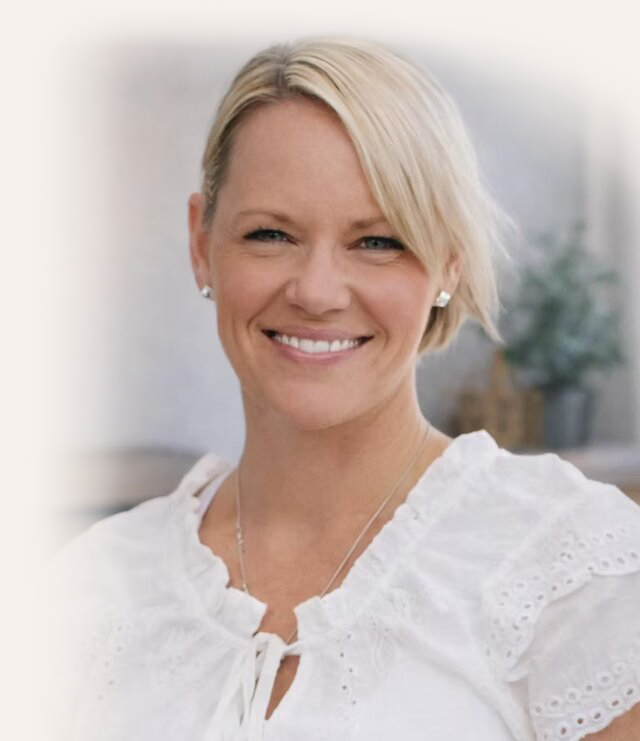
Michelle McMillan, MACP, CCC
Michelle McMillan is a Canadian Certified Counsellor (CCC) with a Master of Arts in Counselling Psychology (MACP). She has extensive experience working with children and supporting clients with ADHD, neurodivergence, anxiety, emotional regulation, relationships and family challenges. Michelle offers both virtual and in-person counselling, with virtual counselling available throughout Alberta, British Columbia, Saskatchewan and Manitoba and in-person appointments available in Calgary.
Important Information
This article is provided for general educational and informational purposes only and is not a substitute for professional counselling, psychological, medical or emergency services. Information shared here should not be considered a diagnosis or individualized treatment advice. If you are experiencing a mental health emergency or are in immediate danger, please contact appropriate emergency services in your area.