
What if recurring arguments about chores, plans, or being late aren’t proof that either partner doesn’t care? In ADHD couples counselling Calgary, you can discuss the patterns beneath the conflict without assuming ADHD explains everything or assigning blame to one person.
If conversations about responsibilities keep going in circles, it makes sense to feel discouraged or wary of counselling. You may wonder whether both perspectives will be heard, especially when you and your partner experience forgetfulness, planning, or time management differently. Couples counselling offers a professional setting to discuss these concerns and explore what may be contributing to tension. It isn’t an ADHD assessment or diagnosis, and it doesn’t determine who is at fault.
This article looks at how ADHD-related differences may show up in a relationship, what couples counselling can and can’t offer, and how to consider a format that feels manageable. Michelle McMillan, MACP, CCC, offers virtual counselling, which couples can attend together or from separate locations, as well as in-person appointments in Calgary.
Key Takeaways
- Repeated disagreements can point to shared relationship patterns, not proof that one partner is to blame.
- Planning, household responsibilities, and conversations may feel different to each partner, even when neither intends harm.
- ADHD couples counselling Calgary provides a setting to discuss relationship concerns without treating counselling as a process for assigning fault.
- Before starting, consider the concerns you share, what you hope to discuss, and any questions you have. You don’t need to agree on every detail first.
- Learn about Michelle McMillan’s experience with ADHD, neurodivergence, relationships, and emotional regulation, along with virtual and Calgary in-person counselling options.
ADHD Couples Counselling in Calgary: When Relationship Tension Deserves Attention
Repeated disagreements can leave both partners tired, even when neither intended to cause hurt. The same tension may involve practical coordination, different expectations, or the meaning each person attaches to what happened. Taking those experiences seriously doesn’t require deciding that one partner is at fault.
ADHD experiences vary, so a diagnosis alone can’t tell you how someone will communicate or relate in a partnership. ADHD may be one part of a couple’s context, but it doesn’t automatically explain every disagreement. The details of the relationship and each partner’s perspective matter.
ADHD couples counselling in Calgary offers a professional setting to discuss relationship concerns where ADHD-related experiences may be relevant. The conversation can focus on the specific concern rather than treating a diagnosis as a complete account of either person or the relationship.
What brings couples to ADHD-related counselling?
Partners may understand the same interaction differently. For instance, one person might experience a delayed response to an important message as distance, while the other was occupied and didn’t realize how the silence would feel. Intention and impact can differ. Making room for both can help keep a conversation from becoming an argument about character or care.
This is one possible example, not a checklist or a way to identify ADHD. Similar disagreements can arise for many reasons, and couples’ experiences aren’t interchangeable. Michelle’s counselling focus on ADHD and relationships includes areas relevant to discussing these concerns.
When does a recurring disagreement become a relationship concern?
A couple may consider professional support when conflict keeps returning, frustration is building, or one or both partners feel unheard. There’s no need to wait for a crisis. Sometimes partners agree that a pattern is painful but disagree about its cause or seriousness. That difference can itself be part of what they want to discuss.
You can begin with the recurring concern, even if you don’t share an explanation for it. Each partner’s account can help clarify what feels difficult and what the disagreement means to them.
How ADHD-Related Differences Can Show Up in a Calgary Couple’s Daily Life
ADHD-related relationship experiences differ from couple to couple. A diagnosis doesn’t tell you exactly how either partner will handle plans, household tasks, or conversation. In a particular relationship, it’s useful to consider how a situation unfolded, what each person understood, and how it affected the shared routine.
For general information about ADHD, the National Institute of Mental Health on ADHD offers an overview of symptoms, diagnosis, and treatment. That background can be useful, but it can’t explain the full meaning of a disagreement between two partners. Circumstances, expectations, and each person’s experience matter too.
Planning and household responsibilities
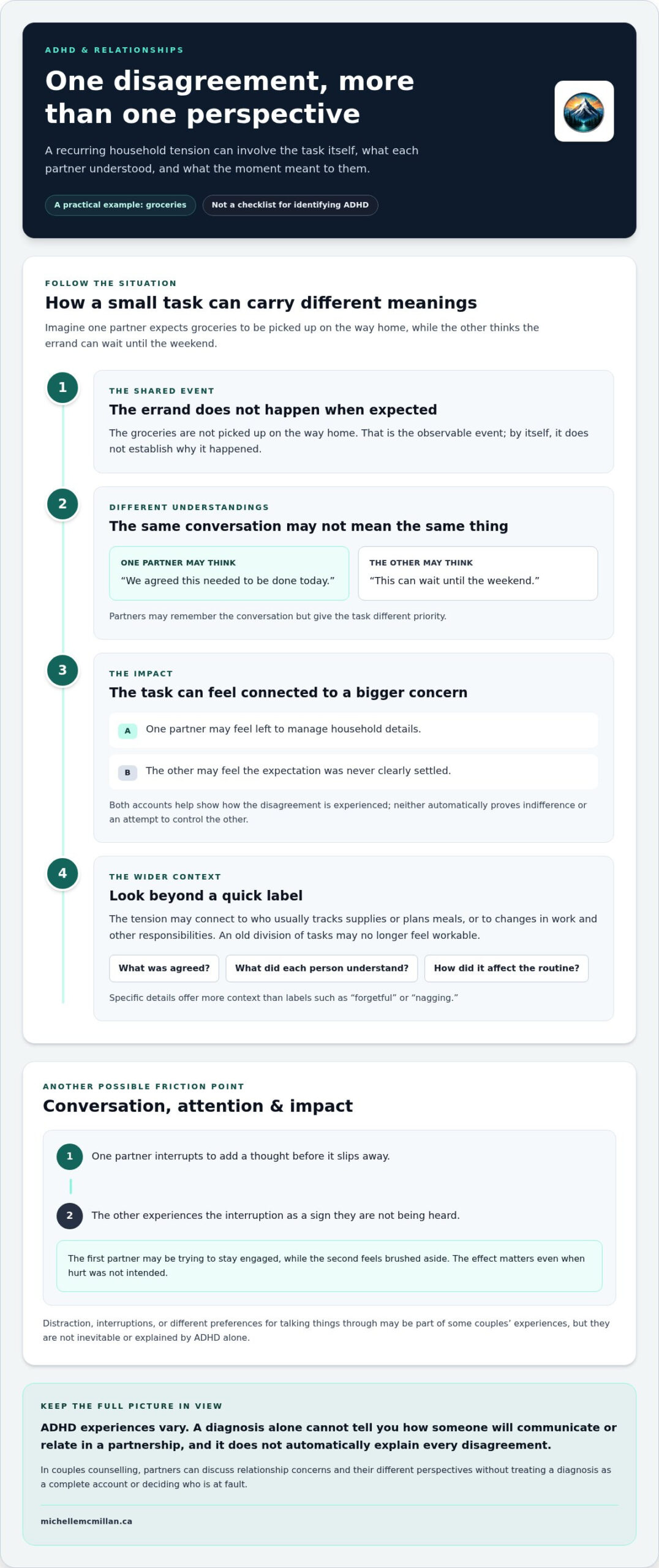
Imagine one partner expects groceries to be picked up on the way home, while the other thinks the task can wait until the weekend. They may remember the same conversation but give it different priority. One might feel left to manage the household details; the other might feel the expectation was never clearly settled. Neither interpretation proves indifference or an attempt to control the other.
Roles and context can shape the tension. If one person usually tracks supplies or plans meals, a missed errand may feel like part of a larger imbalance. If work demands or other responsibilities have shifted, an old division of tasks may no longer feel workable. Looking at the specific agreement, each partner’s understanding, and the impact adds more context than a quick label such as “forgetful” or “nagging.”
Conversations, attention, and emotional responses
During a conversation, one partner may interrupt to add a thought before it slips away, while the other experiences the interruption as a sign they aren’t being heard. In another couple, a pause or change of subject may feel welcome to one person and confusing to the other. Distraction, interruptions, or different preferences for talking things through can be part of some couples’ experiences, but they aren’t inevitable or explained by ADHD alone.
The same exchange can carry different meanings: one person may be trying to stay engaged, while the other feels brushed aside. The effect still matters, even if hurt wasn’t intended. Discussing what each partner noticed and how the interaction landed can make the situation clearer without reducing either person to a diagnosis.
These examples aren’t a checklist for identifying ADHD. They illustrate how daily friction can involve both practical coordination and personal meaning. If you’re considering ADHD couples counselling Calgary, you can explore how ADHD and relationship concerns relate to the areas Michelle McMillan addresses through counselling.
Does ADHD Couples Counselling Mean One Partner Is the Problem?
No. Couples counselling isn’t a hearing to decide which partner is at fault. Relationship concerns can involve individual experiences as well as shared expectations, such as how partners divide responsibilities or what they understand an agreement to mean. Considering both perspectives doesn’t require treating either person as the sole cause.
Understanding why something happened and recognizing its effect are different parts of the conversation. A missed commitment might have an explanation, while its impact on the other partner still deserves attention. Partners can take responsibility for an impact without treating ADHD as a moral failing. That distinction makes it possible to discuss what happened without labelling someone’s character.
How can partners discuss impact without making assumptions?
It may be more useful to describe a particular event and its effect than to make a broad claim about a partner. For example, “I felt left to manage the plans after we understood the agreement differently” describes an experience; “You never care about our plans” turns it into a judgment about character.
Intent and impact may not match. One partner may not have meant to cause hurt, while the other may still feel hurt. Neither perspective has to cancel out the other. Staying with the specific situation leaves room to consider what each person understood and how the interaction affected them, without assuming one account is more valid.
What if only one partner has an ADHD diagnosis?
Couples counselling can address relationship concerns whether one partner has an ADHD diagnosis or both do. The conversation can focus on how each person experiences the relationship; partners don’t need matching explanations before they seek support. A partner’s habits, communication style, or role in a disagreement aren’t enough to determine whether they have ADHD.
Michelle provides counselling related to ADHD and relationship concerns. She doesn’t provide ADHD assessments or diagnoses. Counselling can focus on the couple’s concerns and their effects on the relationship without making a diagnosis the starting point.
What to Consider Before Starting ADHD Couples Counselling in Calgary
You don’t need a complete explanation for your relationship concerns before seeking professional support. Some preparation can help you name what you’d like to discuss, but partners may have different perspectives on what is happening or why. You can begin with the shared concern, even if you don’t yet agree on how ADHD relates to it.
What should partners clarify together first?
Before starting ADHD couples counselling in Calgary, consider these reflection prompts. They aren’t a test or a requirement. They’re a way to identify what feels most important to each of you.
- Name a recurring situation. Choose one or two concerns you’d like to discuss, such as coordinating plans or sharing a responsibility.
- Describe what feels difficult. Consider what you each experience in those moments. You don’t need to use the same words or reach the same conclusion.
- Consider what you hope to explore. You might want to understand different expectations, discuss the effect on the relationship, or make room for perspectives that have been hard to express.
- Bring questions about counselling. If you’re concerned about blame, taking sides, or assumptions about ADHD, those concerns can be part of a conversation about support.
Agreement isn’t a prerequisite. One partner may see ADHD as relevant, while the other may be unsure. You can still identify the situation that feels difficult and discuss what each of you wants to understand. For more information about ADHD-related support, explore the ADHD support and counselling focus.
Virtual or in-person counselling in Calgary
Michelle offers both virtual and in-person counselling, with in-person appointments available in Calgary. Virtual counselling is available in Alberta, British Columbia, Saskatchewan, and Manitoba. Couples can attend virtually together from the same location or join from separate locations when needed. Michelle prefers to provide much of her counselling virtually; both formats are available options, not a promise that one is better or more suitable for every couple.
Practical considerations can help you think about format: whether you prefer to meet in person in Calgary, whether joining virtually is more convenient, and whether you’ll attend from one place or separate locations. You don’t have to settle every relationship question before deciding how you’d like to meet. The format is one part of arranging support; the concerns you bring remain central.
If you’re considering couples counselling and have questions, you can contact Michelle McMillan Counselling.
Couples Counselling with Michelle McMillan: Support and Next Steps
Deciding whether to seek counselling is a personal choice. You may still have questions about what to bring up or how to make room for different perspectives. Couples counselling offers professional support for discussing relationship concerns, including how ADHD-related experiences may intersect with concerns you share.
Michelle McMillan holds a Master of Arts in Counselling Psychology (MACP) and is a Canadian Certified Counsellor (CCC), a national professional certification through the Canadian Counselling and Psychotherapy Association (CCPA). Her areas of experience include ADHD, neurodivergence, anxiety, emotional regulation, relationships, parenting, family challenges, life transitions, self-esteem, and personal growth. She also has 16 years of education experience, including work with children, teens, and families in specialized mental-health and intensive behavioural-support settings.
What couples counselling can offer, and what it cannot
Counselling provides a professional setting to discuss relationship concerns and explore what each partner is experiencing. It can make room for questions about shared expectations, the impact of recurring situations, and how each person understands the concern. The conversation can stay focused on the relationship without assuming that ADHD explains every difficulty or defines either partner.
There is no guaranteed outcome. Counselling is an opportunity to discuss what matters to you as a couple, not a promise that a particular change will follow. Each relationship brings its own concerns and perspectives.
How to explore counselling in Calgary
If you’re considering ADHD couples counselling Calgary, you might begin by identifying one concern you’d like to discuss. Michelle offers virtual and in-person counselling, with in-person appointments available in Calgary. Couples may attend virtually together from the same location or join from separate locations when needed.
You can learn about the available couples counselling services and Michelle’s education and experience through information about Michelle’s counselling background. When you feel ready, review the rates and booking information to consider the next step at your own pace.
Take a Manageable First Step Together
You don’t have to settle every disagreement or agree on why it happens before considering support. A shared starting point can be as simple as naming one relationship concern you’d both be willing to discuss. Even if you understand the situation differently, that difference can be part of what you bring forward.
ADHD couples counselling Calgary may be worth exploring when recurring tension is difficult to talk about together. Considering counselling doesn’t require making a major decision about your relationship. It can begin with learning about the practical details and deciding whether you’re ready to take part.
Michelle McMillan offers couples counselling virtually and in person in Calgary. To consider booking at your own pace, review the rates and booking information for couples counselling. You can talk it over with your partner, bring your questions, and choose a next step that feels manageable to both of you.
Frequently Asked Questions
Can couples counselling help if only one partner has ADHD?
Couples counselling can address relationship concerns when one partner has ADHD, whether or not the other partner has a diagnosis. For example, partners might want to discuss how they divide planning or respond when an agreement is missed. The conversation can include each person’s experience without assuming ADHD explains every disagreement or that the partner without a diagnosis has no part in the relationship dynamics.
Can we attend virtual couples counselling from separate locations?
Yes. Couples may attend virtual counselling together from the same location or join from separate locations when needed. Michelle offers virtual couples counselling, so partners can take part from different locations when that arrangement is needed.
Does ADHD couples counselling include an ADHD assessment or diagnosis?
No. Couples counselling is for discussing relationship concerns, not assessing or diagnosing ADHD. Michelle provides counselling and doesn’t provide ADHD assessments, diagnoses, or medication recommendations. Counselling can still focus on the couple’s concerns without making a diagnosis the starting point.
Is ADHD couples counselling only for married couples?
No. Couples counselling isn’t limited to people who are married. Partners in a relationship can consider counselling when they want professional support to discuss relationship concerns, regardless of marital status. What matters is the concern you’d like to discuss, not whether you’ve formalized the relationship through marriage.
Can couples counselling help when partners disagree about whether ADHD affects the relationship?
Partners don’t need to agree on ADHD’s role before they discuss a relationship concern. You might begin with a specific point of tension, such as how plans are coordinated, and talk about what each partner notices. The discussion can stay focused on the shared concern while leaving room for different explanations. Disagreement about the cause doesn’t make either partner’s experience irrelevant.
Is in-person couples counselling available in Calgary?
Yes. In-person couples counselling appointments are available in Calgary. Virtual counselling is also an option. You can consider practical preferences, such as whether meeting in Calgary or joining virtually better suits your circumstances. These are available formats, not a ranking of which is better.
Can virtual counselling be accessed outside Alberta?
Yes. Virtual counselling is available to clients in British Columbia, Saskatchewan, and Manitoba, as well as Alberta. If you live in one of these provinces and are considering virtual support for a relationship concern, you can explore the rates and booking information for couples counselling.
If recurring tension is affecting your relationship, you can take time to consider whether counselling feels right for both of you. Learn more about rates and booking couples counselling with Michelle McMillan in Calgary or virtually.

Article by
Michelle McMillan, MACP, CCC
Michelle McMillan is a Canadian Certified Counsellor (CCC) with a Master of Arts in Counselling Psychology (MACP). She has extensive experience working with children and supporting clients with ADHD, neurodivergence, anxiety, emotional regulation, relationships and family challenges. Michelle offers both virtual and in-person counselling, with virtual counselling available throughout Alberta, British Columbia, Saskatchewan and Manitoba and in-person appointments available in Calgary.
Important Information
This article is provided for general educational and informational purposes only and is not a substitute for professional counselling, psychological, medical or emergency services. Information shared here should not be considered a diagnosis or individualized treatment advice. If you are experiencing a mental health emergency or are in immediate danger, please contact appropriate emergency services in your area.