
Strong emotions aren’t a sign that you’re failing to cope. They may be a reason to pause and understand what’s happening. If anger, worry, or overwhelm is affecting everyday situations or relationships, emotional regulation counselling Calgary may offer space to discuss what you’re experiencing. You don’t need a diagnosis or to be in crisis to consider counselling.
It can be hard to know what support might involve or whether it fits your concerns. Emotional regulation counselling doesn’t promise control over feelings or a particular outcome. It offers professional support to explore emotions in context and consider how they affect your life.
This article explains what emotional regulation counselling may involve, when you might consider it, and what support can look like for you or a family member. It also covers virtual counselling and in-person appointments in Calgary with Michelle McMillan, as well as virtual counselling available across Alberta, British Columbia, Saskatchewan, and Manitoba.
Key Takeaways
- Emotional regulation involves noticing, understanding, and responding to emotions in context. Difficult feelings alone don’t indicate a diagnosis.
- Age, relationships, stress, and personal circumstances can shape how emotions show up.
- Emotional regulation counselling Calgary may be worth exploring when recurring concerns affect daily life or relationships, even without a crisis.
- Clarifying what concerns you, when it arises, and what support you’re seeking can help you decide what to discuss in counselling.
- Learn about Michelle McMillan’s counselling focus, credentials, and virtual and in-person options in Calgary.
What emotional regulation counselling in Calgary can help you understand
Emotional regulation means noticing, understanding, and responding to emotions in the context of your experiences and circumstances. It doesn’t mean preventing feelings or staying calm at all times. Emotions can signal that something matters to you, and their intensity and expression may shift with the situation. Feeling angry, anxious, sad, or overwhelmed is part of being human. Difficult emotions alone don’t indicate a mental health diagnosis.
What does emotional regulation mean in everyday life?
Emotions can affect what captures your attention, how you communicate, and which decisions feel possible in the moment. After receiving disappointing news, for example, you might feel upset and want to respond to a message right away. Recognizing that feeling is separate from deciding what to say. You might reply, wait, or ask a question first. There isn’t one response that fits every situation.
Regulation isn’t suppression. It doesn’t require hiding feelings, dismissing them, or staying composed regardless of what is happening. It involves recognizing an emotion and considering how to respond in context. After a stressful day, one person may want quiet while another prefers to talk. Neither reaction, by itself, tells the whole story about what that person needs or how they’re coping.
When can intense or difficult emotions become a concern?
It may be worth paying attention when emotions or reactions repeatedly make everyday life harder. Worry might make it difficult to concentrate on routine tasks. A disagreement may escalate quickly, or someone might withdraw from conversations when feeling overwhelmed. These are examples, not diagnostic criteria, and they don’t establish a particular cause.
Experiences vary across people, ages, relationships, and circumstances. A child’s frustration, a teen’s wish for privacy, or an adult’s reaction to work stress can each mean different things depending on the context. Even family members may respond differently to the same change. Considering what else is happening can make an emotional experience easier to discuss without treating it as a personal failing.
If you’re considering emotional regulation counselling Calgary, you could describe what you’ve noticed, the situations in which it tends to arise, and how it affects routines or relationships. Counselling offers a setting to explore those concerns without assuming that a strong feeling means something is wrong with you. Emotional regulation is among the areas of counselling focus available through Michelle McMillan Counselling.
What can shape emotional regulation across different ages and situations?
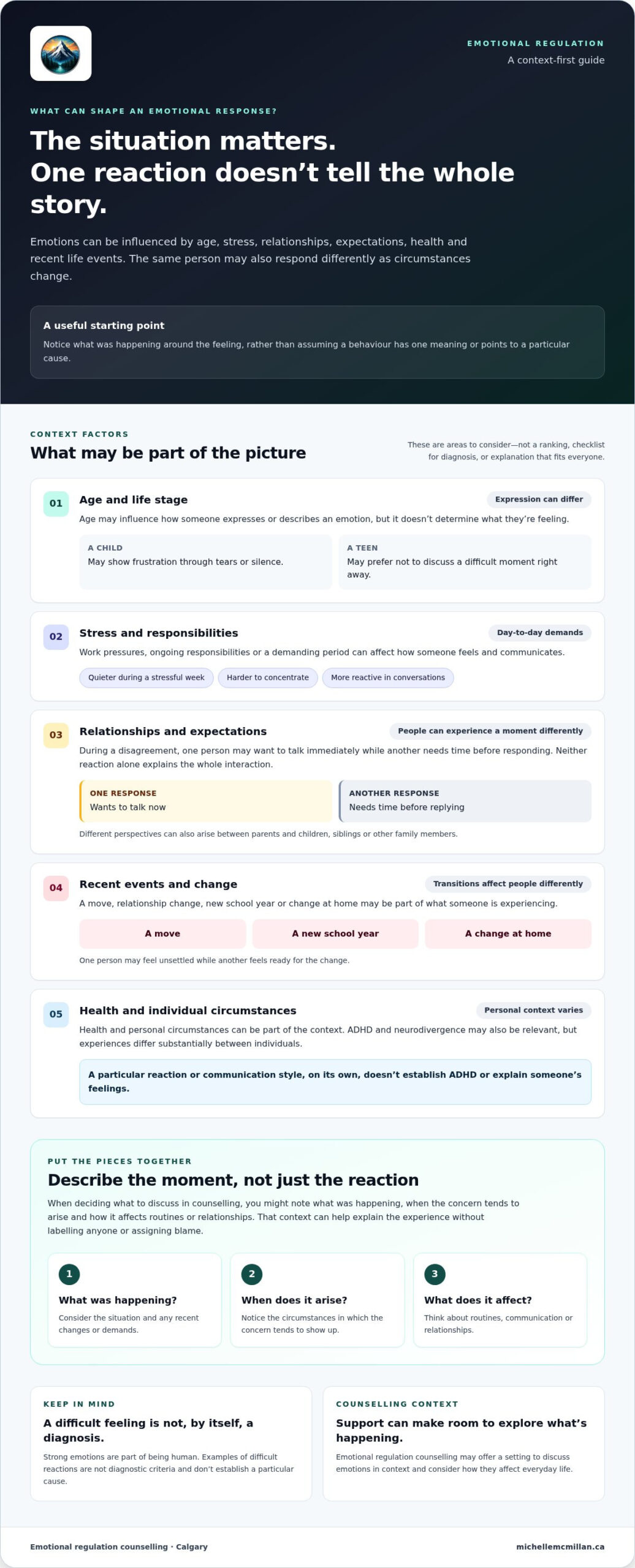
Emotional experiences differ from person to person, and one person may respond differently as circumstances change. Age, stress, relationships, expectations, health, and recent life events can all be part of the context. A reaction that feels manageable one day may feel harder at another time. That difference alone doesn’t mean something is wrong.
How emotional challenges may show up in adult life
A demanding period at work, a move, a relationship change, or ongoing responsibilities can affect how someone feels and communicates. One adult might become quieter during a stressful week; another might find it harder to concentrate or feel more reactive in conversations. These are possibilities, not a checklist. A difficult situation alone doesn’t establish a mental health condition.
How family and relationship context can matter
During a disagreement, one partner may want to talk immediately while the other needs time before responding. Each person may experience the same moment differently, shaped by their own perspective and circumstances. Similar differences can arise between parents and children, siblings, or other family members. Understanding context isn’t about assigning blame. It can help people explain what an interaction was like for them.
Age may influence how someone expresses or describes an emotion, but it doesn’t determine what they’re feeling. A child might show frustration through tears or silence, while a teen may prefer not to discuss a difficult moment right away. These responses can have many explanations. Consider what else is happening rather than assuming a behaviour has one meaning.
Family routines and changes can matter, too. Starting a new school year, adjusting to a change at home, or taking on new responsibilities may affect family members in different ways. One person might feel unsettled while another feels ready for the change. Making room for those differences can help clarify each person’s experience, rather than treating one reaction as the whole family’s story.
ADHD and neurodivergence may also be relevant when considering emotions, but experiences differ substantially between individuals. A particular reaction or communication style doesn’t, on its own, establish ADHD or explain someone’s feelings. ADHD and neurodivergence counselling are among the counselling areas available through Michelle McMillan Counselling for Calgary individuals and families.
These examples can help you describe what’s happening without labelling yourself or someone close to you. If you’re considering emotional regulation counselling Calgary, you might identify which situations feel difficult and how each person involved describes them. That context can help you decide what questions to bring to counselling.
When is emotional regulation counselling in Calgary worth considering?
Counselling doesn’t have to wait until life feels unmanageable. You might consider it when recurring emotional concerns are taking up attention, affecting relationships, or making it hard to talk about what’s happening. Seeking support can be a thoughtful choice, not a sign that you’re in crisis or that your feelings are unusual.
What concerns might lead someone to explore counselling?
There isn’t a single threshold for when counselling is relevant. You may want a place to discuss a pattern you’ve noticed or to understand how a difficult situation is affecting you or your family. Disagreements might keep returning to the same point, stress may make everyday responsibilities feel harder, or you may find it difficult to explain your feelings to someone close to you.
These examples aren’t diagnostic criteria and don’t establish a mental health condition. They’re possible reasons to seek professional support, whether a concern is new, longstanding, or connected to a particular change. You don’t have to wait until it becomes overwhelming to talk it through.
A concern can be worth discussing while still needing context before you draw conclusions about what it means.
- Reasons to explore counselling: a recurring concern is affecting daily routines, you’re finding it hard to discuss emotions, or tension in a relationship keeps resurfacing.
- Reasons to consider context: the reaction happened during a particularly stressful period, you’re adjusting to a change, or you don’t yet know how others involved experience the situation.
This isn’t a test of whether your concern is serious enough. The list can help you identify what you’d like to discuss while leaving room for questions and different perspectives.
What counselling can and cannot tell you
Emotional regulation counselling Calgary provides professional support and a setting to discuss emotions, relationships, and the circumstances around a concern. Seeking counselling doesn’t mean you need to prove something is wrong with you. Counselling isn’t an ADHD assessment, diagnosis, or medication recommendation. Difficult emotions don’t, by themselves, mean you have a diagnosis.
If ADHD is part of what you’re wondering about, it can help to distinguish questions about assessment from a wish to discuss how emotions or everyday experiences affect you. Michelle McMillan Counselling provides counselling, not ADHD assessments, diagnoses, or medication recommendations. Its counselling services include support related to emotional regulation, ADHD, and neurodivergence.
You don’t need to arrive with a specific outcome in mind. You can begin with a question, a recurring situation, or something that has been difficult to put into words. Counselling offers an opportunity to explore the concern, with its meaning considered in the fuller context.
How to think about emotional regulation counselling and the kind of support you need
You don’t need a complete explanation before seeking counselling. Start by identifying what feels difficult, considering the circumstances around it, and thinking about the support you want. Your answers can be tentative. They’re a way to describe your concerns, not a test you need to pass.
These questions may help you prepare what you’d like to discuss:
- Name the concern. Is there a feeling, conversation, or recurring situation you’d like to understand better?
- Consider its context. When does it tend to arise, and who or what else is involved?
- Describe the support you want. Would you like space to talk about your emotions, a relationship, or a family situation?
Clarifying what you hope to discuss
You might want to talk about a particular disagreement, stress during a life change, or uncertainty about how to express what you feel. It’s fine if your concern is broad or difficult to put into words. You don’t need a clear, measurable outcome before beginning counselling, and no particular change can be guaranteed. You can start with what you’ve noticed and what you hope to understand.
Some people find it helpful to think of a recent example; others may only know that a concern keeps returning. Either can be a starting point. You don’t need to prepare a perfect summary or decide in advance what the explanation must be.
Considering counselling for yourself or your family
Some concerns may feel personal, while others involve shared interactions. You might want individual support to discuss your own emotional experiences, or counselling may relate to questions involving a partner or family member. These aren’t rigid categories: an individual concern can affect relationships, and a shared concern can bring up different experiences for each person.
Adults, couples, children, teens, and families may access counselling where appropriate. Michelle McMillan Counselling offers virtual and in-person counselling. In-person appointments are available in Calgary, and virtual counselling is available across Alberta, British Columbia, Saskatchewan, and Manitoba. Michelle prefers to provide much of her counselling virtually. Couples may attend virtually together from the same location or join from separate locations when needed.
If you’re considering individual support, explore counselling services and support options to learn about individual, couples, child, teen, and family counselling. A useful starting question may be, “What would I like help making sense of?” You can bring that question even if you’re still working out the answer.
Emotional regulation counselling with Michelle McMillan in Calgary
Emotional regulation is an area of focus at Michelle McMillan Counselling. If you’re considering counselling, you may want to understand the counsellor’s professional background and the concerns connected to this area of support. You don’t need to arrive with a complete explanation of what you’re experiencing.
Support for concerns across different ages and circumstances
Emotional concerns can connect with relationships, parenting, family challenges, stress, or life changes. The details matter: two people may describe a similar situation differently, and a child’s or teen’s circumstances aren’t automatically the same as an adult’s. Counselling offers professional support to discuss concerns relevant to you or your family, without promising a particular result.
Michelle McMillan has 16 years of education experience, including work in specialized mental-health and intensive behavioural-support settings with children, teens, and families. This background is relevant context for people considering counselling related to young people or family circumstances, but it doesn’t guarantee a particular experience or outcome.
What to know about Michelle McMillan’s credentials
Michelle holds a Master of Arts in Counselling Psychology (MACP). Separately, she is a Canadian Certified Counsellor (CCC), a national professional certification through the Canadian Counselling and Psychotherapy Association (CCPA). These are distinct credentials; the CCC designation does not mean she is a psychologist.
If you’re weighing whether emotional regulation counselling is relevant to your circumstances, begin with the concern or question you’d like to discuss. You can view rates and booking information at your own pace.
Take a considered next step
You don’t need to have everything figured out before deciding whether counselling feels useful. A question you keep returning to or a concern that’s difficult to put into words can be a starting point. Take time to consider what you’d like to discuss and what feels manageable for you.
Emotional regulation counselling Calgary offers a place to talk through concerns without needing to arrive with a diagnosis, a crisis, or a precise goal. The conversation can begin with what’s happening in your life and what you hope to explore, without assuming a particular outcome.
When you’re ready, you can view rates and booking information.
Frequently Asked Questions
Is emotional regulation counselling only for children?
No. Emotional regulation counselling can be relevant at different ages because concerns and circumstances vary. An adult might want to explore how stress affects conversations at work, while a parent may have questions about supporting a child through a difficult transition. These examples aren’t a checklist, and one behaviour doesn’t establish a diagnosis. Counselling provides a place to discuss the specific experience and context.
Can I seek counselling about emotional regulation without a diagnosis?
Yes. You don’t need a diagnosis to begin discussing an emotional concern with a counsellor. You might want to talk about a recurring disagreement, uncertainty about how to describe your feelings, or the effect of a demanding period on daily routines. You can start with a question or situation, even if you don’t yet know what you hope to understand. Counselling offers professional support without requiring a fixed goal or expected result.
Does emotional regulation counselling mean I have a mental health condition?
No. Difficult emotions or finding them hard to manage don’t, by themselves, establish a mental health condition. The meaning of an emotional experience depends on the circumstances and the person experiencing it. For example, a reaction during a stressful change may call for a different conversation than a recurring concern affecting relationships. Counselling can help you discuss what’s happening without treating one feeling as proof of a diagnosis.
Can adults and teens both access emotional regulation counselling?
Yes. Adults and teens may both access counselling, though their questions and circumstances can differ. A teen may want to discuss pressures at school or changes in friendships, while an adult may be considering how emotions affect work or close relationships. These are possibilities, not assumptions about either group. Michelle McMillan Counselling serves individuals and youth, with support centred on the concerns each person brings.
Is virtual counselling available to people outside Calgary?
Yes. Virtual counselling is available in Alberta, British Columbia, Saskatchewan, and Manitoba, where Michelle is eligible to practise. In-person appointments are also available in Calgary, and Michelle prefers to provide much of her counselling virtually. Both formats are offered, without a claim that one is more effective or suitable for everyone.
Does Michelle McMillan provide ADHD assessments or diagnoses?
No. Michelle provides counselling, but not ADHD assessments, diagnoses, or medication recommendations. ADHD and neurodivergence-related challenges are areas of focus in her counselling work. If you’re looking for support to discuss how concerns affect everyday life, counselling can provide a setting for that conversation. It isn’t an ADHD assessment, and no particular outcome is guaranteed.
If you’re considering emotional regulation counselling in Calgary, you can view rates and booking information for Michelle McMillan Counselling.

Article by
Michelle McMillan, MACP, CCC
Michelle McMillan is a Canadian Certified Counsellor (CCC) with a Master of Arts in Counselling Psychology (MACP). She has extensive experience working with children and supporting clients with ADHD, neurodivergence, anxiety, emotional regulation, relationships and family challenges. Michelle offers both virtual and in-person counselling, with virtual counselling available throughout Alberta, British Columbia, Saskatchewan and Manitoba and in-person appointments available in Calgary.
Important Information
This article is provided for general educational and informational purposes only and is not a substitute for professional counselling, psychological, medical or emergency services. Information shared here should not be considered a diagnosis or individualized treatment advice. If you are experiencing a mental health emergency or are in immediate danger, please contact appropriate emergency services in your area.