
Both parents do not automatically need to attend counselling for overwhelmed parents in Calgary. Parent-focused counselling can centre on the parent seeking support, while family therapy typically involves several family members. The right fit depends on whether you want to explore your own parenting experience or address concerns affecting the family as a whole.
Feeling stretched thin does not mean you are failing your family. When daily demands, recurring conflict, or worry about your child feel like too much, it can be hard to know what kind of support might help, or whether you need to attend together.
This article explains what parent counselling can offer, how it differs from family therapy, and what to consider when deciding who should take part. You will also find guidance on when additional support may help and how counselling in Calgary can meet different family needs.
Key Takeaways
- You can seek parent-focused counselling on your own; family therapy generally involves more than one family member.
- Recurring conflict, parenting stress, or concerns affecting family life can be reasons to explore counselling support.
- Ongoing changes in a child’s mood, behaviour, sleep, appetite, or school attendance may be worth discussing with a professional.
- Virtual and in-person counselling are both available options, and couples can join virtual appointments together or from separate locations.
- Consider whether you want space to discuss your own parenting experience or support that includes other family members.
Choosing between parent counselling and family therapy
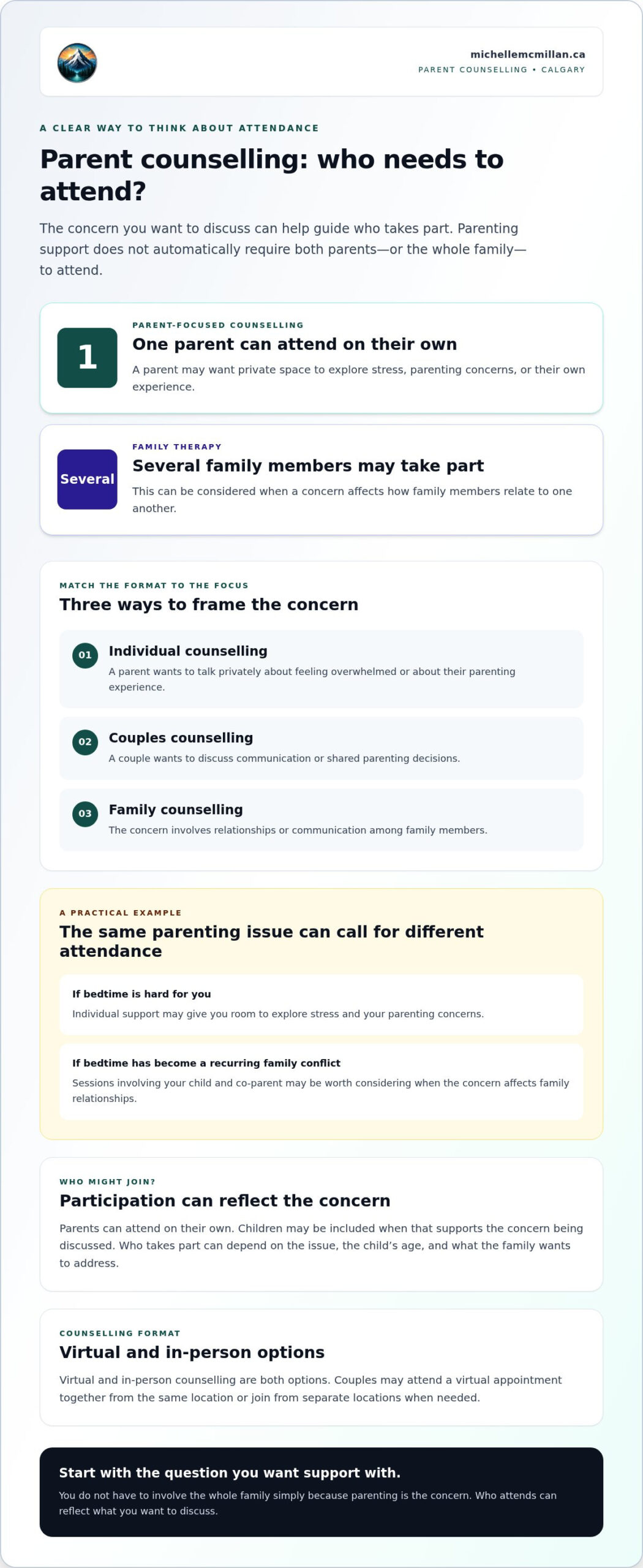
Start by identifying who needs support and where the concern is showing up. Parent counselling focuses on the parent’s experience, while family therapy typically includes several family members. If you are losing patience at bedtime, for example, individual support may help you explore stress and parenting concerns. If bedtime has become a recurring conflict involving your child and co-parent, family sessions may be a better fit.
These options are not opposing choices. Individual, couples, and family counselling each provide space for different concerns. One parent might want to talk privately about feeling overwhelmed. A couple might focus on communication and shared parenting decisions. Family sessions may include children when a concern affects how family members relate to one another. The format can reflect who is involved and what you want to address.
Family patterns can shape present-day parenting, even when you do not intend to repeat them. You might notice that disagreements in your childhood home were avoided, while your current household needs clearer conversations. Or strict rules from your upbringing may influence how you respond when your child pushes a boundary. Exploring these connections can help you consider which patterns still fit your values.
Co-parenting, separation, and blended families can bring practical questions alongside strong feelings. Parents living in separate homes, for example, may disagree about routines, limits, or how to explain changes to their children. In a blended family, a child may be adjusting to new household roles. Couples or family counselling can provide space to discuss how these changes affect relationships and communication.
The Calgary Public Library offers free programs for babies, toddlers, and parents, including storytime and early literacy activities. These are parent-and-child activities, not counselling sessions.
To find a Calgary counsellor who fits your needs, first name the concern: parenting stress, co-parenting conflict, or family communication. Then review the counsellor’s education, professional credentials, and experience with parenting or family concerns. Consider whether you want individual, couples, or family sessions, and whether you want children involved. Clear answers help you compare the support offered without assuming every counsellor has the same training.
For counselling for overwhelmed parents in Calgary, start with the strain affecting home life. You do not have to involve the whole family simply because parenting is the concern. Who attends can reflect what you want to discuss.
What Can Parent Counselling Actually Help With?
Parent counselling can give you space to discuss concerns affecting your child and family life. You might bring questions about anxiety, a recent diagnosis, or a difficult change at home.
Support Through Anxiety and Difficult Periods
A child’s anxiety or diagnosis can leave parents unsure how to respond. Counselling offers a place to explore what you are noticing and how it affects everyday family life. You might discuss a child avoiding school, feeling distressed about a change, or struggling to explain what feels wrong. Counselling can offer space to talk through concerns about a child and family life.
Parenting Across Development Stages
Parenting concerns shift as children grow, and postpartum experiences can bring new questions about family life. One parent may want space to talk about becoming a caregiver, while another adjusts to a child starting school or seeking more independence. The Healthy Parents, Healthy Children resource offers guides for parents of children from birth to age six. These stages can shape what support feels useful.
Emotions, Behaviour, and Children’s Needs
A child’s behaviour can be difficult to understand without considering what is happening around it. A bedtime outburst, for example, may prompt you to consider tiredness, a change in routine, or a hard day. Counselling can help you explore the situation and your emotional response. It can also make space to consider how a child communicates needs when words are difficult.
Parents can attend on their own, or children may be involved when that supports the concern being discussed. You might first want to talk through a school transition privately, then consider whether your child’s perspective would add useful context. Who takes part can depend on the concern, the child’s age, and what the family wants to address.
For a child with a diagnosis, it can help to separate the label from the individual. Two children with the same diagnosis may have different strengths, worries, and support needs. You might bring a specific example, such as a difficult homework routine, and explore what happens before and after the challenging moment. The focus remains on understanding this child’s experience, rather than assuming one explanation fits every family.
Parents can also discuss how stress affects their relationship with a child. If mornings repeatedly become tense, you might explore the sequence of events, your child’s response, and what feels hardest for you. That conversation can help clarify what you want to address next. Explore counselling areas of focus related to parenting, anxiety, and family concerns.
Common emotional and behavioural concerns
Parenting stress can build when difficult moments become a recurring part of family life. A child’s distress at school, frequent arguments at home, or a parent feeling constantly on edge can affect everyone’s day. Looking at the specific situation, rather than labelling a child as “difficult,” can clarify which concerns need attention.
Emotional and behavioural changes can appear in different ways. The Calgary Institute of Counselling identifies ongoing sadness, withdrawal, irritability, changes in sleep or appetite, aggression, and school refusal as possible signs that a child may need counselling. One behaviour alone does not establish a cause. Consider when the change began, where it occurs, and whether it affects relationships, routines, or attendance.
For toddlers, crying, resisting transitions, or becoming upset when a preferred activity ends can make daily routines challenging. A parent might notice that leaving the playground is harder than getting dressed. Rather than assuming one reason explains the behaviour, consider the child’s age, communication, the situation, and any recent changes. A brief record of what happened before and after an episode may help you describe the concern clearly.
Behaviour can communicate a need, but its meaning depends on the child and context. A child who becomes quiet after school may need time before talking; another may want help describing a conflict. Notice patterns across home, school, and social situations without assuming they mean the same thing. Details such as when a concern occurs and what changes around it give a counsellor more context than a broad label.
Cognitive Behavioural Therapy, often called CBT, explores connections between thoughts, feelings, and behaviour. For example, a child worried about making a mistake might avoid starting homework, then feel more distressed as the assignment remains unfinished. CBT may involve examining that pattern. It is one approach among others, and the child’s age, concerns, and needs matter when considering what support involves.
If your child’s emotional or behavioural concerns persist, interfere with school or daily routines, or affect family relationships, you can seek professional support to discuss what is happening. Describe observable examples, such as missed school mornings or a noticeable change in sleep, rather than trying to diagnose the cause yourself. If a child or teen may harm themselves or someone else, seek urgent help through local emergency services.
Do both parents need to attend?
No. One parent can begin counselling alone; both parents may take part if shared concerns or communication are central. Who attends can reflect the purpose of the support, rather than a rule that every parent must be present.
A first counselling appointment in Calgary is an opportunity to explain what brings you in and what you would like help discussing. You can describe a specific concern, such as disagreement about school routines or anxiety around transitions, and talk about who might take part in future sessions.
In-person and virtual appointments are both options. In-person counselling is available in Calgary, while virtual counselling can offer flexibility for parents managing work, childcare, or travel. The format is a practical decision, not a measure of how serious the concern is. Families may also consider which option makes it easier for everyone involved to participate.
For couples using virtual counselling, both people may join from the same location or from separate locations when needed. Separated co-parents, for example, could take part from their own homes to discuss a shared parenting concern. If only one parent attends, they can still use the time to discuss their own experience and questions about family life.
Concerns about borderline personality disorder or another personality disorder can add uncertainty to parenting. A diagnosis does not describe every part of a person or determine how they relate to their children. If a diagnosis is part of your family’s experience, you might discuss its specific effects, such as conflict during transitions or difficulty agreeing on routines. Focus on observed situations and support needs, not stereotypes.
Parenting while navigating mental health concerns may mean balancing a parent’s needs with a child’s day-to-day care. A parent experiencing anxiety, for instance, might find school mornings especially difficult, while the child needs clear information about the routine. Counselling can make room to describe both experiences and consider what support is relevant. Psychology is not a substitute for understanding each family’s circumstances.
Before meeting, it may help to identify the concern you most want to address, who you hope will attend, and whether virtual or in-person appointments suit your circumstances. You do not need to arrive with a complete explanation. A concrete example, such as a recent disagreement about bedtime, can give the conversation a clear starting point. If a child’s safety is at immediate risk, seek urgent help through local emergency services rather than waiting for a counselling appointment.
Parenting counselling for overwhelmed parents in Calgary
Parenting counselling can provide space to discuss the demands accumulating around family life. You might feel unsure how to respond when a difficult morning ends in shouting, or notice stress affecting your connection with your child. Describing a particular situation, such as a rushed school morning or tense bedtime, gives the conversation a concrete starting point without requiring you to solve every concern at once.
Does Alberta health insurance cover counselling for overwhelmed parents? Alberta Health Care Insurance Plan coverage differs from reimbursement through an extended health benefits plan. Most Alberta insurance plans with mental health coverage reimburse services from a Registered Psychologist or Registered Provisional Psychologist, so coverage depends on the plan’s terms and the provider’s designation.
Feeling overwhelmed can affect patience, communication, and how family members respond to conflict. Repeated disagreements about getting ready for school, for example, may leave a parent tense before the day begins. Counselling can provide space to explore what is happening, which demands feel hardest, and what support the parent is seeking. The discussion can focus on the parent’s experience without treating one difficult moment as a verdict on their parenting.
Emotional regulation may also be something parents want to discuss. Counselling can explore what tends to happen before a heated exchange, how each person responds, and what follows. A parent might describe wishing they had answered differently during an argument, then consider what repair could mean in their family’s circumstances. Boundaries and acknowledgement of a child’s feelings can be discussed together, rather than treated as competing needs.
Repeated patterns can feel especially difficult when parents disagree about responsibilities. One parent might handle homework while another sets screen limits, with tension carrying into family time. A child’s distress during transitions may also leave caregivers unsure what to expect. Exploring these situations, each person’s concerns, and the effects on family routines can clarify what the parent wants to address in counselling.
When should overwhelmed parents seek urgent mental health help in Calgary? If you or someone else may be harmed, or a child or teen may harm themselves or another person, seek urgent help through local emergency services. Ongoing parenting stress can be discussed in counselling, but immediate safety concerns need urgent attention.
A compassionate response to parenting stress can take difficult behaviour seriously while considering a parent’s feelings and a child’s needs. If mornings, transitions, or recurring disagreements are wearing you down, counselling offers professional support and space to discuss those specific concerns. You can begin by naming the situation that feels most pressing, such as conflict over routines or uncertainty about how to respond.
Michelle McMillan: Individual Therapy
Michelle McMillan’s Individual Therapy offers space to discuss parenting stress and concerns affecting family life. If you are unsure how to begin, start with one situation that has been weighing on you.
Michelle holds a Master of Arts in Counselling Psychology (MACP) and is a Canadian Certified Counsellor (CCC), a national professional certification through the Canadian Counselling and Psychotherapy Association. She has 16 years of education experience, including work with children, teens, and families in specialized mental-health and intensive behavioural-support settings.
Michelle offers virtual and in-person counselling. To talk about your concerns, contact Michelle McMillan.
Choose a next step that feels manageable
You do not need to have every family concern sorted out before seeking support. It can be enough to identify what feels hardest right now, such as recurring tension, uncertainty about how to respond, or the strain of balancing everyone’s needs. That gives you a simple place to begin.
If you are considering counselling for overwhelmed parents in Calgary, think about what you would like to discuss and whether you want to start on your own or include family members. Michelle McMillan offers counselling for individuals, couples, and families, so support can reflect who is seeking help and what they want to address.
Taking the first step can be a conversation, not a commitment to having all the answers. Contact Michelle McMillan to talk about your concerns and possible next steps. You deserve support that makes room for your experience as a parent.
Frequently Asked Questions
How can I stay calm when my child is upset?
Staying calm can be difficult when your child is crying, refusing a transition, or yelling about a limit. You do not need to understand the whole situation in that moment. Focus on the immediate concern, such as leaving the playground, and return to the larger conversation when you can both take part. If these moments repeatedly leave you distressed or unsure, counselling can provide space to explore the pattern.
Is this just for moms?
No. Parenting support is not limited to mothers. Fathers, guardians, and other caregivers can seek counselling about co-parenting disagreements, stress around school routines, or uncertainty about how to respond to a child. A caregiver can attend individually, or parents may choose a format that includes both of them. The concern being discussed, rather than a parent’s gender, shapes what support may be relevant.
Isn’t this only for parents who are really struggling?
No. You do not have to wait until family life feels unmanageable to seek counselling. A recurring disagreement about screen limits, uncertainty about a child’s changing needs, or a parenting decision weighing on you can be enough reason to seek professional support. Counselling can provide space to discuss a concern before it becomes a larger source of tension. You decide what feels important to bring forward.
What counselling services for overwhelmed parents are available in Calgary?
Options include individual counselling, couples counselling, family counselling, and child and adolescent counselling. One parent, for example, may want space to discuss personal stress, while co-parents may want to address a shared concern. Family or child-focused counselling may be relevant when a concern involves other family members. The most useful format depends on who wants support and what they want to discuss.
Which Calgary therapists specialize in parenting stress, burnout, or family counselling?
Michelle McMillan offers counselling for parenting concerns, family challenges, relationships, anxiety, and emotional regulation. Her services include Individual Therapy, Family Therapy, and Couples Counseling. Rather than assuming one provider or format fits every family, consider the specific issue you want to discuss, such as parental burnout or recurring conflict. This can help you decide whether individual, couples, or family counselling fits your current concern.
Can Calgary parents access counselling online, in person, or through walk-in services?
Calgary parents can access counselling virtually or in person. In-person appointments are available in Calgary, and virtual counselling is available to clients in Alberta, British Columbia, Saskatchewan, and Manitoba. Walk-in care is distinct from counselling. If there is an immediate risk that someone may be harmed, seek urgent help through local emergency services rather than waiting for a counselling appointment.
Are free or low-cost parenting support and counselling programs available in Calgary?
The Calgary Public Library offers free parent-and-child programs, including storytime and early literacy activities, but these are not counselling sessions. If cost is a concern, ask a counselling provider about fees and available options.

Article by
Michelle McMillan, MACP, CCC
Michelle McMillan is a Canadian Certified Counsellor (CCC) with a Master of Arts in Counselling Psychology (MACP). She has extensive experience working with children and supporting clients with ADHD, neurodivergence, anxiety, emotional regulation, relationships and family challenges. Michelle offers both virtual and in-person counselling, with virtual counselling available throughout Alberta, British Columbia, Saskatchewan and Manitoba and in-person appointments available in Calgary.
Important Information
This article is provided for general educational and informational purposes only and is not a substitute for professional counselling, psychological, medical or emergency services. Information shared here should not be considered a diagnosis or individualized treatment advice. If you are experiencing a mental health emergency or are in immediate danger, please contact appropriate emergency services in your area.