
Parenting therapy can combine practical guidance, skills-building and space to understand family patterns, rather than focusing only on a child’s behaviour. Virtual parenting support in Alberta may also help parents make sense of a teen’s distress and consider what support fits their family’s needs. Therapy for parenting problems can last from weeks to months, depending on the challenges and the treatment used.
If family life feels tense or you’re unsure how to respond, seeking support doesn’t mean you’ve failed as a parent. It can give you space to talk through what’s happening and consider options without assuming every family needs the same kind of support.
This article explains what parenting counselling can involve, how counselling differs from general advice or skills-focused programs, and what to consider when choosing support. It also looks at how parents can seek help when a teen is struggling, while keeping the needs of the whole family in view.
Key Takeaways
- Parenting support can involve practical advice, focused skills-building or therapy that explores wider family concerns.
- In Alberta’s Triple P pilot, Level 2 offered seminars and brief consultations, while Level 3 focused on parent skills training.
- Therapy duration depends on the family’s challenges and the type of support; cognitive behavioural therapy for parenting problems is described as 5 to 20 sessions.
- When a teen is distressed, consider their individual experience and the needs of the family rather than treating every change in behaviour as the same kind of problem.
- Online classes and counselling serve different purposes, so the article helps clarify which kind of support may fit your parenting question.
Building resilience and problem-solving skills
Parent skills training can focus on one challenge rather than every family concern at once. In Alberta’s pilot, Level 3 Triple P support involved narrow-focus parent skills training. A family might focus on calmer transitions from playtime to bedtime, then practise agreed responses. The goal is to make the concern concrete and identify what parents can try in daily routines. With virtual parenting support in Alberta, parents can discuss practical family situations without travelling to a program location.
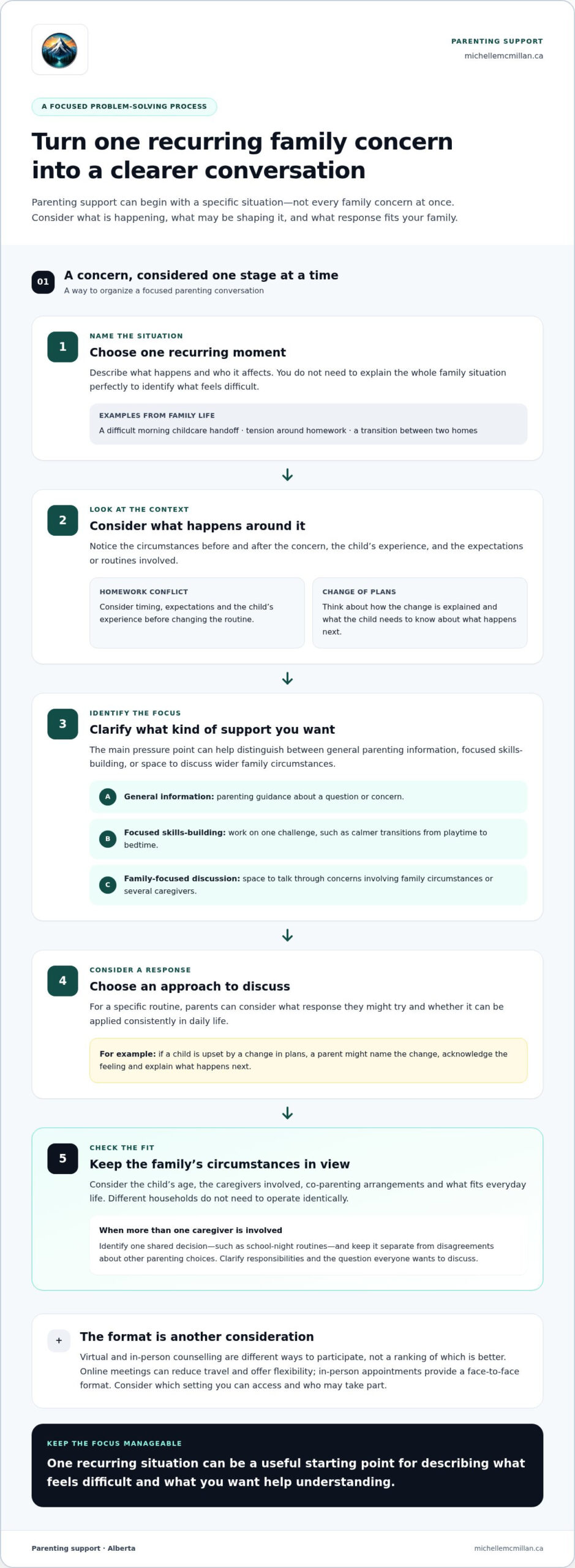
Resilience is not about expecting children to manage every difficulty alone. It can mean helping them face age-appropriate challenges while keeping a reliable adult involved. For example, if a child becomes upset about a change in plans, a parent can name the change, acknowledge the feeling and explain what happens next. Skills-focused support can help parents reflect on which responses fit their child and family, then consider how to apply them consistently.
Eligibility for publicly funded virtual parenting programs depends on each program. Alberta families can review the stated criteria, such as the intended age group and concerns covered, rather than assume the same rules apply everywhere.
Online parenting programs may offer different language options, but these vary by program. If you need support in a language other than English, check the program’s language information before joining.
For parents of babies and young children, support may focus on everyday concerns, such as settling into routines, responding to a toddler’s frustration or adjusting to childcare. The child’s age and the specific concern shape what is discussed. You might bring up a recurring moment, such as a difficult morning handoff, and consider what happens before and after it.
Virtual services differ in their confidentiality and privacy practices. Before sharing sensitive family information, review the service’s explanation of confidentiality, its limits and how personal information is handled. These details depend on the service, not simply on whether it is online.
Stepfamilies and co-parents may want support with predictable communication across households. Start by identifying one shared decision, such as school-night routines, and keep it separate from disagreements about other parenting choices. Adults can clarify responsibilities and use consistent language with the child without expecting every household to operate identically.
Problem-solving can feel more manageable when parents identify one issue, consider the circumstances around it and choose a response to discuss. If homework repeatedly leads to conflict, for example, the family can consider timing, expectations and the child’s experience before changing the routine. A focused conversation can help parents assess what fits their child, co-parenting arrangement and daily life.
Parent needs and family support outcomes
Parents may seek support when a concern affects several parts of family life. Arranging visits between two homes, for example, can raise questions about schedules, communication and a child’s experience of transitions. Identifying the main pressure point can help clarify whether you want general parenting information, a place to discuss your concerns or support involving other family members. You don’t need to explain the whole family situation perfectly to name what feels difficult.
Virtual and in-person counselling are different ways to participate, not a ranking of which is better. Online meetings can reduce travel and offer flexibility, while in-person appointments provide a face-to-face format. Consider which setting you can access and how you want to take part. If several caregivers are involved, it may also help to consider who can join and what shared concern they want to discuss.
Online access alone doesn’t tell you whether a service is free or low-cost. Costs vary between classes, consultations and counselling. Review the specific program’s cost information before registering, and don’t assume online delivery means there’s no charge.
Registration steps vary by program. Start by identifying the support you’re looking for, then find the program’s sign-up or intake instructions. Review its intended participants, subject and format, and provide the requested information. For example, if you’re seeking guidance about coordinating care across households, describe that concern on the intake form rather than listing every family issue at once.
- Name the concern: Describe one recurring situation and who it affects.
- Choose the focus: Decide whether you want general information or space to discuss family circumstances.
- Prepare for participation: Consider which caregivers should be involved and what question they share.
Support conversations can help families put concerns into words and clarify what they want to address. They also give parents a chance to consider differing perspectives, such as how each caregiver understands a child’s transition between homes. These are topics to explore, not guaranteed results. Keep the focus on what you want help understanding.
If a child faces an immediate safety concern, a routine parenting class or counselling appointment is not emergency support. Seek urgent local help suited to the situation. For concerns that are not immediate, parents can describe the issue and discuss what ongoing support may address it. Distinguishing urgent safety needs from longer-term parenting questions helps make the next step relevant.
Structural family therapy often takes several months. A therapy group for parents of children with complex needs is described as an 8-session program. These timeframes may help families consider what kind of support and commitment fits their circumstances.
Parenting advice and consultations
Parenting advice and consultations can help clarify a focused question without treating every family concern as one problem. In Alberta’s pilot, Level 2 Triple P support involved parenting advice through seminars and brief consultations with parents. A seminar shares information around a topic; a consultation centres on a parent’s specific concern. For example, a caregiver might want to discuss how to respond when a child refuses to visit a relative. The starting point is the parent’s question, not a presumption about why the child is responding that way.
A useful consultation starts with a specific situation. You might describe what happened before a refusal, what the child said and how the adults responded. This offers relevant context without requiring you to explain every family history or concern. If the question involves another caregiver, note where your views differ. That can keep the discussion focused on the decision you’re trying to understand.
Seminars work differently: parents learn about a general subject and consider how it relates to their circumstances. Information about family transitions, for instance, might prompt questions about introducing a new caregiving routine. A seminar offers shared learning, while a consultation can focus on your own situation. One format doesn’t automatically replace the other.
Before a consultation, it may help to organize the concern into a few parts:
- The moment: Describe one recent example, such as a child refusing a family visit.
- The context: Explain what changed recently in the child’s schedule or relationships.
- The question: State what you want help considering, such as how adults can respond consistently.
- The people involved: Identify whether another caregiver’s perspective is part of the concern.
You don’t need a polished explanation. A note with the child’s words, the situation and your main question can be enough to begin. If the concern involves a decision shared across households, identify that decision. For example, caregivers may need to discuss how they’ll communicate about changes to a child’s schedule. Keeping the question specific can prevent unrelated disagreements from taking over.
Advice is easier to consider when you distinguish what you observed from what you fear it means. “My child became quiet after the visit was mentioned” describes an observation. “My child will never accept this arrangement” predicts an outcome. Sharing both the observation and the worry can clarify what you hope to understand, without treating an interpretation as established fact.
A seminar or consultation can be a starting point for a specific parenting question. If the concern also involves ongoing family conflict or distress, a broader counselling conversation may help you consider what support fits. Naming the difference helps connect the format to the concern.
Parenting support for teens experiencing emotional distress
A teen’s distress can affect sleep, school attendance, friendships or conversations at home. Withdrawing after school, for example, can have different explanations and is not a diagnosis by itself. Parents can note what changed, when it happens and what the teen says, then share those observations with a counsellor or other appropriate professional. Specific examples can help clarify whether the concern needs more support.
Online resources for Alberta parents include educational seminars about youth mental health and ADHD. The Community Education Service scheduled “Practical Insights for Adults Supporting Young People with ADHD” for November 20, 2025. That date has passed, so it’s a past example of the topic offered, not a current event listing. Parents can look for relevant seminar materials or other educational resources for adults supporting teens.
Support for a teen should make room for their perspective as well as the parent’s concerns. A caregiver might describe missed classes, while the teen describes feeling overwhelmed by a particular part of the school day. Both perspectives can inform a discussion about what is happening, what support the teen wants and whether individual or family counselling may be useful.
Prepare for a conversation by recording observations rather than conclusions. Note the situation, the teen’s words and any changes in daily routines. For instance, “left dinner early three evenings this week” is more specific than “is always distant.” Concrete details can help a counsellor or other professional understand the concern without labelling ordinary adolescent behaviour as a disorder.
- Describe the change: Identify a specific example, such as avoiding a previously enjoyed activity.
- Include the setting: Note whether it happens at home, school or during social plans.
- Invite the teen’s view: Ask what they want adults to understand about the situation.
- Choose a support question: Clarify whether the family seeks information, counselling or help coordinating support.
Children with complex needs may also benefit from resources designed for their parents. An Alberta example was an eight-session group for parents of children with complex needs, described as starting in Fall 2025 in Airdrie. Because that start period has passed, it should be understood as a past program example, not a current registration option. Its format illustrates how parent education may address needs beyond teen distress.
If a teen’s distress involves an immediate safety concern, prioritize urgent help rather than relying on a class or routine counselling appointment. For ongoing concerns, virtual counselling can provide space to discuss the teen’s experiences and the parent’s questions. The focus is the young person’s circumstances, not assumptions based on age or behaviour.
The seminar Real Talk states that 1 in 3 individuals experience violence in their lifetime in Alberta. Parents may keep this statistic in mind when approaching sensitive conversations with care.
Which Alberta organizations offer online parenting classes or counselling?
Alberta’s available examples include Triple P and the Community Education Service, but classes and counselling serve different needs. A parenting class provides information or skills-focused learning. Counselling offers a setting to discuss a particular parent, child or family concern. Before choosing, consider whether you want general guidance or help exploring your family’s situation.
Triple P appears in Alberta’s pilot programming, with support organized by level and format. A seminar introduces a topic to parents together, while a consultation focuses on a parent’s specific question. The distinction matters: a caregiver seeking general information about routines may prefer a class, while a family facing ongoing conflict may want a counselling conversation.
The Community Education Service has offered seminars for adults supporting young people. One example was “Practical Insights for Adults Supporting Young People with ADHD,” scheduled for November 20, 2025. That date has passed, so it is a historical example, not a current registration date. It shows how educational sessions can address a focused parenting concern without being individual counselling.
Other dated Community Education Service listings also illustrate the range of family topics. A seminar about supporting youth and responding to sexual health misinformation was scheduled for November 26, 2025. A session about navigating technology with youth was scheduled for December 4, 2025, and described as lasting 90 minutes. These past listings demonstrate topic variety, not current availability.
When considering an online option, identify its format and purpose. A parent looking for information about a teen’s ADHD-related needs may find educational material useful. A parent trying to understand a recurring disagreement at home may need a conversation that considers the family’s circumstances. These formats serve different purposes.
- For general learning: Look for a class or seminar with a topic matching your question.
- For a focused parenting concern: Consider whether a consultation format addresses an individual situation.
- For a broader family issue: Look for counselling that can make space for the relationships involved.
Online access is separate from an organization’s name or a program’s topic. A dated seminar listing doesn’t establish that the session was virtual, and a program’s existence doesn’t mean registration is currently open. Review each program description for delivery format, intended participants, subject and registration steps. For example, a class for parents of children with complex needs may not address co-parenting or teen distress.
For virtual parenting support in Alberta, matching the format to your question can make the next step clearer. A class can introduce a shared topic; counselling offers space to discuss how a concern affects your family.
Michelle McMillan: Individual Therapy
Individual Therapy with Michelle McMillan can offer space to discuss how parenting stress, family conflict or concern about a teen is affecting you. Michelle holds a Master of Arts in Counselling Psychology (MACP) and is a Canadian Certified Counsellor (CCC), a national professional certification through the Canadian Counselling and Psychotherapy Association (CCPA). She also has 16 years of education experience, including work in specialized mental-health and intensive behavioural-support settings with children, teens and families.
Michelle offers virtual and in-person counselling, and prefers to provide much of her counselling virtually. Virtual counselling is available throughout Alberta, British Columbia, Saskatchewan and Manitoba; in-person appointments are available in Calgary. Family Therapy may also be relevant when concerns involve several family members.
If you’d like to discuss your parenting concerns, you’re welcome to contact Michelle McMillan.
Choose support that fits your family’s next step
You don’t need to have every concern neatly explained before seeking help. Start with what feels most pressing, whether it’s parenting stress, tension between family members or uncertainty about supporting your teen. Virtual parenting support in Alberta can include counselling focused on your experience and the relationships involved. The first step can simply be naming what you want to talk through.
Michelle McMillan offers individual, family and couples counselling. Individual counselling can focus on your concerns as a parent, while family or couples counselling can make room for shared relationship concerns. You don’t need a perfect plan before reaching out. A brief conversation about what’s happening can help you consider a suitable next step.
If you’re ready to explore support, learn more about connecting with Michelle McMillan. One thoughtful step is enough to begin.
Frequently Asked Questions
What does therapy for parenting look like?
Counselling for parenting concerns starts by exploring what’s happening and what you want help understanding. You might discuss a child’s recurring school-morning struggles, your response to conflict or how family changes affect daily life. Depending on the concern, counselling may focus on you as a parent or include family members. The conversation can help clarify what support you’re seeking and which concerns feel most pressing.
What virtual parenting support services are available in Alberta?
Alberta parents can access parenting classes, educational seminars and virtual counselling, though each format serves a different purpose. Classes offer general information; counselling provides space to discuss personal or family concerns. Michelle McMillan offers virtual individual, family, and child and adolescent counselling. A parent might explore personal concerns individually or discuss family stress through family counselling. These are counselling services, not online parenting classes.

Article by
Michelle McMillan, MACP, CCC
Michelle McMillan is a Canadian Certified Counsellor (CCC) with a Master of Arts in Counselling Psychology (MACP). She has extensive experience working with children and supporting clients with ADHD, neurodivergence, anxiety, emotional regulation, relationships and family challenges. Michelle offers both virtual and in-person counselling, with virtual counselling available throughout Alberta, British Columbia, Saskatchewan and Manitoba and in-person appointments available in Calgary.
Important Information
This article is provided for general educational and informational purposes only and is not a substitute for professional counselling, psychological, medical or emergency services. Information shared here should not be considered a diagnosis or individualized treatment advice. If you are experiencing a mental health emergency or are in immediate danger, please contact appropriate emergency services in your area.