
Confidential counselling can provide space to discuss parenting stress, perinatal concerns, emotional changes, and family relationships. Therapy for moms in Calgary can focus on what is affecting you, whether it relates to pregnancy, adjusting after birth, or the demands of parenting. Information shared in counselling is kept confidential, with specific exceptions for legal obligations and serious safety concerns.
It’s understandable to want support and still have questions about what you can share. You may be carrying worries about your child, tension in a relationship, or feelings that are difficult to put into words. You don’t need to explain everything perfectly to start considering what support could be useful.
This article explores how parenting stress and perinatal concerns can affect daily life, and how emotional changes may shape your experience of motherhood. It also considers communication at home, counselling formats, and practical questions to help you understand where professional support may fit. The aim is to offer clear information without assuming every mother has the same needs.
Key Takeaways
- Learn what to ask about confidentiality so you can understand the boundaries before discussing personal concerns.
- Recognize when parenting stress or burnout may be affecting your daily life, and what caregiver-focused counselling can make space to explore.
- Understand how temporary emotional changes after birth can differ from ongoing concerns that deserve attention.
- Explore how individual, couples, or family counselling can address concerns involving communication and relationships at home.
- Consider whether individual support or counselling with family members better fits the concerns you want to discuss.
Parenting stress and burnout
In Calgary, look for a therapist who describes experience supporting mothers, parenting stress, or perinatal concerns. Review the professional designation and relevant experience, rather than relying on the word “licensed” alone. Counselling can make room to examine how caregiving pressures affect your mental health and family life.
Parent-only and child-involved sessions
Parent counselling usually focuses on caregivers discussing parenting concerns without the child present. One parent can attend independently, for example, to talk about managing school calls and caregiving responsibilities. The conversation may centre on a specific concern, such as bedtime conflict or uncertainty about responding to a teacher.
Depending on a family’s needs, the child may be involved in some sessions, or parent counselling may be combined with child therapy. Consider whether the main concern is your stress, your child’s needs, or an interaction affecting the family. That distinction can help clarify who might take part.
Therapy options and therapist fit
Look for Calgary counsellors whose stated areas of focus relate to parenting, family challenges, or the concerns you want to discuss. A useful first step is to identify one situation, such as feeling overwhelmed after repeated school meetings. Then consider whether individual support or a conversation involving family members better fits the concern.
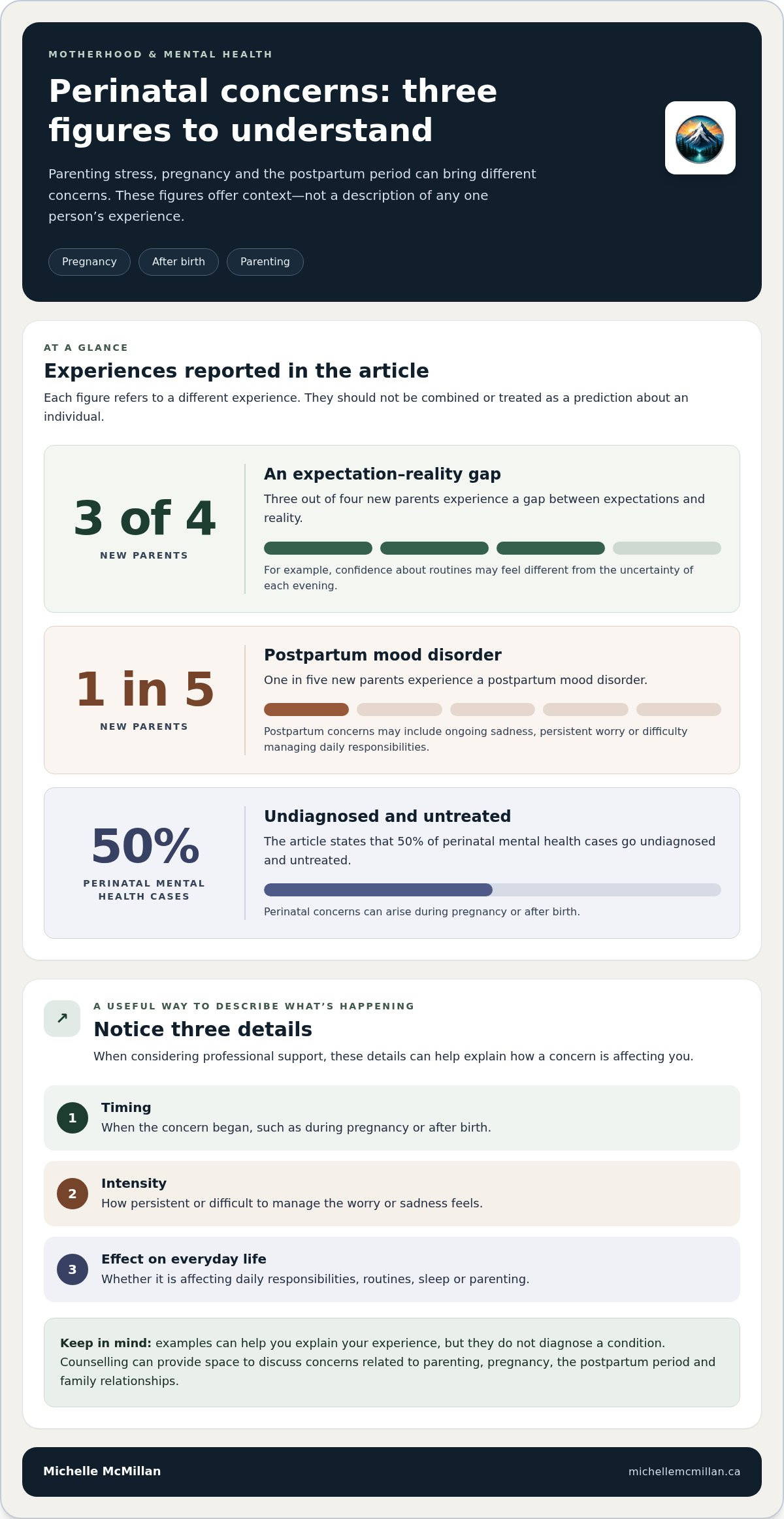
Three out of four new parents experience a gap between expectations and reality. For example, you might expect to feel confident about routines but feel unsure each evening. Naming the moment, what you were managing, and how it affected you gives a counsellor a concrete starting point.
Parenting a child with ADHD, autism, or a learning difference can involve navigating individual support needs. One caregiver might coordinate school communication while another manages appointments. Every child and family is different; discussing a particular challenge avoids treating one behaviour as universal or assuming it reflects poor parenting.
A parent with borderline personality disorder may have concerns about emotional distress, relationships, or conflict at home. A diagnosis does not define someone’s parenting. For instance, a parent might want to explore how a tense handoff or disagreement affects family interactions, while keeping the discussion focused on their circumstances.
Co-parenting differences can add strain around boundaries, routines, or school decisions. One caregiver may prefer a firm bedtime, while the other allows flexibility on weekends. Describing the disagreement and its effect on the child can clarify the shared parenting concern without reducing it to blame.
Burnout may show up in specific moments, such as dreading the after-school rush or feeling unable to manage another decision. You can bring an example to counselling and explore the pressures involved, including caregiving demands, family transitions, or disagreements about responsibilities.
Postpartum and perinatal depression and anxiety
Perinatal concerns can arise during pregnancy or after birth, while anxiety can also affect parenting and family life. Details such as timing, intensity, and the effect on everyday activities can help describe what you’re experiencing.
Perinatal mood concerns
Perinatal counselling can address concerns related to pregnancy and the postpartum period. Depression and anxiety during pregnancy or postpartum may involve persistent worry, sadness, or difficulty managing daily responsibilities. One in five new parents experience a postpartum mood disorder, and 50% of perinatal mental health cases go undiagnosed and untreated.
Alberta Health covers psychiatrist visits because psychiatrists are medical doctors. Alberta Health doesn’t cover counselling from psychologists or non-physician mental-health therapists, even with a physician referral. Some workplace Employee Assistance Programs provide a set number of free counselling sessions, and some therapists offer sliding-scale fees.
For example, note whether worry centres on the baby’s health, an upcoming birth, or being alone with your newborn. A psychologist or counsellor can discuss how these concerns affect sleep, parenting, and daily routines.
Signs to seek support
Consider professional counselling when distress persists, feels difficult to manage, or interferes with everyday care. Examples include worry that makes routine decisions feel overwhelming, ongoing sadness, or difficulty connecting with people you trust. These examples don’t diagnose a condition; they can help you explain your experience to a professional.
Anxiety can also affect children, though each child’s experience is different. A child might repeatedly seek reassurance before school, while another may struggle to name their feelings. A counsellor can help explore the concern and emotional-regulation needs without assuming every behaviour signals a disorder.
Finding perinatal mental health support
In Calgary, look for a counsellor or psychologist whose stated focus includes pregnancy, postpartum concerns, or perinatal mental health. Ask about their experience with anxiety, depression, and the transitions involved in becoming a parent. These details help you identify support that relates to the struggles you want to discuss.
Which Calgary therapists specialize in postpartum depression and anxiety? Seek professionals who explicitly describe perinatal or postpartum concerns as an area of focus. To find support, start with a Calgary counselling practice or discuss your concerns with a health professional involved in your care.
Are there low-cost or free options? Some workplaces offer Employee Assistance Programs with a set number of free sessions; some therapists use sliding-scale fees. Ask about these options when exploring counselling.
For urgent mental-health support, contact local emergency services or go to an emergency department if there’s immediate danger. For a child or teen, Alberta Health Services lists 403-955-7211 for Emergency Services Child and Adolescent at Alberta’s Children’s Hospital.
Emotional changes during pregnancy and new motherhood
Pregnancy can bring anticipation, uncertainty, and emotions that don’t arrive neatly one at a time. A change in a birth plan, an unexpected medical appointment, or questions about becoming a parent can shift how a day feels. You might feel excited about meeting your baby and worried about what will change. Mixed feelings can coexist, and describing the specific situation can make them easier to discuss.
Motherhood can also affect how you understand your identity. You may miss the freedom to make plans spontaneously, feel distant from work you once valued, or struggle to recognize yourself in a new routine. These feelings can appear alongside love and care for a child. Naming what feels different, such as personal time, friendships, or responsibilities, can clarify which parts of the transition you want to explore.
Messages from family, friends, and social media can create competing expectations. One person may say a new mother should enjoy every moment, while another emphasizes returning to previous routines. Those ideas can make ordinary uncertainty feel like a personal shortcoming. Comparing your first weeks with carefully edited online posts, for example, may leave you questioning your experience. Noticing whose expectations you’re carrying can help separate outside pressure from what matters to you.
Fertility challenges and infertility can shape how someone experiences pregnancy or the possibility of becoming a parent. A pregnancy announcement, a family gathering, or another appointment may bring complicated feelings. You may feel hope and grief close together, or find that a subject you once discussed easily now feels painful. These reactions are personal; a specific event and its meaning can provide useful context for a conversation.
Physical changes during pregnancy and after birth can coincide with emotional shifts, but they don’t explain everyone’s experience. If a change in mood concerns you alongside a physical symptom, bring both details to a healthcare professional. Counselling can offer space to discuss the emotional meaning of a health experience, fertility uncertainty, or changes in family roles, without treating every feeling as a sign of depression.
Before a conversation with a counsellor or healthcare professional, you might note what changed, when you noticed it, and how it affects daily life. For example, you could describe feeling unsettled after a family visit or anxious when plans change. These details help distinguish a passing reaction from a concern you want to explore further, while leaving room for your own understanding of the transition.
The baby blues usually improve within the first two weeks after birth. They typically resolve on their own and feel more like temporary mood swings. Noticing how emotions shift over time can help you describe the experience clearly, rather than judging yourself for having a difficult moment.
If the changes feel troubling, you can raise them with a healthcare professional and explain when they began and how they affect daily life. You might also tell a counsellor what feels hardest, whether that is uncertainty, a change in routine, or a gap between expectations and your experience. Counselling can make room for an honest account without assuming every emotional shift means the same thing.
Communication and family relationships
A new baby, a return to work, or changing parenting responsibilities can put pressure on family relationships. Talking about one recurring challenge, such as who handles bedtime, can reveal where expectations differ and what each person wants understood.
Family conflict can feel overwhelming when the same exchange repeats. For example, one parent may ask for help after dinner, while the other hears criticism and withdraws. Counselling can provide a setting to describe the interaction, including what happened before the disagreement and how each person experienced it. Specific examples are more useful than broad labels such as “we never communicate.”
Family therapy generally involves multiple family members discussing communication, relationships, and shared challenges. Depending on the family’s needs and concerns, the conversation may include parents and children. A family might discuss how a move has affected routines, or how a child responds when caregivers disagree. Each person may describe the same event differently, making room for perspectives that are hard to hear during an argument.
A relationship can also be affected by the practical demands of parenting. One partner may feel responsible for appointments and school messages, while the other feels excluded from decisions. Naming these experiences helps clarify the issue under discussion. The goal is not to assign blame, but to understand what each person means by support and what pressures are shaping the disagreement.
Children benefit from being heard in family conversations, with their age and readiness considered. A child who becomes quiet during conflict may have a different experience from a sibling who argues openly. Rather than treating either response as the whole story, families can explore what the child noticed, what felt confusing, and what they need explained. Listening and spending time together can also be part of parenting.
Before an appointment, choose one recent situation to discuss, such as a tense school-morning routine or disagreement about screen time. Describe what each person said, what happened next, and what remains unresolved. This gives the conversation a clear starting point and helps distinguish the incident from the broader pattern. A specific interaction can be easier to explore than assumptions about someone’s intentions.
Family communication can also change during major transitions, including a new baby, separation, or a child starting school. Families may need to develop shared language for discussing changes, boundaries, and responsibilities. Counselling offers an opportunity to examine these subjects together, while recognizing that each family member may have a different perspective on the same challenge.
The Family Psychology Place describes opening up communication as a way to improve negative family situations. It also identifies listening to a child and spending time together as part of parenting, themes that connect communication with attention to a child and shared time.
What types of therapy are available for mothers in Calgary?
The right format depends on what you want to discuss and who needs to take part. You might want space to explore your own stress, support with co-parenting disagreements, or help addressing a concern affecting your child. Therapy for moms in Calgary can involve individual support or conversations that include family members.
Individual counselling centres on your experiences as a parent and person. You might discuss anxiety, changing family responsibilities, or a difficult transition such as returning to work. It can also provide space to consider how parenting pressures affect your relationships and mental health.
Parent counselling focuses primarily on caregivers’ parenting concerns, child development, and practical strategies. A parent can attend independently, even if another caregiver isn’t present. Some parents prefer a few focused appointments about one issue, while others choose ongoing support for concerns that change over time.
Couples counselling may be relevant when partners are struggling with shared parenting responsibilities or relationship tension. You might discuss differences around routines, childcare decisions, or dividing household tasks. Couples can attend virtual counselling together from the same location or join from separate locations when needed.
Family counselling brings multiple family members together to discuss relationships, communication, or shared challenges. It may suit a family navigating a move, a change in caregiving arrangements, or recurring disagreement at home. The focus is on the family concern, rather than assuming one person is solely responsible.
Child and adolescent counselling centres on the young person’s concerns, with parent involvement considered in relation to their needs. For example, a family might be concerned about a child’s emotional or behavioural struggles at school. Counselling is distinct from a psychological assessment, which may help clarify a child’s strengths and challenges when developmental, emotional, or learning needs are a concern.
Perinatal counselling is another option for discussing emotional concerns related to pregnancy or the period around birth. It can give you space to talk about changes in your role, worries about parenting, or how new responsibilities are affecting family relationships. Therapy for moms in Calgary may be individual or involve family members, depending on the concern you want to address.
To choose a starting point, name the main issue and who it affects. If the concern is primarily your own stress, individual counselling may be a natural fit. If it involves shared decisions or recurring family interactions, couples or family counselling may better match the people involved. These are different formats, not a ranking of which concerns matter most.
Michelle McMillan: Individual Therapy
Michelle McMillan offers individual therapy for mothers who want a professional space to discuss parenting stress, emotional changes, or family concerns. She also offers family therapy, couples counselling, and child and adolescent therapy when support involves other family members. Michelle holds a Master of Arts in Counselling Psychology and is a Canadian Certified Counsellor (CCC).
Michelle offers virtual and in-person counselling, with in-person appointments in Calgary. Virtual counselling is available to clients in Alberta, British Columbia, Saskatchewan, and Manitoba. Choosing individual or family support depends on who is affected by the concern and what you want to discuss.
If you’d like to explore whether counselling may fit your needs, view rates and booking information.
Choose a first step that feels manageable
You don’t need to have every concern neatly explained before seeking support. Start with the issue that feels most present today, whether it’s a difficult interaction at home, an emotional change, or the pressure of balancing caregiving with your own needs. That can give an initial conversation a clear place to begin.
Therapy for moms in Calgary can offer a professional setting to discuss what’s weighing on you and consider the kind of support that fits your concerns. Reaching out doesn’t require certainty about what comes next. It can simply be a way to explore your options and ask questions.
If you’d like to take that step, view Michelle McMillan’s rates and booking information. You can begin with the concern that feels easiest to name, and take things from there.
Frequently Asked Questions
How confidential are the counselling sessions?
Information shared in counselling is kept confidential, with specific exceptions. Disclosure may be required for concerns related to child abuse or neglect, abuse or neglect of a vulnerable person, risk of serious harm to self or others, or records required by a court order or other legal obligation. If you’re unsure what an exception means for a situation you’re considering discussing, you can ask about confidentiality before sharing details.
What issues can women’s counselling help with?
Women’s counselling can provide space to discuss concerns such as anxiety, stress, parenting challenges, relationship difficulties, family conflict, life transitions, self-esteem, or personal growth. For example, you might want to explore how returning to work affects family responsibilities, or how a change in a relationship is affecting you. Counselling can focus on your concerns without requiring a formal diagnosis to begin.
Which Calgary therapists specialize in postpartum depression and anxiety?
Look for Calgary counsellors or psychologists who explicitly list perinatal or postpartum concerns, including anxiety and depression, as areas of focus.

Article by
Michelle McMillan, MACP, CCC
Michelle McMillan is a Canadian Certified Counsellor (CCC) with a Master of Arts in Counselling Psychology (MACP). She has extensive experience working with children and supporting clients with ADHD, neurodivergence, anxiety, emotional regulation, relationships and family challenges. Michelle offers both virtual and in-person counselling, with virtual counselling available throughout Alberta, British Columbia, Saskatchewan and Manitoba and in-person appointments available in Calgary.
Important Information
This article is provided for general educational and informational purposes only and is not a substitute for professional counselling, psychological, medical or emergency services. Information shared here should not be considered a diagnosis or individualized treatment advice. If you are experiencing a mental health emergency or are in immediate danger, please contact appropriate emergency services in your area.