
Mom rage isn’t simply a bad mood. It can feel like an intense, hard-to-control surge of anger that builds under stress and may be followed by guilt or regret. If you’re looking for how to cope with mom rage in Calgary, recognizing how these overwhelming episodes differ from everyday anger can help you decide when to seek more support.
Anger is a normal emotion, and feeling it doesn’t make you a bad parent. But when it feels bigger than the moment, happens repeatedly, or leaves you worried about how you’ll react, it deserves attention, not shame.
This article explores what mom rage can look like and how it differs from everyday anger. You’ll find practical ways to notice triggers, create space when emotions rise, ask for support, and build emotional regulation skills. There’s no single explanation or solution that fits every mother. The aim is to help you understand what may be contributing and identify a manageable next step.
Key Takeaways
- Anger can signal that something needs attention; noticing what may be underneath it can help you consider what needs to change.
- Make support and personal needs part of the conversation, including asking for help with household responsibilities or time to rest.
- When anger rises, creating space can offer a pause before you respond, as long as your children are safe and supervised.
- Look for patterns in difficult moments, such as noise, exhaustion, overwhelm or feeling unsupported, to better understand possible triggers.
- Emotional regulation can involve noticing early warning signs and exploring coping strategies that suit your circumstances.
1. What is rage and is it different from anger?
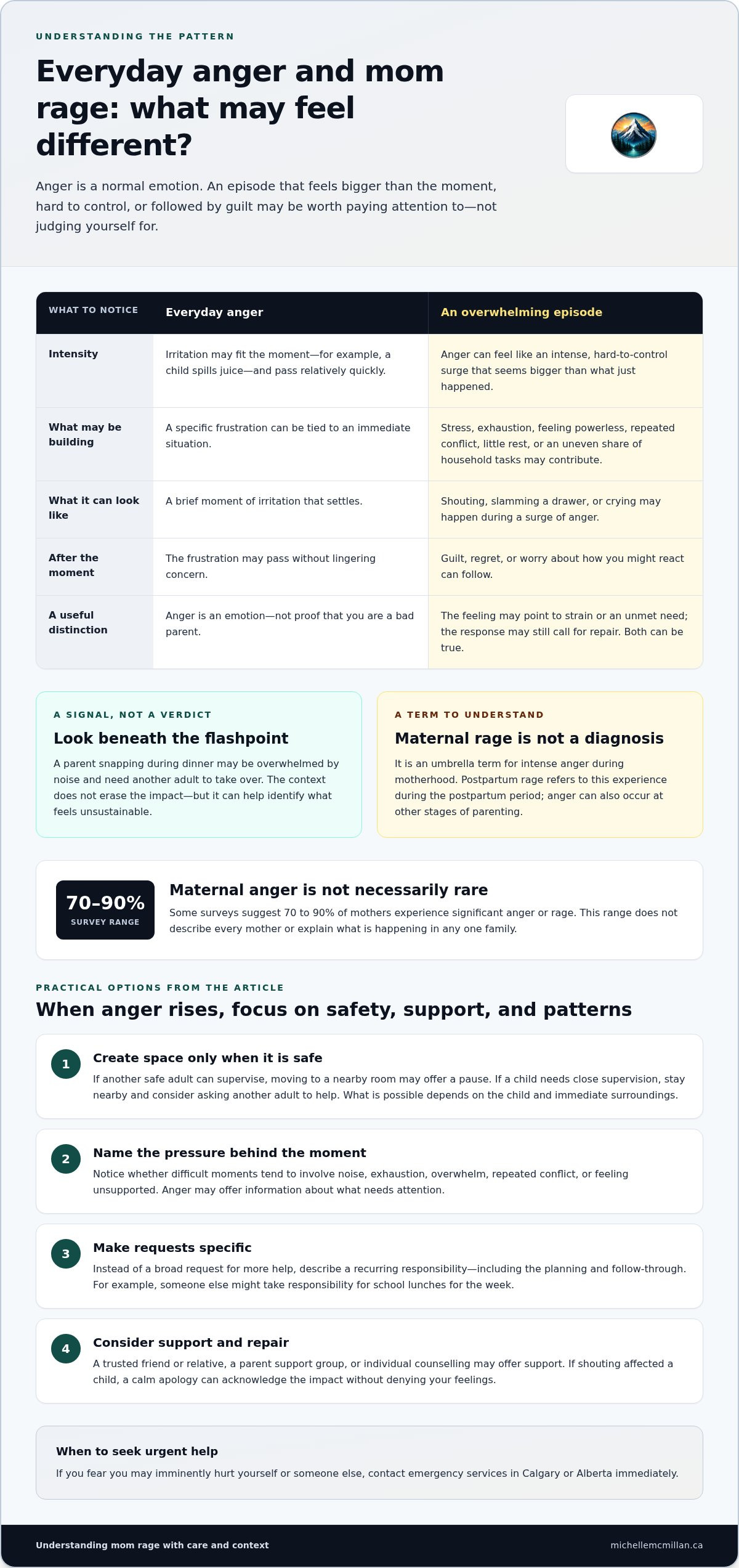
Anger is an emotion; mom rage describes episodes that can feel intense and difficult to control. They aren’t separate emotions, but their intensity, frequency, and aftermath can differ. Irritation when a child spills juice may pass quickly. A surge that leads to shouting, slamming a drawer, or crying, followed by guilt, may feel harder to manage.
Maternal rage is an umbrella term for this experience during motherhood, not a diagnosis. Stress, exhaustion, or feeling powerless may build and then erupt over something that seems small. A parent might snap when a child refuses their coat, while the deeper strain involves repeated conflict, little rest, or an uneven share of household tasks.
Some surveys suggest 70 to 90% of mothers experience significant anger or rage. That range doesn’t describe every mother or explain what’s happening in one family. It does help challenge the idea that maternal anger is rare. Postpartum rage refers specifically to maternal rage during the postpartum period; anger can also occur at other stages of parenting.
Social expectations can make anger especially difficult to admit. The idea that mothers should be endlessly patient may leave little room for frustration, even during a noisy bedtime or morning rush. Comparing yourself with an ideal of constant calm can turn anger into shame: “A good parent wouldn’t feel this.” That judgement may hide useful information about what feels unsustainable.
Anger can be viewed as a signal, not a verdict on someone’s character. A parent who shouted during dinner, for instance, may have felt overwhelmed by noise and needed another adult to take over. That context doesn’t erase the impact of shouting, but it can help distinguish the action, which may call for repair, from the feeling, which may point to a need for change.
Guilt and resentment can occur together. A parent might regret snapping at a partner while resenting that they handled every appointment and lunch. Naming the unmet need, such as shared planning or uninterrupted rest, gives more context than labelling yourself an angry person. If shouting affected a child, a calm apology can acknowledge the impact without denying your feelings.
Learning how to cope with mom rage in Calgary starts with noticing the difference between anger and an overwhelming pattern. The feeling may deserve attention, while the response may call for repair. Both can be true at once.
2. Asking for help and proactively meeting personal needs
Motherhood can involve a steady stream of decisions that others may not see. The mental load might include remembering permission forms, planning meals, tracking appointments, and noticing when children need new clothing. If frustration rises during a particular routine, that pressure may be part of the picture. Describing the task itself can make a request for support easier to understand.
Instead of saying, “I need more help,” a parent might ask, “Could you take responsibility for school lunches this week, including checking what we need?” This names both the task and the planning behind it. A partner could take on a different recurring responsibility. A workable arrangement accounts for follow-through, not just the visible task.
Personal needs can also be easier to discuss when they’re specific. “I need some time alone” might become “I’d like a quiet half-hour after work before we start dinner.” This is an example, not a script everyone must use. Another household might need a shared calendar, a simpler evening routine, or a clearer plan for dividing appointments.
Support can come from more than a partner. A trusted relative or friend may be able to listen, help with a particular task, or offer company during a difficult transition. A parent support group can provide space to discuss caregiving pressures with others. Individual counselling offers professional support for exploring recurring frustration, guilt, or strain affecting mental health.
If you fear you may imminently hurt yourself or someone else, contact emergency services in Calgary or Alberta immediately. For crisis-line support, use a current official Alberta or Calgary public-service listing to find the appropriate line and contact details.
Asking for support can feel complicated if previous requests led to conflict or were forgotten. A written division of recurring tasks, for example, may make responsibilities clearer than relying on memory during a rushed evening. If a request can’t be met, discuss what may be possible instead. These are options to adapt to your circumstances, not a measure of whether you’re trying hard enough.
When the strain keeps returning, counselling can give you space to discuss what’s happening and consider the support you need. You don’t have to wait until every responsibility feels unmanageable before speaking with someone.
3. Creating physical space during an angry moment
Physical space can be one option when anger rises, if the situation allows. A parent might move to a nearby room after another safe adult takes over supervision. A simple explanation, such as “I need a moment before we keep talking,” can help children understand that the pause is about calming the interaction, not rejecting them.
Safety shapes what’s possible. A sleeping baby, a toddler near stairs, or a child who needs close supervision may mean leaving the room isn’t appropriate. In those moments, space might mean turning slightly away, reducing conversation, or asking another adult to stay close. What works depends on the child’s age, needs, and immediate surroundings.
Making a plan outside a difficult moment may make choices easier to remember. Some families identify a nearby place where a parent can pause while children remain supervised. Others agree on a short phrase to signal a handoff, such as “Could you take over for a moment?” Adapt these possibilities to your household rather than treating them as universal instructions.
Physical distance isn’t the only kind of pause. You might lower your voice, stop an argument temporarily, or focus on one immediate task instead of continuing a heated exchange. During a tense bedtime, for instance, a disagreement with a partner could wait until the children are settled. A pause can change the interaction without requiring you to leave.
Consider what happens after the pause, too. Children might need a brief explanation or reassurance that you’ll return to the conversation. If you shouted, reconnecting later can include acknowledging what happened and listening to how your child experienced it. A pause is most useful as a break in the interaction, not as a way to avoid repair.
Stepping away may feel uncomfortable, especially if you worry your children will feel ignored. A clear, age-appropriate explanation can distinguish a temporary pause from withdrawing affection. If another adult is present, their support may make a handoff possible; otherwise, staying nearby may be more workable.
If anger repeatedly feels difficult to manage, counselling can provide space to discuss situations where it’s hard to create a pause. The goal isn’t to force one strategy. It’s to understand what makes space possible, what limits it, and what support could fit your family’s circumstances.
4. Recognizing triggers and understanding stress responses
Mom rage can build around a moment that seems small while the strain behind it accumulates. A child refusing to get dressed may be the immediate trigger, but the deeper pressure might include interrupted sleep, competing demands, or feeling solely responsible for the morning. Noticing the sequence helps you understand your experience without assuming one behaviour explains everything.
Expectations can also collide with real needs. You may expect a partner to share childcare, then find yourself managing dinner, clean-up, and bedtime alone. That gap can bring frustration or resentment, especially when you’ve already asked for support. The trigger may not be the spilled milk itself, but the feeling that your need for help keeps being overlooked.
A brief record of difficult moments can help reveal patterns. Note what was happening before anger rose, what you noticed in yourself, and what followed. For example, you might record that noise during the after-school rush coincided with a headache and impatience. Reviewing your notes may show whether certain settings, tasks, or unmet needs tend to appear together.
Noise is one possible trigger, but experiences differ. A mother in Cochrane described noise as a trigger while raising a three-and-a-half-year-old and an 18-month-old. That example isn’t a template for every family. It illustrates how the same sound may feel harder to tolerate when several children need attention and a parent is already stretched.
Stress responses don’t always look like shouting. You might withdraw, go quiet, or stop responding during a tense exchange. After repeated bedtime conflict, for example, a parent may retreat into another room or feel unable to continue talking. Recognizing these responses matters because anger and overload can show up as distance, not just an outburst.
Once a pattern appears, ask what the moment may be pointing to. Is the struggle linked to exhaustion, overstimulation, a change in plans, or a responsibility you expected to share? Journalling can help put feelings such as fear or powerlessness into words. The aim isn’t to prove you’re doing something wrong, but to gather clues about what may need attention.
Look for patterns, not a single culprit. If frustration tends to rise during rushed transitions, consider what makes that period difficult: competing tasks, noise, or a lack of help. If resentment follows repeated unmet requests, shared responsibilities may be part of the issue. These observations can clarify what support or changes to discuss while leaving room for your family’s circumstances.
5. Developing emotional regulation skills
Emotional regulation isn’t about never feeling angry. It’s about noticing emotions early enough to choose what happens next. A racing heart or clenched jaw during a noisy morning, for example, can be a cue to pause before responding. The aim isn’t perfect calm, but more room between the feeling and your action.
Start by noticing your early signs. You might feel your voice getting louder, your shoulders tightening, or your thoughts speeding up as several requests come at once. Naming the moment privately, such as “I’m getting overwhelmed,” can help you recognize that your capacity is stretched. Signs vary, so pay attention to your own experience rather than relying on a fixed checklist.
Some parents find that a slower breath, a brief movement break, or stepping into another room helps interrupt an automatic reaction. These are options to explore, not rules. If children need supervision, safety comes first: stay with them or arrange for another safe adult to take over before stepping away.
After a difficult exchange, try replacing harsh self-judgement with a more accurate description. “I was trying to manage dinner, noise, and questions at once” gives more context than “I’m a terrible parent.” Self-compassion doesn’t excuse shouting or remove the need to repair; it can help you look honestly at what happened without adding shame to an already difficult moment.
Repair can be simple and age-appropriate. After raising your voice, you might say, “I’m sorry I yelled. You didn’t deserve that. I was overwhelmed, and I’m working on responding differently.” Then consider what needs attention before a similar situation comes around, such as the mental load of dinner or a transition that regularly feels rushed.
Emotional regulation skills develop through noticing, reflection, and practice, though managing everything alone can feel difficult. If anger repeatedly affects your relationships or parenting, professional support can give you space to discuss the experience and explore what contributes to it. You’re not alone in finding these moments hard, and you deserve support that takes your circumstances seriously.
For more information about emotional regulation support, explore the areas of focus that may relate to your concerns.
Michelle McMillan: Individual Therapy
Michelle McMillan offers Individual Therapy, providing space to discuss mom rage, parenting pressures, and emotions that can arise around family life. If anger feels difficult to manage or is affecting your relationships, individual counselling can help you explore your concerns and consider what support may be useful.
Michelle holds a Master of Arts in Counselling Psychology (MACP) and is a Canadian Certified Counsellor (CCC), a national professional certification through the Canadian Counselling and Psychotherapy Association. She offers virtual and in-person counselling, with in-person appointments in Calgary. Virtual counselling is available throughout Alberta, British Columbia, Saskatchewan, and Manitoba.
If you’d like to discuss counselling, contact Michelle McMillan.
Choose one small next step
You don’t have to change every part of family life at once. Choose one small thing to notice this week, such as when tension begins to rise or what support might make a difficult part of the day more manageable. A single observation can give you a clearer starting point for a conversation or seeking support.
If you’re considering how to cope with mom rage in Calgary, counselling can give you space to talk about what’s happening and what you’d like to understand better. You don’t need to have everything figured out before asking for support.
Contact Michelle McMillan to explore counselling as a possible next step. Be gentle with yourself as you begin; noticing that you need support is already meaningful.
Frequently Asked Questions
What is rage and is it different than anger?
Rage usually describes anger that feels unusually intense or difficult to contain; anger itself is a normal emotion. The difference may be clearer in the impact: irritation about a messy room may pass, while a recurring surge that disrupts family interactions can feel harder to manage. “Rage” describes an experience, not a diagnosis. Considering intensity, recurrence, and consequences can help clarify what concerns you.
How does mom rage look and feel?
Mom rage can involve an intense emotional reaction, but it doesn’t look the same for every parent. One person may feel suddenly flooded and speak sharply; another may feel tense, overwhelmed, or unable to engage. Some parents notice distress mostly afterwards, while others recognize the build-up as it happens. Consider what changes for you before, during, and after difficult moments, including how those moments affect interactions with children or a partner.
Is burnout the cost of trying to be Supermom?
No, burnout isn’t an inevitable cost of parenting, and struggling doesn’t mean you’ve failed to meet an ideal. More than 60% of parents experience significant levels of stress and exhaustion. Those experiences don’t automatically mean someone is burned out, but they can make daily demands feel harder. For example, keeping up appearances while managing work, childcare, and household tasks may leave little room to notice your own limits.
What can be done to cope with mom rage?
Coping can start with identifying what happens before anger takes over and what support might change the situation. If conflict tends to arise during a rushed transition, for example, consider which part of the routine creates the most strain. Some parents find professional counselling or a peer support group useful for discussing recurring anger. The right next step depends on what’s contributing to the distress and what resources are available to you.
What causes mom rage?
There isn’t one cause that explains every parent’s anger. Possible contributors include exhaustion, limited time for personal needs, inadequate support, and feeling overwhelmed or overstimulated. A specific event, such as repeated interruptions while preparing a meal, may combine with ongoing pressure. Context matters: the same parenting demand can feel different depending on what else is happening in someone’s life and how much support they have.
Why does it happen?
Mom rage may arise when demands keep accumulating and a parent has little space to recover or respond to unmet needs. An immediate trigger, such as a child refusing a request, may be only one part of the situation. Ongoing pressure, disrupted rest, or feeling alone with responsibilities can also shape the intensity of the moment. Understanding the surrounding circumstances can be more useful than blaming one incident or labelling yourself.
Why is it important to talk about mom rage or maternal rage?
Talking about maternal anger can make it easier to describe what’s happening and identify the support you need. Silence may leave a parent struggling to explain why ordinary tasks feel unmanageable or resentment is growing. A specific conversation, such as telling someone you trust that evenings feel especially difficult, gives them something concrete to understand. Discussing the experience also separates feeling anger from being a bad parent.
What is mom rage, and what can cause it?
Mom rage is a descriptive term for intense anger experienced in the context of motherhood, not a formal diagnosis. It may be connected to stress, exhaustion, feeling unsupported, or a sense that important needs are repeatedly set aside. The reasons differ from one parent to another and may change over time. The pressures surrounding a new baby, for instance, may differ from those arising during a demanding school-week routine.

Article by
Michelle McMillan, MACP, CCC
Michelle McMillan is a Canadian Certified Counsellor (CCC) with a Master of Arts in Counselling Psychology (MACP). She has extensive experience working with children and supporting clients with ADHD, neurodivergence, anxiety, emotional regulation, relationships and family challenges. Michelle offers both virtual and in-person counselling, with virtual counselling available throughout Alberta, British Columbia, Saskatchewan and Manitoba and in-person appointments available in Calgary.
Important Information
This article is provided for general educational and informational purposes only and is not a substitute for professional counselling, psychological, medical or emergency services. Information shared here should not be considered a diagnosis or individualized treatment advice. If you are experiencing a mental health emergency or are in immediate danger, please contact appropriate emergency services in your area.