
What if the same argument isn’t really about the dishes, a parenting decision or who is doing more, but about a pattern you haven’t had space to understand together? When conversations keep circling back to the same conflict, it can be hard to know how to begin changing the discussion. Couples counselling Calgary can offer a professional setting to explore relationship dynamics and communication concerns without reducing either partner to “the problem.”
You may also be balancing parenting demands with time and attention for your relationship, while wondering who is qualified to help. This article explains what to consider when looking for couples counselling in Calgary, how to compare a counsellor’s education and designation, and what questions can help you decide whether a professional is a good fit.
You’ll also find practical considerations for virtual counselling and for discussing ADHD, neurodivergence or parenting concerns as a couple. Michelle McMillan holds a Master of Arts in Counselling Psychology (MACP) and is a Canadian Certified Counsellor (CCC) through the Canadian Counselling and Psychotherapy Association (CCPA), a national certification body rather than a statutory provincial regulator. The aim is to help you make an informed choice at a pace that feels right for both of you.
Key Takeaways
- Couples counselling Calgary can provide a professional setting to discuss recurring disagreements, communication concerns and relationship changes.
- When comparing counsellors, check their education and professional designation. An MACP is an academic degree, while a CCC through the CCPA is a national professional certification.
- Virtual counselling may be a practical format for partners balancing work, parenting and other commitments. Consider whether it suits both of you.
- ADHD and neurodivergence affect people differently. Describe the specific relationship or parenting concerns you want to discuss rather than assuming one explanation fits every family.
- Before booking, prepare questions about a counsellor’s credentials, relevant experience and what to expect from an initial appointment.
When to Consider Couples Counselling Calgary
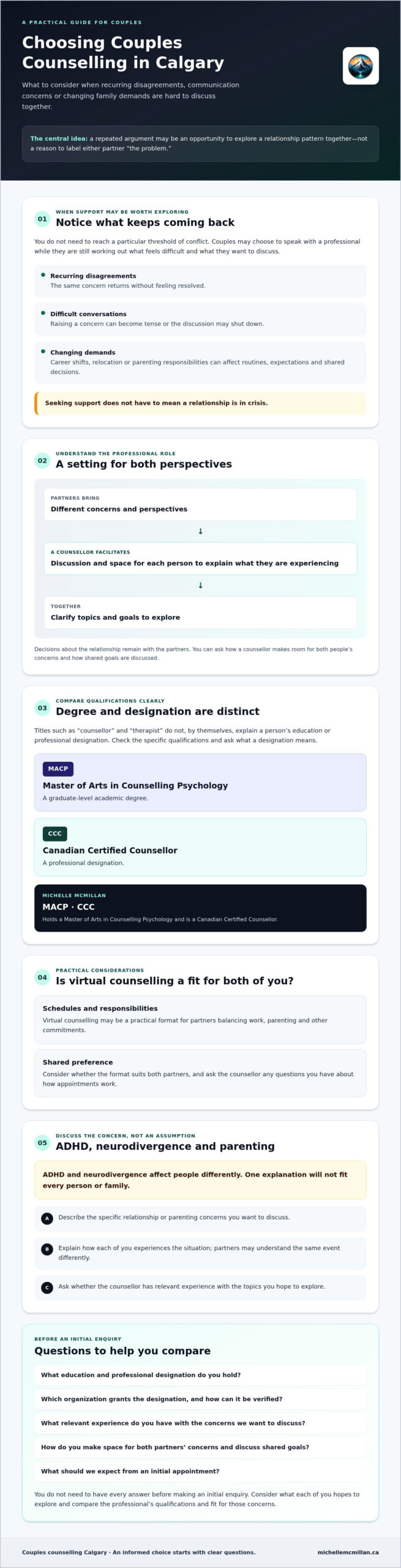
Couples counselling is a professional setting where partners can discuss their relationship with a counsellor facilitating the conversation. The counsellor’s role is to help each person explain what they are experiencing and what they hope to address. Partners may bring different concerns or understand the same situation differently. Counselling gives them an opportunity to explore those perspectives and discuss goals together.
Couples may seek support when conversations feel difficult, recurring concerns remain unresolved, or a change in circumstances is affecting the relationship. A career shift, a move or new parenting responsibilities can alter routines and expectations. Couples counselling Calgary can also provide space to discuss how family pressures relate to the partnership. Seeking support does not have to mean a relationship is in crisis. Some couples choose to speak with a professional while they are still working out what feels difficult and what they want to discuss.
The Role of a Professional Counsellor
A counsellor facilitates discussion and makes room for each partner to describe their concerns. Partners can talk about differing perspectives and identify topics they want to explore. The couple and counsellor can clarify goals collaboratively, while decisions about the relationship remain with the partners. When contacting a potential counsellor, ask how they make space for both people’s concerns and how shared goals are discussed.
Signs Your Relationship Might Benefit from an Outside Perspective
You do not need to meet a particular threshold of conflict to consider counselling. It may be worth exploring if the same disagreement keeps returning, or if you are unsure how to raise a concern without the discussion becoming tense or shutting down. A counsellor can provide an outside perspective as you consider what each person wants understood.
Changes outside the relationship can bring new demands. A career change or relocation may affect schedules, responsibilities and shared decisions. Parenting pressures can also make it harder to find time to talk about the partnership itself, especially if most conversations centre on children or household needs. These circumstances do not mean either partner is failing. They may simply be concerns you want to address together.
Before choosing a counsellor, consider asking about their education, designation, relevant experience and how they facilitate conversations between partners. You can also discuss what each of you hopes to explore. You do not need to have every answer before making an initial enquiry.
Finding the Right Fit: Professional Designations in Calgary
Credentials can be confusing because the words “counsellor” and “therapist” do not tell you by themselves what education or professional designation someone has. When comparing options for couples counselling Calgary, check the person’s specific education, designation and relevant experience. If a professional has a designation, ask what it means and which organization grants it.
What Is a Canadian Certified Counsellor (CCC)?
A Canadian Certified Counsellor (CCC) is a national professional certification through the Canadian Counselling and Psychotherapy Association (CCPA), not a statutory provincial regulation. A Master of Arts in Counselling Psychology (MACP) is a graduate-level academic degree. The degree and certification are distinct: one identifies academic education, while the other is a professional credential. Michelle McMillan holds an MACP and is a CCC through the CCPA.
When you compare counsellors, look at the specific qualifications each person lists rather than assuming that two similar titles mean the same thing. To learn more about Michelle’s credentials, visit the about Michelle McMillan page.
Comparing Counsellors, Therapists and Psychologists
Professional titles and qualifications can differ, so check what a particular designation means before making a decision. The Government of Alberta outlines professional designations for psychologists in Alberta. Psychologists and counsellors may have different educational pathways and professional roles. The right fit depends on the support you are seeking and the professional’s relevant qualifications.
Ask about education, certification or designation, relevant experience and the scope of the service. If you are considering someone with a specific designation, you can ask which organization grants it and how to verify it.
A Practical Credential-Checking Framework
- Confirm the exact designation: Ask what the letters after the professional’s name mean and which organization grants them.
- Review education: Check the degree title and whether it relates to counselling or psychology.
- Ask about professional standards: Find out what ethical code or professional standards apply to the designation.
- Consider your needs: Identify the concerns you want to discuss, then ask about relevant experience and the scope of the service.
These questions can help you compare options without assuming that one title suits every couple.
The Practical Side of Support: Virtual Couples Counselling
For couples balancing work, parenting and other responsibilities, virtual counselling can make arranging relationship support more practical. Couples counselling Calgary does not have to involve travel to an appointment, which may help with shared schedules and winter travel. Michelle McMillan provides virtual counselling for couples across Alberta, British Columbia, Saskatchewan and Manitoba.
Virtual counselling can accommodate couples who join together from one location or participate from separate locations. Ask the counsellor what arrangements are needed for the format and consider whether it suits your circumstances.
Convenience for Calgary Couples and Families
Meeting online avoids adding a drive to the day, which may simplify planning around work, parenting responsibilities or winter travel. You will still want to consider where each partner can take part in the conversation and how to manage interruptions. If you hope to meet outside your usual work hours, ask the counsellor about scheduling options rather than assuming a particular time is available.
Preparing for a Virtual Appointment
A reliable internet connection, a computer or tablet and a space where you can speak comfortably are useful practical considerations. Beforehand, think about whether you can talk without being overheard and let the counsellor know if privacy at home may be difficult. If you are joining from separate locations, confirm the arrangements in advance.
- Choose a quiet space: Reduce interruptions where possible and consider what you will do if someone needs to enter the room.
- Check your setup: Make sure your device is charged and your connection is reliable enough for a conversation.
- Clarify practical details: Ask about joining from different locations, privacy and any technology requirements before booking.
For more information about counselling formats, visit the counselling services page.
Navigating Complex Dynamics: ADHD and Parenting
Relationship concerns do not happen in isolation. ADHD or other neurodivergent experiences may be part of how partners manage plans, household responsibilities, conversations and parenting, but there is no single pattern that applies to everyone. Couples counselling can provide space to discuss what is happening in your relationship without reducing either partner to a diagnosis or assuming one person is to blame.
For couples seeking couples counselling Calgary, this may mean looking beyond a disagreement about a missed task or a busy family calendar. Consider how each partner experiences the situation, what expectations are involved and what both of you want to address. Professional support can make room for these different perspectives.
ADHD and Relationship Communication
For some people with ADHD, planning, remembering tasks or organizing household responsibilities can be challenging. For example, one partner may rely on reminders and shared lists, while the other experiences repeated reminders as criticism. These examples are not universal and do not establish a diagnosis. They may, however, point to a practical topic for a couple to explore: how expectations are communicated and how responsibilities are understood.
Rejection Sensitive Dysphoria, often shortened to RSD, is an informal term sometimes used to describe intense sensitivity to perceived rejection. It is not a formal diagnosis or a universal feature of ADHD. If either partner uses the term to describe an experience, a counsellor can help the couple discuss what it means to them rather than treating the label as a complete explanation.
Support for Parents Facing Added Demands
Parenting a neurodivergent child may involve additional questions or pressures, such as communicating with school staff, responding to behavioural challenges and coordinating different perspectives at home. These demands can leave partners feeling as though they are managing a constant list of decisions. Parents do not have to experience these pressures in the same way to talk about how they affect their relationship.
Couples can use counselling to explore how they want to approach shared parenting concerns and where their views differ. The aim is not to assume there is one right way to parent, but to make space for each partner’s perspective and identify the questions they want to work through together.
Michelle McMillan’s areas of focus include ADHD and neurodivergence-related challenges. For further information, explore the areas of focus, including ADHD and neurodivergence.
Preparing for Your First Appointment and Next Steps
Taking the first step can bring up questions, especially if you and your partner are unsure what to expect. The initial contact and first appointment can vary between counsellors, so ask how the process works before booking. You do not need to arrive with a complete account of every disagreement. It can help to name the main concern you would like to discuss and what you hope a professional conversation might make room for.
Questions to Ask a Potential Counsellor
Use an initial conversation, if offered, to learn about the counsellor’s education, designation and relevant experience. You can also ask how goals are discussed, how both partners can share their perspectives and what happens at a first appointment. This is an opportunity to consider whether the counsellor’s explanation of the process feels like a fit. Both partners should have room to ask questions and say what they need to know.
Goals do not have to be identical at the outset. One partner may want to discuss recurring arguments, while the other is focused on parenting decisions or time together. Describe these different priorities and ask how they might be explored collaboratively. The counsellor can help clarify what each of you wants to address; you and your partner decide what matters to you.
Booking and Practical Considerations
Consider how appointments could fit around work, parenting and other commitments. Discuss scheduling with the counsellor rather than assuming a particular frequency or appointment time. If coordinating is difficult, ask what options are available and decide what is realistic for both of you.
For Michelle McMillan’s current rates and booking information, visit the Rates and Booking page. Reviewing the details can help you decide whether virtual couples counselling with a Canadian Certified Counsellor is a suitable next step for you both.
Take a Thoughtful Next Step Together
Recurring arguments, parenting pressures and major life changes can be difficult to untangle without an outside perspective. Couples counselling Calgary offers a professional setting to explore relationship dynamics, while understanding a counsellor’s education and designation can help you make an informed choice. Virtual counselling may also be a practical option for couples balancing busy schedules in Calgary and elsewhere in Alberta.
If ADHD, neurodivergence or parenting concerns are part of what you would like to discuss, consider whether a counsellor’s professional background and areas of focus fit your needs. Michelle McMillan holds a Master of Arts in Counselling Psychology (MACP) and is a Canadian Certified Counsellor (CCC) through the CCPA, a national certification body. She provides virtual counselling for couples across Alberta, British Columbia, Saskatchewan and Manitoba, with partners able to join together or from separate locations. In-person services in Calgary primarily focus on children and families.
If you are considering couples counselling in Calgary, review current rates and booking information to decide whether virtual counselling with Michelle McMillan is a fit for you and your partner.
Frequently Asked Questions
What is the difference between a counsellor and a psychologist in Calgary?
Education and professional designations vary, so check the specific qualifications of anyone you are considering. The Government of Alberta provides information about professional designations for psychologists in Alberta. When comparing professionals, ask about their education, exact designation, relevant experience and the professional standards that apply.
Is virtual couples counselling as effective as in-person therapy?
There is no single answer here about whether virtual and in-person counselling are equally effective or whether one is better. Consider which format is practical for both partners, including privacy, internet access and whether you can join from the same or separate locations. Michelle provides virtual counselling for couples in Alberta, including Calgary. You can ask a potential counsellor about the format and decide what suits your circumstances.
What happens if one partner is reluctant to attend counselling?
Reluctance is worth discussing with care rather than treating it as a refusal that needs to be overcome. Ask what concerns your partner has, such as uncertainty about the process, privacy or being blamed. You could gather information together before deciding. A counsellor can explain what to expect and answer questions. Both partners should have room to consider whether counselling feels like a choice they are ready to make.
How many sessions will we need before we see a change in our relationship?
There is no set number of appointments that applies to every couple, and counselling cannot guarantee a particular change. Your concerns, priorities and goals are specific to your relationship. Ask the counsellor how you will discuss goals and review whether the conversations remain relevant to what you want to address. You can also raise questions about scheduling and make decisions together as your needs become clearer.
Do you provide in-person couples counselling in Calgary?
Michelle McMillan provides virtual counselling for couples across Alberta, British Columbia, Saskatchewan and Manitoba, including Calgary. Couples may join together or from separate locations. In-person services in Calgary primarily focus on children and families.
Can couples counselling help if we are also navigating ADHD in our family?
Couples counselling can provide space to discuss how ADHD or neurodivergence-related concerns intersect with your relationship and parenting conversations. Experiences differ between individuals, so describe the specific challenges your family faces rather than assuming a diagnosis explains every disagreement. Michelle’s areas of focus include ADHD and neurodivergence-related challenges, relationship difficulties and parenting. Counselling offers an opportunity to explore these concerns without promising a particular outcome.
If you are considering couples counselling, you can review the Rates and Booking page for current details and decide at your own pace whether reaching out to Michelle McMillan feels right for you and your partner.

Article by
Michelle McMillan, MACP, CCC
Michelle McMillan is a Canadian Certified Counsellor (CCC) with a Master of Arts in Counselling Psychology (MACP). She has extensive experience working with children and supporting clients with ADHD, neurodivergence, anxiety, emotional regulation, relationships and family challenges. Michelle offers both virtual and in-person counselling, with virtual counselling available throughout Alberta, British Columbia, Saskatchewan and Manitoba and in-person appointments available in Calgary.
Important Information
This article is provided for general educational and informational purposes only and is not a substitute for professional counselling, psychological, medical or emergency services. Information shared here should not be considered a diagnosis or individualized treatment advice. If you are experiencing a mental health emergency or are in immediate danger, please contact appropriate emergency services in your area.