
What if choosing support for anxiety is less about finding the “perfect” counsellor and more about gathering clear information and deciding what feels like a good fit? Searching for help can bring up different credentials, service details and formats, making it hard to know where to begin. You don’t need to diagnose yourself or find the perfect words for what you’re experiencing before exploring support. Michelle McMillan offers in-person counselling in Calgary and virtual counselling throughout Alberta, British Columbia, Saskatchewan and Manitoba.
If you’re unsure whether counselling fits your concerns or how to begin, that uncertainty is understandable. This article explains what counselling for anxiety may involve, including common concerns people bring to sessions and practical topics you may wish to explore with a counsellor.
Michelle McMillan holds a Master of Arts in Counselling Psychology (MACP) and is a Canadian Certified Counsellor (CCC). She offers in-person counselling in Calgary as well as virtual counselling throughout Alberta, British Columbia, Saskatchewan and Manitoba. The information below can help you understand possible counselling topics and decide what questions you would like to bring to an appointment.
Key Takeaways
- Counselling for anxiety offers a professional setting to discuss worry, stress, avoidance, uncertainty and the effects these concerns may have on daily life. You don’t need to diagnose yourself before asking about support.
- Potential counselling topics include noticing patterns that intensify worry, understanding emotional and physical responses, communicating needs, navigating life changes and developing practical ways to respond to difficult moments.
- Michelle McMillan offers in-person counselling in Calgary and virtual counselling throughout Alberta, British Columbia, Saskatchewan and Manitoba.
- You can begin with a simple description of what has been difficult. A complete personal history or a polished goal is not required.
- Michelle holds a Master of Arts in Counselling Psychology (MACP) and is a Canadian Certified Counsellor (CCC), which are separate credentials.
Anxiety Counselling in Calgary: What Support Can, and Cannot, Mean
Persistent worry or stress can affect concentration, sleep, decision-making, relationships and your willingness to take part in everyday activities. Counselling for anxiety provides a space to examine what you’re experiencing without needing to assign it a clinical name. Conversations may include worries about work, relationships, health, finances, parenting, major transitions or situations that feel difficult to predict.
Looking for support does not mean you have diagnosed yourself. People may reach out while they are still trying to understand what is happening, including recurring worry, physical tension, irritability, overthinking, avoidance or difficulty settling after a stressful event. Counselling can focus on the concerns that matter to you rather than requiring a particular threshold or timeline.
When might someone consider counselling for anxiety?
You might notice that worry is affecting how you approach ordinary situations. Perhaps you repeatedly reread a message, put off a decision because certainty feels necessary, avoid a conversation, or find that your thoughts remain focused on possible problems. These examples are not diagnostic criteria. They are possible reasons someone may want space to understand their experience and consider support.
You can seek support before you have a clear summary or a specific goal. Starting with “I’m not sure how to explain this, but I’ve been feeling worried” is enough to begin a conversation.
What can counselling for anxiety involve?
Counselling provides a setting to explore your concerns with a trained professional. Depending on what you bring to sessions, conversations may include identifying situations that contribute to worry, distinguishing immediate problems from imagined possibilities, considering how thoughts and emotions influence behaviour, and noticing patterns such as reassurance-seeking, procrastination or avoidance. You might also discuss boundaries, communication, self-criticism, stress connected with life changes and ways to make decisions when certainty is not available.
Counselling offers professional support, not a guaranteed result. A counsellor can help you reflect on your concerns and consider appropriate ways forward, but cannot promise a particular outcome. The focus and pace can be discussed together as you develop a clearer understanding of what you would like support with.
How to Choose Anxiety Counselling in Calgary Without Assuming One Approach Fits Everyone
Different people seek counselling for different anxiety-related concerns, so there is no universal “best” method. Useful information includes whether a counsellor has experience with the issues you want to discuss, how they describe their approach and whether the service format fits your circumstances. These details can help you begin an informed conversation without needing to choose a particular label or technique in advance.
Counselling approaches vary, and a label alone may not tell you what working with a counsellor would involve. If you’re learning about anxiety-related concerns, the Centre for Addiction and Mental Health offers general information about anxiety disorders. This can provide background, but it isn’t a way to assess yourself or determine which counsellor is right for you.
Questions to ask a Calgary anxiety counsellor
Choose a few questions that matter most to you. You don’t need to ask everything at once.
- What experience do you have supporting people who bring concerns about anxiety or stress?
- How would you describe your counselling approach, and what might that mean for the conversations we have?
- What practical details, such as service format, fees or booking information, can I review before deciding whether to proceed?
- Is there anything about your service that I should know to decide whether it matches what I’m seeking?
A counsellor’s answers can help you understand their services. They don’t need to sound impressive or match a particular method’s name. Notice whether the information is clear enough to support an informed choice, and ask for clarification if it isn’t.
Credentials and professional titles to understand
Credentials describe education, certification or other professional qualifications. Job titles describe how a person identifies their role. These terms aren’t interchangeable, so check what a counsellor’s listed credentials stand for and who issued them. If a profile uses a title or abbreviation you don’t recognize, it’s reasonable to ask what it means and how it relates to the services offered.
Also review the service information that’s publicly available, including the concerns supported, appointment formats and practical details. For an overview of the concerns Michelle McMillan Counselling lists, explore its counselling areas of focus. This information can help you consider whether the service is relevant to the anxiety-related concerns you want to discuss.
Virtual or In-Person Anxiety Counselling in Calgary
Format is a practical part of planning counselling. Michelle McMillan offers in-person counselling in Calgary and virtual counselling throughout Alberta, British Columbia, Saskatchewan and Manitoba. Both formats can provide a setting for discussing anxiety-related concerns; the choice may depend on your preferences, schedule, location and what helps you feel comfortable participating.
Michelle McMillan provides in-person counselling in Calgary and virtual counselling throughout Alberta, British Columbia, Saskatchewan and Manitoba. The table summarises these service options and the locations they serve.
| Format | Availability | Practical detail |
|---|---|---|
| Virtual counselling | Throughout Alberta, British Columbia, Saskatchewan and Manitoba | Sessions can be attended from a suitable private location in one of these provinces. |
| In-person counselling | Calgary | Sessions take place in person in Calgary. |
What to know about virtual counselling in Alberta
Virtual counselling may make it possible to explore support without travelling to an appointment. Michelle offers virtual counselling throughout Alberta, British Columbia, Saskatchewan and Manitoba. Before an appointment, consider arranging a private space and a reliable way to participate. You can also discuss practical questions about the format when booking.
If you’re looking for broader information about support options in Canada, the Government of Canada’s page on Canadian mental health services is a useful starting point.
In-person counselling in Calgary
Michelle offers in-person counselling in Calgary for people who prefer to meet face to face. You can consider practical factors such as travel, scheduling and the setting that will allow you to participate comfortably. In-person counselling and virtual counselling are both available options, with virtual services offered throughout Alberta, British Columbia, Saskatchewan and Manitoba.
Format is a preference to discuss, not a clinical recommendation. You might choose in-person sessions in Calgary, virtual sessions from elsewhere in the listed provinces, or the format that best fits your circumstances. The important starting point is having a setting in which you can discuss your concerns openly and comfortably.
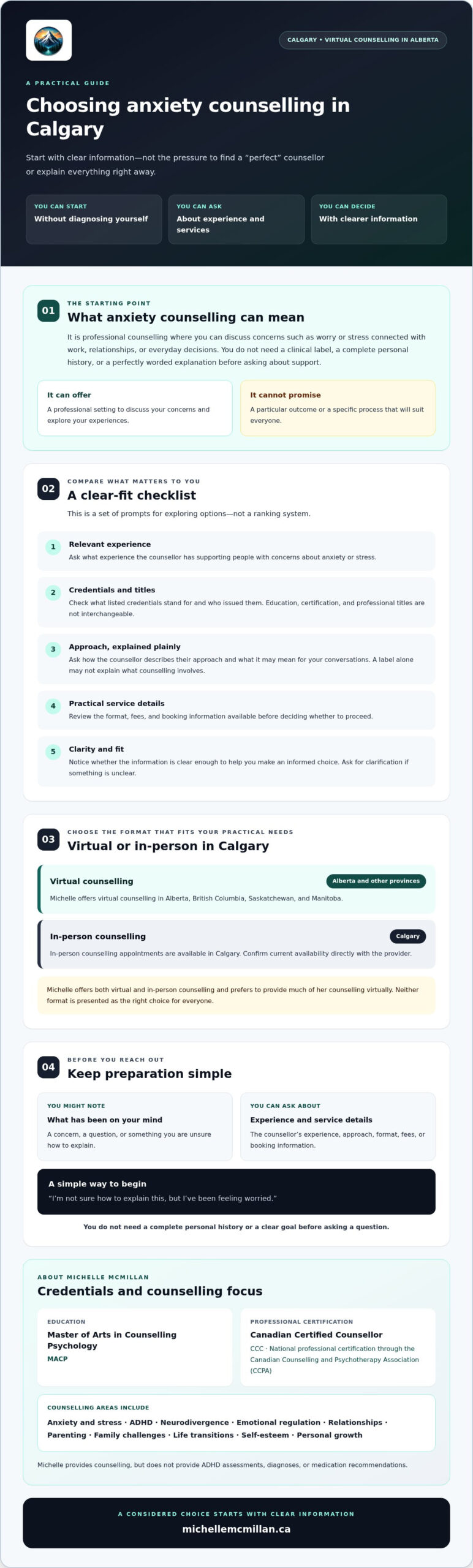
Before You Contact an Anxiety Counsellor: A Practical Calgary Decision Checklist
Reaching out doesn’t require a complete account of everything you’ve experienced. A few notes can help you organize what you want to ask and decide whether the available information suits your needs. Take it one step at a time.
- Identify what has been difficult. Note what prompted you to seek support, such as persistent worry, avoidance, physical tension, overthinking, sleep disruption or stress related to a particular situation. You don’t need a diagnosis or a detailed history.
- Consider what you want to explore. You may wish to discuss patterns that maintain worry, the effect of anxiety on relationships or work, responses to uncertainty, communication, boundaries, decision-making or coping with a life transition.
- Choose a practical format. Michelle offers in-person counselling in Calgary and virtual counselling throughout Alberta, British Columbia, Saskatchewan and Manitoba. Consider which setting fits your location, schedule and preferences.
- Make contact when you’re ready. A short description of your concerns and a few questions are enough to begin. You can discuss the focus and practical details of counselling before deciding on next steps.
What to consider before reaching out
Keep your notes simple. You might list what you hope to discuss, what you want to know about a counsellor’s experience, and whether you’re considering virtual or in-person counselling. These prompts can help you prepare without assuming how quickly counselling may help or what a first appointment will include.
Practical questions are appropriate before you make a decision. Depending on what’s missing from the public information, you could ask about service format, fees, booking details or how the counsellor describes their approach. You can choose which questions matter to you.
How to assess whether the information feels clear
For background on Michelle McMillan’s qualifications and professional experience, review the about page. Her Master of Arts in Counselling Psychology (MACP) is her graduate degree, while Canadian Certified Counsellor (CCC) is her professional designation. You can also review the counselling services page for information about available support.
Michelle offers in-person counselling in Calgary and virtual counselling throughout Alberta, British Columbia, Saskatchewan and Manitoba. Reviewing the counselling services and Rates and Booking pages can help you understand the practical options before reaching out.
Anxiety Counselling with Michelle McMillan in Calgary: Services and Next Steps
If you’re considering counselling for anxiety, it can help to understand what you may want to discuss before deciding what to do. Michelle McMillan Counselling offers professional counselling for concerns including anxiety and stress. Sessions may provide space to explore worry, avoidance, overthinking, emotional responses, relationship effects, life transitions and practical ways of responding to difficult situations. Michelle offers in-person counselling in Calgary and virtual counselling throughout Alberta, British Columbia, Saskatchewan and Manitoba.
What Michelle McMillan Counselling confirms
Michelle McMillan holds a Master of Arts in Counselling Psychology (MACP) and is a Canadian Certified Counsellor (CCC). These are separate credentials: the MACP is her degree, and the CCC is her professional designation.
Michelle McMillan Counselling offers in-person counselling in Calgary as well as virtual counselling throughout Alberta, British Columbia, Saskatchewan and Manitoba. You can choose the format that best fits your location, schedule and preferences while discussing anxiety-related concerns.
How to explore counselling availability and booking information
Before taking a next step, consider what you want to explore: the situations that prompt worry, how anxiety affects daily life, patterns such as avoidance or reassurance-seeking, or practical concerns about relationships, work and change. A short description is enough; there’s no need to prepare a full account before looking into counselling.
The Rates and Booking page provides current service and booking information. Michelle offers in-person counselling in Calgary and virtual counselling throughout Alberta, British Columbia, Saskatchewan and Manitoba. If you have a question that isn’t answered there, you can use the Contact page to get in touch.
If you’d like to review the information at your own pace, visit Rates and Booking. You can decide for yourself whether to take another step.
Consider Your Next Step at Your Own Pace
Choosing counselling for anxiety can begin with clear, practical questions, not a diagnosis or a commitment to a particular approach. You may wish to discuss worry, avoidance, uncertainty, physical stress responses, relationships, communication, life changes or the ways anxiety affects everyday decisions. Counselling offers professional support, but it cannot guarantee a specific result.
Michelle McMillan offers counselling for anxiety and stress. She holds a Master of Arts in Counselling Psychology (MACP) and is a Canadian Certified Counsellor (CCC). She offers in-person counselling in Calgary and virtual counselling throughout Alberta, British Columbia, Saskatchewan and Manitoba.
To review current service and booking information, visit Rates and Booking. You can take the time you need to consider your options and choose a reasonable next step.
Frequently Asked Questions
What is anxiety counselling?
Anxiety counselling is professional counselling where you can discuss concerns related to worry, stress, avoidance, uncertainty or their effects on everyday life. Sessions may include exploring patterns, relationships, communication, life transitions and ways of responding to difficult situations. You don’t need a diagnosis or a prepared explanation to begin. Counselling provides professional support, but it cannot guarantee a particular outcome or follow one approach for everyone.
How do I know if I should consider counselling for anxiety?
You can consider counselling if you’d like professional support to talk through worry, stress or their effects on everyday life. You might want to understand recurring thoughts, avoidance, physical tension, difficulty making decisions or changes in relationships and routines. There is no particular threshold or timeline that means you must seek counselling, and you do not need to know exactly what you want to discuss before beginning.
Is anxiety counselling available virtually in Alberta?
Yes. Michelle McMillan offers virtual counselling throughout Alberta, British Columbia, Saskatchewan and Manitoba. She also offers in-person counselling in Calgary. You can consider the format that best suits your circumstances and preferences, then discuss practical details when arranging an appointment.
Can I attend in-person anxiety counselling in Calgary?
Yes. Michelle McMillan offers in-person counselling in Calgary. She also offers virtual counselling throughout Alberta, British Columbia, Saskatchewan and Manitoba. You can choose the format that fits your circumstances while discussing concerns such as worry, stress, avoidance, uncertainty and their effects on daily life.
Is Michelle McMillan a psychologist?
Michelle McMillan’s listed credentials are a Master of Arts in Counselling Psychology (MACP) and the professional designation Canadian Certified Counsellor (CCC). These credentials describe her education and designation. If you’re comparing providers, you can ask what their listed credentials mean and which organization issued them.
What should I ask an anxiety counsellor before starting?
You might ask how the counsellor supports people who bring concerns about anxiety or stress, how they describe their counselling approach, and what topics could be explored in sessions. You may also ask about fees, booking details and whether sessions are offered in person or virtually. You don’t need to prepare a complete personal history; a few notes about what has been difficult and what you hope to understand are enough.
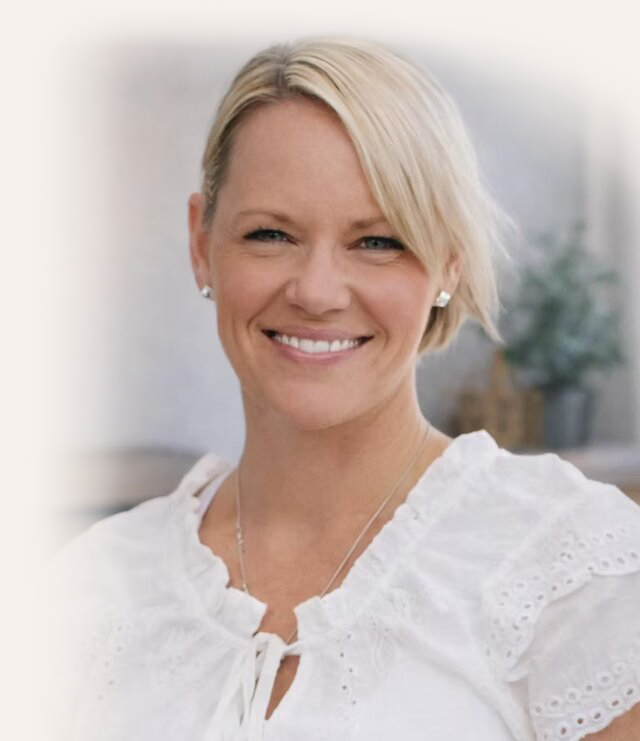
Article by
Michelle McMillan, MACP, CCC
Michelle McMillan is a Canadian Certified Counsellor (CCC) with a Master of Arts in Counselling Psychology (MACP). She has extensive experience working with children and supporting clients with ADHD, neurodivergence, anxiety, emotional regulation, relationships and family challenges. Michelle offers both virtual and in-person counselling, with virtual counselling available throughout Alberta, British Columbia, Saskatchewan and Manitoba and in-person appointments available in Calgary.
Important Information
This article is provided for general educational and informational purposes only and is not a substitute for professional counselling, psychological, medical or emergency services. Information shared here should not be considered a diagnosis or individualized treatment advice. If you are experiencing a mental health emergency or are in immediate danger, please contact appropriate emergency services in your area.