
What if seeking parenting counselling in Calgary isn’t a sign you’ve failed, but a way to talk through what’s weighing on your family? Parenting can bring difficult questions, conflict, and uncertainty. Asking for professional support doesn’t mean you need to have all the answers on your own.
It can be hard to know where to start. Would parenting counselling, family counselling, or counselling for your child be the better fit? The answer depends on the concerns you want to discuss and who may need to take part. Counselling offers a professional setting to explore those concerns, but it can’t promise a particular outcome or a quick fix.
This article explains what parenting counselling can involve and how it differs from related services. It also considers common concerns such as family conflict, communication, boundaries, differing parenting styles, emotional regulation, and transitions. Michelle McMillan offers both in-person sessions in Calgary and virtual sessions across Alberta, British Columbia, Saskatchewan, and Manitoba, where she is eligible to practise.
Key Takeaways
- Parenting counselling offers professional support for discussing parenting concerns. Seeking help doesn’t mean you’ve failed.
- You can explore counselling for parenting challenges, family conflict, transitions, or uncertainty without needing a diagnosis or severe concern.
- Parenting counselling may involve concerns about communication, boundaries, emotional regulation, or differing parenting approaches.
- Michelle McMillan offers in-person sessions in Calgary and virtual counselling to clients in Alberta, British Columbia, Saskatchewan, and Manitoba, where she is eligible to practise.
- Michelle holds a Master of Arts in Counselling Psychology (MACP) and is a Canadian Certified Counsellor (CCC), a national professional certification through the CCPA. These are separate credentials.
What Does Parenting Counselling in Calgary Involve?
Parenting concerns can feel personal and difficult to discuss, especially when you’re unsure how your choices will be understood. Asking questions or seeking support doesn’t mean you’ve failed. It can be a way to talk through a concern with a qualified professional.
In general, parenting counselling is professional support for exploring concerns connected to parenting and family life. You might want to discuss a change in family circumstances, a recurring disagreement, or uncertainty about how to respond to a challenge. The focus depends on what you bring forward and the counsellor’s stated scope of service.
Counselling isn’t a diagnosis, a judgement of your parenting, or a guarantee that a particular concern will change. It offers a setting to discuss your experiences and consider what support may fit. The term parenting counselling can mean different things from one provider to another, so ask what the service includes rather than relying on the name alone.
How Is Parenting Counselling Different from Family Counselling?
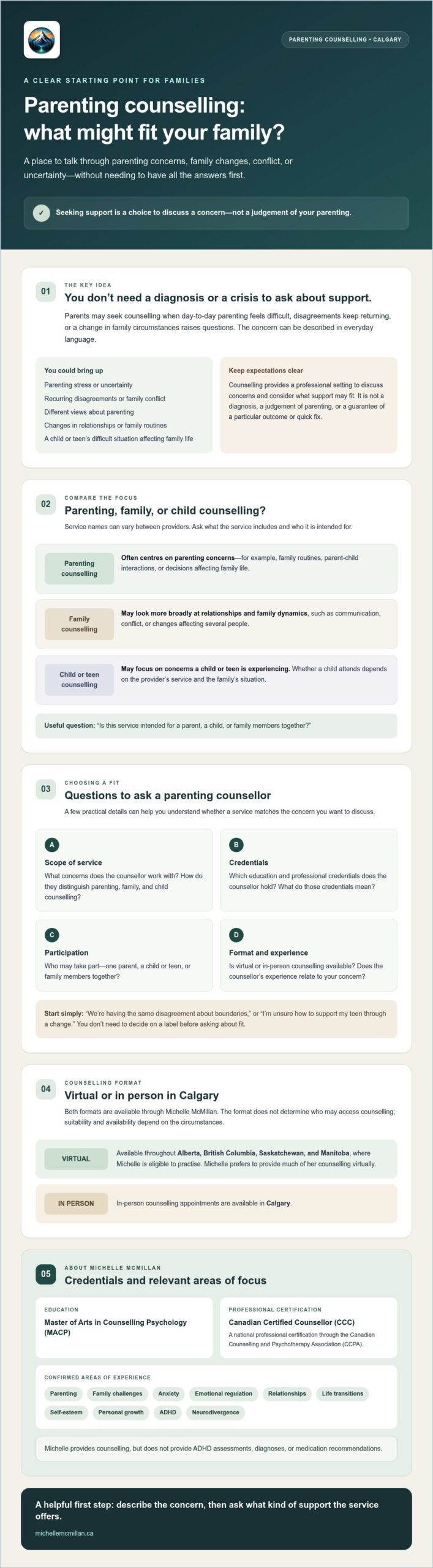
Parenting support generally centres on concerns connected to parenting, such as family routines, parent-child interactions, or decisions affecting family life. Family counselling may focus more broadly on relationships and dynamics among family members. A family might discuss communication, conflict, or changes affecting several people, but the service name alone doesn’t determine who participates.
These terms may be used differently across practices. Parenting counselling generally centres on the parent’s concerns and the ways parenting connects with family life, while family counselling considers relationships and dynamics among family members more broadly. Child counselling and teen counselling focus more directly on the child’s or teen’s experiences. The service name alone does not determine who participates, so the concern and the people affected can help clarify which service is relevant.
Does Seeking Parenting Support Mean You Are a Bad Parent?
No. Wanting a place to discuss a parenting concern isn’t a verdict on your character or a declaration that you’ve done something wrong. Families can face uncertainty and disagreement without those experiences defining a parent or child.
Asking for parenting support is a choice to discuss a concern, not a judgement of your parenting.
You don’t need a perfect explanation before asking about counselling. It may be enough to describe what feels difficult and ask whether the provider’s service fits. Counselling can make room to explore a concern, but it can’t promise a specific resolution. Keeping that distinction in mind can help set clear expectations as you consider parenting counselling Calgary options.
When Might a Calgary Parent Consider Counselling Support?
You don’t need to wait until a family concern feels overwhelming before asking about support. Parents may consider counselling when day-to-day parenting feels difficult to manage, disagreements keep returning, or a change in family circumstances raises questions about what to do next. The concern doesn’t have to fit a diagnostic label, and a child’s behaviour or a family’s circumstances alone don’t prove that anyone has a condition or needs treatment.
What Concerns Can Parents Bring to Counselling?
There isn’t one required reason to enquire. You might want to discuss parenting stress, tension around family communication, differing views on parenting, or a transition such as a change in relationships or family routines. A child or teen may also be facing a difficult situation that affects family life. That context can be discussed without assuming it points to a diagnosis.
It can help to describe the concern in everyday language rather than trying to decide which service or label applies. For example: “We’re having the same disagreement about boundaries,” or “I’m unsure how to support my teen through a change.” The American Psychological Association’s parenting resources offer general information on parenting topics, but they aren’t a substitute for checking whether a particular counsellor’s service fits your circumstances.
Michelle McMillan’s confirmed areas of focus include parenting, family challenges, anxiety, and emotional regulation. To explore whether those areas relate to what you’d like to discuss, review her counselling areas of focus. This is a starting point for understanding service scope, not a promise of a particular result.
Does a Child Have to Attend Parenting Counselling?
Not necessarily. Who participates depends on the counsellor’s service and the family’s situation. Some services may be intended for a parent to discuss concerns; others may involve a child, teen, or family members together. Don’t assume the name “parenting counselling” means parents attend alone, or that “family counselling” means every family member must take part.
Participation can also reflect how a concern is unfolding. For example, one parent may want to discuss recurring disagreements about boundaries, while another may experience the issue differently. A child or teen may be affected by the tension without being responsible for resolving it. Counselling can make space to consider these perspectives without assuming that every family member must attend or that one person is at fault.
How Can You Choose a Parenting Counsellor in Calgary?
Choosing support is easier when you compare what a counsellor actually offers rather than relying on a service label. Use this checklist to see whether the provider’s scope, qualifications, format, and participation arrangements fit the concern you want to discuss.
- Check the service scope. Does the provider describe support for parenting concerns, family challenges, or the specific issue you want to bring forward? Similar service names can mean different things between practices.
- Review education and professional designations. Look for clearly stated qualifications and relevant areas of focus. Michelle McMillan holds a Master of Arts in Counselling Psychology (MACP) and is a Canadian Certified Counsellor (CCC). The CCC is a national professional certification through the Canadian Counselling and Psychotherapy Association (CCPA). These are separate credentials, and neither guarantees a particular fit or outcome.
- Confirm the format and location. Ask whether virtual counselling is available for your location and for the service you’re considering. Michelle offers virtual counselling in Alberta, British Columbia, Saskatchewan, and Manitoba, where she is eligible to practise.
- Ask who participates. Find out whether the service is intended for a parent, a child or teen, or family members together. Don’t assume based on the service name.
- Clarify the next step. Ask how to proceed if the service seems relevant and what information the provider needs to understand your concern.
Parenting concerns often involve more than one perspective. Parents may disagree about limits, routines, consequences, or how much support a child needs. Communication can become strained when each person feels unheard, particularly during emotional moments or family transitions. Counselling may provide a setting to describe these patterns and consider the concern together, without requiring a diagnosis or assigning blame.
What Else Might You Compare?
Consider whether the provider’s stated service areas match your concern and whether you understand what the service does and doesn’t cover. Michelle’s counselling services page can help you review the options she offers. If you’re also exploring community-based resources, the Government of Alberta’s information on Alberta Family Resource Networks describes another type of support available to children, youth, and families.
Clear information can be more useful than promises of a particular result. Consider how the service addresses communication, family conflict, boundaries, emotional regulation, differing parenting styles, or transitions, as well as who may participate and which formats are available. These details can help you understand parenting counselling Calgary options without reducing a complex family concern to a service label.
Virtual or In-Person Parenting Counselling in Calgary
Format is one practical part of accessing support. Michelle McMillan offers in-person sessions in Calgary as well as virtual sessions for clients across Alberta, British Columbia, Saskatchewan, and Manitoba, where she is eligible to practise. Parents, children, teens, and families are not restricted to one format by the type of concern; the available option depends on location, the service being considered, and the people involved.
In-person sessions in Calgary may suit people who prefer to meet at the practice, while virtual sessions can make counselling more accessible across the provinces served. Parenting, child, teen, and family counselling may be discussed in either format when the service is available for the client’s location and circumstances. The format is a practical consideration, not a guarantee about how a concern will develop.
What Should You Ask About Virtual Counselling?
Start with your location and the specific service you’re looking for. Ask whether virtual counselling is available in your province and whether the provider offers it for parenting, family, or related concerns. You can also ask who would participate and what the next step is. These questions help clarify practical fit without assuming that virtual counselling changes the nature or outcome of support.
Virtual counselling is available across Alberta, British Columbia, Saskatchewan, and Manitoba, where Michelle is eligible to practise. In-person sessions are available in Calgary. The appropriate format may depend on where you live, who is involved, and the service you are considering; adults, children, teens, and families are not automatically limited to one option.
What Should You Know About In-Person Counselling in Calgary?
Michelle McMillan offers in-person counselling sessions in Calgary as well as virtual counselling across Alberta, British Columbia, Saskatchewan, and Manitoba, where she is eligible to practise. Parenting, child, teen, and family counselling are not restricted to a single format; the available option depends on the client’s location and the service being considered.
To review the services and ask a practical question about format or participation, use the practice’s contact page. A brief enquiry can help clarify whether the service matches what you’re looking for in parenting counselling Calgary. You can describe your location and concern in your own words, then ask what options are available.
Explore Parenting Counselling with Michelle McMillan in Calgary
Finding support starts with a clearer picture of what’s offered and how it relates to your concern. Michelle McMillan Counselling offers parenting support and family counselling, alongside counselling for individuals, children, and youth. Depending on what’s happening in your family, child or youth counselling may also be relevant to explore. You don’t have to decide in advance who should attend; ask about participation when you enquire.
What Counselling Services Does Michelle McMillan Offer?
Michelle holds a Master of Arts in Counselling Psychology (MACP) and is a Canadian Certified Counsellor (CCC). The CCC is a national professional certification through the Canadian Counselling and Psychotherapy Association (CCPA). These are separate credentials that describe Michelle’s education and professional certification, not a promise of a particular counselling experience or result. You can read more about her background on the About Michelle McMillan page.
Her confirmed areas of focus include parenting, family challenges, relationships, anxiety, emotional regulation, ADHD, neurodivergence, life transitions, self-esteem, and personal growth. Michelle provides counselling related to ADHD and neurodivergence, but doesn’t provide ADHD assessments, diagnoses, or medication recommendations. If your question involves a child or teen, ask whether child or youth counselling, parenting support, or family counselling is the relevant service. Counselling offers professional support for discussing concerns, not a guaranteed result.
Michelle provides in-person sessions in Calgary and virtual counselling to clients across Alberta, British Columbia, Saskatchewan, and Manitoba, where she is eligible to practise. Parenting, child, teen, and family counselling may be considered in either format when available for the client’s location and circumstances. The people involved can be discussed without assuming that adults, children, teens, or families must use one particular format.
How Can You Take a Low-Pressure Next Step?
You can review the service information, note what you’d like to discuss, and decide whether you want to make an enquiry. It may help to have a simple description ready, such as “I’m looking for support with a parenting concern and want to understand who would participate.” You can also consider whether in-person sessions in Calgary or virtual counselling across the provinces served is more practical for your circumstances. There’s no need to have a diagnosis or a perfectly formed explanation before reaching out.
If you’re considering parenting counselling Calgary, review the available details and decide whether to continue. For information about rates and booking, visit the Rates and Booking page when you’re ready.
Take the Next Step at Your Own Pace
Choosing parenting counselling in Calgary can begin with a simple question: what concern would you like to discuss? Family conflict, communication difficulties, boundaries, differing parenting styles, emotional regulation, and transitions can all affect family life in different ways. Michelle McMillan offers in-person sessions in Calgary and virtual counselling across Alberta, British Columbia, Saskatchewan, and Manitoba, where she is eligible to practise.
Michelle McMillan holds a Master of Arts in Counselling Psychology (MACP) and is a Canadian Certified Counsellor (CCC), a national professional certification through the CCPA. Counselling offers professional support for discussing concerns, not a promise of a particular outcome.
If you’d like to review the next steps, visit the Rates and Booking page when it feels right. You can take your time deciding whether to enquire. To ask whether a service may fit your family’s concern, use the contact page.
Frequently Asked Questions
Is parenting counselling only for parents dealing with a serious problem?
No. You can ask about parenting counselling when you’re facing a question, conflict, transition, or uncertainty, even if the concern doesn’t feel severe or fit a diagnostic label. You don’t need to prove that something is wrong before seeking information. Counselling can provide professional support for discussing what’s happening, but it doesn’t guarantee a particular change or outcome.
Can parenting counselling help if my child is having a difficult time?
It may be worth asking a counsellor what service fits your family’s concern. A child or teen’s difficult situation can be relevant to parenting or family discussions, but it doesn’t by itself indicate a diagnosis. Depending on the provider’s scope and who may participate, child or youth counselling may also be an option. Ask about the available service rather than assuming one type is right.
Does my child need to attend parenting counselling?
Not necessarily. Participation depends on the counsellor’s service and your family’s circumstances. Some support may be intended for a parent, while other services may involve a child, teen, or family members together. Before arranging counselling, ask who the service is designed for and who would attend. Don’t assume that a service labelled “parenting” or “family” automatically determines participation.
What is the difference between parenting counselling and family counselling?
Parenting counselling generally focuses on concerns connected to parenting and family life. Family counselling may address relationships and dynamics among family members. However, providers may use these service names differently, and the label doesn’t necessarily specify who attends. Ask what concerns the counsellor works with, who can participate, and whether the service matches the issue you want to discuss.
Is virtual parenting counselling available in Calgary?
Yes. Michelle McMillan offers in-person sessions in Calgary and virtual counselling to clients in Calgary and elsewhere in Alberta, as well as in British Columbia, Saskatchewan, and Manitoba where she is eligible to practise. Parenting, child, teen, and family counselling are not automatically restricted to one format; the available option depends on the location and service being considered.
How do I choose a parenting counsellor in Calgary?
Start by checking the counsellor’s education, professional designation, stated service areas, available formats, and who may participate. Ask directly whether the service fits your concern. Michelle McMillan holds a Master of Arts in Counselling Psychology (MACP) and is a Canadian Certified Counsellor (CCC), a national professional certification through the Canadian Counselling and Psychotherapy Association (CCPA). Credentials describe qualifications, not guaranteed outcomes or personal fit.

Article by
Michelle McMillan, MACP, CCC
Michelle McMillan is a Canadian Certified Counsellor (CCC) with a Master of Arts in Counselling Psychology (MACP). She has extensive experience working with children and supporting clients with ADHD, neurodivergence, anxiety, emotional regulation, relationships and family challenges. Michelle offers both virtual and in-person counselling, with virtual counselling available throughout Alberta, British Columbia, Saskatchewan and Manitoba and in-person appointments available in Calgary.
Important Information
This article is provided for general educational and informational purposes only and is not a substitute for professional counselling, psychological, medical or emergency services. Information shared here should not be considered a diagnosis or individualized treatment advice. If you are experiencing a mental health emergency or are in immediate danger, please contact appropriate emergency services in your area.