
Considering teen anxiety counselling Calgary does not require a firm decision right away. It can begin with a conversation about what your teen is experiencing and what support they may be willing to explore. As a parent, you may be unsure whether ongoing worries reflect a difficult period or a reason to seek professional support. Your teen may see things differently or feel hesitant to talk.
Those uncertainties are understandable. This article explains what changes in everyday life may prompt a conversation about counselling, how to raise the subject without labelling or pressuring your teen, and what families may want to consider when reviewing virtual and in-person options in Calgary.
Key Takeaways
- Notice patterns in your teen’s daily life and ask how they understand what is happening.
- Teen anxiety counselling offers a supportive place to discuss a young person’s concerns and experiences.
- A teen’s questions or reluctance can be part of the conversation rather than something to dismiss.
- Michelle McMillan offers virtual counselling across Alberta, British Columbia, Saskatchewan and Manitoba, as well as in-person counselling in Calgary.
- Michelle holds a Master of Arts in Counselling Psychology (MACP) and a separate national professional certification, Canadian Certified Counsellor (CCC), through the CCPA.
When might teen anxiety counselling in Calgary be worth considering?
A parent and teen may understand the same concern differently. You might notice a change and wonder whether it reflects stress, while your teen may see it as temporary or prefer not to discuss it. Both perspectives matter. Teen anxiety counselling in Calgary can provide a welcoming space to talk about what is happening without deciding in advance what your teen needs.
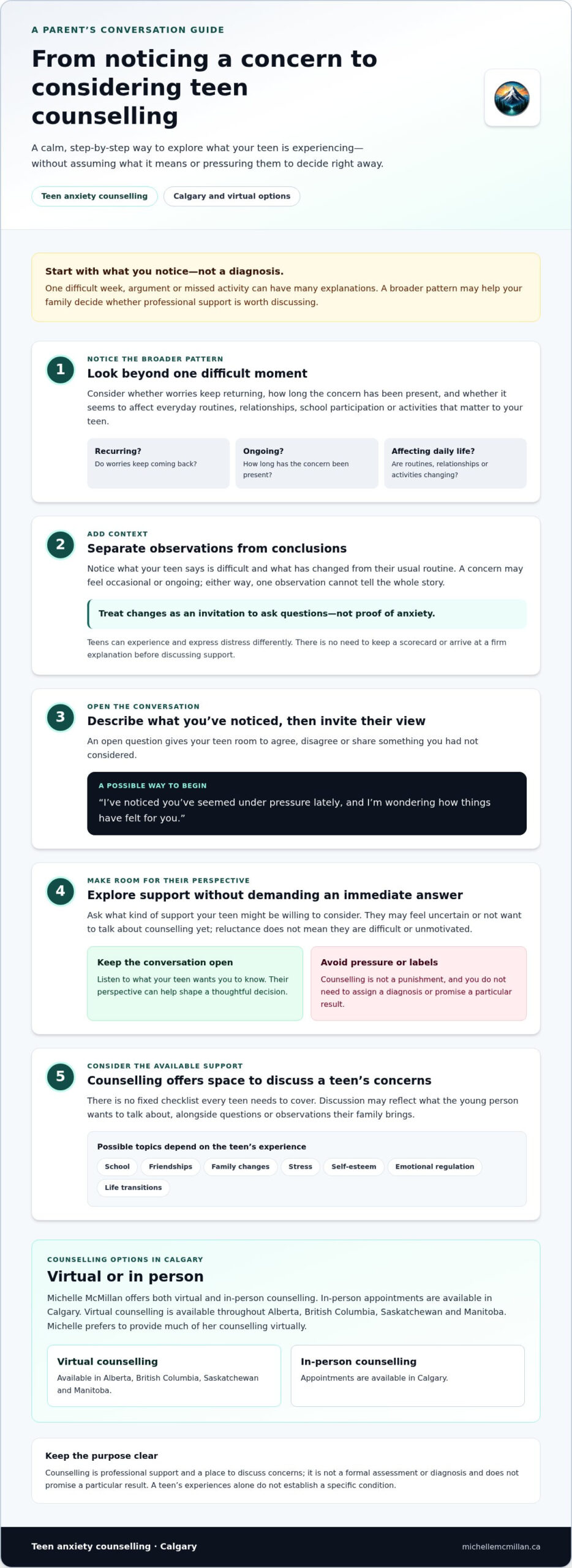
Rather than focusing on one difficult week, argument or missed activity, consider the broader picture. Has the concern continued or returned? Does it seem to affect routines, relationships, school participation or activities that matter to your teen? These observations can help your family decide whether to discuss professional support.
What concerns might prompt a conversation about counselling?
A family might consider support when worries or stress occupy much of a teen’s attention or seem to affect everyday life. A young person may talk about school, friendships, family changes or activities, or you may notice changes in routines, relationships or interest in things they usually enjoy. Ask about the context rather than trying to interpret a change on your own. One teen may readily describe what is happening, while another may need more time and space to find the words.
It can help to notice without keeping a scorecard. What does your teen say is difficult? What has changed from their usual routine? Does the concern seem occasional or ongoing? If the pattern is troubling to you or your teen, counselling is one option to discuss with a professional.
How can parents raise the subject without making assumptions?
Describe what you have observed, then invite your teen’s view. For example: “I’ve noticed you’ve seemed under pressure lately, and I’m wondering how things have felt for you.” Keep the question open. Your teen may agree, disagree or mention something you had not considered. Listening first can move the conversation from defending an interpretation toward understanding what they want you to know.
You can ask what kind of support they might be willing to consider and explain that counselling is not a punishment. Avoid assigning a label or demanding an immediate answer. The aim is to understand your teen’s perspective and leave room for a thoughtful decision.
What can teen anxiety counselling help a teen and family explore?
Teen anxiety counselling is professional support focused on a young person’s concerns and experiences. It offers space to describe what has been weighing on them and consider how it connects with everyday life. There is no fixed checklist every teen must cover. Discussion can reflect what the young person wants to talk about, along with questions or observations their family brings.
One teen may be concerned about school or friendships. Another may want to discuss family changes, stress, self-esteem, emotional regulation or a life transition that feels demanding. The teen’s own description matters, while a parent’s observations can provide helpful context.
Which parts of a teen’s experience might be discussed?
Possible topics include recurring worries, stress around particular responsibilities, relationship concerns and how a young person is experiencing a change in their life. A teen might want to explain what feels difficult, what they have already tried to communicate or what they wish their family understood. These topics can help shape a conversation that feels relevant to the young person.
Pulling back from an activity, for example, can have different meanings in different circumstances. Counselling provides a setting to explore your teen’s account with care. Michelle McMillan Counselling offers support related to anxiety and stress. Find more information on the anxiety and stress areas of focus page.
What counselling does, and doesn’t, mean
Counselling provides professional support and a place to discuss concerns and explore experiences. It is distinct from formal assessment or diagnosis. Michelle provides counselling rather than formal diagnoses or medication advice, including ADHD assessments, diagnoses or medication recommendations. Families can keep this distinction in mind when considering the kind of support they are seeking.
What if a teen is reluctant or a parent is unsure?
A parent’s interest in counselling does not automatically mean a teen feels ready to take part. They may have questions, feel uncertain about what counselling involves or simply not want to talk about it yet. Take that hesitation seriously and use it to understand what would make the conversation feel safer and more manageable.
For families considering teen anxiety counselling in Calgary, the decision can begin as a conversation rather than a demand. A parent may be worried while the teen does not see the situation in the same way. Both perspectives can be acknowledged without labelling the young person.
How can a teen’s perspective stay part of the decision?
Make room for your teen’s questions and preferences. Explain what you have noticed, then ask what they think and what they would want to know before considering counselling. They may be concerned about talking with someone new, unsure what they would discuss or not ready to decide. Listening does not require agreement on everything immediately.
Frame counselling as an option to explore, not a consequence for behaviour or a test your teen has to pass. You might say, “I’m concerned because you seem under a lot of pressure. We could learn more about counselling together, but I’d like to hear what you think.” This invites an honest response without pressure.
What might parents want to understand about participation?
Families may have questions about how parent and teen participation is handled, including what information may be shared and how confidentiality works. It is reasonable to ask about confidentiality and its limits when considering counselling. The details depend on the circumstances and relevant professional obligations, so ask rather than assuming a particular arrangement.
Participation may look different across families. A young person’s age, concerns and family circumstances can all be relevant. Ask how parent involvement is handled and review the service information as you consider the areas of support offered by Michelle McMillan Counselling.
Choosing virtual or in-person counselling in Calgary
Practical details can help a family think through counselling format. Travel, school and work schedules, a teen’s preferences and whether a parent may take part are all worth considering. These factors can help you choose an option that feels manageable for your family.
Michelle McMillan offers both virtual and in-person counselling. In-person appointments are available in Calgary, while virtual counselling is available throughout Alberta, British Columbia, Saskatchewan and Manitoba. Michelle prefers to provide much of her counselling virtually, while both formats remain available.
What should families consider when choosing a format?
Virtual counselling can offer a convenient way to access support without travelling to an appointment. In-person counselling is also available for Calgary families who prefer to attend in person. Consider your family’s schedules, the teen’s preferences and what setting feels easiest to arrange.
For virtual participation, consider finding a time and place where your teen can take part. The setup does not need to become a major project. Discussing the format with the young person and weighing it alongside family routines can make the decision more concrete.
How can parents and teens think about taking part?
Talk about the format as part of the decision rather than choosing on your teen’s behalf before hearing their view. Ask what would feel manageable and take their preferences seriously. The goal is to consider the available options together.
Michelle’s counselling formats are not divided by a fixed rule that assigns a particular age group to virtual or in-person care. To review the range of counselling options, visit the counselling services page and consider what may suit your family’s practical needs.
How can Calgary families take a considered next step?
You do not need every answer before considering support. A simple sequence can help: name the concern, include your teen’s perspective, review the available formats and decide whether booking feels like a reasonable next step. Keep the conversation open as your family considers what matters most.
What information can families bring to an initial decision?
You might note what your teen would like to discuss, along with any questions you have as a parent. These could be broad, such as what counselling involves, or specific to your family’s concerns. You can begin without a complete explanation of what is happening.
It may also help to consider practical preferences: whether virtual or in-person counselling seems more manageable, how schedules affect participation and whether a parent may want to be involved. These are useful points to discuss as you review your options.
Where can Calgary families find counselling information?
Michelle McMillan holds a Master of Arts in Counselling Psychology (MACP) and is a Canadian Certified Counsellor (CCC). These are separate credentials. The CCC is a national professional certification through the Canadian Counselling and Psychotherapy Association (CCPA). Learn more about Michelle’s background on the about page.
Michelle works with adults, couples, children, teens and families. She has 16 years of experience in education, including specialized mental-health and intensive behavioural-support environments. While ADHD is her primary area of focus, this article focuses on support for teen anxiety.
If your family would like to explore booking, review the Rates and Booking page at your own pace. You can also contact Michelle through the contact page with questions about taking a next step.
Consider a next step that includes your teen
Deciding whether to seek support does not require complete certainty. Notice what concerns you, make room for your teen’s perspective and consider which counselling format fits your family’s practical needs. Counselling can offer a supportive place to discuss what your teen is experiencing.
For families exploring teen anxiety counselling in Calgary, Michelle McMillan offers virtual counselling across Alberta, British Columbia, Saskatchewan and Manitoba, as well as in-person appointments in Calgary. She holds a Master of Arts in Counselling Psychology (MACP) and is a Canadian Certified Counsellor (CCC), a separate national professional certification through the Canadian Counselling and Psychotherapy Association.
When you are ready to explore counselling for your teen, review the Rates and Booking page for information about taking a next step with Michelle McMillan.
Frequently Asked Questions
How can I tell whether my teen may benefit from anxiety counselling?
Counselling may be worth considering if worries or stress seem to affect your teen’s daily life. You might notice changes in routines, relationships, activities or school participation. Teen anxiety counselling in Calgary can provide professional support and space to describe what is happening.
Can a teen attend counselling if they are unsure about it?
A teen can consider counselling while feeling uncertain, and their hesitation deserves to be taken seriously. Invite them to share questions about what counselling involves or what they might discuss. You can talk together about what support they would feel comfortable exploring.
What happens if a parent and teen disagree about counselling?
Parents and teens can have different views about what feels concerning or what kind of support might help. Try identifying each person’s concerns, listening to the teen’s perspective and keeping counselling separate from punishment. Ask about parent participation and confidentiality in light of the teen’s circumstances and applicable professional obligations.
Is teen anxiety counselling available in Calgary in person?
Yes. Michelle McMillan offers in-person counselling appointments in Calgary, as well as virtual counselling. Families can weigh location, schedules and the teen’s preferences when thinking about format.
Can Calgary teens access virtual counselling?
Yes. Michelle offers virtual counselling in Alberta, British Columbia, Saskatchewan and Manitoba, and prefers to provide much of her counselling virtually. Families can consider schedules, privacy and the teen’s preferences when thinking about this option.

Article by
Michelle McMillan, MACP, CCC
Michelle McMillan is a Canadian Certified Counsellor (CCC) with a Master of Arts in Counselling Psychology (MACP). She has extensive experience working with children and supporting clients with ADHD, neurodivergence, anxiety, emotional regulation, relationships and family challenges. Michelle offers both virtual and in-person counselling, with virtual counselling available throughout Alberta, British Columbia, Saskatchewan and Manitoba and in-person appointments available in Calgary.
Important Information
This article is provided for general educational and informational purposes only and is not a substitute for professional counselling, psychological, medical or emergency services. Information shared here should not be considered a diagnosis or individualized treatment advice. If you are experiencing a mental health emergency or are in immediate danger, please contact appropriate emergency services in your area.