
If you’re searching for “life transitions counselling Calgary,” you may be trying to make sense of a change without being told what to do next. A move, relationship shift, career change or several changes at once can leave you unsure where to begin. Counselling can offer a warm, practical space to slow down and consider what matters to you.
Key Takeaways
- Transitions can feel complicated even when they are expected or chosen, especially when practical decisions and changing roles overlap.
- Life transitions counselling Calgary can provide space to explore what has changed, how it is affecting daily life and what you would like to understand.
- Reflection questions can help you identify the concerns, relationships and responsibilities you want to bring into a conversation.
- Michelle McMillan holds a Master of Arts in Counselling Psychology (MACP) and is a Canadian Certified Counsellor (CCC) through the CCPA. She has 16 years of education experience and offers virtual counselling across Alberta, British Columbia, Saskatchewan and Manitoba, as well as in-person appointments in Calgary.
What Is Life Transitions Counselling in Calgary?
Major changes can bring practical questions and personal adjustments, even when they’re expected or chosen. Starting a new career, becoming a parent, changing a relationship, caring for a family member, relocating or retiring can affect routines and responsibilities as well as how you think about what comes next. There isn’t one typical response to a transition; the experience depends on the person and their circumstances.
Life transitions counselling is professional support for exploring a change and its effects on your life. In life transitions counselling Calgary residents may discuss what has shifted, what feels uncertain and which parts of the experience they want to understand. This can include practical concerns, such as new responsibilities or decisions, alongside the personal meaning of the change.
Which life changes can bring someone to counselling?
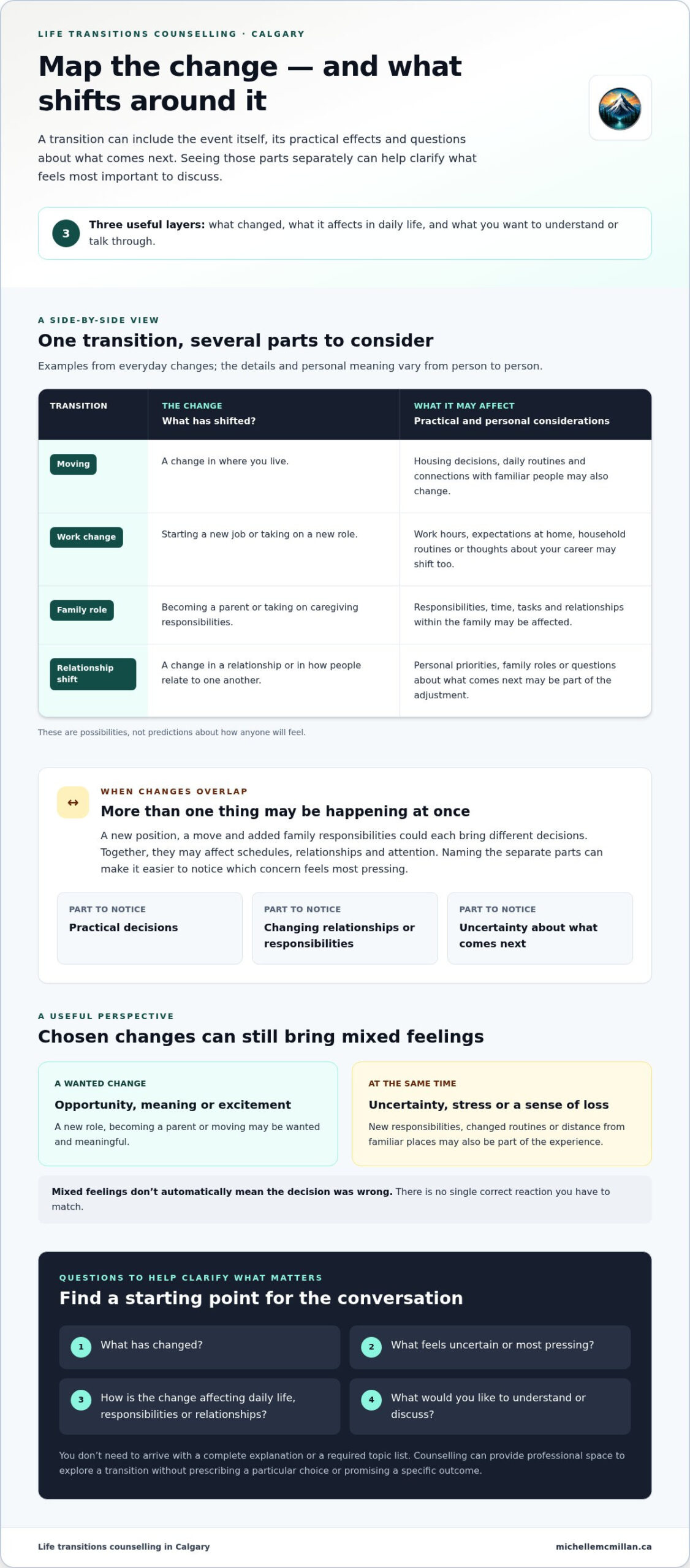
Transitions can be planned or unexpected. They may involve work, relationships, living arrangements, identity, health circumstances or changing roles within a family. For example, a move can involve decisions about housing while also changing daily routines and connections with familiar people. A shift in caregiving responsibilities may affect how time and tasks are shared among family members. These are possibilities, not predictions about how anyone will feel.
What can someone discuss with a counsellor?
Possible topics include uncertainty about what comes next, new responsibilities, effects on relationships and changing priorities. You might want to put words to what matters most, consider how different parts of the transition connect or discuss a decision that feels difficult to approach. You do not need to arrive with a complete explanation.
Life transitions and personal growth are among the areas described on the Areas of Focus page. The concerns you bring to counselling are personal to your circumstances.
Why Can a Life Transition Feel Difficult Even When It Is Chosen?
Choosing a change does not mean every part of it will feel straightforward. A transition can involve practical decisions, shifting responsibilities and questions about what comes next. Someone starting a new role, for example, may also be adjusting to different hours, new expectations at home and a changing sense of direction.
The external event is only one part of the experience. Its effects can depend on relationships, circumstances, priorities and past experiences. A work change may influence family routines, while a change in a family role may affect relationships, living arrangements or identity.
People can respond differently to the same transition. One person may feel ready for a change while another feels unsure. A person’s own feelings may also shift over time. There’s no single correct reaction you have to match.
When several changes happen at once
Overlapping transitions can make it difficult to tell which concern feels most pressing. Someone might accept a new position while preparing to move and taking on more responsibilities for a family member. Each change brings separate decisions, while together they affect schedules, relationships and attention. Naming the different parts can make it easier to identify where you would like to begin.
It may help to name the different parts of the change rather than assuming they all carry equal weight. The most demanding concern might be a practical decision, a changing relationship, uncertainty about responsibilities or a combination of issues. Identifying what feels most present can give a conversation a clearer starting point.
When a positive change brings mixed feelings
A wanted change can still involve uncertainty, stress or a sense of loss alongside excitement. A new role may bring opportunity as well as questions about time and expectations. Becoming a parent can be meaningful while changing responsibilities and relationships. Moving may open new possibilities while creating distance from familiar places or routines.
Mixed feelings do not automatically mean a decision was wrong. They can be a natural part of responding to a change that matters. Counselling may offer space to explore both the hopeful and difficult parts without having to choose one feeling over the other.
Do You Need Counselling for a Life Transition, or Is Change Just Part of Life?
Questions that can clarify whether counselling feels relevant
Consider what you’d like space to talk about. For example:
- What feels most difficult or uncertain about this change?
- What has shifted in your responsibilities, relationships or everyday decisions?
- Is there a concern you would like to understand but find difficult to discuss with people close to you?
- What kind of conversation or support would feel useful right now?
How to Think Through Counselling Options During a Life Transition
You do not need to arrive with a complete explanation. A few simple questions can help you decide what you would like to explore and which format may work best.
- Name the change. What has shifted, or what are you anticipating?
- Notice its effects. Which parts of daily life, relationships or responsibilities feel different?
- Clarify your concerns. What questions, decisions or experiences would you like space to discuss?
- Consider a format. Would you prefer virtual counselling or an in-person appointment in Calgary?
You might want to talk about family dynamics, parenting, self-esteem, relationships or personal growth, depending on what the transition means in your life. There’s no required topic list, and you don’t have to know in advance which concern matters most. A general sense of what has changed can be enough to begin a conversation.
Clarify what you would like to bring into the conversation
Consider virtual or Calgary in-person counselling
Michelle offers virtual counselling across Alberta, British Columbia, Saskatchewan and Manitoba, as well as in-person appointments in Calgary. Virtual sessions may be a convenient option if travel, work or family responsibilities make appointments more difficult. You can consider the format that fits your circumstances.
Life Transitions Counselling in Calgary with Michelle McMillan
Life transitions are among Michelle McMillan’s areas of focus. She holds a Master of Arts in Counselling Psychology (MACP) and is a Canadian Certified Counsellor (CCC) through the Canadian Counselling and Psychotherapy Association. Michelle also has 16 years of education experience, including work in specialized mental-health and intensive behavioural-support settings with children, teens and families.
Michelle offers virtual counselling across Alberta, British Columbia, Saskatchewan and Manitoba, along with in-person appointments in Calgary. If you are considering life transitions counselling Calgary, you can choose the setting that feels most practical for you.
To learn more about working with Michelle, visit her individual counselling services and review the Rates & Booking page at your own pace.
Choose Support That Fits This Season of Change
A transition can be difficult while still holding hopeful possibilities. Identifying what has changed, what feels hardest and what you would like to understand can help you decide whether counselling is a useful next step.
Michelle offers individual counselling, virtual counselling across Alberta, British Columbia, Saskatchewan and Manitoba, and in-person appointments in Calgary. Explore her individual counselling services and visit the Rates & Booking page to learn more.
Frequently Asked Questions
What is life transitions counselling?
Life transitions counselling is professional support for exploring a significant change and its effects on daily life, relationships, responsibilities or priorities. Changes might include starting a new job, becoming a parent, taking on caregiving responsibilities, moving or retiring. In life transitions counselling Calgary, you can discuss what has shifted and what you want to understand.
Can counselling help with a life change that was my choice?
Yes. A new role, move or change in family life can bring practical adjustments alongside excitement. Mixed feelings do not automatically mean the choice was wrong. Counselling can provide space to explore what the change means to you.
When should I consider counselling during a life transition?
You might consider counselling when you want space to discuss what feels difficult, what has changed in your responsibilities or relationships, or what questions you are carrying. Reflection questions can help you identify a useful starting point.
What happens in life transitions counselling?
You might bring questions about uncertainty, changing responsibilities, relationships, family dynamics, parenting or personal priorities. There is no need to arrive with a complete explanation; the conversation can begin with what feels most present to you.
Is virtual counselling available for people in Calgary?
Yes. Virtual counselling is available in Calgary and throughout Alberta, as well as in British Columbia, Saskatchewan and Manitoba. Michelle also offers in-person appointments in Calgary, so you can consider which format fits your circumstances.

Article by
Michelle McMillan, MACP, CCC
Michelle McMillan is a Canadian Certified Counsellor (CCC) with a Master of Arts in Counselling Psychology (MACP). She has extensive experience working with children and supporting clients with ADHD, neurodivergence, anxiety, emotional regulation, relationships and family challenges. Michelle offers both virtual and in-person counselling, with virtual counselling available throughout Alberta, British Columbia, Saskatchewan and Manitoba and in-person appointments available in Calgary.
Important Information
This article is provided for general educational and informational purposes only and is not a substitute for professional counselling, psychological, medical or emergency services. Information shared here should not be considered a diagnosis or individualized treatment advice. If you are experiencing a mental health emergency or are in immediate danger, please contact appropriate emergency services in your area.