
When conversations turn tense, circle back to the same point or end before either person feels heard, it can be hard to know how to raise the next concern. Couples communication counselling Calgary offers a professional setting to discuss what happens between you during difficult conversations, without treating one partner as the problem. Considering counselling doesn’t mean you’ve failed or decided what should happen to the relationship.
This article explains how couples counselling can make room to explore recurring conversations and the concerns beneath them. It also covers practical points to consider when deciding whether support feels relevant, and the virtual and in-person couples counselling options available in Calgary. You don’t need to agree on every detail or have a complete explanation before considering a conversation with a counsellor.
Key Takeaways
- Couples communication counselling Calgary provides professional support for discussing difficult conversations and recurring communication patterns without assigning blame.
- Exploring how a concern, each partner’s interpretation and their responses connect can clarify what happens during tense or circular discussions.
- Consider whether private conversations are helping you address concerns, or whether a supported setting may be useful. Communication challenges can overlap with other relationship questions.
- Michelle McMillan offers couples counselling virtually and in person in Calgary. Couples may join virtually from the same location or from separate locations when needed.
- Michelle holds a Master of Arts in Counselling Psychology (MACP) and is a Canadian Certified Counsellor (CCC), a national professional certification through the Canadian Counselling and Psychotherapy Association (CCPA).
When communication feels difficult: could couples counselling in Calgary help?
Some conversations leave you feeling closer; others seem to stall before either person feels understood. You might revisit the same concern without reaching a shared understanding, or notice that a practical question quickly turns into defensiveness. These moments can feel painful or discouraging, especially when both partners care about the issue but experience the discussion differently. A difficult pattern alone doesn’t prove that a relationship is unhealthy or that one person is at fault.
Couples communication counselling is professional support for discussing relationship concerns and exploring how each partner experiences communication in the relationship. The focus may include what each person is trying to express, how a conversation unfolds and what makes certain topics difficult to discuss. Couples communication counselling Calgary may be worth considering if talking together about a concern has become challenging. Counselling does not promise a particular result or require you to make a decision about the relationship.
What communication difficulties can look like in a relationship
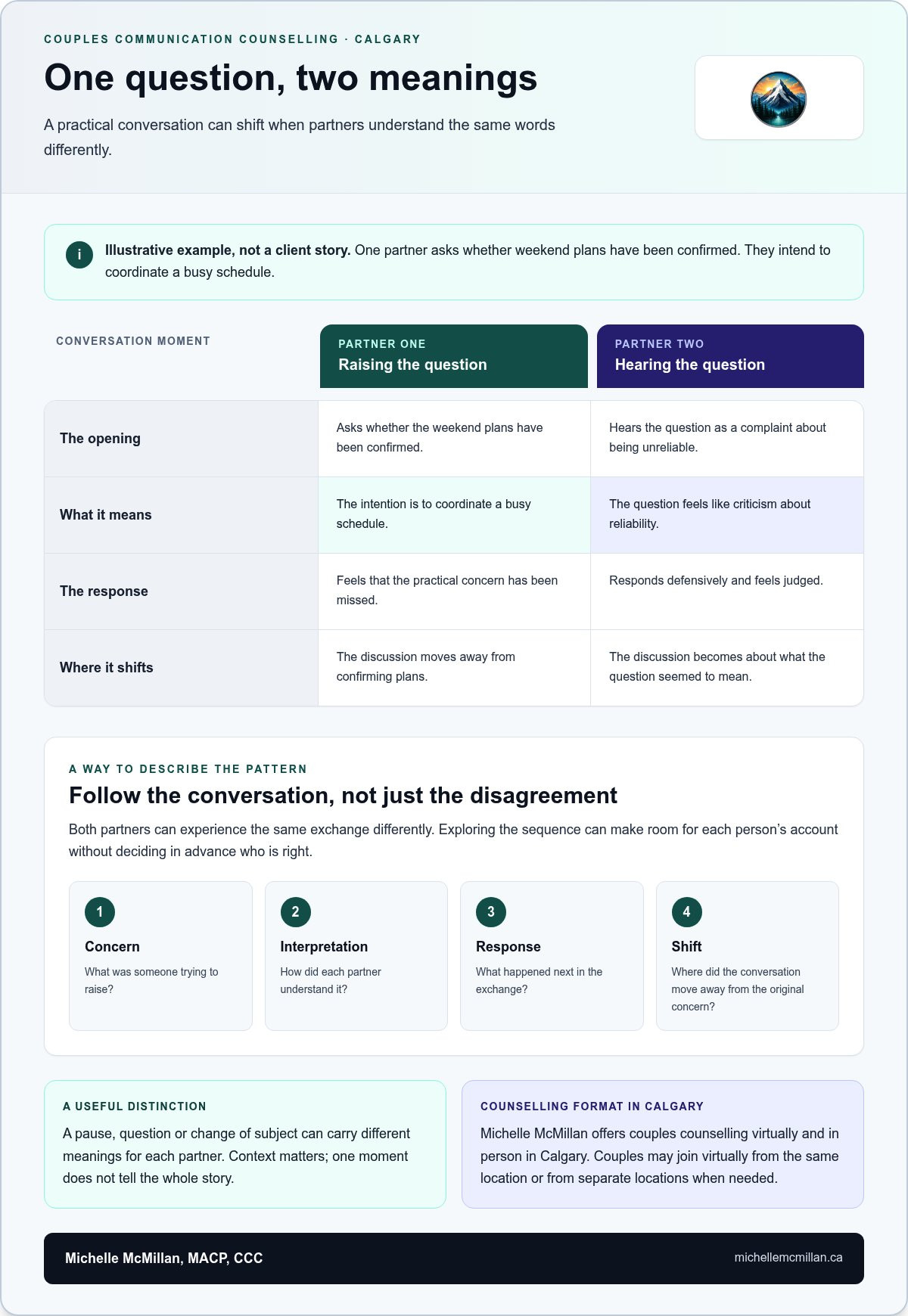
Communication strain can take different forms. One partner may raise a practical concern, such as how household responsibilities are shared, while the other hears criticism. The first partner may then feel dismissed; the second may feel blamed. The conversation can shift away from the original topic, repeat without resolution or end before either person has said what they hoped to say.
Partners may also attach different meanings to a pause, a question or a change of subject. One person might pause to think, while the other experiences that pause as withdrawal. A request for more detail might feel like genuine interest to one partner and questioning or doubt to the other. The context matters, and no single moment tells the whole story.
It can be useful to identify what makes a conversation hard to continue. Is the difficulty mostly about one subject, such as money or family plans? Does it happen across many topics? Do you disagree about what was said, or about what the words seemed to mean? These distinctions can help you describe the concern more clearly without deciding in advance who is right.
When professional support may be worth considering
Couples may consider counselling when a concern feels hard to discuss together, when attempts to talk keep getting interrupted or sidetracked, or when one partner isn’t sure how to raise an issue. You don’t need to agree on every detail before seeking support. One person may see a recurring disagreement as the main concern, while the other sees the difficulty as how the two of you discuss it.
There’s no required level of distress, diagnosis, crisis or decision about separating that must come first. Counselling can be a setting to discuss concerns, whether you’re trying to understand a longstanding pattern or make room for a conversation that feels difficult to begin privately. The decision is personal. Consider what you would want support to make room for, rather than expecting to have a complete account of the problem before starting.
If you’re weighing communication-focused support against a broader conversation about your relationship, the distinction can be a starting point, not a rigid category. Concerns about trust, shared responsibilities or future plans may also involve how you talk with one another. Michelle McMillan offers couples counselling services for partners who want professional support to discuss relationship concerns.
How couples communication counselling explores recurring conversations
A recurring disagreement can seem to be about one practical issue, yet the conversation may become difficult because of what each partner thinks the issue means. One person raises a concern, the other interprets it in a particular way and responds. That response then shapes how the first person hears the exchange. Couples counselling provides professional support for discussing these interactions and the different experiences within them. It doesn’t require deciding that one partner is right or the other is wrong.
Partners can experience the same conversation differently, even when they agree on the words that were said. One may remember trying to bring up a concern carefully; the other may remember feeling caught off guard. Both accounts matter as descriptions of personal experience, though neither alone has to settle the whole story. A related overview from the American Psychological Association discusses the importance of communication in relationships.
Understanding the pattern without deciding who is at fault
Looking at a recurring exchange can bring each person’s perspective into the discussion. The focus is not simply on who started an argument or used the wrong words. It may include the original concern, how each person understood it, what each did next and where the conversation began to shift. This broader view leaves room for both partners’ accounts without treating either as the only objectively correct version.
Illustrative example, not a client story: One partner asks whether weekend plans have been confirmed. They intend to coordinate a busy schedule. The other hears the question as a complaint about being unreliable and responds defensively. The first partner feels their practical concern has been missed, while the second feels judged. The discussion may become less about the plans and more about the meaning each person attached to the question and reply.
In couples communication counselling Calgary, exploring this kind of sequence can clarify what partners are responding to, not just the surface topic. That doesn’t mean every disagreement has a hidden cause or that all conversations follow the same pattern. The details depend on the people involved and the situation they want to discuss.
Making room for different perspectives and concerns
Partners can value different things in the same situation. One might want a decision made early to plan around it; the other may prefer to leave options open. One may express concern directly, while the other needs more time to find the words. These differences don’t automatically indicate a lack of care. They can affect how a message is sent and received, especially when the subject already feels sensitive.
Communication-focused counselling offers space to describe what each partner hoped to convey and what they understood in response. It doesn’t require agreement on every interpretation before a conversation can be explored. If you’d like to learn about the couples counselling services Michelle offers, the services page provides relevant information.
What to compare when considering couples communication counselling in Calgary
Deciding whether to keep talking privately or seek professional support isn’t a test of how hard you’ve tried. Some couples can work through concerns together; others find that a particular subject is difficult to raise without the discussion becoming tense or stopping short. You don’t have to exhaust every other option before considering couples communication counselling Calgary.
Couples counselling versus trying to resolve concerns alone
Private conversations offer familiarity and flexibility. You can choose when to talk and what to focus on. But if the same concern repeatedly leads to misunderstanding, or one partner avoids raising it because of how the discussion may unfold, another setting may be worth considering. Couples counselling provides professional support for discussing relationship concerns and making room for each person’s perspective. It can’t guarantee agreement or determine a single solution for you.
Communication concerns may also connect with questions about trust, shared responsibilities, closeness or the future of the relationship. These topics can overlap. Instead of sorting them into strict categories, consider which part feels most pressing to discuss. Michelle’s relationship and communication areas of focus offer related information.
It may help to distinguish between a concern you can bring to counselling and an outcome no one can promise. For example, you can identify a recurring disagreement or a conversation you find difficult to start. Whether you reach agreement, make a decision or see the issue differently afterward cannot be guaranteed.
Questions about fit, goals, and expectations
Before starting, each partner can consider the concern they most want to discuss. Your answers don’t have to match. One of you may want to talk about how disagreements begin, while the other wants to discuss feeling unheard. Naming these different priorities can clarify what you hope to explore without requiring you to agree on the cause or outcome.
It may also help to think about what would make the discussion useful to you. Is there one recurring topic you want to be able to talk about? Are you trying to understand why conversations often go off course? Or do you want to discuss a broader relationship concern that includes communication? These are ways to describe your priorities, not promises about what counselling will achieve.
Michelle holds a Master of Arts in Counselling Psychology (MACP) and is a Canadian Certified Counsellor (CCC). The CCC is a national professional certification through the Canadian Counselling and Psychotherapy Association.
| Concern | What counselling can offer | What it cannot guarantee |
|---|---|---|
| A topic keeps being avoided | Professional support for discussing the concern | That either partner will agree with the other |
| You remember a conversation differently | Space to describe each person’s experience | A ruling on whose recollection is objectively correct |
| You’re unsure what the relationship question is | An opportunity to explore what feels important to discuss | A fixed decision about the relationship |
These distinctions can help set realistic expectations. Considering counselling doesn’t guarantee a particular relationship outcome. It provides a professional setting to discuss concerns that feel difficult to address together.
Choosing a counselling format for couples in Calgary
Once you’ve considered what you want to discuss, format is another practical choice. Michelle offers both virtual and in-person couples counselling in Calgary, and she prefers to provide much of her counselling virtually. Neither format needs to be framed as the better option. The choice can come down to what is workable for you as a couple and what you feel comfortable arranging.
Virtual couples counselling from Calgary
Virtual counselling is an option for couples in Calgary. You can join together from the same location or participate from separate locations when needed. This can suit partners who aren’t in the same place or who find it easier to join separately. The relevant question is which arrangement is practical for both of you, not whether one format guarantees a different experience or result.
For planning, consider whether you can both set aside time to participate and whether joining from one location or two suits your circumstances. The decision can stay simple: what arrangement is easiest for both of you to manage?
In-person counselling appointments in Calgary
In-person counselling appointments are available in Calgary. Some couples may prefer meeting in person, while others may find virtual counselling fits more easily with their schedules or circumstances. These are format preferences, not indicators of how committed either partner is or what counselling will accomplish. There’s no need to rank one option above the other.
If you’re weighing the formats, consider these practical questions. They can help you identify preferences without dictating which option you should choose:
- Consider logistics. Which format is easier for you both to arrange around travel, schedules and being in the same or separate locations?
- Notice your preference. Do you feel more at ease with a virtual appointment or an in-person meeting? Your answers may differ.
- Keep the purpose in view. Whichever format you consider, what concern would you want to make room to discuss?
You don’t have to reach identical preferences before exploring your options. Talking together about format may bring practical needs into focus, such as one partner having limited flexibility or preferring to meet in person. Couples communication counselling Calgary is available virtually and in person, so you can consider what feels workable without expecting a particular outcome.
Michelle provides couples counselling virtually and in person in Calgary. Couples may join virtual counselling together from the same location or from separate locations when needed.
Considering couples communication counselling with Michelle McMillan
If you’re thinking about professional support, it may help to start with a concern rather than a complete explanation. You might know that certain discussions become difficult but not agree with your partner about why. That difference doesn’t have to be settled in advance. Each of you can consider what you most want to discuss and what feels important for the other person to understand.
Michelle McMillan’s relevant credentials and experience
Michelle McMillan holds a Master of Arts in Counselling Psychology (MACP) and is a Canadian Certified Counsellor (CCC). Her CCC is a national professional certification through the Canadian Counselling and Psychotherapy Association. She also has 16 years of education experience, including work in specialized mental-health and intensive behavioural-support settings with children, teens and families.
That education experience is part of Michelle’s professional background. For you and your partner, the practical question is whether the concerns you want to raise are ones you would like to discuss in couples counselling. You may have different priorities, such as a recurring disagreement or a conversation that feels difficult to begin. You don’t need to resolve those differences before considering support.
A low-pressure next step for Calgary couples
You can take time to decide whether counselling feels relevant. One partner may be ready to explore support while the other is still weighing it; that difference doesn’t have to be treated as a final answer. It may be enough to talk about what each person is uncertain about and what they would want to know before making a decision.
If you’re considering couples counselling with Michelle, reviewing the Rates and Booking information can help you consider a next step at your own pace.
Take the next step at your own pace
You don’t need to have the perfect words for what’s happening between you before considering support. It may be enough to recognize that certain conversations are difficult and that you’d like space to discuss them together. Couples communication counselling Calgary is one option for exploring that concern without committing to a predetermined decision about your relationship.
If you and your partner are considering counselling with Michelle McMillan, take the time you need to decide what feels right. You can begin by identifying the conversation or recurring concern you would like to discuss. You don’t need to have every detail settled before taking a look at the practical information.
Review Rates and Booking information to consider couples counselling with Michelle in Calgary. You can take the next step when you feel ready.
Frequently Asked Questions
Can couples counselling help if we keep having the same argument?
Couples counselling can provide professional support for discussing a recurring disagreement, though it can’t guarantee that you’ll reach agreement. For example, a dispute about how to spend a holiday might also involve different expectations about family time or planning. You can bring a specific concern like this into the conversation even if you’re not sure why it keeps resurfacing or what decision you’ll make.
Do both partners need to agree before starting couples counselling?
You don’t need to agree on every detail of the problem to consider couples counselling. One partner may feel the main issue is the subject you argue about, while the other may be more concerned about how discussions unfold. It can still be useful to consider what each person hopes counselling might offer. If one of you feels hesitant, that concern is worth acknowledging rather than treating it as a failure.
Can we attend virtual couples counselling from separate locations?
Yes. Couples can join virtual counselling from separate locations when needed, or attend together from the same location. Beforehand, you can decide which arrangement works for both of you and consider practical details such as coordinating a suitable time to participate.
Is in-person couples counselling available in Calgary?
Yes, in-person couples counselling appointments are available in Calgary. Virtual counselling is also available, so you can consider either format. The choice is a practical preference, not a promise that one format will lead to a particular experience or result.
Does couples communication counselling mean the relationship is ending?
No. Seeking couples counselling doesn’t mean you’ve decided to separate, and it doesn’t require a predetermined relationship outcome. Partners may seek professional support while they’re still uncertain about what they want or how to approach a concern. Counselling can provide a setting to discuss what’s happening; decisions about the relationship remain yours to consider.
What is the difference between a Canadian Certified Counsellor and a psychologist?
A Canadian Certified Counsellor (CCC) and a psychologist hold different professional designations. The CCC is a national professional certification through the Canadian Counselling and Psychotherapy Association (CCPA), not a provincial licence. In Alberta, Registered Psychologists are regulated by the College of Alberta Psychologists. Michelle McMillan holds a Master of Arts in Counselling Psychology (MACP) and the separate CCC designation. She isn’t a psychologist.
Can we seek couples counselling if we are not married?
Yes. Partners don’t need to be married to have relationship or communication concerns they may want to discuss with a counsellor. You might be dating, living together or building a shared life in another way. The relevant question is whether you want professional support to talk about concerns in your relationship, not your marital status.
Article by
Michelle McMillan, MACP, CCC
Michelle McMillan is a Canadian Certified Counsellor (CCC) with a Master of Arts in Counselling Psychology (MACP). She has extensive experience working with children and supporting clients with ADHD, neurodivergence, anxiety, emotional regulation, relationships and family challenges. Michelle offers both virtual and in-person counselling, with virtual counselling available throughout Alberta, British Columbia, Saskatchewan and Manitoba and in-person appointments available in Calgary.
Important Information
This article is provided for general educational and informational purposes only and is not a substitute for professional counselling, psychological, medical or emergency services. Information shared here should not be considered a diagnosis or individualized treatment advice. If you are experiencing a mental health emergency or are in immediate danger, please contact appropriate emergency services in your area.