
What if the same argument about forgotten plans or unfinished tasks means something different to each of you? When communication, responsibilities, or follow-through keep causing tension, one partner may feel unsupported while the other feels judged. ADHD may shape some relationship patterns, but it doesn’t affect everyone in the same way or explain every conflict. If you’re considering ADHD and relationships counselling Calgary, start by looking at the specific situations that keep troubling you rather than assuming you already know their cause.
This article explores how ADHD-related differences may intersect with couple dynamics and what counselling can offer as a place to discuss those concerns. You’ll also learn how relationship counselling differs from an ADHD assessment or diagnosis, what to consider before seeking support, and what virtual and in-person counselling options are available in Calgary.
Key Takeaways
- ADHD can be relevant to relationship tensions, but its effects differ between people and don’t explain every disagreement.
- Looking at each partner’s perspective on communication, planning, and shared responsibilities can help clarify recurring friction.
- ADHD and relationships counselling Calgary can provide a setting to discuss relationship concerns. It isn’t an ADHD assessment or diagnosis.
- Before counselling, consider the specific patterns you want to discuss and how each of you experiences them.
- Michelle McMillan offers couples counselling virtually and in person in Calgary. Couples can join virtual sessions together or from separate locations.
ADHD and relationships in Calgary: why the same situation can feel different to each partner
ADHD is a neurodevelopmental condition, but its effects vary from person to person. In a relationship, differences related to attention, planning, or follow-through may be relevant to recurring tensions, but they don’t tell the whole story of a couple. Relationship counselling offers professional support for discussing concerns between partners, including situations where ADHD may be part of the context.
For couples exploring ADHD and relationships counselling Calgary, the aim isn’t to decide who is at fault or make every disagreement about ADHD. It’s to understand what happens between you and make room for each partner’s experience. ADHD may be relevant to a relationship pattern without explaining every conflict.
Which relationship patterns might prompt couples to seek counselling?
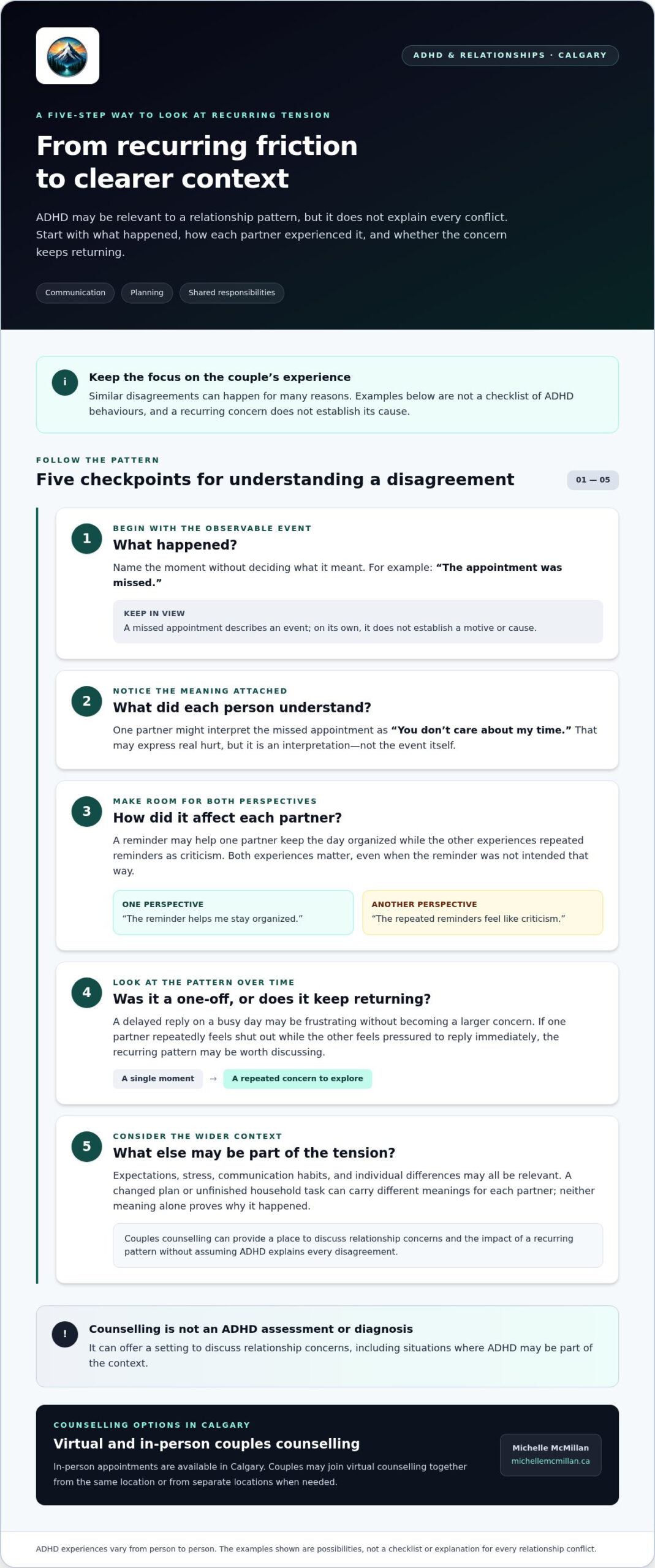
Couples may consider counselling when similar disagreements keep returning. One partner might feel unsettled when plans change, while the other finds planning difficult to keep track of. A household task may be left unfinished: one person sees a broken agreement, while the other remembers intending to complete it. Neither interpretation, by itself, proves a motive or establishes that ADHD caused the situation.
Communication can also be experienced differently. One partner may value reminders about an appointment because they help keep the day organized. The other may hear repeated reminders as criticism, even if that wasn’t the intention. Both reactions matter. The reminder may be useful to one person and uncomfortable for the other. Discussing that difference can clarify what each partner means and how the interaction affects them.
These are examples, not a checklist of ADHD behaviours. Similar conflicts can happen for reasons unrelated to ADHD, and ADHD won’t show up in the same way in every relationship. A useful starting point is the couple’s experience: what happened, what each person understood, and why it became painful or frustrating.
How can couples discuss ADHD without making it the whole relationship?
Separate what can be observed from the explanation attached to it. “The appointment was missed” describes an event. “You don’t care about my time” assigns meaning and intention. The second statement may express genuine hurt, but it isn’t the only possible explanation for what happened. Keeping the distinction in view makes room to discuss both the practical concern and its emotional impact.
Each partner can describe their perspective without treating it as the only accurate account. One might feel alone managing household tasks; the other might feel overwhelmed by repeated reminders. Listening to both doesn’t require either person to dismiss their own experience or settle the cause immediately.
There may be several factors at play, including expectations, stress, communication habits, and individual differences. Couples counselling can provide a place to discuss these layers without assuming ADHD excuses hurtful impact or explains every disagreement.
How ADHD-related differences can show up in communication and shared responsibilities
Friction can arise in everyday moments: a message left unanswered, a plan that shifts, or a task that stays unfinished. These situations can affect both partners, but they don’t automatically point to ADHD or reveal what either person intended. The same relationship pattern can carry different meanings for each partner.
It can help to distinguish a one-off disagreement from a recurring concern. A delayed reply on a busy day may be frustrating without becoming a larger issue. If one partner repeatedly feels shut out while the other feels pressured to answer immediately, the recurring pattern may be worth discussing. Focus on what happened, how it affected each person, and whether it keeps returning.
Communication differences are individual, not a checklist
Imagine one partner asks a question and hopes for an immediate response. The other wants time to think before replying. The first may experience the pause as distance; the second may feel rushed. Neither interpretation establishes the other person’s motive, and neither communication style is proof of ADHD. Describe the moment and its impact rather than labelling a partner as uncaring or difficult.
ADHD experiences vary, and communication differences can have many possible explanations. For general background on ADHD, the National Institute of Mental Health’s ADHD information covers symptoms, diagnosis, and treatment. It can offer context, but it can’t determine what a particular interaction means for a couple.
Planning and follow-through can become shared relationship concerns
A changed plan may leave one partner disappointed after they arranged their evening around it. The other may have misunderstood the timing or found that circumstances changed. An unfinished task can carry meaning beyond the task itself: one partner may feel left to manage the household, while the other may feel their efforts are being reduced to what remains undone. Those feelings deserve attention without turning a difficulty into a character judgement.
Shared responsibilities also involve expectations. Partners may differ on what “done” means, when a task needs to happen, or who is keeping track of it. Naming the point of friction can be more useful than arguing over whether someone “always” follows through. A single lapse doesn’t diagnose ADHD, and a recurring concern doesn’t establish its cause.
In ADHD and relationships counselling Calgary, couples can discuss how a repeated situation affects each person while considering the wider relationship context. If these conversations feel difficult to have together, couples counselling services offer a professional setting to raise relationship concerns.
Does ADHD explain the conflict, and what can couples counselling address?
ADHD can be part of the context for relationship tension, but it isn’t a complete explanation for every disagreement. A couple may be dealing with different expectations, stress, communication habits, or unresolved hurt alongside ADHD-related concerns. Taking ADHD seriously means considering its possible relevance without assuming it tells the whole story or excuses hurtful impact.
Couples counselling is a place to discuss relationship concerns, not a diagnostic assessment. It can provide professional support as partners describe what feels difficult, how each person experiences it, and what they hope to address together. You don’t need to arrive with a settled explanation for every conflict.
When might couples consider counselling for ADHD-related relationship concerns?
Couples may consider support when tension keeps returning or conversations about the same concern become difficult because one or both partners feel defensive, withdrawn, or unheard. This may include a couple where one partner has ADHD and both want to discuss how it relates to their shared experience. The focus can remain on the relationship concern rather than assigning one person responsibility for everything.
There’s no threshold a couple has to reach before seeking support, and counselling doesn’t guarantee a particular result. It can provide space to clarify what each partner wants to discuss, even when you understand the problem differently.
Counselling is different from ADHD assessment or diagnosis
These supports have different purposes. Keeping that distinction clear can help you identify the kind of support that matches your question.
Couples counselling: Professional support for discussing relationship experiences, recurring tension, and personal concerns that may affect the partnership.
ADHD assessment or diagnosis: A separate process focused on determining whether a person meets criteria for ADHD. Couples counselling does not establish a diagnosis.
Michelle McMillan provides counselling, but not ADHD assessments, diagnoses, or medication recommendations. Her ADHD support and counselling focus offers further information about ADHD-related concerns.
For couples considering how ADHD-related experiences and relationship dynamics intersect, ADHD and relationships counselling Calgary can provide a professional setting to discuss the impact on both partners without presuming a single cause. Learn more about couples counselling services as you consider what kind of support you’re looking for.
How to prepare for ADHD and relationships counselling in Calgary
You don’t need a perfect summary of your relationship before counselling. It can help to identify what has been difficult lately, what each of you hopes to discuss, and where your perspectives differ. Preparing is about bringing your concerns into focus, not proving whose explanation is right.
What relationship concerns might each partner want to bring?
Choose one recurring situation as a starting point. It might involve a plan changing, a household task, or a conversation that repeatedly ends with one person feeling unheard. Focus on what happened and its effect on the relationship rather than trying to settle the cause in advance.
Each partner may find it helpful to consider:
- The situation: What happened, and what made it stand out as a concern?
- The impact: How did it affect you, your partner, or the way you relate to each other?
- Your hopes: What would you like counselling to give you space to discuss?
Your answers don’t have to match. One partner might see a missed agreement as a practical problem that needs attention, while the other may be more concerned about feeling criticized during conversations about it. Both experiences can be part of the discussion. If it’s hard to choose a single issue, identify a few examples and consider which feels most important to address first.
This reflection can help keep ADHD and relationships counselling Calgary centred on your relationship as you experience it, rather than assumptions about what ADHD must mean for either of you.
What virtual and in-person counselling options are available?
Michelle offers both virtual and in-person counselling, and prefers to provide much of her counselling virtually. In-person counselling appointments are available in Calgary. Virtual counselling is available in Alberta, British Columbia, Saskatchewan, and Manitoba.
For virtual couples counselling, partners may join from the same location or from separate locations when needed. You can consider practical factors, such as where each partner will be joining from and whether you’d prefer to attend together in person or connect virtually. The couples counselling service information provides further details.
Couples counselling with Michelle McMillan in Calgary: credentials, experience, and next steps
Considering counselling can bring up questions about the counsellor, the support they provide, and whether your concerns are suitable for couples counselling. Clear information can help you decide what you’d like to explore without requiring a complete explanation for the relationship difficulties you’re facing.
Michelle’s relevant experience with ADHD, relationships, and families
Michelle McMillan holds a Master of Arts in Counselling Psychology (MACP) and is a Canadian Certified Counsellor (CCC). The MACP is her academic degree; the CCC is her national professional certification through the Canadian Counselling and Psychotherapy Association (CCPA).
Michelle has 16 years of education experience, including work in specialized mental-health and intensive behavioural-support settings with children, teens, and families. Her areas of focus include ADHD and neurodivergence, anxiety, emotional regulation, relationships, parenting, family challenges, life transitions, self-esteem, and personal growth. These concerns can overlap in different ways for different people and couples. For more context about her professional background, visit the About Michelle page.
Choose a next step that feels manageable
You might begin by identifying the relationship concern you most want to discuss, or by reviewing information about ADHD, neurodivergence, and relationship concerns. You don’t have to settle on a single explanation before looking into counselling. It’s enough to have a sense of what has been difficult and what you’d like space to talk about together.
Michelle offers virtual and in-person counselling. In-person appointments are available in Calgary, and virtual counselling is available in Alberta, British Columbia, Saskatchewan, and Manitoba. Couples may join virtual counselling together from one location or from separate locations when needed.
If you’re considering ADHD and relationships counselling Calgary, review the rates and booking information to consider whether you’d like to take the next step.
Make room for a different conversation
Recurring conflict can leave both partners feeling unheard. It may help to approach the issue with curiosity, not to decide whether ADHD is the reason, but to understand what each person is experiencing and what they want to address together. You don’t need to agree on every detail before beginning a conversation.
ADHD and relationships counselling Calgary can provide professional support for discussing relationship concerns without reducing the partnership to a diagnosis. The focus can remain on the specific difficulties you’re facing, while recognizing that ADHD may be relevant for one or both partners in different ways.
If you’re considering couples counselling, review the practical details and decide whether you’d like to explore booking. Explore rates and booking when you’re ready to consider that next step.
Frequently Asked Questions
Can couples counselling help if only one partner has ADHD?
Couples counselling can be a place to discuss relationship concerns even if only one partner has ADHD. The conversation can include how each person experiences a shared issue, rather than treating the partner with ADHD as the sole focus. For example, partners may want to discuss how ADHD-related needs fit alongside their expectations of each other. Counselling can make room for both perspectives without assuming the same explanation applies to every couple.
Is every recurring relationship conflict connected to ADHD?
No. A repeated disagreement doesn’t establish that ADHD is its cause. Partners may have different expectations, priorities, or ways of responding to a situation, and several factors can overlap. For instance, tension around spending time with extended family may involve differing preferences or past disagreements, whether or not ADHD is part of the relationship. Consider the specific concern and its context rather than treating recurrence alone as evidence of ADHD.
Can couples attend virtual counselling from separate locations?
Yes. Couples may join virtual counselling from separate locations when needed, rather than being together in one room. You can think about the concern you’d like to discuss and what each of you hopes to contribute, even if you’ll be connecting from different locations.
Does couples counselling diagnose ADHD?
No. Couples counselling provides professional support for discussing relationship concerns, but it isn’t an ADHD diagnostic assessment. Michelle provides counselling, not ADHD assessments, diagnoses, or medication recommendations. If the main question is whether one partner has ADHD, keep that distinct from the couple’s concerns about how you relate to each other.
What should we talk about in ADHD and relationships counselling?
Bring the concern that feels most important to discuss, even if you and your partner see it differently. You might talk about what you hope will be understood, what feels hard to say together, or how a relationship tension affects decisions you make as a couple. It’s also reasonable to name uncertainty: you may know something feels difficult without knowing whether ADHD, another factor, or a combination is involved.
Can we choose between virtual and in-person counselling in Calgary?
Yes. Michelle offers virtual and in-person counselling, with in-person appointments available in Calgary. Virtual counselling is available in Alberta, British Columbia, Saskatchewan, and Manitoba. You can consider practical factors such as where each partner will be joining from and whether you’d prefer to attend together in person or connect virtually.
What does Canadian Certified Counsellor (CCC) mean?
Canadian Certified Counsellor (CCC) is a national professional certification through the Canadian Counselling and Psychotherapy Association (CCPA). It is distinct from Michelle McMillan’s Master of Arts in Counselling Psychology (MACP), which is her academic degree. The CCC designation is not a provincial licence or the title of psychologist. These terms describe different credentials, so it’s helpful to use each accurately.
Article by
Michelle McMillan, MACP, CCC
Michelle McMillan is a Canadian Certified Counsellor (CCC) with a Master of Arts in Counselling Psychology (MACP). She has extensive experience working with children and supporting clients with ADHD, neurodivergence, anxiety, emotional regulation, relationships and family challenges. Michelle offers both virtual and in-person counselling, with virtual counselling available throughout Alberta, British Columbia, Saskatchewan and Manitoba and in-person appointments available in Calgary.
Important Information
This article is provided for general educational and informational purposes only and is not a substitute for professional counselling, psychological, medical or emergency services. Information shared here should not be considered a diagnosis or individualized treatment advice. If you are experiencing a mental health emergency or are in immediate danger, please contact appropriate emergency services in your area.