
Relationship counselling in Calgary can help couples discuss recurring conflict, communication difficulties, changes in closeness, and other concerns affecting their relationship. A couples counsellor offers a space to understand each partner’s perspective and work together on the issues they bring forward. The counsellor supports the process; decisions about the relationship remain with the partners.
It can be hard to know whether a difficult period is something you can work through together or whether outside support could help. Seeking counselling doesn’t mean you’ve failed. It offers a structured setting to discuss concerns before the same arguments or misunderstandings keep taking over.
This article explains what couples counselling may address, how approaches such as Emotion-Focused Therapy and the Gottman Method differ, and when it may be useful to seek support. You’ll also learn what to consider when choosing a counselling format, how insurance direct billing generally works, and how relationship concerns can connect with wider family or individual challenges.
Key Takeaways
- Couples counselling can help partners explore recurring conflict, communication difficulties and other concerns without deciding the relationship’s future for them.
- Different therapy approaches focus on different parts of relationship concerns; learn what distinguishes EFT, the Gottman Method and CBT.
- Consider seeking support when difficult conversations keep repeating or relationship concerns are affecting family life.
- Virtual and in-person counselling are available in Calgary, and couples can join virtually together or from separate locations.
- Understand how direct billing differs from reimbursement, and how individual or family counselling may relate to concerns affecting a couple.
What can a couples therapist help with?
A couples counsellor can help partners talk through concerns that feel difficult to address alone. For people considering relationship counselling in Calgary, a useful first step is identifying the specific issue each person wants understood. Partners don’t need identical explanations. One may describe frequent tension; the other may feel decisions happen without them.
Marriage and Couples Therapy
Marriage counselling and couples therapy can make space for concerns at different stages of a relationship. Partners might want to discuss shifting responsibilities, parenting decisions, trust, or a transition such as moving or changing work arrangements. Naming the subject helps keep the conversation grounded in what is happening now, rather than turning it into a general judgment about either partner.
Relationship counselling in Calgary can also help partners clarify what each hopes to get from the conversation. One person might want to feel heard, while the other wants to agree on a practical decision. A counsellor can support discussion of both priorities without deciding whether the couple should stay together.
Support for Conflict and Disconnection
Sometimes the issue is not a single argument but its effect on daily life. A disagreement about household tasks, for example, may also involve expectations about fairness, time, or recognition. Discussing one concrete situation can help partners explain what mattered to them and where their interpretations differ.
Feeling disconnected can mean different things to each person. One partner may want more shared time, while the other wants fewer tense conversations. A counsellor can help make those differences discussable without treating either preference as the only valid one. The couple can then consider which concern to address first.
Emotionally Focused and Developmental Approaches
Approaches such as Emotion-Focused Couples Therapy and Developmental Couples Therapy frame relationship concerns in different ways. Rather than choosing a method by its name alone, consider the issue you want to explore: a change in shared roles, a difficult transition, or a gap between what each partner needs from the relationship.
It can also help to consider what you want from counselling at this point. You might hope to understand a recurring disagreement, discuss a decision, or put words to a change in closeness. Sharing that goal during an appointment gives the counsellor useful context while leaving room for both partners’ perspectives.
Couples therapy is collaborative: each partner contributes their perspective, and the counsellor supports the discussion. Before an appointment, choose one recent situation you both remember. Describing what happened and what each of you wants to understand can give the conversation a clear starting point.
EFT, Gottman Method, CBT, and other therapy approaches
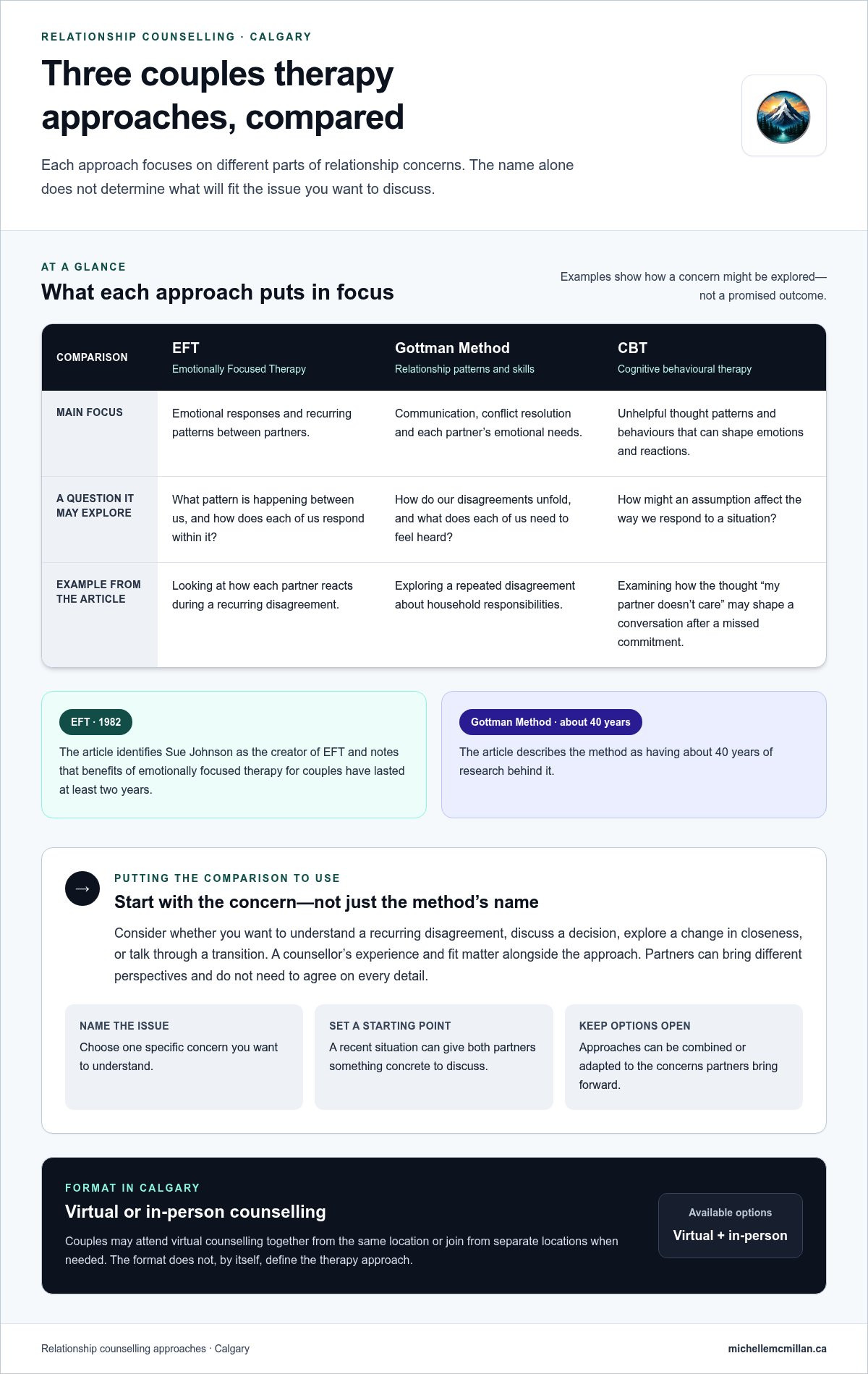
Couples therapy approaches differ in their focus, which may include emotional patterns, conflict skills, or thoughts and behaviours. Understanding these differences can help you discuss what matters most during an initial appointment.
How the approaches differ
Emotionally Focused Therapy (EFT) explores emotional responses and recurring patterns between partners. Sue Johnson created EFT in 1982. Benefits of emotionally focused therapy for couples have lasted at least two years. Rather than treating one partner as the problem, EFT considers how each person responds within the relationship.
The Gottman Method focuses on communication, conflict resolution, and understanding each partner’s emotional needs. It has about 40 years of research behind it. For example, a couple who repeatedly argues about household responsibilities might use this approach to examine how disagreements unfold and what each partner needs to feel heard.
Cognitive behavioural therapy (CBT) addresses unhelpful thought patterns and behaviours that can shape emotions and reactions. A couple might explore how an assumption such as “my partner doesn’t care” affects a conversation after a missed commitment. Approaches can also be combined or adapted to the concerns partners bring forward.
Choosing a therapist and starting sessions
A counsellor’s experience and fit matter alongside a therapy’s name. Consider their education, professional designation, and experience with relationship concerns. Ask how the approach relates to your goals, such as discussing conflict more constructively or understanding emotional distance. A respectful process makes room for both partners’ perspectives, without requiring agreement on every detail.
Initial sessions may include discussing what brings you to counselling, each partner’s concerns, and what you hope to address. You can use a recent disagreement as a concrete starting point. Notice whether the counsellor explains their role clearly and helps both partners participate. The first conversation can clarify whether the approach feels relevant to the concerns you want to explore.
Virtual and in-person options in Calgary
In Calgary, couples can choose virtual or in-person counselling. Virtual appointments can be convenient when schedules or distance make meeting in person difficult. Couples may attend together from the same location or join from separate locations when needed.
The format does not, by itself, define the therapy approach. Discussing your preferred setting and practical circumstances can help you decide what works for both partners. A useful next step is identifying the concern you want to bring to the first session, whether it’s a recurring disagreement, a transition, or a wish to reconnect.
When should a couple seek counselling?
Consider counselling when the same concern keeps returning without a productive conversation, or when distance is affecting daily life. For example, you may repeatedly argue about parenting schedules, avoid discussing finances, or feel unsure how to talk after a breach of trust. Seeking support before a difficult pattern becomes your main way of communicating can give both partners space to explain what is happening.
There’s no standard number of sessions or universal schedule for couples counselling. The length and frequency depend on the concerns, the partners’ goals, and how the work develops. The plan can be discussed and revisited as sessions progress.
Abuse, threats, or fear of a partner’s reaction call for careful attention to safety. Joint counselling may not be safe or suitable when one partner cannot speak freely. Prioritize immediate safety and seek confidential, individual support before considering shared sessions.
Choosing virtual or in-person counselling
In Calgary, in-person appointments and virtual counselling are available. Virtual counselling is offered to residents of Alberta, British Columbia, Saskatchewan, and Manitoba. The format is a practical choice, not a therapy method: consider where each partner can participate, travel demands, work schedules, and whether both people can join consistently.
Couples may attend virtual sessions together from the same location or join from separate locations when needed. Different work schedules or travel between Alberta communities, for example, may make separate connections more practical. In-person appointments are also available in Calgary for partners who prefer meeting face to face. Neither format determines whether a counsellor uses an emotionally focused method; the concerns and goals shape the conversations.
Signs support may be timely
A decision to seek help doesn’t require both partners to describe the problem in the same way. One might say arguments have become more frequent; the other may notice they’ve stopped sharing decisions or spending time together. Those differences can be discussed directly. A useful first step is to name one recent moment, what each person experienced, and what they hope to understand.
Consider support when a mental health concern, major transition, or family pressure is affecting the relationship. A new parenting responsibility or a change in work demands, for instance, can alter how partners divide time and communicate. Counselling offers room to examine how the change affects each person and what they want to address together. You can begin by agreeing on the main concern for an initial appointment, even if you’re still developing a shared view of the relationship.
Insurance direct billing
Whether a counselling appointment is covered depends on the eligibility rules that apply to your plan. For Alberta health insurance, don’t assume a relationship counselling appointment qualifies simply because it involves mental health. Coverage terms and the type of service determine whether a cost is eligible. Workplace and individual benefit plans also have their own conditions, so review the wording that applies to your situation.
Direct billing describes a payment process: a provider submits an eligible claim to an insurer. Reimbursement is different. You pay for the appointment and submit a claim yourself under your plan’s process. Neither term guarantees coverage. The insurer’s eligibility decision depends on its rules and the details submitted with the claim.
Plans may define eligible counselling services and provider designations differently. One plan might describe coverage by the professional’s designation; another might distinguish between individual and couples services. For example, a benefit category that names individual counselling does not, by itself, explain how a joint appointment is treated. Read the relevant plan language before relying on an assumption about coverage.
What to review in a benefits plan
Look for the section on counselling or mental health services. Note the eligible provider designations, service types, and claim requirements. If the wording refers to one covered person, consider whether it addresses a session attended by two partners. These details help you understand how the plan evaluates a particular appointment, rather than relying on broad labels such as “therapy coverage.”
Keep the provider designation and service description in view when reading the plan. For instance, if the plan names specific professional categories, compare those terms with the information used for the appointment claim. If an insurer declines a claim, its explanation can identify the applicable condition. That may clarify whether the issue concerns the provider category, the service, or another plan rule.
Planning for payment
Before an appointment, identify whether the intended payment route is direct billing or reimbursement, and understand what information the claim requires. If both partners have separate benefit plans, each plan’s terms apply independently. Coverage under one person’s plan does not establish eligibility under the other’s.
For Calgary couples, separating the counselling decision from the payment question can make planning more manageable. A relationship concern may feel difficult to raise, while administrative details can seem unfamiliar. Start by locating the plan’s counselling section and noting its eligibility language. Then use that information to understand the possible payment process for the appointment, without treating general benefit descriptions as a guarantee of coverage.
Counselling for families and individuals
A relationship concern can be part of a wider family story. Parenting demands, family roles, or an individual life change may shape how partners relate. For example, one parent may want more structure at home while the other prioritizes flexibility. Counselling can help clarify whether the concern is mainly between partners, shared across the family, or connected to one person’s experience.
When individual support may be useful
Individual counselling gives one person space to explore their own concerns, even when a relationship is part of the context. Someone facing a major transition, anxiety, or questions about self-esteem might want to understand how those experiences affect conversations at home. This doesn’t require assigning blame or deciding what the other partner should do.
A helpful starting point is naming what you want to understand. You might notice, for instance, that you avoid raising a concern because you expect an argument. Exploring that experience individually can help you identify what you want to discuss, while leaving decisions about the relationship with you.
When family counselling may fit
Family counselling can make sense when a concern involves more than the couple. A change in caregiving responsibilities, tension between a parent and teenager, or disagreements about household expectations may affect several family members. The focus can include how each person experiences the issue and what they want the conversations to address.
Family members may see the same situation differently. A teenager might describe a household rule as restrictive, while a parent views it as a safety concern. Making room for those perspectives can help define the shared concern without labelling a family member as the problem. The issue can be discussed in the context of each person’s role and needs.
Choosing the focus
Before arranging support, consider who is most affected and what you hope to discuss. If the concern centres on a couple’s interaction, couples counselling may be the relevant focus. If parenting or family communication is central, family counselling may better reflect the people involved. One person may also begin individually when they want to reflect before a shared conversation.
The Gottman Method, discussed earlier, is a couples therapy approach; its name alone doesn’t determine whether family or individual counselling fits. Likewise, “psychologist” is a different professional designation from “counsellor.” When reading professional profiles, look at the stated qualifications and the type of support offered, then connect those details to your concern.
If your relationship concern overlaps with parenting, family tension, or personal change, explore counselling service options that relate to the people affected and the questions you want to address.
Michelle McMillan: Individual Therapy
Michelle McMillan offers Individual Therapy, Couples Counseling, Family Therapy, and Child & Adolescent Therapy. If relationship concerns overlap with parenting stress, family conflict, or a personal life transition, counselling can provide space to discuss what is affecting you or your family.
Michelle holds a Master of Arts in Counselling Psychology and is a Canadian Certified Counsellor, a national professional certification through the Canadian Counselling and Psychotherapy Association. She has 16 years of education experience, including work with children, teens, and families in specialized mental-health and intensive behavioural-support settings.
Michelle offers virtual and in-person counselling, with in-person appointments available in Calgary. Virtual counselling is available throughout Alberta, British Columbia, Saskatchewan, and Manitoba. To explore whether counselling suits the concerns you’re bringing forward, visit the Rates and Booking page.
Choose a next step that feels manageable
You don’t need to have every concern resolved before beginning a conversation. Start by naming what you want support to focus on, whether that’s a difficult decision, family strain, or something you want to explore individually. You and your partner may have different hopes, and that’s useful context to bring into counselling.
Michelle McMillan offers Couples Counseling, Individual Therapy, and Family Therapy. If you’re considering counselling in Calgary, review the Rates and Booking information as a low-pressure next step. You can take time to decide what feels right for you.
Frequently Asked Questions
How much does counselling cost in Calgary?
The fee depends on the counselling service and appointment details. Don’t assume an individual appointment and a couples appointment have the same price. For current fee information and booking details, use the Rates and Booking page. If you’re budgeting, consider how the service you’re seeking and the appointment arrangement fit your needs, rather than relying on an average from another practice.
What can I expect during the initial session?
The first session is 90 minutes. You can use that time to describe what brings you to counselling, what you hope to discuss, and any context that feels relevant. For example, a couple might outline a recurring point of tension and how each partner experiences it. You don’t need a formal diagnosis to begin counselling; you can start with the concern you want to explore.
What methods do you use, and how do they differ?
Michelle’s listed approaches include Emotion-Focused Therapy (EFT), Cognitive Behavioural Therapy (CBT), Strengths-Based Therapy, Person-Centred Therapy, and Attachment-Based approaches. EFT focuses on emotional patterns in relationships, while CBT looks at connections between thoughts, feelings, and behaviours. Strengths-Based and Person-Centred approaches emphasize a person’s resources and perspective. Attachment-Based approaches consider how relational experiences may shape connection. The approach used depends on the counselling context.
Why seek support?
Support can be useful when a concern keeps affecting conversations, family life, or your ability to manage a transition. For example, you may want space to discuss parenting disagreements, tension with a family member, or how a major change is affecting you. Counselling offers a professional setting to explore those concerns. You can begin by identifying what feels most important to talk about, without having a complete solution in mind.
What relationship counselling services are available in Calgary?
Michelle offers Couples Counseling, as well as Individual Therapy and Family Therapy. In-person counselling appointments are available in Calgary, and virtual counselling is offered to people residing in Alberta, British Columbia, Saskatchewan, and Manitoba. Couples can attend virtual counselling together from the same location or join from separate locations when needed. The format and service focus can help you describe what kind of support you’re seeking.
How much does couples counselling cost in Calgary?
Couples counselling fees depend on the appointment and service details, so a general Calgary price may not reflect the cost of your counselling. Michelle’s Rates and Booking page provides current fee and booking information. If you’re planning with a partner, consider how you’ll handle payment and any workplace-benefit claims; coverage depends on the terms of each individual policy.
Are there low-cost or sliding-scale couples counselling options in Calgary?
A sliding-scale fee adjusts the amount charged according to a person’s financial circumstances, while low-cost counselling refers more broadly to reduced-fee options. These arrangements depend on each provider’s policies, so don’t assume a particular fee adjustment applies. For counselling with Michelle, use the Rates and Booking page for current fee information. If you’re planning your budget, distinguish the appointment fee from any amount an insurer may reimburse.
How do I choose a couples counsellor in Calgary, and what qualifications should I check?
Start by matching the counsellor’s experience and stated focus to the concerns you want to discuss, such as recurring conflict or family changes. Michelle holds a Master of Arts in Counselling Psychology (MACP) and is a Canadian Certified Counsellor (CCC). The CCC is her national professional certification through the Canadian Counselling and Psychotherapy Association. These credentials are distinct; the CCC designation does not mean she is a psychologist.

Article by
Michelle McMillan, MACP, CCC
Michelle McMillan is a Canadian Certified Counsellor (CCC) with a Master of Arts in Counselling Psychology (MACP). She has extensive experience working with children and supporting clients with ADHD, neurodivergence, anxiety, emotional regulation, relationships and family challenges. Michelle offers both virtual and in-person counselling, with virtual counselling available throughout Alberta, British Columbia, Saskatchewan and Manitoba and in-person appointments available in Calgary.
Important Information
This article is provided for general educational and informational purposes only and is not a substitute for professional counselling, psychological, medical or emergency services. Information shared here should not be considered a diagnosis or individualized treatment advice. If you are experiencing a mental health emergency or are in immediate danger, please contact appropriate emergency services in your area.