
Online psychotherapy can be a suitable option if you’re looking for professional support and feel comfortable meeting remotely. Whether it fits depends on your concerns, preferences and access to a counsellor who can work with you where you live. The key question is whether virtual appointments feel like a practical way for you to get support.
It’s understandable to wonder whether online counselling can meet your needs, or whether you need a referral, diagnosis or health card first. This article explains what virtual counselling can involve, how online cognitive behavioural therapy relates to psychotherapy, and what to consider when looking for support in Calgary and Alberta.
You’ll also find practical guidance on access and common questions to help you make an informed decision at your own pace.
Key Takeaways
- Understand how provider service areas can affect access to virtual counselling when you live in Ontario or another province.
- Consider what you’d need to make switching between online and in-person sessions practical for you.
- Separate referral requirements from questions about diagnosis, health cards and insurance coverage.
- Explore how virtual counselling can be arranged for individuals, couples, families and young people.
- Learn what online CBT involves and how to decide whether this kind of support matches what you’re looking for.
Access to online therapy across Ontario and other provinces
Online therapy lets you meet with a mental health professional remotely, rather than travelling to an office. In Alberta, British Columbia, Saskatchewan, Manitoba and across other regions, qualified practitioners are among the professionals who may offer psychotherapy services. The word “therapist” alone doesn’t tell you a person’s education, professional designation or areas of practice. Before beginning, look at the provider’s stated credentials and the concerns they work with. For example, someone seeking support for depression may want to understand whether the professional has relevant experience and what their service includes.
Access also depends on whether a counsellor is registered to work with you where you live. A virtual appointment doesn’t mean a professional can serve clients in every province, as registration requirements are tied to specific jurisdictions such as Alberta or British Columbia. Check the service area, professional designation and appointment format. These details matter if you’re moving between provinces or live outside a major centre. Families can also look for information about the age groups served, since children and adults may have different support needs.
A good fit depends on your concerns and preferences, not just the appointment format. You might be seeking support with anxiety, depression, obsessive-compulsive disorder (OCD) or post-traumatic stress disorder (PTSD). These concerns affect people differently. When reviewing a counsellor’s profile, note their areas of practice and professional background, and whether they describe working with the concern you want to discuss. You can also prepare a brief list of topics, such as how anxiety affects work or how low mood changes your daily routine.
- Identify the main concern: name the issue you want to discuss, such as depression or OCD.
- Review professional information: distinguish a psychologist, social worker or clinical counsellor by their stated designation.
- Consider the fit: note whether the provider’s stated experience and service details relate to your needs.
Personalized counselling responds to the person’s concerns and goals rather than assuming that everyone with the same diagnosis needs identical support. For example, two people experiencing anxiety may want to discuss different situations, such as social interactions or workplace stress. A conversation about goals can clarify what you hope to explore and which priorities you may want to revisit. It can also cover practical preferences, including whether online appointments feel accessible and comfortable.
Online therapy can be as effective as in-person therapy for some concerns, including anxiety, depression, stress and relationship challenges. A 2018 systematic review and meta-analysis compared internet-based cognitive behavioural therapy with face-to-face cognitive behavioural therapy. That comparison does not establish that every online service or treatment fits every person. If you’re considering support for OCD or PTSD, focus on the professional’s stated experience and discuss what you want help addressing. The format is one consideration; the provider’s background and your specific needs also matter.
Switching between online and in-person sessions
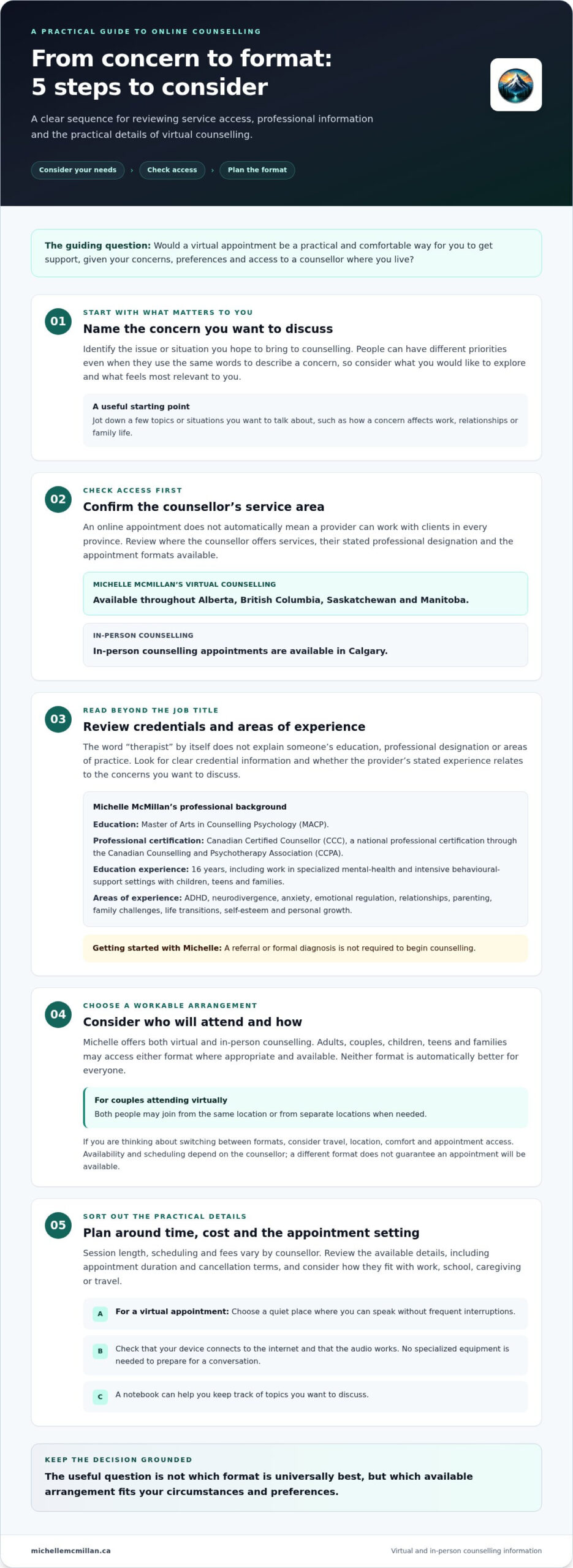
Some counsellors offer both virtual and in-person appointments, but the available formats depend on their practice. If you’re considering a change in format, think about what would make it easier to attend and take part. For example, an online appointment may suit a week when travel is difficult. Neither format is automatically better for everyone.
Appointment length and scheduling vary by counsellor. Before starting, look for information about session length, scheduling and available formats. These details can help you plan around work, school, caregiving or travel. If your schedule changes, discuss your options rather than assuming another format will have an appointment available.
Changing the format doesn’t necessarily change the focus of counselling. Individual appointments may centre on personal concerns, while couples or family counselling involves more than one participant. Children and teens can also access counselling, depending on the service. Couples may join a virtual appointment together or from separate locations. A counsellor’s service description can clarify who the appointments are for and how they’re offered.
Cost is another practical consideration, and there isn’t one standard fee across counsellors. Fees may vary with the professional, format and session length. Compare the stated fee with the appointment duration and cancellation terms, rather than considering cost alone. Professional designations also differ, so read the counsellor’s information carefully to understand who would provide the service.
For a virtual appointment, choose a quiet place where you can speak without frequent interruptions. Check that your device connects to the internet and that the audio works before the appointment. A notebook can help you keep track of topics, such as a relationship concern or family stress. You don’t need specialized equipment to prepare for a conversation.
When deciding whether to change formats, consider appointment access, location, cost, session length and your comfort with each option. A parent, for example, might choose virtual counselling during a demanding school week when travel is difficult. Families can also discuss how each person will join and which format suits the appointment. The useful question is not which format is universally best, but which available arrangement fits your circumstances.
Do I need a referral, a diagnosis, or a health card?
You don’t need a referral to begin counselling with Michelle McMillan. You also don’t need a formal diagnosis to start. A referral and diagnosis are different: a referral directs someone to a service, while a diagnosis identifies a health condition. Counselling can begin with a conversation about your thoughts, experiences and support needs.
A diagnosis isn’t an entry requirement for counselling. You might want to discuss stress affecting your sleep or relationships without having a formal diagnosis. The service and payment route still matter: counselling isn’t the same as a medical assessment or diagnosis, and a counsellor’s professional role differs from a physician’s. If you’re seeking an assessment or medical care, those are separate services.
A provincial health card and workplace benefits serve different purposes. Publicly funded health care and private benefits follow different rules, so don’t assume an online counselling appointment is billed through the Ontario Health Insurance Plan (OHIP). OHIP and an employer’s extended health plan are separate payment routes. Coverage depends on the service and the provider’s designation.
Some Canadian benefit plans cover services from specific professional designations, such as social workers or registered psychotherapists. Your plan’s wording determines which designations qualify. It may also set reimbursement limits, eligible appointment types and any copayment. A plan may recognize one designation but not another, even when both professionals provide mental health support. The designation on a receipt can matter when you submit a claim.
Use these steps to understand the payment route before starting:
- Identify the provider designation: note whether the professional is a social worker, psychologist, psychiatrist, counsellor or registered psychotherapist.
- Read your benefit terms: look for eligible designations, appointment coverage, reimbursement limits and copay details.
- Separate public and private coverage: an Ontario health card and an employer plan don’t represent the same funding source.
For example, one person may have a health card but no workplace benefits. Another may have extended coverage through work, with reimbursement tied to a listed professional designation. These situations call for different budgeting decisions. A diagnosis alone doesn’t determine what a benefits plan will reimburse; provider credentials and plan terms also affect eligibility.
Keep plan documents and receipts together if you intend to submit a claim. This makes it easier to compare the counsellor’s designation with your plan’s wording and track any copayment or reimbursement. The key questions are separate: whether you need a referral, whether you’re seeking counselling or an assessment, and which payment route applies. Considering them individually can make your next step clearer.
What are the advantages of online counselling?
Online counselling can fit around work, school, caregiving or travel. For example, you might attend from home rather than add a commute to a demanding day. Virtual appointments can also make it easier to attend when distance makes regular travel difficult. The practical benefit is flexibility, not a promise of a particular outcome.
Different formats can support different conversations. You may want to discuss anxiety, stress or a personal transition in individual counselling. Couples can talk about relationship concerns, while family counselling can bring relatives together to address shared challenges. Children and teens can also receive counselling, with the format and participants shaped by the service. Couples may join a virtual appointment together or from separate locations.
Online services may offer video, telephone or text-based appointments. Some platforms also provide booking, reminders or document sharing. These features vary, so consider which format you can use comfortably and what will help you take part. For instance, if you don’t have privacy for a video appointment, telephone counselling may be an option if the counsellor offers it.
Some community programs offer free support by telephone or video. Volunteer counsellors’ training, roles and supervision vary by program. Before treating volunteer support as professional therapy, find out whether the person is a peer supporter, a trained volunteer or a registered mental health professional. These are different roles, and a volunteer’s title alone doesn’t establish clinical credentials.
For anxiety or stress, counselling provides a professional setting to talk about what’s happening and the support you’re seeking. You might bring a specific example, such as feeling overwhelmed before a work presentation or finding it hard to switch off after caregiving. A counsellor can discuss these concerns with you. Online delivery changes how you meet, not the importance of explaining what you want help with.
- Choose the format: decide whether video, phone or another available option suits your circumstances.
- Clarify the role: distinguish volunteer peer support from counselling provided by a registered professional.
- Name your concern: identify a topic, such as anxiety, relationship tension or family stress.
To assess online support, consider the counsellor’s qualifications, the service offered and how appointments work. For instance, a family discussing a shared concern may need a format that allows each participant to take part. If you’re seeking individual counselling, you may prioritize a private conversation centred on your needs. Start by understanding what the service provides and whether it matches the support you’re looking for.
Online CBT and virtual psychotherapy in Ontario
Virtual counselling may not suit someone who needs immediate crisis support, emergency care or an in-person assessment. If you’re in immediate danger in Canada, call 9-1-1; for suicide crisis support, call or text 9-8-8, according to the Government of Canada.
Online cognitive behavioural therapy (CBT) can provide a structured way to discuss personal challenges. CBT considers how situations, thoughts, feelings and actions may relate. For example, someone who feels anxious before work presentations might explore what they expect and how that anxiety affects their choices. A counsellor can discuss whether this approach fits the concerns you want to address.
With virtual counselling, you meet a counsellor remotely. Professional backgrounds and designations differ, so review the counsellor’s stated credentials. If a profile uses the word “licensed,” look for the full designation and the organization associated with it. A specific professional title provides clearer information than a broad label such as “therapist.”
CBT isn’t identical for everyone. One person might want to discuss avoiding social situations, while another may focus on recurring worries or low mood. Before an appointment, consider which concern you want to bring forward and what you hope to understand. You might describe how anxiety affects a particular conversation or decision. A concrete example can help frame the discussion, even if you don’t have everything figured out.
The connection and appointment format are practical considerations too. Think about whether you can speak comfortably and attend without frequent interruptions. Consider whether virtual appointments are manageable in your circumstances. These questions help you assess whether you can take part, not whether virtual care is universally effective. Consider the format alongside your concerns and the counsellor’s background.
CBT and scheduled counselling aren’t substitutes for every kind of mental health care. Someone seeking diagnosis, medication advice or urgent intervention needs the relevant clinical service. Counselling can provide a setting to discuss concerns, but it doesn’t replace emergency response. If a crisis arises, call or text 9-8-8 for suicide crisis support, or call 9-1-1 in an emergency.
A practical next step is to note the concern you want to address, the support you’re seeking and any barriers to attending. You might write down whether anxiety is affecting work, relationships or daily routines. Then review the counsellor’s professional background and service description. These notes can help you discuss whether virtual CBT is a suitable option for your needs.
Michelle McMillan: Individual Therapy
Michelle McMillan offers individual counselling to discuss personal concerns such as anxiety, relationships, life transitions or self-esteem. She also offers family counselling, couples counselling, and child and adolescent therapy. These services provide options for individuals and families seeking support relevant to their situation.
Michelle holds a Master of Arts in Counselling Psychology and is a Canadian Certified Counsellor, a national professional certification through the Canadian Counselling and Psychotherapy Association. She offers virtual counselling in Alberta, British Columbia, Saskatchewan and Manitoba, along with in-person appointments in Calgary. If you’re considering counselling, you can contact Michelle McMillan to learn more.
Choose a next step that feels manageable
Deciding whether online psychotherapy suits you doesn’t require having every concern neatly explained. You can begin with what’s prompting you to seek support and what you hope to discuss. That might be a change in your relationships, ongoing stress or wanting space to make sense of your thoughts. A first step can be small: write down what matters most, then consider whether talking with a counsellor feels right for you.
There’s no need to have a diagnosis or a polished explanation before reaching out. If you’re ready to explore counselling, you’re welcome to view Michelle McMillan’s rates and booking information. You can take time to consider the details and decide what feels appropriate for you. Asking for information is a way to begin, not a commitment to a particular course of care.
Frequently Asked Questions
Is Psychotherapy Right for Me?
It may be worth exploring counselling if emotional, relationship or everyday concerns are affecting your life. You don’t need to wait for a diagnosis or a clear explanation. You might want support with recurring stress, a difficult transition or tension with someone close to you. Counselling offers a professional setting to talk through your concerns and consider the support you’re seeking.
How do I get matched with a therapist?
Begin with the concern you want to discuss and the kind of conversation that would feel useful. For example, if you’re coping with a major life change, you may want a counsellor who works with life transitions. Consider whether you prefer individual, couples or family counselling, and whether you want appointments remotely or in person. These preferences can help narrow your options without requiring you to explain everything at the outset.
How many sessions do I get?
There’s no standard number of counselling sessions for every person or concern. The number can depend on what you want to discuss and how you and the counsellor decide to use counselling. You might begin with one concern, such as a recent change at work, then revisit what feels important. The number of appointments is a planning conversation, not a fixed measure of whether counselling is worthwhile.
Is what I share confidential?
Information shared with Michelle McMillan is confidential, except for concerns related to child abuse or neglect, abuse or neglect of a vulnerable person, risk of serious harm to self or others, and records required by a court order or other legal obligation. If you’re uncertain about a particular disclosure, you can ask how confidentiality applies before sharing that detail.
What is a mental health therapist?
“Therapist” is a general term for a professional who supports people discussing emotional or psychological concerns. The title doesn’t identify a specific credential. For example, a psychologist, social worker or Canadian Certified Counsellor has a distinct professional designation. Review the counsellor’s stated credentials and role to understand their background and the support they provide.
What is online psychotherapy and how does it work in Canada?
It’s a way to discuss mental health concerns with a professional remotely, rather than meeting in the same room. You can bring a specific topic, such as a difficult conversation or a personal decision, and use the appointment to explore it. In Canada, providers’ professional designations differ, so the term doesn’t identify one particular credential or guarantee that every service follows the same format.
Is virtual counselling covered by provincial health plans in Canada?
A health card alone doesn’t tell you whether a particular appointment is covered. Coverage depends on the plan and the professional providing the service. If you’re reviewing public-plan information, look for eligibility details that name the service and provider type. For private benefits, focus on your plan’s exact wording. This helps distinguish coverage rules from the format of an appointment.
How much does online psychotherapy cost in Canada?
There isn’t one national fee for online appointments. Costs vary by counsellor and service, so focus on the stated fee and what the appointment includes. If you’re budgeting, consider how often you may book and whether benefits could contribute. These details help you assess the overall expense without relying on a general average that may not reflect the counsellor or type of counselling you’re considering.

Article by
Michelle McMillan, MACP, CCC
Michelle McMillan is a Canadian Certified Counsellor (CCC) with a Master of Arts in Counselling Psychology (MACP). She has extensive experience working with children and supporting clients with ADHD, neurodivergence, anxiety, emotional regulation, relationships and family challenges. Michelle offers both virtual and in-person counselling, with virtual counselling available throughout Alberta, British Columbia, Saskatchewan and Manitoba and in-person appointments available in Calgary.
Important Information
This article is provided for general educational and informational purposes only and is not a substitute for professional counselling, psychological, medical or emergency services. Information shared here should not be considered a diagnosis or individualized treatment advice. If you are experiencing a mental health emergency or are in immediate danger, please contact appropriate emergency services in your area.