
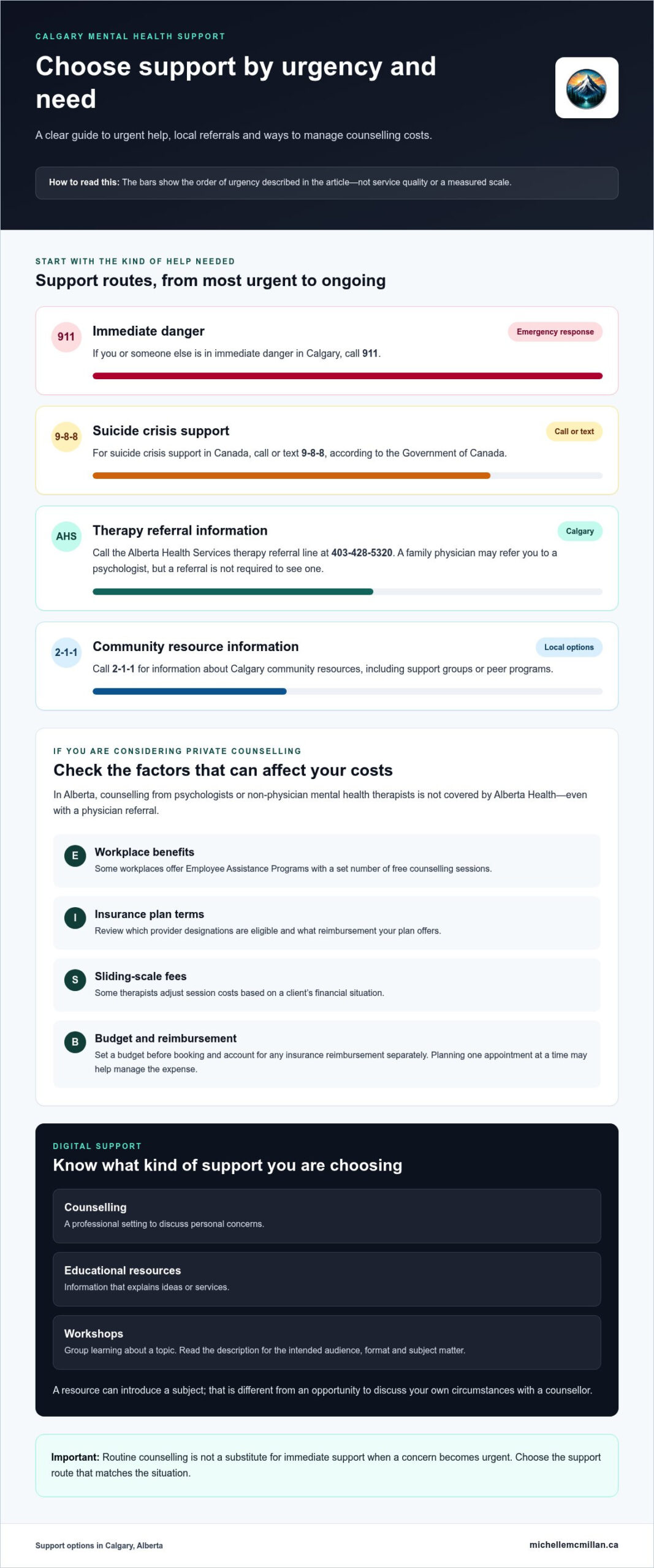
If you or someone else is in immediate danger in Calgary, call 911. For suicide crisis support, call or text 9-8-8, according to the Government of Canada. These options serve different needs: emergency response, crisis support, and help locating therapy. Knowing which kind of support you’re seeking can make the first step clearer.
It’s understandable to wonder whether counselling will be affordable, whether you need a physician’s referral, or which type of appointment to choose. In Alberta, counselling from psychologists or non-physician mental health therapists isn’t covered by Alberta Health, even with a physician referral. Some workplaces offer Employee Assistance Programs with a set number of free counselling sessions. These details can shape where you begin and which questions matter most to your circumstances.
This article covers free and lower-cost options, digital resources, urgent support, and private counselling costs in Calgary. It also explains practical differences between virtual and in-person appointments. Whether you’re exploring support for yourself or someone close to you, use this information to identify a reasonable next step. You don’t need to have everything figured out first.
Key Takeaways
- Explore workplace Employee Assistance Programs and local counselling referrals as possible starting points for free or lower-cost support.
- Review your health benefits before booking private counselling, since coverage depends on your plan.
- Virtual and in-person counselling are both options in Calgary; the article explains practical factors to consider when choosing a format.
- For suicide crisis support in Canada, call or text 9-8-8, according to the Government of Canada. For immediate danger, call 911.
- Learn how private counselling costs are determined and what questions can help you understand the financial commitment.
Free and low-cost counselling in Calgary
In Calgary, possible starting points include Alberta Health Services referrals, workplace benefits, and information about community resources. The right option depends on whether you’re seeking private counselling, financial assistance, or details about local programs.
To access mental health care through Alberta Health Services in Calgary, call its therapy referral line at 403-428-5320. A family physician may also refer patients to a psychologist, though a referral isn’t required to see one.
For information about Calgary community resources, call 2-1-1. You can ask about support groups or peer programs and describe the kind of emotional health support you’re looking for. The service provides community resource information, which can help you identify local options relevant to your concern.
Finding Psychologists and Counsellors
Start by identifying the type of professional support you want and the concern you’d like to discuss. Alberta Health Services can provide therapy referrals at 403-428-5320. A family physician may refer you to a psychologist, but you can also seek one without a referral. When reviewing a provider, look at their stated designation and whether their service matches your needs.
Counselling Costs and Insurance Coverage
In Alberta, counselling from psychologists or non-physician mental health therapists isn’t covered by Alberta Health, even with a physician referral. Some workplaces offer Employee Assistance Programs with a set number of free counselling sessions. Before booking, check your insurance plan’s terms for eligible provider designations and reimbursement. Some therapists also offer sliding-scale fees, which adjust session costs based on a client’s financial situation.
Depression and Mood Counselling
Counselling can offer a place to discuss low mood, depression-related concerns, or changes affecting daily life. You might start with a specific example, such as finding it difficult to keep up with usual responsibilities. You don’t need to prepare a complete explanation. Begin with what has changed and what you’d like help discussing.
If you’re paying privately, planning one appointment at a time can help you manage the expense. Set a budget before booking, then account for any insurance reimbursement separately. For lower-cost options, consider workplace benefits, referral information, or sliding-scale fees. If your concern becomes urgent, routine counselling isn’t a substitute for immediate support.
Digital anxiety, stress and depression support
Digital mental health support can include counselling, educational resources, or online workshops, each serving a different purpose. Counselling offers a professional setting to discuss personal concerns. Educational resources explain ideas or services, while workshops provide group learning on a topic. Before choosing, consider whether you want information, a guided discussion, or space to talk about your own experiences.
Anxiety, stress, and depression affect people in different ways. A student facing exam pressure may want to discuss how stress is affecting school. Someone experiencing low mood may seek support with concerns affecting daily life. A digital resource can introduce a subject, but reading information is different from discussing personal circumstances with a counsellor.
To decide whether online counselling may suit your needs, identify a concern you want to raise. For example, you might explain that worry is interfering with work, or that low mood is affecting your interest in usual activities. You don’t need a clinical label to describe what you’re experiencing. A specific example can make it easier to explain the support you’re seeking.
Workshop titles can describe a learning topic, but a title doesn’t establish a workshop’s location or availability. If you encounter a listing called “Anxiety 101,” read its description to learn its intended audience, format, and subject matter. The same applies to “Anxiety to Calm.” Treat these names as examples of topics to investigate, not as evidence of a Calgary program.
For students and working adults, digital appointments may fit more flexibly around classes or other responsibilities. Practical considerations still matter: can you set aside uninterrupted time, and would a group format or individual conversation better suit what you want to discuss? The purpose of the service matters more than the fact that it happens online.
Use these questions to assess a digital resource:
- What is it? Identify whether it’s counselling, educational information, or a workshop.
- Who is it for? Look for the intended participants and the topics covered.
- What support does it offer? Distinguish general learning from an opportunity to discuss personal concerns.
If anxiety or stress is affecting your relationships, school, or work, professional counselling may offer a place to explore those concerns. Digital resources can be a starting point for learning, while counselling provides a different kind of support. You can review counselling areas of focus to see which topics relate to what you’d like to discuss.
Distress and wellness support
Choose support according to urgency. A mental health emergency calls for immediate help, while ongoing concerns may be addressed through counselling, community programs, or a family doctor’s referral. Knowing the difference can help you decide which service to contact first in Alberta.
If you or someone else faces immediate danger in Alberta, call 911. People in Canada can call or text 9-8-8 to reach the Suicide Crisis Helpline, according to the Government of Canada. The crisis line is available 24 hours a day, 7 days a week, for people experiencing suicide-related distress.
For immediate mental health help in Calgary, contact Distress Centre Calgary or go to the nearest urgent care centre or emergency room. If you’re uncertain whether a concern needs urgent medical attention, Alberta Health Link offers free health advice by phone at 811, 24 hours a day. It can help you consider the next step, but it isn’t a replacement for emergency services.
For non-emergency wellness and community support, call 2-1-1 in Calgary for information about local resources. Explain what kind of support you need, such as a peer program, a group, or help finding a community service. If you’re looking for Indigenous support, you can tell the 2-1-1 service that culturally relevant resources matter to you.
A family doctor may refer patients to a behavioural health consultant through the Calgary Foothills Primary Care Network. This may be a useful route for concerns affecting daily life that aren’t an immediate emergency. Prepare a brief description of what has changed, such as sleep, mood, school attendance, or work routines, to make the conversation more specific.
Use this simple guide to choose a starting point:
- Immediate danger: Call 911 in Alberta or go to an emergency room.
- Suicide-related distress: Call or text 9-8-8 in Canada.
- Health advice: Call Alberta Health Link at 811.
- Calgary community information: Call 2-1-1 and describe the type of program or resource you’re seeking.
These options address different needs. A crisis line can respond to urgent distress, while a community program may offer peer connection or practical information. For ongoing concerns that aren’t an emergency, counselling provides a setting to discuss what’s happening and consider suitable support. If someone is at immediate risk, contact emergency services rather than waiting for a routine appointment.
In-person and virtual therapy in Calgary
Calgary counselling is available in person and virtually for children aged 8 and older, teens, adults, couples, and families. The format can shape practical parts of care, such as travel, scheduling, and where participants join. It doesn’t determine what concerns you can discuss. Start by considering which setting fits your daily routines and preferences.
In-person appointments take place at a counselling location. Consider transportation and appointment timing around work or school. Families may also want to plan how everyone who needs to attend will get there. The physical setting can matter to someone who prefers having a conversation outside their home.
Virtual counselling lets participants connect remotely, which can be convenient when travel or distance is difficult. Someone with a full workday, for example, may find it easier to attend without commuting. Virtual counselling can also serve people who live outside Calgary but within Alberta. Consider whether you have a private place to talk and can set aside time without interruptions.
Depending on the service, counselling may be individual, couples, or family focused. Couples may join a virtual appointment together from the same location or from separate locations when needed. Families can consider who will participate, whether everyone can contribute, and what practical arrangements will make attendance possible.
To compare the options, use these steps:
- List your priorities: Note travel, privacy, schedules, accessibility, and whether other people will attend.
- Picture a typical appointment: Consider an in-person visit after work or a virtual session between home responsibilities.
- Choose the format: Identify the setting that feels workable for your current circumstances.
Some support comes through community programs or public health services, while counselling may be arranged privately. Alberta Health Services referrals can be one starting point for locating therapy, although the format depends on the service. A family doctor can also discuss available health services with you. These routes serve different purposes, so identify whether you need a referral, ongoing counselling, or immediate help.
Preparing for an appointment is practical, not clinical. For a virtual meeting, choose somewhere you can speak without being overheard. For an in-person appointment, plan your route and allow time to arrive. Individuals, couples, and families can decide beforehand which concerns they want to raise. These preparations can help keep the focus on why you sought support.
When comparing emotional health support in Calgary, treat format as one of several decisions. The type of support, who will participate, location, and schedule all matter. Counselling offers a place to discuss concerns, while urgent or emergency needs require a different response from a scheduled appointment.
What are the costs of private counselling and therapy in Calgary?
Private counselling costs in Calgary vary by provider and service. A useful estimate depends on the provider’s fee, appointment format, and type of counselling. Since prices differ, build your budget around the details relevant to your situation rather than a citywide average. Consider whether you want to pay one appointment at a time or plan for ongoing support.
In Alberta, counselling from psychologists or non-physician mental health therapists isn’t covered by Alberta Health, even with a physician referral. By contrast, visits to psychiatrists are covered by Alberta Health because psychiatrists are medical doctors. These are different professional services, so identify the type of care you’re considering before estimating what you may pay yourself.
Private counselling prices depend on the case and are given after a quote request. Relevant factors include the service type, appointment format, and provider’s fee. For counselling from this practice, consult the counselling service information as part of understanding the available service options.
Insurance can affect your out-of-pocket cost. Before booking, read your plan’s terms for eligible provider designations, reimbursement limits, referral requirements, and the claims process. A plan may cover some providers but not others. If you have workplace benefits, the benefits booklet or insurer can explain the terms that apply to your coverage.
Some therapists offer sliding-scale fees, adjusting session costs based on a client’s financial situation. This can provide a lower-cost option when budgets are tight. Ask what the scale considers and how the adjusted fee applies. Don’t assume every private practice offers this arrangement.
When budgeting one appointment at a time, work out what you can allocate to counselling without relying on future insurance reimbursement. Consider how the appointment fee fits alongside transportation, childcare, or other practical expenses. A virtual appointment, for example, may remove travel costs, while an in-person visit may require transport planning. These added costs are separate from the provider’s fee.
Use this short checklist before committing to private care:
- Identify the service: Individual, couples, and family counselling may have different fees.
- Review coverage: Check your plan’s eligible provider designations and reimbursement process.
- Set a budget: Decide what you can pay directly and whether you prefer booking one session at a time.
- Ask about reduced fees: Some therapists offer sliding-scale options based on financial circumstances.
A clear cost plan helps you compare the fee with your coverage and budget, so you can decide what’s manageable before beginning counselling.
Michelle McMillan: Individual Therapy
Michelle McMillan offers individual counselling for people seeking a professional space to discuss emotional health concerns, life transitions, anxiety, or relationships. She also provides family therapy, couples counselling, and child and adolescent therapy. Michelle holds a Master of Arts in Counselling Psychology and is a Canadian Certified Counsellor (CCC), a professional certification through the Canadian Counselling and Psychotherapy Association.
Virtual counselling is available to clients in Alberta, British Columbia, Saskatchewan, and Manitoba. In-person counselling is provided in Calgary. These options allow individuals to consider what fits their circumstances and preferences. Counselling supports discussion and exploration, but it isn’t crisis intervention or a substitute for emergency services.
If individual counselling feels like a suitable next step, you’re welcome to visit the Rates and Booking page to explore booking information.
Choose a next step that feels manageable
Finding emotional health support in Calgary doesn’t require you to have every concern neatly explained. Start with one priority: what feels hardest to carry right now, what kind of support you’re seeking, or what would make counselling financially manageable. That can help shape a conversation about what support may suit you.
If you’re considering individual, family, or couples counselling, Michelle McMillan offers these services virtually and in person in Calgary. Explore the booking details and decide whether to take the next step. Counselling is for ongoing support, not an emergency response. If immediate danger is present, use emergency services or crisis support instead.
For information about arranging counselling, visit the Rates and Booking page. You deserve to have your concerns taken seriously, and reaching out can begin with a simple inquiry.
For therapy referrals, call Alberta Health Services at 403-428-5320.
Frequently Asked Questions
Need Immediate Help?
If you or someone else is in immediate danger in Alberta, call 911 or go to an emergency department. For suicide-related distress, call or text 9-8-8 to reach the Suicide Crisis Helpline, according to the Government of Canada. These options are for urgent situations, not routine counselling bookings. If you’re supporting someone, stay with them when it’s safe to do so and contact emergency help when danger is immediate.
Need immediate support?
If you need urgent guidance but aren’t facing immediate danger, call Alberta Health Link at 811 for health advice. In Calgary, Distress Centre Calgary can also provide immediate mental health support. For help identifying community resources, call 2-1-1. Think about whether you need crisis response, health advice, or information about services; the right starting point depends on what’s happening now.
What emotional health support services are available in Calgary?
Calgary residents can access public referral information, community resources, peer support, and private counselling. Counselling may focus on individuals, couples, families, or children and adolescents. Common concerns include anxiety, stress, relationships, family challenges, and life transitions. Some services offer virtual and in-person appointments. Consider who needs to participate and whether you’re seeking professional counselling, peer connection, or information about local programs.
Where can Calgary residents access free or low-cost mental health support?
Start by calling Alberta Health Services for therapy referral information or 2-1-1 for community resource details. If you’re employed, your workplace may have an Employee Assistance Program with a set number of counselling sessions. Some therapists offer sliding-scale fees based on financial circumstances. Before arranging private care, review your benefits plan’s eligible provider designations and reimbursement process so you can plan your out-of-pocket spending.
How can I find a licensed therapist or counsellor in Calgary?
Begin by identifying the professional designation relevant to the service you’re seeking. In Alberta, a family physician may refer you to a psychologist, but a referral isn’t required. Counsellors and psychologists have different designations, so read a provider’s stated credentials carefully. Michelle McMillan holds a Master of Arts in Counselling Psychology and is a Canadian Certified Counsellor (CCC), a professional certification through the Canadian Counselling and Psychotherapy Association.
What mental health support is available for children, teens, families, and newcomers in Calgary?
Children, teens, and families can seek counselling focused on their concerns, including relationships, family conflict, or difficult situations at home or school. Newcomers can call 2-1-1 for information about Calgary community resources and explain what kind of support they’re seeking. Virtual and in-person counselling may be options for families, depending on the service. A family physician can also help discuss support needs and referral routes.
How do Calgary counselling services compare for in-person, phone, and online appointments?
In-person counselling takes place at a physical location, while virtual counselling happens remotely. Phone support can serve a different purpose: Alberta Health Link provides health advice by phone, but that isn’t the same as a counselling appointment. When comparing formats, consider travel, privacy, schedules, and whether others will join. Couples using virtual counselling may attend together from one location or join from separate locations when needed.

Article by
Michelle McMillan, MACP, CCC
Michelle McMillan is a Canadian Certified Counsellor (CCC) with a Master of Arts in Counselling Psychology (MACP). She has extensive experience working with children and supporting clients with ADHD, neurodivergence, anxiety, emotional regulation, relationships and family challenges. Michelle offers both virtual and in-person counselling, with virtual counselling available throughout Alberta, British Columbia, Saskatchewan and Manitoba and in-person appointments available in Calgary.
Important Information
This article is provided for general educational and informational purposes only and is not a substitute for professional counselling, psychological, medical or emergency services. Information shared here should not be considered a diagnosis or individualized treatment advice. If you are experiencing a mental health emergency or are in immediate danger, please contact appropriate emergency services in your area.