
A child needs understanding, not just a label. A child psychologist can assess what may be contributing to a child’s difficulties and help identify suitable support. For mental health for children in Calgary, community clinics provide short-term, goal-focused therapy for children and youth with moderate to severe mental health concerns. Outside The Summit’s walk-in service hours, call Health Link at 811.
If you’re worried about your child, it can be hard to tell whether professional support might help or where to begin. You don’t need to have all the answers before seeking guidance.
This article explains how child psychologists may help, what a psychosocial assessment and treatment can involve, and how Calgary families can find support for children and youth. It also outlines public youth mental health services and where to turn when concerns feel urgent.
Key Takeaways
- Calgary community clinics provide short-term, goal-focused therapy for children and youth with moderate to severe mental health concerns.
- A child psychologist can help assess a child’s needs and clarify what kinds of support may be appropriate.
- A psychosocial assessment looks beyond a single behaviour or concern to understand a child’s experiences and circumstances.
- Public clinic referrals are triaged by urgency: urgent referrals are typically seen within 14 days, while the routine assessment access target is within 1 month.
- For support outside The Summit’s walk-in hours, call Health Link at 811; in an emergency, call 911 or go to the nearest emergency room.
Child and youth mental health support in Calgary
Calgary families can consider community clinics, school supports, hospital services and private counselling. The right starting point depends on the young person’s safety, concerns and support needs. Their age, daily circumstances and the kind of help they need can guide the next step.
Immediate Mental Health Support
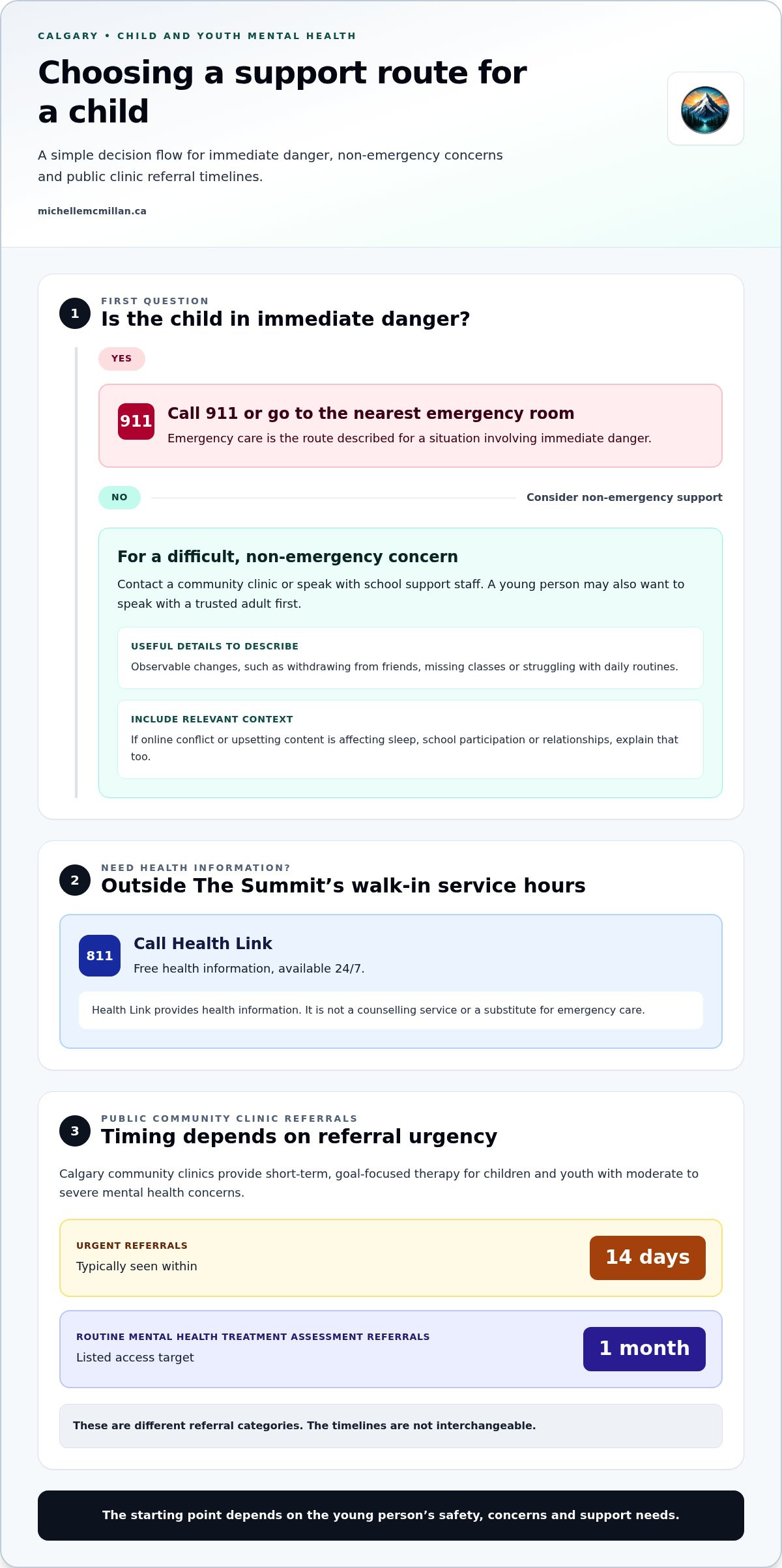
If a child may be in immediate danger, call 911 or go to the nearest emergency room. For health information outside The Summit’s walk-in service hours, call Health Link at 811. Health Link is free and available 24/7. These options serve different purposes: emergency care addresses immediate danger, while Health Link provides health information.
For a difficult but non-emergency situation, families can contact a community clinic or speak with school support staff. Describe observable changes, such as withdrawing from friends, missing classes or struggling with daily routines. Digital stress may also be relevant: explain whether online conflict or upsetting content is affecting sleep, school participation or relationships.
A young person seeking support may prefer to talk with a trusted adult first. That adult can help describe the concern and identify a suitable contact. Health Link provides free health information, but it isn’t a counselling service or a substitute for emergency care.
Comparing Services, Wait Times, Approaches and Age Ranges
Calgary community clinics provide short-term, goal-focused therapy for children and youth with moderate to severe mental health concerns. Urgent referrals are typically seen within 14 days; routine mental health treatment assessment referrals have a listed access target within 1 month. These targets apply to different referral categories, so they shouldn’t be treated as interchangeable.
Services differ in purpose and age range. A clinic may provide focused therapy, while a conversation with school support staff may address concerns affecting learning or participation. Hospital services address needs that require hospital care. Age eligibility depends on the individual program. When describing the concern, give examples, such as anxiety affecting school attendance or conflict disrupting friendships.
Counselling Costs, Insurance and Subsidies
Public clinic services and private counselling have different access routes and costs. Private fees depend on the service, provider and whether the appointment involves counselling or psychological assessment. Insurance coverage depends on the plan and the type of professional or service it covers.
Families seeking lower-cost support can explore public community clinics and ask school staff about supports offered through their school. Subsidies depend on each program’s eligibility rules. Before choosing private counselling, review your plan’s coverage, including whether child counselling and assessment are treated differently.
How Can a Child Psychologist Help?
A child psychologist can help clarify concerns, assess a child’s needs and discuss possible supports. In Calgary, families may consider community clinics, hospital services and counselling.
Child Psychology and Counselling in Calgary
A psychologist may assess a child’s emotional, behavioural and developmental concerns, then discuss the findings and possible next steps with caregivers. Counselling offers space to talk about experiences and concerns, but it is distinct from assessment and diagnosis. For example, a parent might describe changes at home and school while the child shares what feels difficult in daily life.
Specialized support should fit the concern. A psychologist’s assessment may help when a family needs a clearer understanding of a child’s needs; counselling can offer ongoing space to explore concerns. Calgary’s public services and private counselling differ in access routes, scope and age eligibility.
Counselling for Children and Teens
Child and teen counselling gives young people a setting to discuss concerns such as friendship conflict, family changes, school pressure or persistent worry. What they choose to discuss may vary with age, communication style and circumstances. Parents can share observations, while the child or adolescent describes their own experience.
For example, a school change might affect one young person’s friendships and another’s daily routine. A counsellor can explore the concern with the young person and, when appropriate, their family. The aim is to understand what is happening, rather than assume a behaviour has only one cause.
Walk-in counselling can provide an initial point of contact for families seeking support. The Summit has walk-in service hours in Calgary; outside those hours, Health Link at 811 offers health information. If safety is a concern, families can discuss a safety plan with a qualified professional. That conversation may identify a trusted adult, who to contact and where to seek urgent help.
Parents can also seek consultation about how a child’s concerns appear at home or school. They might bring a specific example, such as repeated conflict over school attendance, to explain the situation. A discussion with a parent can clarify what support is being considered and how caregivers may be involved.
Referral routes depend on the service. Alberta Health Services lists 403-428-5320 as its therapy referral phone number. Families without a referral can begin by contacting a counselling service directly to learn its intake process; public clinic access may follow a separate referral route. Naming the child’s age, main concern and any immediate safety issue helps explain what support is being sought.
Psychosocial assessment and treatment
A psychosocial assessment brings together information about a young person’s emotional wellbeing, relationships and daily circumstances. It can help families organize their questions before discussing possible support. Rather than focusing on one moment or behaviour, it considers the wider context. A recent family change, ongoing peer tension or a shift in daily routines may all be relevant.
The young person’s perspective matters. A child may describe a concern differently from a parent or caregiver, and both accounts can add useful information. An adolescent may prefer to explain what feels difficult in their own words. The clinician can also consider which situations feel manageable, what the young person enjoys and which relationships feel supportive. These details help keep the discussion balanced.
Preparing for an appointment can help keep it focused. Caregivers might note what they hope to understand, when they first noticed the concern and what they have already tried. Instead of writing “things are hard,” for example, they could note that a child has become reluctant to join a weekly activity. The young person can add their own observations, including what they want adults to understand.
Depending on the service and the questions being explored, assessment may involve more than one conversation. A clinician may gather information from the young person and caregiver, then explain what it suggests and what remains unclear. Families can ask what the assessment is intended to answer, how findings will be shared and whether further assessment or support is being considered.
Treatment planning turns the discussion toward practical priorities. A family and clinician might choose one concern to focus on first, such as recurring conflict during transitions between activities. The goal should be clear enough to discuss in everyday language. This gives the young person and caregivers a shared reference point without defining the child by a difficulty.
Support may involve the young person, caregivers or both, depending on the service and concern. Caregivers, for example, may want to discuss how a family change is affecting routines, while the young person may want space to describe their own experience. The plan can clarify who participates and how support relates to home, community or other services.
Later conversations can review whether the original priorities still fit. A child’s circumstances may change after a family transition, a shift in friendships or a new school routine. If the concern changes, the family can raise it and revisit the focus of support. Assessment and treatment are connected, but gathering information and providing counselling are distinct parts of care.
Youth mental health services in Calgary
Calgary youth services include community clinics, walk-in support, hospital care and school-based support. Families seeking mental health support for children in Calgary can start by identifying what they need: an initial conversation, focused therapy, assessment or urgent help. These services have different roles, so matching the concern to the service’s purpose can make the first contact more useful.
Community clinics provide short-term, goal-focused therapy for children and youth with moderate to severe mental health concerns. Referrals are prioritized by urgency. Urgent referrals are typically seen within 14 days, significant mental health risk has a typical access target of 14 business days, and routine mental health treatment assessment referrals have a listed target within 1 month. These categories have distinct targets, so describe the young person’s current circumstances clearly.
When discussing a referral, families can describe the main concern and its effect on daily life. Note whether it affects attendance, friendships, family routines or participation in activities. A young person may see things differently from a caregiver, so sharing both perspectives can give a referral a fuller picture. School staff may also explain how the concern appears during the school day.
The Summit offers walk-in support in Calgary. Its address is 1015 – 17 Street NW. Families can use its walk-in service during its hours; outside those hours, Health Link at 811 provides free health information 24/7. These are different kinds of support: Health Link offers information, while the walk-in service provides a local point of contact for youth mental health concerns.
Some young people may need hospital services or day hospital care. Families can ask the care team what the service addresses, how caregivers are involved and how information will be shared with school or community supports. If care is moving between settings, clarify who will communicate the next steps. This can make the transition easier to understand without assuming every young person follows the same path.
When weighing mental health services for children in Calgary, consider the young person’s age, the service’s purpose, urgency and referral requirements. School support may address concerns affecting learning, while a community clinic offers focused therapy for eligible children and youth. Hospital services may be involved when the care needed differs from community-based support.
For immediate danger, call 911 or go to the nearest emergency room. For non-emergency concerns, describe the change that prompted the search for help and the setting where it occurs. Clear examples help families explain what kind of support they’re seeking and help services consider the next appropriate contact.
School-based support may help address mental health concerns affecting learning. School staff can explain how a concern appears during the school day and share that perspective in a referral conversation.
What are the eligibility rules and referral steps for Alberta public child mental health services?
Alberta’s public child mental health services don’t use one eligibility rule for every program. Calgary community clinics provide short-term, goal-focused therapy for children and youth with moderate to severe mental health concerns. The service being requested, the child’s needs and the referral information all matter. Start by identifying whether the family is seeking assessment, therapy or urgent support.
For a clinic referral, explain the child’s age, main concern and its impact on daily life. Include practical examples, such as repeated school absences, difficulty with ordinary routines or concerns about safety. These details help communicate the reason for referral and its urgency. A general description alone may not show how the concern affects the young person at home, school or with peers.
- Contact the appropriate referral route. Alberta Health Services lists 403-428-5320 as its therapy referral phone number.
- Describe the concern clearly. Include the child’s circumstances, relevant changes and the support being requested.
- Share information about urgency. Explain whether the concern is escalating or involves immediate safety risks.
- Follow the referral process for the specific service. A clinic aims to acknowledge receipt of a referral to the referring source within 3 days.
The 3-day acknowledgement is not a treatment appointment or a decision about eligibility. It means the clinic aims to notify the referring source that the referral arrived. Keep a record of the service contacted and the information shared, so the family can refer to the same details during follow-up. The referring professional can help clarify the next step if more information is requested.
Access timing depends on triage category. Urgent referrals are typically seen within 14 days, significant mental health risk has a typical target of 14 business days, and routine mental health treatment assessment referrals have a listed target within 1 month. These are different categories, not interchangeable promises. Describe the child’s current needs accurately so the referral reflects the situation.
If a family isn’t sure where to begin, Health Link at 811 provides free health information 24/7. For immediate danger, call 911 or go to the nearest emergency room rather than waiting for a routine referral. Alberta families reporting suspected child abuse can call the Children & Family Services Child Abuse Hotline at 1-800-387-5437. Each route serves a different need: referral for public care, health information, emergency help or child-protection concerns.
Michelle McMillan: Individual Therapy
Michelle McMillan offers Individual Therapy and Child & Adolescent Therapy for families seeking counselling. If a child’s concerns affect home, relationships or school, counselling can provide space to discuss those experiences. Michelle holds a Master of Arts in Counselling Psychology (MACP) and is a Canadian Certified Counsellor (CCC), a national professional certification through the Canadian Counselling and Psychotherapy Association.
Virtual counselling is available throughout Alberta, and in-person appointments are available in Calgary. Counselling is not a substitute for emergency support or a psychological assessment. To explore booking options for mental health for children Calgary families can rely on, visit the Rates and Booking page when it feels right for you.
Choose a next step that feels manageable
It can be difficult to know what to do first when a child is struggling. You don’t need to explain every concern perfectly before starting a conversation. A useful next step may be to note what you’ve observed, what your child says and what support you hope to explore. That can help you decide whether to start by discussing counselling or another service.
For families considering private support, Michelle McMillan offers Individual Therapy, Family Therapy and Couples Counseling. These services provide options for discussing concerns affecting a young person or the relationships around them. Support for children’s mental health in Calgary can begin with a conversation about the family’s needs and the type of care they’re seeking.
If you’d like to explore counselling with Michelle, contact Michelle McMillan. Taking one thoughtful step is enough to begin considering what support may fit your family.
Frequently Asked Questions
What child and youth mental health services are available in Calgary?
Calgary families can explore community clinic therapy, hospital-based care, school support and private counselling. These options serve different needs: a school contact may help address concerns affecting learning, while a community clinic offers focused care for more complex difficulties. A young person may need assessment rather than counselling. Start by describing the support needed, such as help understanding a concern, discussing it or addressing its effect on daily routines.
How can parents get a mental health assessment for a child in Calgary?
Parents can describe the concern to a health professional or the service they’re approaching, then ask about its assessment referral process. Beforehand, note when the change began, which situations affect the child and how the child describes it. For example, a parent might share observations about mornings alongside the child’s own account of school. This keeps the discussion specific without treating one behaviour as a diagnosis.
What Calgary child psychologists and therapists offer counselling, and what ages do they serve?
Calgary has public and private services, including community clinic therapy and child or adolescent counselling. Age eligibility depends on the specific service, so the program’s intake process determines whether it serves a particular young person. Michelle McMillan offers Child & Adolescent Therapy, but families should not assume a specific age cutoff. Psychologists and counsellors also have different professional designations, so identify the credential and service you’re seeking.
Are there free or low-cost mental health programs for children and families in Calgary?
Public community clinics are an option for families seeking child and youth mental health care. Health Link at 811 provides free health information, but it isn’t itself counselling. Private counselling costs and any insurance or subsidy support depend on the service and plan. Before committing to private care, families can review their plan’s counselling and assessment terms and ask the public service about its referral process.
What signs mean a child needs urgent mental health help, and what should Calgary caregivers do?
If a child may harm themselves or someone else, cannot stay safe, or faces immediate danger, treat the situation as an emergency. Call 911 or go to the nearest emergency room in Calgary. Stay with the child if it’s safe to do so, and tell emergency responders plainly what happened and what risks concern you. For urgent health information that isn’t an emergency, caregivers can call Health Link at 811.

Article by
Michelle McMillan, MACP, CCC
Michelle McMillan is a Canadian Certified Counsellor (CCC) with a Master of Arts in Counselling Psychology (MACP). She has extensive experience working with children and supporting clients with ADHD, neurodivergence, anxiety, emotional regulation, relationships and family challenges. Michelle offers both virtual and in-person counselling, with virtual counselling available throughout Alberta, British Columbia, Saskatchewan and Manitoba and in-person appointments available in Calgary.
Important Information
This article is provided for general educational and informational purposes only and is not a substitute for professional counselling, psychological, medical or emergency services. Information shared here should not be considered a diagnosis or individualized treatment advice. If you are experiencing a mental health emergency or are in immediate danger, please contact appropriate emergency services in your area.