
Virtual therapy for anxiety and stress in Alberta lets you speak with a counsellor remotely by video or phone. For people in Calgary and across Alberta, virtual counselling can provide a professional setting to discuss anxiety, ongoing stress, and how these concerns affect daily life. Choose a format that feels workable and consider practical questions such as privacy and benefits coverage.
It’s reasonable to have questions before trying counselling online. You may wonder whether phone sessions are available, what happens during an appointment, or whether your extended health plan covers virtual care. This article explains how phone and video counselling work, what concerns people may bring to counselling, and which privacy and insurance factors to consider. These details can help you decide whether virtual counselling fits your circumstances and what you want to know before arranging a session.
Key Takeaways
- Phone and video are both ways to access virtual counselling in Alberta; consider which format feels more comfortable for you.
- Anxiety and ongoing stress are among the concerns people may bring to online therapy, alongside other personal or family challenges.
- Plan for privacy by choosing a space where you can speak comfortably, and understand that confidentiality cannot be guaranteed in every circumstance.
- Insurance coverage depends on your individual benefits plan, including its eligible provider types and limits.
- Learn what to consider when deciding whether virtual counselling is a practical option for your needs.
Secure video and phone sessions
Virtual mental health care in Alberta can use video, telephone, or messaging. Each format offers a different way to communicate, so consider what helps you explain your concerns comfortably.
Video, Telephone, and Messaging
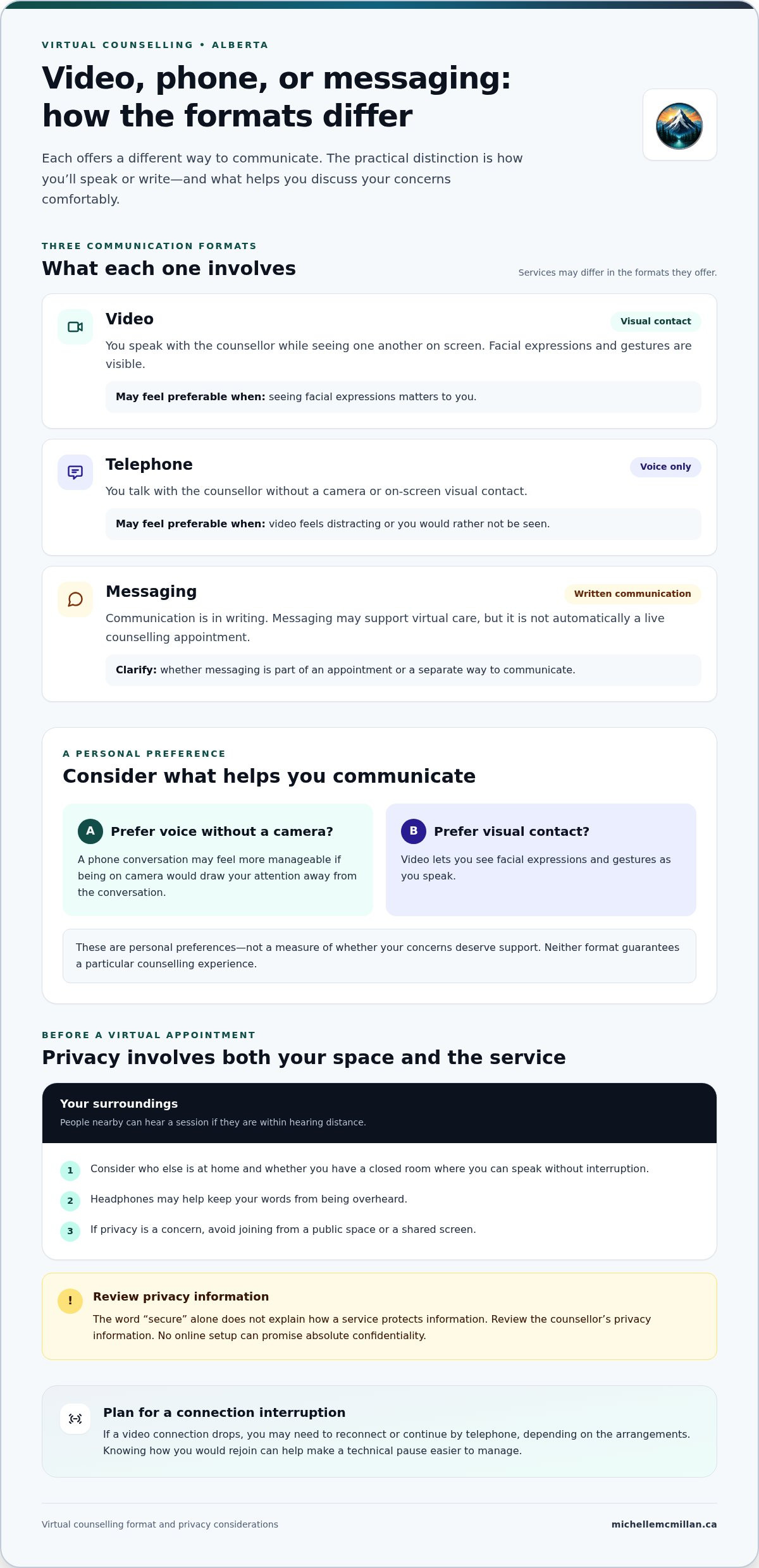
Video sessions let you speak with a counsellor while seeing one another on screen. Telephone sessions use voice only, while messaging allows written communication. These formats can support virtual care, but they aren’t interchangeable in every situation. Think about whether you’d rather speak face-to-face on screen, talk without a camera, or communicate in writing.
For example, you might prefer a phone conversation when video feels distracting, or video when seeing facial expressions matters to you. Messaging may suit some forms of communication, but it isn’t automatically a live counselling session. Clarify what a service means by messaging, including whether it is part of an appointment or a separate way to communicate.
Benefits of Video and Telephone Counselling
Virtual counselling connects you with a counsellor remotely, whether you’re in Calgary or elsewhere in Alberta. It can make attending more convenient when travel, distance, or scheduling makes an in-person appointment harder. The main practical difference is the format: video includes visual contact, while telephone counselling centres on conversation by voice.
Consider what would help you discuss your concern, whether it’s ongoing stress, anxiety, or experiences related to trauma. If being on camera would draw your attention away from the conversation, telephone may feel more manageable. If visual contact matters to you, video may be preferable. These are personal preferences, not a measure of whether your concerns deserve support.
Confidentiality in Secure Sessions
Confidentiality involves more than the video platform. Your surroundings matter too. A session can be private from people nearby only if they can’t hear the conversation. Before starting, consider who else is at home, whether you have a closed room, and whether headphones would help keep your words from being overheard.
The word “secure” alone doesn’t explain how a particular service protects information. Before an appointment, review the counsellor’s privacy information and consider whether others could see or hear sensitive details. Avoid joining from a shared screen or public space if privacy is a concern. No online setup can promise absolute confidentiality.
Planning for Phone or Video Therapy
Choose the format based on the kind of conversation you want to have. A phone call may suit you if you’re uncomfortable being seen, while video lets you see facial expressions and gestures. Neither format guarantees a particular counselling experience, and virtual care still requires a private setting.
Before an appointment, choose a place where you can speak without interruption and keep your device within reach. If the connection drops, you may need to reconnect or continue by telephone, depending on the arrangements. Knowing how you’ll rejoin can prevent a technical pause from becoming another source of stress.
Online therapy for anxiety, stress, and other concerns
Virtual counselling can provide a place to discuss anxiety, stress, and other concerns. Michelle McMillan offers virtual counselling to clients in Alberta, British Columbia, Saskatchewan, and Manitoba.
Starting Online Therapy
Beginning online counselling usually starts with identifying what you want support with. You might describe stress affecting sleep, anxious thoughts before work, or tension in a relationship. An initial conversation can help clarify what you hope to discuss and whether counselling fits those concerns.
Before arranging counselling, consider whether you’re seeking individual, couples, or family support and whether you prefer video or telephone. This can help clarify what you’re looking for and what to expect from the service.
Eligibility for Online Care
Eligibility depends on the service. Alberta’s Rapid Access Counselling offers appointments by secure video or phone from Monday to Friday, and can address mental health, stress, relationships, parenting, and grief. Public programs and private services may have different intake steps, service scopes, and eligibility conditions.
When considering an option, look for who it serves, how appointments are accessed, and whether the service fits your concern. Virtual counselling can be considered for anxiety or stress without assuming that every program has the same requirements.
Choosing a Therapist or Service
How do you choose between virtual therapy platforms, private therapists, and public services in Alberta? Compare the type of support, appointment format, access process, and whether you speak with a counsellor directly or use a platform to connect. Rapid Access Counselling is one public option; private services and platforms have their own arrangements.
How can you verify an online therapist is registered and licensed in Alberta? Ask which professional designation they hold, then search the relevant regulator’s public register using their full name. Match the register entry to the person and designation, rather than relying on a website’s general use of “therapist.”
Which Alberta-licensed therapists offer online anxiety therapy? The answer depends on the professional title and the individual’s registration status. Look up a specific therapist in the appropriate public register and confirm that their listed designation matches the service you’re seeking.
Suitability and Urgent Support
What virtual therapy options for anxiety and stress are available to Alberta residents? Options include private online counselling, virtual appointments through public programs such as Rapid Access Counselling, and services accessed through therapy platforms. The format may be video or telephone, depending on the program.
Is virtual therapy effective for anxiety and stress, and who is it suitable for? It can offer a way to discuss these concerns remotely, but suitability depends on your needs, preferred format, and the support available through the service. Virtual care isn’t emergency response.
If you’re in immediate danger in Alberta, call 911. If you’re in crisis and need support, call or text 9-8-8 in Canada.
Can my privacy be guaranteed?
No online appointment can guarantee that every part of a conversation stays private. Someone nearby may overhear, a shared device may expose information, or a connection may fail. Privacy depends on the service’s practices and the setting you use.
Privacy and Confidentiality
Confidentiality involves how information is handled and who may hear or see it. Before discussing depression, trauma, or relationship concerns, consider whether anyone can overhear you or view your screen. For a couples appointment, each person should know who else is present and whether they can speak privately.
Before an appointment, review the service’s privacy information. Look for explanations of what information is collected, how records are handled, and who may have access. A general statement about privacy doesn’t describe every detail of a service’s practices. If something is unclear, ask about that specific point before sharing sensitive information.
Technology and Private-Space Requirements
Online counselling requires a computer, laptop, tablet, or smartphone, a stable internet connection, and a private space. These practical requirements help you join and speak during an appointment. If you share a home, consider whether another room is available or whether a quieter time would work better.
Before the session, check that your device is charged and your connection works. Close unrelated apps or browser tabs that could display private notifications while you speak. These steps may reduce avoidable interruptions, but they can’t control who enters the room or what happens on a shared device.
Online Therapy Risks
Consider risks such as overheard conversations, shared accounts or devices, interruptions, and unstable connections. A message preview could appear on a family tablet, for example, or a dropped call could interrupt a difficult conversation. Planning where and how to connect can help you think through these practical concerns.
Choose a space where you can speak without being overheard, and use a device other people don’t access during your appointment. If privacy at home is difficult, consider another private location where you can speak freely. These considerations apply whether you connect from Calgary or elsewhere in Alberta, by phone or video.
Connection problems can also affect communication. If a video freezes while you’re explaining something important, you may need to pause or reconnect. A private setting and stable connection can limit some disruptions, while the service’s privacy information can explain its practices. No setup removes every risk, so decide what information you’re comfortable discussing online.
Is online therapy covered by insurance?
Coverage for online therapy in Alberta depends on your extended health benefits. Your plan’s eligible provider types and coverage limits help determine whether a claim is reimbursed.
Before booking, review the mental health coverage details in your benefits booklet or insurer portal. Look for the eligible professional designation, annual or per-visit limits, and whether virtual appointments qualify. A plan may cover sessions with one provider type but not another. The format alone doesn’t determine eligibility.
A receipt can support a claim, but it doesn’t guarantee reimbursement. Keep the receipt and compare its provider information with your plan’s requirements. If your benefits cover only part of a session, the remaining amount is your responsibility. The amount depends on your plan and the service fee, not a standard Alberta-wide rate.
Session fees vary between providers and services. A private provider sets fees based on their own arrangements, while public programs have their own access and funding rules. Don’t assume an online appointment costs less than an in-person one. Video and telephone are formats, not fixed price categories.
Virtual sessions take place by video or telephone. The conversation gives you a chance to describe what brings you to counselling, such as persistent stress or anxiety affecting work. An initial appointment can also help clarify what you want to discuss and whether the service addresses those concerns. Counsellors may organize this conversation differently.
Some people seek a single conversation about a specific concern, while others look for ongoing counselling. Whether a counsellor offers one-session support depends on the service’s structure. Before arranging an appointment, review how the service works so your expectations are clear.
What free or low-cost online mental health counselling is available in Alberta? Rapid Access Counselling offers appointments by secure video or phone from Monday to Friday. Public programs and private counselling have different access and funding arrangements, so eligibility and cost depend on the specific service. This option can be a starting point for exploring virtual support.
For insurance planning, identify your plan’s provider criteria first, then consider appointment format and fees. That sequence helps you understand likely out-of-pocket costs before beginning online counselling for anxiety or stress.
Virtual anxiety and stress care in Alberta
Choosing virtual counselling can begin with identifying what you want the conversation to centre on. Anxiety and stress may overlap with work pressure, family responsibilities, a life transition, or relationship concerns. Naming what feels most pressing can help you describe what’s happening without explaining everything at once. Virtual therapy for anxiety and stress in Alberta offers a remote setting to explore those concerns with a counsellor.
Consider what you’d like the counsellor to understand about the situation. You might identify when the stress began, what has changed recently, or which part of daily life feels hardest to manage. These details aren’t a checklist or a test. They simply give you a way to organize your thoughts before discussing them.
It can also help to separate the concern from the question you want to explore. “I’m tense most evenings” describes an experience, while “I want to understand what is contributing to it” identifies a discussion goal. You can begin with either. The conversation can develop as you explain what matters to you.
If more than one concern is present, choose a starting point rather than trying to cover everything immediately. A parent might want to discuss how personal stress affects family routines. Someone facing a job change might want to talk about uncertainty and its effect on relationships. A specific focus can make a broad concern easier to describe.
You can also think about what information you want to share and what you’d rather keep private initially. For example, you could begin with the impact of a stressful situation, then decide whether background details are relevant. Taking that choice at your own pace can make it easier to communicate clearly.
Virtual therapy for anxiety and stress in Alberta can be considered alongside the kind of support you’re seeking and the concerns you want to discuss. If several people are affected, consider whether the main focus is your own experience, a relationship, or a family concern. Identifying whose perspective you want to bring forward can help clarify the purpose of counselling.
After identifying a starting point, write down a few phrases that capture what you want addressed. “Work worries follow me home” or “family tension has been on my mind” can be enough to begin. You don’t need a polished explanation. A straightforward description can give the conversation a meaningful place to start.
As you consider online counselling, focus on whether the service’s stated scope matches the concern you hope to discuss. This practical comparison can help you choose what to explore first and make your initial conversation more purposeful, without needing every answer in advance.
Michelle McMillan: Individual Therapy
Michelle McMillan offers Individual Therapy for people seeking support with anxiety, stress, and other personal concerns. She also offers Family Therapy and Couples Counseling.
Michelle has 16 years of education experience, including work with children, teens, and families. She prefers to provide much of her counselling virtually. In-person appointments are also available in Calgary.
If you’re considering individual therapy, you can learn more about contacting Michelle McMillan to discuss the next step.
Choose a first step that feels manageable
Deciding to seek support doesn’t require having everything figured out. You can begin with a simple idea of what you want to discuss, such as anxiety affecting daily routines or stress connected with a relationship. That gives an initial conversation somewhere to start, while leaving room for your concerns to become clearer over time.
If virtual therapy for anxiety and stress in Alberta feels like a practical option, consider what you’d want a counsellor to understand about your situation and which session format you prefer. Michelle McMillan offers Individual Therapy, Family Therapy, and Couples Counseling for people seeking support for themselves or their relationships.
When you’re ready to explore whether counselling may suit your needs, you can contact Michelle McMillan to discuss care. Taking that first step can be as small as sharing what has been weighing on you. You deserve space to consider support at a pace that feels right.
Frequently Asked Questions
What about phone sessions?
Phone sessions are a virtual counselling option if you’d rather speak without video. Before the appointment, choose a quiet place and make sure your phone is charged. If you’re concerned about interruptions, consider where you can speak privately. You can also make a brief note of the topic you want to raise, such as tension at work or an upcoming change, to make it easier to begin.
What are the benefits of telephone or online therapy?
Telephone and video counselling make it possible to access support remotely, which can be useful when travel or distance makes attending in person difficult. Consider practical details such as your schedule, privacy, and comfort with a screen. These factors can help you decide which format feels workable for discussing your concerns.
Can I switch between online and in-person sessions?
Michelle McMillan offers virtual counselling and in-person counselling appointments in Calgary. The available formats give you options to discuss when arranging care. If your circumstances change, such as travel becoming difficult or your preference shifting, raise the format question as part of scheduling. Moving between formats may require coordination, so don’t assume a change is automatic or that every appointment can be switched at short notice.
Can all forms of treatment be provided through online therapy?
No. Online counselling provides professional counselling remotely, but it isn’t a substitute for every form of health care or treatment. For example, a counselling appointment doesn’t provide a medical assessment or medication prescription. Consider the kind of help you’re seeking and distinguish counselling from medical care or urgent crisis response.
How does it work?
After arranging an appointment, you join remotely using the format agreed for the session. The conversation can start with what prompted you to seek counselling, such as stress affecting work or a concern involving a relationship. You can identify what you’d like to discuss and ask questions about the counselling process. Sharing the details relevant to your concern can make the starting point clearer.
How long will I have to wait?
Michelle’s practice strives to see new clients within 1-5 days whenever possible. This is not a guaranteed appointment time, so plan around your actual scheduling needs. If your concern feels urgent or you’re in crisis, a counselling appointment is not emergency support. In Alberta, call 911 for an emergency, or call or text 9-8-8 for crisis support in Canada.
Is online therapy as effective as in-person therapy?
There isn’t one answer that applies to every person or concern, and online and in-person counselling shouldn’t be described as universally equivalent. Consider the format you can participate in comfortably, the privacy available to you, and the kind of support you’re seeking. Someone who finds travel difficult may value remote access, while another person may prefer meeting in person.
How much does virtual therapy cost in Alberta?
Virtual therapy fees vary by counsellor and service, and no single Alberta-wide rate applies. Michelle’s current fee information is provided through her Rates and Booking information. Before arranging counselling, consider your benefits plan and the provider designation it covers. Reimbursement depends on your individual plan, so a session fee and an insurer’s eligible amount may not be the same.

Article by
Michelle McMillan, MACP, CCC
Michelle McMillan is a Canadian Certified Counsellor (CCC) with a Master of Arts in Counselling Psychology (MACP). She has extensive experience working with children and supporting clients with ADHD, neurodivergence, anxiety, emotional regulation, relationships and family challenges. Michelle offers both virtual and in-person counselling, with virtual counselling available throughout Alberta, British Columbia, Saskatchewan and Manitoba and in-person appointments available in Calgary.
Important Information
This article is provided for general educational and informational purposes only and is not a substitute for professional counselling, psychological, medical or emergency services. Information shared here should not be considered a diagnosis or individualized treatment advice. If you are experiencing a mental health emergency or are in immediate danger, please contact appropriate emergency services in your area.