
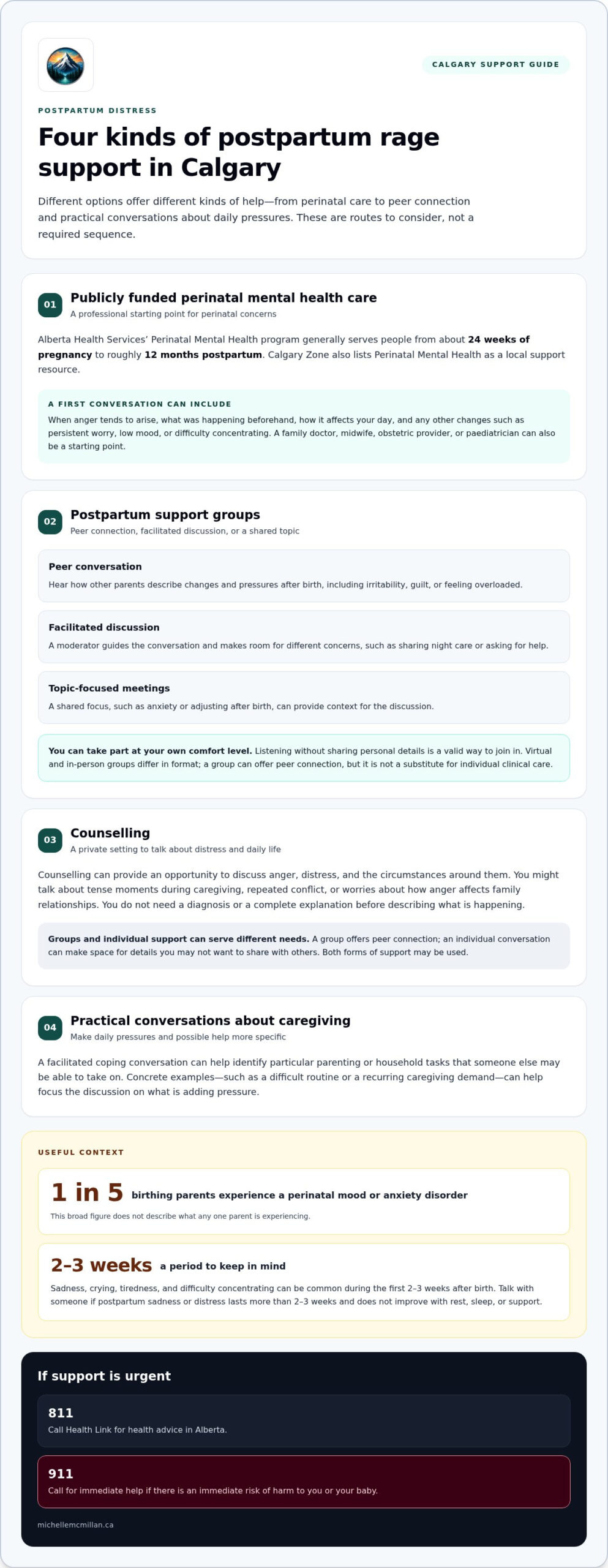
Postpartum rage support in Calgary can include publicly funded perinatal care, peer groups, counselling, and help discussing daily pressures. These options provide different kinds of support, from speaking with a professional to connecting with other parents. If anger feels difficult to understand or manage, you can describe what’s happening without having a diagnosis or a complete explanation.
Intense anger after childbirth can be confusing, especially when it feels unlike you. It can also be difficult to discuss if you’re worried about being judged. You deserve to have your concerns taken seriously, without being reduced to a label or blamed for struggling.
This article explains how parents in Calgary can explore local perinatal mental health care, support groups, and counselling for postpartum distress. It also covers practical ways to discuss caregiving demands and where to turn if a situation becomes urgent. The aim is to help you identify a next step that fits the support you need.
Key Takeaways
- Calgary’s publicly funded perinatal mental health program generally serves people from about 24 weeks of pregnancy to roughly 12 months postpartum.
- Support groups can provide space to connect with others experiencing the changes and pressures of life after childbirth.
- Counselling offers an opportunity to discuss anger, distress and the circumstances surrounding them, whether individually or with family support.
- Facilitated coping conversations can help identify specific parenting and household tasks others may be able to take on.
- For health advice in Alberta, call Health Link at 811; call 911 for immediate help.
Publicly funded perinatal mental health care in Calgary
In Calgary, Alberta Health Services’ Perinatal Mental Health program is a publicly funded starting point for perinatal concerns. According to Alberta Health Services, the program generally serves people from about 24 weeks of pregnancy to roughly 12 months postpartum. That range includes people who are seeking support before birth and those experiencing distress after bringing a baby home. Calgary Zone also lists Perinatal Mental Health as a local support resource.
Postpartum anger can involve intense irritation, frustration, or reactions that feel larger than the immediate situation. It isn’t a diagnosis in the DSM-5-TR, but anger can occur alongside postpartum depression or anxiety. You don’t need to decide what the feeling means before describing it. A clear example, such as “I’m getting angry during routine caregiving tasks,” gives a health professional something specific to discuss.
Sadness, crying, tiredness, and difficulty concentrating can be common during the first 2-3 weeks after a baby is born. Talk with someone if postpartum sadness or distress lasts more than 2-3 weeks and doesn’t improve with rest, sleep, or support. Roughly one in five birthing parents experience a perinatal mood or anxiety disorder. That figure describes a broad group, not what any one parent is experiencing.
- Alberta Health Services Perinatal Mental Health: A publicly funded program for perinatal concerns within its general service period.
- Calgary Zone Perinatal Mental Health listing: A local resource entry for finding perinatal support information.
- Health Link 811: A phone resource for health advice in Alberta.
When you first talk with a professional, name the feeling and give a recent example. Describe when the anger tends to arise, what was happening beforehand, and how it affects your day. Mention other changes too, such as persistent worry, low mood, or difficulty concentrating. A family doctor, midwife, obstetric provider, or paediatrician can be a starting point for discussing postpartum distress. These details keep the conversation grounded in your experience rather than assumptions about its cause.
If postpartum anger creates an immediate risk of harm to you or your baby, call 911 now. Tell the operator you’re concerned about immediate safety after childbirth, and ask another adult nearby to stay with you and the baby while help is arranged.
Postpartum support groups
A postpartum support group offers a different kind of conversation from an individual appointment. Instead of speaking only with a professional, you hear how other parents describe the changes, pressures and emotions of life after birth. One parent might mention feeling overwhelmed during evening feeds; another may recognize a similar strain in their own routine. Shared experiences can make it easier to put difficult feelings into words.
Groups differ in format and focus. Some centre on peer conversation, while others are facilitated by a professional who guides the discussion. A group might focus broadly on adjusting to life with a baby or address perinatal mental health more specifically. In Calgary, the Calgary Zone lists Perinatal Mental Health as a local support resource. It’s one place to find information about perinatal support in the area.
Think about what you want from a group before choosing a format. If speaking aloud feels difficult, you may prefer a group where you can mostly listen. If you want practical discussion, a facilitated group may leave room for questions about sharing night care, handling family expectations, or asking for help. A virtual group may remove travel from the day, while an in-person group offers conversation in the same room. These are differences in format, not promises about what a group will provide.
- Peer conversation: Useful for hearing how other parents describe experiences such as irritability, guilt, or feeling overloaded.
- Facilitated discussion: Useful when you want a moderator to keep the conversation focused and make room for different concerns.
- Topic-focused meetings: Useful when a particular issue, such as anxiety or adjustment after birth, is easier to discuss with shared context.
You can prepare a sentence before attending. For example: “I’ve been snapping at people more than I want to, and I’d like to hear how others talk about anger after birth.” You can also decide what you feel comfortable sharing. Listening without disclosing personal details is a valid way to take part.
A group isn’t a substitute for individual clinical care. It can offer peer connection and a place to speak, but intense or persistent distress may call for a personal conversation with a health professional. If anger feels frightening, affects your day-to-day care, or raises a safety concern, seek individual support rather than relying on group discussion alone. You can use both forms of support for different needs.
Postpartum rage support in Calgary can include peer connection alongside other care. A group may help you feel less alone with a specific experience, while a private conversation can make space for details you don’t wish to share with others.
Counselling approaches for postpartum distress
Counselling offers a private setting to discuss postpartum distress and its effects on daily life. You might talk about feeling tense during ordinary caregiving, repeated conflict, or worries about how anger affects family relationships. Start with the concern that feels most pressing. You don’t need a polished explanation before asking for support.
There isn’t one counselling approach that suits every parent or situation. Some people want to focus on their own feelings and experiences; others want to discuss relationship pressures or changing family responsibilities. First, consider what you hope to address: your emotional experience, a recurring interaction, or the practical demands of caregiving. These concerns can overlap, but you don’t have to discuss them all at once.
It may help to consider the kind of conversation you want. Individual counselling centres your experience. Couples counselling gives partners a setting to discuss shared concerns, while family counselling can address broader family dynamics. These are different formats for discussion, not promises of a particular outcome. You can also speak with a health professional about whether your distress calls for clinical assessment or another form of care.
- Concern statement: A short description, such as “I’m worried about how often I feel irritable,” helps open the conversation.
- Question list: Notes about what you want to understand can help keep a first discussion focused.
- Relationship map: Naming who is involved in a recurring tension can clarify whether individual or shared discussion feels relevant.
- Care-context notes: Brief details about routines, responsibilities, and major changes can provide useful background.
These are optional ways to organize what you want to say, not clinical tests or required preparation. You can bring one example, ask a question, or begin by saying you’re unsure where to start. If speaking openly feels difficult, a short written note can help you remember the concern you wanted to raise.
Counselling is distinct from medical assessment and diagnosis. If you’re seeking a diagnosis or medical care, raise that need with a physician or another health professional. Counselling can still provide a setting to discuss emotional concerns and their effects on your relationships or daily responsibilities. Depending on what you’re experiencing, more than one kind of support may be relevant.
Anger doesn’t define your character, and describing it honestly can clarify what’s concerning you. You might begin with what feels most disruptive, what you want to understand, or what support you hope to discuss. A focused conversation can start with one concern, even when the wider situation feels complicated.
Facilitated coping strategies and self-care
Sleep deprivation can affect emotional regulation, lower frustration tolerance, and increase sensitivity to stress. After a night of repeated waking, a small interruption may feel harder to manage. That context matters when exploring postpartum anger. It doesn’t make distress less important; it can help identify what demands may be shaping a difficult moment.
A facilitated conversation can turn broad concerns into practical questions about daily life. A counsellor or other support professional may help you identify the situations that feel most difficult, the tasks involved, and where support could fit. For example, you might notice that tension rises when feeding, meals, and household chores overlap. Naming those demands can make a discussion about support more specific.
One useful focus is redistributing parenting and household work. Instead of asking someone to “help more,” identify a task they could take over. Examples include preparing dinner, doing laundry, or handling a household errand. The aim is to make invisible work visible and discuss who can reasonably manage each responsibility.
- Task list: Captures recurring care and household responsibilities, such as preparing bottles or arranging meals.
- Support map: Names people who may be able to take on a specific task, such as a partner handling laundry.
- Daily-pressure notes: Records situations linked with heightened frustration, such as several requests arriving during bedtime.
- Shared-care plan: Helps turn a general request into a clear division of responsibilities for a particular day or routine.
These tools are conversation aids, not tests or guaranteed solutions. A task list may show that one person is managing appointments, supplies, and night-time care alongside other responsibilities. A shared-care plan can focus the discussion on what someone else could take over, rather than placing every change on the parent experiencing anger.
Self-care also needs to fit the reality of caring for a baby. A plan that assumes uninterrupted sleep or long periods alone may not reflect your circumstances. A more grounded discussion could consider whether another adult can cover a specific task or whether a meal can be simplified on a demanding day. The key question is what support is actually available in your household.
If anger feels strongest during a particular routine, bring that example to a facilitated conversation. “I become overwhelmed when I’m settling the baby and answering household requests” is more specific than “I’m coping badly.” You can discuss which demands might change, who could share them, and whether additional support may help. A professional conversation can help organize these concerns without treating self-care as a substitute for care when distress is persistent or severe.
Where can Calgary parents get urgent mental health support after childbirth?
If you’re worried you may harm yourself or your baby, call 911 now. Tell the operator that there’s an immediate safety concern after childbirth. If another adult is nearby, ask them to stay with you and the baby while help is arranged. Don’t wait for a routine appointment when immediate safety is at risk.
For urgent support in Alberta, choose the contact that matches the need:
- 911: Call for immediate danger or an urgent risk of harm to you or your baby.
- 988: Call or text the Suicide Crisis Helpline, available 24/7 in Canada, if you’re in crisis or thinking about suicide.
- 1-866-332-2322: Call Alberta’s Suicide Prevention Line for suicide-related support.
- Health Link 811: Call this free Alberta health information service, available 24/7, for health advice.
- 211 Alberta: Call 211 for support information and help identifying a suitable contact.
If you’re unsure which number fits, consider whether danger is immediate. A direct threat to someone’s safety calls for 911. A mental health crisis involving suicidal thoughts can be met with 988 or Alberta’s Suicide Prevention Line. For health advice when immediate danger isn’t present, Health Link 811 is available by phone. These services have different roles, so explain plainly what’s happening and whether anyone is at immediate risk.
When you call, share the safety-related detail first. You might say, “I’ve recently given birth, I’m afraid I could hurt myself, and I’m caring for my baby.” If you’re calling for someone else, explain what you’ve observed and whether the parent and baby are together. Be clear about the baby’s location and any immediate safety concern, rather than trying to explain every postpartum challenge at once.
Postpartum psychosis is a rare but serious perinatal mental health concern, reported in roughly 1 to 2 in 1,000 births. If you’re worried about a severe change in someone’s mental state or immediate safety, use emergency support rather than waiting for a support group or standard counselling appointment. You don’t need to determine a diagnosis before asking for urgent help.
For a non-immediate concern, Health Link 811 can help you discuss health questions, while 211 Alberta offers a separate number for support information. If risk increases while you’re seeking advice, switch to 911 or 988 as appropriate. Keep these numbers accessible, and share them with a trusted person who may be supporting you after birth.
Michelle McMillan: Individual Therapy
Michelle McMillan offers individual therapy, where you can discuss postpartum anger, anxiety, or pressures affecting daily life. You can bring specific examples, such as feeling overwhelmed during a caregiving routine, and explore what support may be useful. Counselling provides space to discuss concerns; it does not replace urgent help when someone’s safety is at risk.
Michelle holds a Master of Arts in Counselling Psychology (MACP) and is a Canadian Certified Counsellor (CCC), a national professional certification through the Canadian Counselling and Psychotherapy Association. She offers virtual and in-person counselling, with in-person and virtual appointments available locally in Calgary and surrounding areas.
If you’d like to discuss individual counselling, contact Michelle McMillan.
Choose a next step that feels manageable
Putting a name to postpartum anger can be difficult, especially when you’re already managing the demands of caring for a baby. You don’t need a complete explanation before asking for support. A simple next step is to write down what you’d like to discuss, such as recurring tension, changing family responsibilities, or how distress is affecting daily life. This can help you begin a conversation in your own words.
If you’re considering postpartum rage support in Calgary, individual counselling can give you space to discuss your concerns. Family therapy or couples counselling may also be relevant if you want to talk about how postpartum distress affects relationships or shared responsibilities. Start with the option that reflects what you want to discuss now.
Michelle McMillan offers these counselling options. Contact Michelle McMillan to explore whether counselling is a useful next step for you. You deserve to have your concerns taken seriously, and reaching out can begin with one honest conversation.
Frequently Asked Questions
What postpartum rage support services are available in Calgary?
Options include Alberta Health Services’ Perinatal Mental Health program, peer or facilitated support groups, and individual counselling. The right starting point depends on what you need: clinical care, shared experiences, or private space to discuss family pressures. When seeking postpartum rage support in Calgary, describe the anger directly rather than assuming it will come up in a general conversation about mood.
Which Calgary therapists specialize in postpartum rage, anger, or perinatal mental health?
Alberta Health Services’ Perinatal Mental Health program is a Calgary-area resource for perinatal concerns. Michelle McMillan offers individual counselling, but this article does not identify her as a postpartum-rage specialist. If you speak with a counsellor or health professional, describe the timing, impact, and concerns you want addressed. That helps clarify whether individual counselling or another perinatal service suits the question you’re bringing forward.
Are there Calgary postpartum support groups for anger, overwhelm, or intrusive thoughts?
The Calgary Zone lists Perinatal Mental Health as a local support resource, but this article doesn’t identify a group specifically devoted to anger or intrusive thoughts. Support groups may focus on peer sharing, facilitated discussion, or broader postpartum adjustment. If intrusive thoughts feel frightening or raise a safety concern, explain that clearly to a health professional rather than relying on group discussion alone.
How can I access a Calgary perinatal psychiatrist or psychologist, and do I need a referral?
Start by describing your concerns to a family doctor, midwife, or obstetric provider; they can discuss appropriate perinatal mental health care. Referral steps vary by service, so there isn’t one referral rule for every psychiatrist or psychologist. Calgary’s Perinatal Mental Health resource is another local starting point. Explain whether you’re seeking assessment, medical care, counselling, or support with postpartum distress.
What are the costs and wait times for postpartum mental health support in Calgary?
Alberta Health Services’ Perinatal Mental Health program is publicly funded. Private counselling fees are set by individual practices, and access timelines depend on the service and its intake process. There isn’t one price or wait time for all postpartum support in Calgary. If cost affects your options, distinguish publicly funded care from private counselling when discussing possible routes with a health professional.
Does Alberta health insurance cover postpartum counselling or therapy?
Publicly funded care through Alberta Health Services is separate from reimbursement for private counselling. Coverage for private sessions depends on the terms of your extended health benefits plan, including eligible provider designations and any plan limits. Review your plan’s counselling benefits before budgeting for private care. Public funding for a perinatal program doesn’t mean private counselling is reimbursed.
What are the symptoms and causes of postpartum rage, and when should I seek help?
Postpartum rage can involve intense anger, irritability, or frustration after childbirth, sometimes alongside postpartum depression or anxiety. Possible contributors include sleep loss, parenting workload, and physical changes after birth; anger alone can’t identify a single cause. Seek professional input if these feelings are troubling, continue, or affect daily life. Share what has changed and how it affects your relationships or caregiving.
Are there Calgary-specific helplines, crisis services, or supports for new parents?
Calgary parents can use Alberta’s health and crisis resources, including Health Link, the Suicide Prevention Line, 988, 211 Alberta, and 911 for immediate danger. Each serves a different need: health advice, suicide-related crisis support, community-service information, or emergency response. If you’re unsure which applies, explain whether anyone faces immediate danger and whether the concern involves suicidal thoughts or another health question.

Article by
Michelle McMillan, MACP, CCC
Michelle McMillan is a Canadian Certified Counsellor (CCC) with a Master of Arts in Counselling Psychology (MACP). She has extensive experience working with children and supporting clients with ADHD, neurodivergence, anxiety, emotional regulation, relationships and family challenges. Michelle offers both virtual and in-person counselling, with virtual counselling available throughout Alberta, British Columbia, Saskatchewan and Manitoba and in-person appointments available in Calgary.
Important Information
This article is provided for general educational and informational purposes only and is not a substitute for professional counselling, psychological, medical or emergency services. Information shared here should not be considered a diagnosis or individualized treatment advice. If you are experiencing a mental health emergency or are in immediate danger, please contact appropriate emergency services in your area.