
You don’t have to wait until your relationship is in crisis to seek support. Couples counselling for communication problems in Calgary may be worth considering when the same arguments keep returning, misunderstandings are hard to resolve, or conversations about what matters quickly become defensive or withdrawn. These patterns can leave both partners feeling unheard, even when they want to reconnect.
It’s understandable to hope a difficult stretch will pass on its own. But when conversations repeatedly end in conflict or silence, a supportive setting can help you explore what’s happening, understand each other’s perspectives, and discuss the concerns beneath the disagreement.
This article explains when communication support may be useful, what couples counselling can involve, and how partners can explore recurring conflict and emotional distance. It also covers choosing a counselling format in Calgary and considering a first step, without treating counselling as proof that your relationship has failed.
Key Takeaways
- Look beneath a disagreement to understand the feelings and assumptions each partner brings to the conversation.
- Notice when arguments repeat or end in silence, and consider what those patterns may be making difficult to discuss.
- Small moments of attention and understanding can matter when partners are trying to feel more connected.
- Recognize when blame, withdrawal, or escalating conflict is getting in the way of a respectful conversation.
- Communication support may be worth considering before a relationship reaches a crisis point.
Understanding partners’ perspectives and feelings
A disagreement often involves more than its visible subject. A conversation about dishes, for example, may also touch on fairness, workload, or feeling appreciated. Each partner may focus on a different part of the exchange: one remembers the unfinished task, while the other remembers a demanding day. Naming those different meanings can help explain why the same event feels different to each person.
Curiosity makes room for different perspectives without requiring either partner to agree immediately. If one person feels unimportant after a late arrival, while the other was managing an unexpected delay, asking what the moment meant to each can shift attention from blame to context. The goal isn’t to decide whose feelings are correct, but to understand what each person experienced.
Couples counselling can provide a setting to examine these interpretations together. A counsellor may help partners slow down a conversation and distinguish what happened, what each person concluded, and how that conclusion shaped their response. For instance, “You didn’t text” describes an event; “You don’t care” adds an interpretation. Separating the two can show where partners are reacting to different meanings, not just different facts.
Counsellors may draw on approaches such as Emotion-Focused Therapy, Cognitive Behavioural Therapy, Strengths-Based Therapy, Person-Centred Therapy, or Attachment-Based approaches. The approach depends on the counselling context and concerns being discussed. Exploring how each partner interprets an event can help make different perspectives clearer without assuming that one account is the whole story.
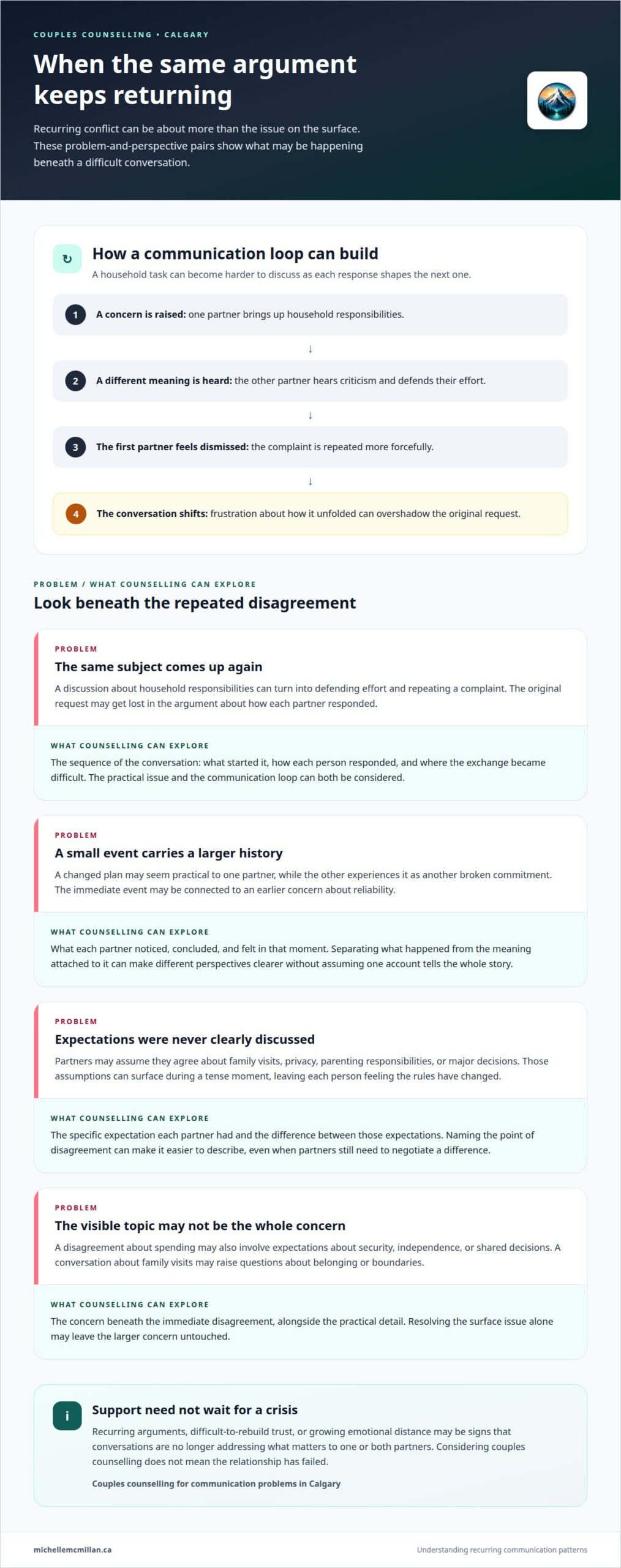
Curiosity can also uncover concerns beneath a repeated disagreement. A discussion about spending might involve different expectations about security, independence, or shared decisions. A conversation about family visits may raise questions about belonging or boundaries. These concerns deserve attention alongside the immediate issue, since resolving the practical detail alone may leave the larger concern untouched.
Partners don’t need to wait for a relationship crisis before considering counselling, and seeking support doesn’t mean the relationship has failed. In Calgary, couples may bring a specific conversation, recurring misunderstanding, or difficult decision to counselling. Each partner can describe what they noticed, how they felt, and what they hoped the other would understand. Listening to those details can make a disagreement more understandable, even when partners still see the issue differently.
Make the conversation more concrete by describing one moment at a time, then checking whether you’ve understood the other person’s account. Ask what felt most significant, what each person needed, and what they would like to do differently in a similar moment. Listening before responding can keep the discussion focused on understanding rather than winning. If the exchange becomes difficult, you can pause and return to it when ready.
The Calgary Narrative Collective says couples do not need to wait until their relationship is in crisis to seek counselling. The Calgary Narrative Collective says seeking counselling does not mean a relationship has failed.
Recurring arguments and communication difficulties
A recurring argument can circle the same subject without resolving the concern beneath it. One partner raises household responsibilities; the other hears criticism and defends their effort. The first then feels dismissed and repeats the complaint more forcefully. Each response becomes part of the next exchange. Over time, frustration about how the conversation unfolded can overshadow the original request.
Small triggers may carry a larger history. A missed message, changed plan, or unfinished chore can prompt reactions shaped by earlier disagreements. One partner may see a cancelled plan as a practical change, while the other experiences it as another broken commitment. Discussing only the cancellation may miss the concern about reliability that gives it emotional weight.
Couples counselling can offer a setting to map the pattern instead of deciding which partner is entirely at fault. The conversation might examine what started an argument, how each person responded, and what happened next. In a disagreement about spending, one partner may ask about a purchase, the other may hear mistrust, and both may stop discussing shared priorities. Seeing that sequence can clarify where communication becomes difficult.
Recurring conflict can also stem from expectations that were never clearly discussed. Partners may assume they agree about family visits, privacy, parenting responsibilities, or major decisions. When those assumptions surface during a tense moment, each person may feel the other has changed the rules. Naming the specific expectation can make the disagreement easier to describe, even if the couple still needs to negotiate a difference.
In Calgary, couples may consider counselling when the same conflicts keep returning, trust is difficult to rebuild, or emotional distance is growing. These signs don’t prove a relationship is failing. They may indicate that conversations are no longer addressing what matters to one or both partners. Repeated arguments about plans, for example, may leave the real question, “Can I rely on you?”, untouched.
It can help to distinguish a practical disagreement from a repeating communication loop. Deciding who handles a recurring task may call for a clear agreement. A loop may persist because each partner feels unheard, misunderstood, or blamed during the discussion. Counselling can make space to explore both the practical problem and how partners respond to it, without reducing the relationship to one argument.
Not every disagreement needs professional support. But if attempts to discuss an issue repeatedly end in accusation, silence, or unresolved tension, couples counselling for communication problems in Calgary can provide a place to examine the pattern together. Discussion can include the issue itself, each partner’s experience, and the interaction that makes resolution difficult.
Strengthening emotional connection
Emotional connection is shaped through ordinary exchanges, not only dramatic gestures. Remembering a difficult meeting, sharing a meal, or following through on a plan can communicate attention. A missed response during a vulnerable conversation may carry a different meaning. The same moment can feel caring to one person and disappointing to another, depending on expectations and circumstances. Noticing those details helps couples describe what connection means in their relationship.
The Calgary Narrative Collective describes relationships as being shaped by thousands of small moments. That idea shifts attention from one idealized measure of closeness to the everyday interactions partners experience. For example, a brief check-in after work, an affectionate greeting, or a respectful conversation about schedules can matter. So can repeated interruptions or forgotten commitments. Looking at specific moments gives partners more to discuss than a broad conclusion such as “we’re not close anymore.”
Connection can also involve feeling recognized as an individual. One partner may value practical help, such as handling a household task, while the other values focused conversation. If each assumes their way of showing care is obvious, both can feel overlooked. Talking about what each person recognizes as consideration makes different expectations clearer. Preferences don’t have to be identical; describing what feels meaningful gives partners more specific language.
Acknowledging positive experiences doesn’t erase painful ones. A couple might appreciate a quiet weekend together while still needing to discuss a hurtful exchange from Monday. Holding both realities prevents a difficult moment from defining the entire relationship, without dismissing its impact. In counselling, partners can discuss these mixed experiences and what they mean, including what each person misses, values, and wants understood.
Emotional connection can change with life circumstances. A new parenting responsibility, work schedule, move, or caregiving role can alter how much time and attention partners have for each other. One person managing bedtime may feel alone, while the other sees extra work hours as supporting the household. Naming the circumstance and its effect can separate practical strain from assumptions about commitment or care.
When partners struggle to express feelings without withdrawing or becoming defensive, couples counselling can provide a setting to explore those experiences. The aim isn’t to make every exchange pleasant or prevent disagreement. Partners can clarify what happened in a particular interaction, how each person experienced it, and what they want the other to understand. Talking about attention, affection, time, or shared responsibilities makes connection a more concrete part of relationship counselling.
Unhealthy communication and conflict patterns
Disagreement is part of sharing decisions, but how partners handle it matters. Insults, threats, intimidation, or repeated humiliation can replace discussion with harmful behaviour. Mocking a partner’s concern about household tasks, for example, shifts attention from the task to personal attack. A difficult exchange doesn’t define an entire relationship, but repeated disrespect can make honest conversation harder.
Criticism and blame can narrow what partners hear. “You forgot to pick up groceries” names an event; “You’re useless” attacks the person. The second statement may prompt defensiveness or hurt rather than a discussion about dinner plans. Partners don’t have to avoid naming problems. It helps to distinguish a concern about a specific action from a judgement about someone’s character.
Withdrawal can be difficult to interpret. One partner may stop responding during a disagreement, while the other follows them from room to room seeking an answer. The first may need space, feel overwhelmed, or be avoiding the subject; the behaviour alone doesn’t establish the reason. What matters in the conversation is its effect: the issue remains unresolved, and both partners may feel more alone.
Conflict can also become unproductive through scorekeeping. During a discussion about one missed responsibility, a partner may list old disagreements, forgotten plans, and past apologies. Those details may matter, but bringing them all into one exchange can make the immediate issue harder to address. Ask whether each example clarifies the concern or adds another charge against the other person.
Notice what happens after a sharp exchange. A partner might acknowledge a hurtful remark, clarify what they meant, or return to the topic calmly. Another exchange may end with silence, sarcasm, or a threat to leave. These outcomes offer concrete information about how conflict is handled, but don’t explain each partner’s intentions or the full context on their own.
Couples counselling can provide space to examine interactions without assigning either person a fixed role, such as “the angry one” or “the avoidant one.” A counsellor may help partners describe a specific exchange: what was said, how each responded, and what remained unresolved. This keeps discussion grounded in observable moments rather than broad labels and can reveal where partners’ accounts differ.
If a conversation involves fear, coercion, threats, or concern about someone’s safety, safety takes priority over improving communication in that moment. A disagreement about finances is different from controlling a partner’s access to money or threatening them for disagreeing. Naming that distinction matters. Communication counselling addresses relationship concerns; it shouldn’t make threatening or coercive behaviour seem like ordinary conflict.
Signs that couples may need communication counselling
Communication support may be worth considering when conversations affect how you make decisions, share responsibilities, or discuss sensitive subjects. You might notice that one partner edits what they say to avoid upsetting the other, or that important topics stay untouched because neither person knows how to begin. These experiences can signal that communication deserves attention, even if you still care about the relationship and want to understand each other.
Consider the effect, not just the subject of a disagreement. Can you reach a decision together, or does one person leave feeling pressured to agree? Do you understand what the other person is asking for, even when you see the issue differently? Specific examples can help you decide whether counselling may provide a useful setting to discuss what’s happening.
How to choose a couples counsellor in Calgary: Consider the counsellor’s professional designation, experience with relationship concerns, and whether the service focuses on communication. It may also help to clarify what you both hope to discuss, such as decision-making, recurring tension, or feeling unable to raise concerns.
Online vs. in-person couples counselling in Calgary: Michelle McMillan offers virtual counselling to clients in Alberta, British Columbia, Saskatchewan, and Manitoba, as well as in-person counselling in Calgary. Practical considerations include each partner’s preference, schedule, and ability to participate in the chosen format.
Does Alberta health insurance cover couples counselling? Coverage depends on the terms of your plan and its eligible services and provider criteria. Review your Alberta health benefits before relying on coverage.
What can couples counselling therapists in Calgary help with? Couples may bring concerns such as difficulty making decisions together, feeling unable to raise sensitive topics, or uncertainty about what each partner expects. Counselling provides a setting to discuss these concerns and consider how they affect the relationship.
What happens in the first couples therapy session? The initial conversation generally gives partners space to explain why they’re seeking support and what they hope to address. You can describe your priorities separately, including any differences in what each of you wants from counselling.
How long does couples counselling take to improve communication? There isn’t one timetable that applies to every couple. The pace depends on the concerns being discussed, what each partner wants to work on, and how the focus of counselling develops over time.
How can you find a registered couples therapist in Alberta? Check the counsellor’s professional designation and the organization that grants it. The Canadian Certified Counsellor designation is a national professional certification through the Canadian Counselling and Psychotherapy Association, not provincial registration.
Pay attention to whether a difficult conversation can be revisited calmly, and whether both partners can explain what they understood without having to settle every difference immediately. Bringing one recent example to a counsellor may help keep the discussion concrete and show where each person would like communication to change. Innovative Counselling Solutions states that it has 12+ years of experience.
Michelle McMillan: Individual Therapy
Michelle McMillan offers couples counselling for partners who want a place to discuss communication concerns and recurring conflict. Couples can attend virtually together from the same location or join from separate locations. In-person counselling is available in Calgary.
Michelle has 16 years of education experience, including work in specialized mental-health and intensive behavioural-support settings with children, teens and families. She offers both virtual and in-person counselling, and prefers to provide much of her counselling virtually. Her credentials include a Master of Arts in Counselling Psychology and the Canadian Certified Counsellor designation.
If you’d like to explore counselling as a next step, you’re welcome to contact Michelle McMillan.
Make room for a different conversation
You don’t need to have every concern neatly explained before considering a next step. It may be enough to recognize that an important subject keeps being avoided or that conversations aren’t going as you hope. Couples counselling for communication problems in Calgary offers a setting to discuss what you’d like to address.
Before taking that step, consider what you each hope will become easier to talk about. One partner may want to feel heard; the other may want to discuss difficult topics without losing sight of the issue. Different priorities can be part of the conversation, too. You don’t have to settle them before beginning.
If you’re ready to explore counselling, visit the Rates and Booking page to consider a next step at your own pace.
Frequently Asked Questions
When Should Couples Consider Counselling?
Couples may consider counselling when communication difficulties affect everyday decisions, shared responsibilities, or their willingness to raise important subjects. If you’re postponing a conversation about parenting or finances because you expect it to become overwhelming, professional support may help you discuss what’s getting in the way. You don’t have to wait for a crisis or reach complete agreement before seeking a place to talk.

Article by
Michelle McMillan, MACP, CCC
Michelle McMillan is a Canadian Certified Counsellor (CCC) with a Master of Arts in Counselling Psychology (MACP). She has extensive experience working with children and supporting clients with ADHD, neurodivergence, anxiety, emotional regulation, relationships and family challenges. Michelle offers both virtual and in-person counselling, with virtual counselling available throughout Alberta, British Columbia, Saskatchewan and Manitoba and in-person appointments available in Calgary.
Important Information
This article is provided for general educational and informational purposes only and is not a substitute for professional counselling, psychological, medical or emergency services. Information shared here should not be considered a diagnosis or individualized treatment advice. If you are experiencing a mental health emergency or are in immediate danger, please contact appropriate emergency services in your area.