
Understanding Online Relationship Counselling in Canada
Relationship counselling online offers couples and individual partners the opportunity to access professional therapeutic support through secure, digital platforms. Rather than travelling to a traditional clinic, participants connect with a professional counsellor or therapist using encrypted video conferencing. Across Canada, this delivery model has evolved from an occasional alternative into a standard, widely utilized format for addressing interpersonal communication, unresolved conflict, and complex life transitions.
In Alberta and across Western Canada, choosing to pursue relationship counselling online allows couples to engage with professional support directly from their own residences or personal spaces. This approach is frequently utilized by couples residing in urban centres such as Calgary and Edmonton, as well as those living in rural areas where access to specialized relationship therapists may be geographically limited. While the setting differs from an in-person office visit, the professional framework, clinical ethics, and therapeutic objectives remain rooted in standard counselling practices.
Virtual Therapy vs. Traditional In-Person Sessions
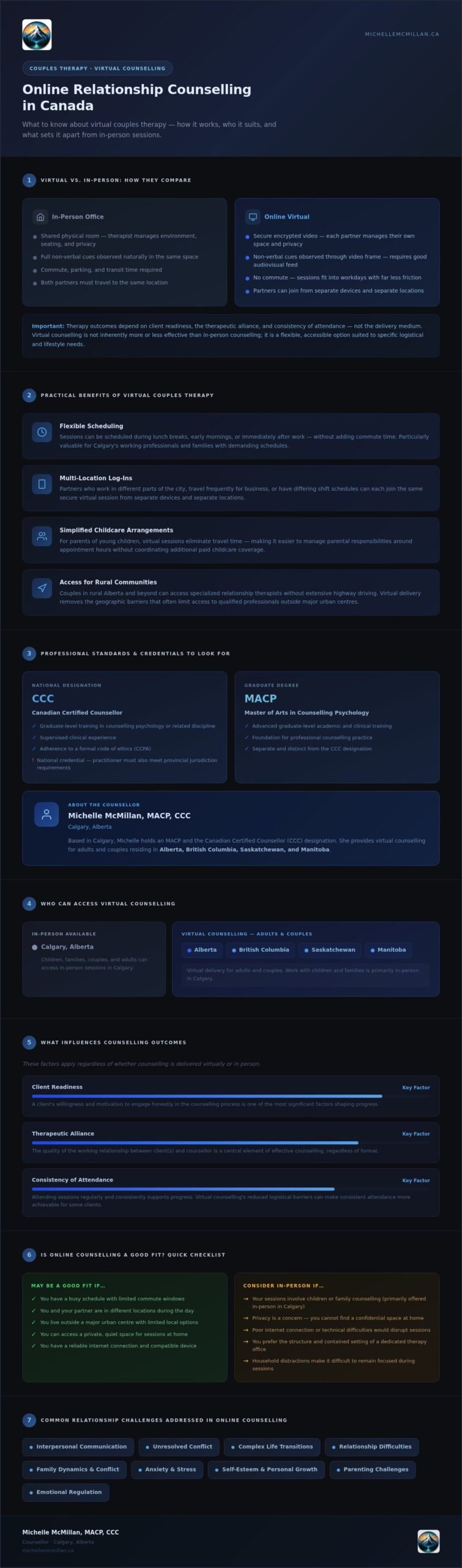
The primary difference between virtual couples counselling and traditional in-person therapy lies in the medium of delivery and logistics, rather than the underlying clinical objectives. In an office setting, both partners and the therapist sit together in the same physical room. In an online setting, participants connect via secure video links, either sharing a screen from a single location or logging in from separate locations when schedules or physical distance require it.
When considering relationship counselling online, couples often evaluate the practical trade-offs between virtual and in-person formats:
- Geographic Reach: Virtual sessions allow couples to work with qualified professionals based outside their immediate community, expanding their options beyond local clinics.
- Logistical Demands: Online sessions remove commuting, parking, and transit times, allowing sessions to fit more easily into busy workdays.
- Screen-Mediated Interaction: Communication occurs over video, which relies on adequate internet bandwidth and clear audiovisual feeds. Non-verbal cues, facial expressions, and body language are observed through the frame of the screen rather than in a shared physical room.
- Environmental Control: In an office, the therapist manages the physical environment, seating, and privacy. In virtual counselling, partners take responsibility for managing their own space, ensuring privacy, and minimizing household distractions.
Therapy outcomes are influenced by numerous individual and relational factors, including client readiness, the therapeutic alliance, and consistency of attendance. Virtual counselling is not inherently more effective or less effective than in-person counselling; rather, it represents a flexible, accessible delivery method that suits specific logistical and lifestyle needs.
Provincial Eligibility and Professional Standards
In Canada, counselling and mental health services are subject to provincial standards and professional regulatory frameworks. When seeking relationship counselling online, it is essential to verify that your practitioner is professionally credentialed and authorized to offer services within your province of residence.
Practitioners holding the Canadian Certified Counsellor (CCC) designation have met national certification standards established by the Canadian Counselling and Psychotherapy Association (CCPA). This certification requires graduate-level training in counselling psychology or a related discipline, supervised clinical experience, and adherence to a formal code of ethics. However, the CCC designation is a national professional credential rather than a provincial statutory license; practitioners must also adhere to the regulatory requirements of the specific jurisdiction where their clients reside.
Michelle McMillan holds a Master of Arts in Counselling Psychology (MACP) and is a Canadian Certified Counsellor (CCC). Based in Calgary, Alberta, Michelle provides virtual counselling for adults and couples residing throughout Alberta, British Columbia, Saskatchewan, and Manitoba. For individuals interested in learning more about her professional background, credentials, and practice focus, detailed information is available on the About Michelle page.
The Practical Benefits of Virtual Couples Therapy
The growing adoption of relationship counselling online is primarily driven by practical, real-world considerations. Modern relationships often involve complex schedules, demanding careers, household responsibilities, and parenting commitments that make attending weekly in-person appointments challenging. Virtual therapy addresses these friction points by providing structured mental health support with fewer logistical barriers.
Convenience for Busy Calgary Families and Professionals
For working professionals and families in Calgary and surrounding communities, navigating traffic, unpredictable winter weather, and strict office hours can turn an in-person counselling appointment into a multi-hour commitment. Virtual therapy streamlines this process by eliminating the commute entirely.
Practical logistical advantages include:
- Flexible Scheduling: Sessions can often be scheduled during lunch breaks, early mornings, or immediately after work hours without adding commute time.
- Multi-Location Log-ins: When partners work in different quadrants of the city, travel frequently for business, or maintain differing shift schedules, they can join the same secure virtual therapy room from separate devices and locations.
- Simplified Childcare Arrangements: For parents of young children, attending an in-person appointment often requires coordinating paid childcare. Virtual sessions eliminate travel time, making it easier to manage parental responsibilities around appointment hours.
- Access for Rural Communities: Couples living outside major urban centres in Alberta gain access to specialized relationship therapists without the burden of extensive highway driving.
To learn more about the broader range of therapy formats available for individuals and partners, you can review Michelle McMillan’s Services.
Managing the Counselling Environment from Home
Engaging in relationship counselling online means that sessions take place within a space chosen and managed by the participants. This presents both practical opportunities and specific responsibilities for the couple.
When attending sessions from home, partners remain in an environment that reflects their daily routines. Unlike an office where the therapist establishes physical neutrality, couples participating virtually must actively prepare their physical surroundings to ensure the session remains confidential, uninterrupted, and focused. This involves setting boundaries with family members, arranging comfortable seating, and turning off household distractions.
For couples seeking a dedicated couples therapist in Calgary, virtual options provide a way to consult with a qualified professional while maintaining autonomy over the physical setting in which the discussions occur.
Common Relationship Challenges Addressed Through Online Support
Couples seek professional counselling for a wide variety of reasons. Relationship dynamics are inherently multifaceted, influenced by stress, individual coping mechanisms, family histories, and evolving life circumstances. Participating in relationship counselling online allows partners to explore these patterns systematically with a neutral third party.
Navigating Communication Barriers and Conflict Patterns
One of the most frequent reasons couples pursue counselling is the experience of unproductive, repetitive conflict. Over time, many couples develop predictable interaction cycles that make resolving disagreements difficult.
Common relational dynamics addressed in counselling include:
- Demand-Withdraw Patterns: A dynamic where one partner raises a concern with increasing urgency or frustration, while the other partner responds by withdrawing, going silent, or physically leaving the interaction.
- Escalation Cycles: Conversations that rapidly shift from a specific disagreement over household tasks or schedules into generalized criticisms, defensive responses, or past grievances.
- Emotional Distance: A gradual reduction in meaningful verbal sharing, where partners feel like roommates managing logistical duties rather than connected individuals.
- External Stressors: The impact of financial pressures, career demands, or health concerns spilling over into daily interpersonal interactions.
In a counselling setting, the therapist serves as an objective observer who helps partners identify these recurring interaction loops. Rather than assigning fault, discussions typically examine how each partner experiences the interaction and what factors contribute to defensive or avoidant reactions. Those exploring specific therapy topics can read more on the Areas of Focus page.
Support for ADHD and Neurodivergence in Relationships
Neurodivergence, including Attention-Deficit/Hyperactivity Disorder (ADHD), can introduce distinct complexities into adult romantic partnerships. While ADHD is formally diagnosed at the individual level, its executive functioning characteristics frequently intersect with shared relational responsibilities, communication, and emotional dynamics.
In relationships where one or both partners have ADHD, couples frequently report specific areas of tension:
- Division of Household Labour: Difficulties with working memory, organization, task initiation, and time estimation can lead to missed commitments, uneven distribution of chores, or frustration over unfinished household tasks.
- Parent-Child Dynamics: When executive functioning differences result in one partner routinely taking on scheduling, reminding, and tracking responsibilities, the relationship can unintentionally drift into an imbalanced dynamic where one person feels overburdened and the other feels micro-managed.
- Attentional Distribution: A non-ADHD partner may interpret hyperfocus on hobbies or external tasks, alongside distraction during shared conversations, as a lack of emotional investment or care, even when that is not the intention.
- Emotional Regulation Differences: Some neurodivergent adults report experiencing rapid emotional shifts or intense reactions to perceived interpersonal tension or perceived criticism (sometimes informally referred to as rejection sensitive dysphoria). These reactions can accelerate conflict cycles.
It is important to emphasize that ADHD manifests uniquely in every individual; there is no single neurodivergent relationship experience. Professional counselling can provide an educational setting where partners examine how attention and executive functioning differences interact with their communication styles, without treating either person as fundamentally deficient. For a deeper discussion of these dynamics, consider reading ADHD Couples Therapy in Calgary: Navigating Neurodivergent Relationships Together, as well as broader provincial resources on virtual ADHD counselling in Alberta.
Preparing for Your First Virtual Counselling Session
A successful virtual counselling experience requires deliberate practical preparation. Because sessions occur in your private environment rather than a managed clinic, taking concrete steps to establish technical stability and personal privacy helps minimize logistical interruptions.
Technical Setup and Privacy Considerations
Before your first appointment, taking time to configure your equipment and environment ensures the session can proceed smoothly without technical delays.
- Choose an Appropriate Device: Use a laptop, desktop computer, or stable tablet rather than a handheld smartphone. A larger screen provides a clearer view of both your partner and the counsellor, while a stable, stationary device prevents screen shaking during discussions.
- Test Audiovisual Equipment: Verify that your microphone, web camera, and speakers or headphones are functioning properly at least fifteen minutes prior to the scheduled call. If you are sharing a screen, ensure the camera is positioned wide enough to capture both individuals comfortably.
- Verify Internet Stability: Video conferencing requires a dependable broadband connection. Where possible, position your setup close to your Wi-Fi router, disconnect bandwidth-heavy household downloads, or use an ethernet cable to minimize connection dropouts.
- Select a Private Physical Space: Choose a room with a closing door. If living in close quarters with roommates, children, or extended family, consider placing a white noise machine, small fan, or speaker playing gentle background audio outside the closed door to prevent voices from carrying.
- Eliminate Digital Distractions: Close unnecessary browser tabs, mute email and messaging notifications, and place personal smartphones in another room or on silent mode to maintain focus throughout the allotted time.
Setting Expectations and Shared Intentions
Engaging in relationship counselling online requires both partners to approach the process with clear personal expectations. Unlike individual therapy, where the sole focus is on one person’s inner experience, relationship therapy focuses on the interpersonal dynamic between partners.
To make the most of your sessions, couples may find it helpful to consider the following reflective questions before beginning:
- What specific recurring communication challenges or situations would we like to understand more clearly?
- Are both of us participating willingly, or does one of us feel hesitant, anxious, or uncertain about the process?
- Can we agree to approach our discussions with an openness to hearing our partner’s perspective, even when disagreements arise?
- What logistical agreements do we need to establish (e.g., managing work interruptions or childcare) to ensure we are both fully present for the duration of each call?
Clarifying these factors beforehand allows partners to enter the virtual therapy room with a realistic understanding of what the counselling process entails.
Evaluating Whether Online Relationship Counselling Fits Your Needs
While relationship counselling online is an effective and highly practical format for many couples, it is not universally appropriate for every situation. Evaluating your circumstances objectively ensures that you select the therapeutic setting best suited to your safety and clinical needs.
Appropriate Scenarios for Virtual Couples Therapy
Online relationship therapy is well-suited for situations where both individuals are physically safe and motivated to explore their relational dynamics. Common appropriate scenarios include:
- Couples seeking to improve day-to-day communication, decision-making, and conflict resolution skills.
- Partners navigating major life transitions, such as welcoming a child, relocating, career changes, or adjusting to an empty nest.
- Couples managing busy schedules who require the flexibility of attending sessions without travel time.
- Partners managing the relational impact of adult ADHD, chronic stress, or work-life balance challenges.
- Long-distance couples or partners who frequently work in different locations.
When In-Person Support or Alternative Care Is Recommended
Certain relational and clinical presentations require a different level of intervention than standard outpatient virtual counselling can safely provide. Virtual couples therapy is generally not recommended under the following conditions:
- Active Domestic Abuse or Intimate Partner Violence: If there is ongoing physical violence, coercion, severe intimidation, or fear of retaliation, standard couples counselling (whether online or in-person) is contraindicated due to safety concerns. Specialized individual support and crisis intervention services are necessary.
- Severe, Unmanaged Addictions: When active, untreated substance dependence severely compromises daily functioning or emotional safety, individual medical and specialized addiction treatment should typically precede or accompany relational work.
- Severe Mental Health Crises: If a partner is experiencing active psychosis, severe unmanaged mania, or acute suicidal ideation, immediate psychiatric and crisis stabilization is required. Virtual relationship counsellors do not provide 24/7 crisis intervention.
- Severe Lack of Privacy: If partners cannot secure a confidential room free from the presence or listening ear of others, the safety and integrity of the therapeutic process can be substantially compromised.
Frequently Asked Questions About Online Relationship Counselling
Is online relationship counselling as effective as in-person therapy?
Research across psychotherapy literature indicates that telepsychology and virtual counselling can provide comparable client satisfaction and therapeutic utility to in-person services for a wide variety of concerns. However, effectiveness depends significantly on individual circumstances, such as client motivation, consistency of attendance, the quality of the working relationship with the counsellor, and the absence of distracting home environments. Virtual therapy is not inherently superior or inferior to in-person care; it is an alternative service format that offers distinct practical conveniences.
What provinces can Michelle McMillan provide virtual counselling for?
Michelle McMillan, MACP, CCC provides virtual counselling for adults and couples residing throughout Alberta, British Columbia, Saskatchewan, and Manitoba. Clients must be physically present in one of these four provinces at the time their virtual session takes place in order to comply with professional practice boundaries.
Do we both need to be in the same room for our online session?
No. While many couples choose to sit together on a shared sofa or at a desk facing a single camera, it is entirely acceptable to log in from separate devices and separate physical locations. This multi-location setup is frequently utilized when partners have differing work locations, business travel commitments, or distinct daily schedules.
What if my partner is hesitant to try relationship counselling online?
Ambivalence about therapy is common. One partner is frequently more eager to seek professional support than the other. In virtual counselling, hesitant partners sometimes appreciate the ability to participate from their familiar home environment without visiting an unfamiliar clinical office. Openly acknowledging reservations and agreeing to attend an initial consultation without committing to a prolonged course of therapy can be a constructive way to evaluate whether the format feels workable for both individuals.
How do we ensure our virtual sessions remain private and confidential?
Canadian Certified Counsellors adhere to professional ethical standards that mandate the use of secure, PIPEDA-compliant video platforms designed specifically for telehealth. On the client side, confidentiality requires personal diligence: conducting the session behind a closed door, using private personal computers rather than employer-monitored work laptops, and using headphones if there is any risk of other household members overhearing the conversation.
What happens during the first virtual relationship counselling appointment?
The initial appointment generally focuses on assessment, information gathering, and establishing the framework for future work. The counsellor typically reviews informed consent, privacy policies, and practice boundaries. Each partner is invited to share their perspective on what brought them to counselling, their current relational concerns, and what they hope to address. The counsellor may ask questions regarding the relationship’s history, communication habits, and relevant family backgrounds to better understand the couple’s overall context.
Can online counselling help with ADHD-related relationship challenges?
Yes. Many couples seek relationship counselling online to address communication hurdles, organizational friction, or division-of-labour imbalances related to ADHD. Virtual counselling allows partners to explore how neurodivergent characteristics influence their interactions, develop realistic household coordination strategies, and establish clearer communication habits. Counselling does not replace medical assessment or medication management, which must be overseen by a physician or psychiatrist.
Does Michelle McMillan offer in-person counselling as well?
Michelle McMillan’s practice is based in Calgary, Alberta. While her counselling work with adults and couples across Alberta, British Columbia, Saskatchewan, and Manitoba is conducted virtually, her counselling work with children and families is primarily provided in-person in Calgary.
Professional Support with Michelle McMillan, MACP, CCC
Navigating relationship challenges requires intentional effort, patience, and professional guidance. Whether you are dealing with communication breakdowns, recurring conflict loops, life adjustments, or neurodivergence within your partnership, professional counselling provides a structured, neutral space to examine your concerns constructively.
Michelle McMillan is a Canadian Certified Counsellor (CCC) with a Master of Arts in Counselling Psychology (MACP). Based in Calgary, she provides professional virtual counselling to adults and couples throughout Alberta, British Columbia, Saskatchewan, and Manitoba. Her practice focuses on helping clients explore relational dynamics, understand communication patterns, and navigate complex personal and family challenges.
If you and your partner are interested in exploring virtual relationship counselling, you can review session information, service options, and scheduling availability by visiting the Rates and Booking page.
About the Author
Michelle McMillan, MACP, CCC is a Canadian Certified Counsellor providing professional counselling services to clients across Western Canada. Holding a Master of Arts in Counselling Psychology, Michelle works with adults and couples virtually throughout Alberta, British Columbia, Saskatchewan, and Manitoba, and primarily provides in-person counselling for children and families in Calgary, Alberta. Her clinical focus includes relationship difficulties, communication patterns, ADHD and neurodivergence, emotional regulation, anxiety, and family dynamics.

Article by
Michelle McMillan, MACP, CCC
Michelle McMillan is a Canadian Certified Counsellor (CCC) with a Master of Arts in Counselling Psychology (MACP). She has extensive experience working with children and supporting clients with ADHD, neurodivergence, anxiety, emotional regulation, relationships and family challenges. Michelle provides virtual counselling for adults throughout Alberta, British Columbia, Saskatchewan and Manitoba and primarily in-person counselling for children and families in Calgary.
Important Information
This article is provided for general educational and informational purposes only and is not a substitute for professional counselling, psychological, medical or emergency services. Information shared here should not be considered a diagnosis or individualized treatment advice. If you are experiencing a mental health emergency or are in immediate danger, please contact appropriate emergency services in your area.