
Understanding the Impact of ADHD on Your Calgary Relationship
In any partnership, navigating life’s demands requires teamwork and understanding. For couples in Calgary, where one or both partners have Attention-Deficit/Hyperactivity Disorder (ADHD), the dynamic can present unique challenges. High-pressure careers, busy family schedules, and the general pace of city life can amplify underlying difficulties related to neurodivergence. Some couples may notice unintentional patterns that cause friction, not from a lack of love or effort, but from differences in neurological functioning.
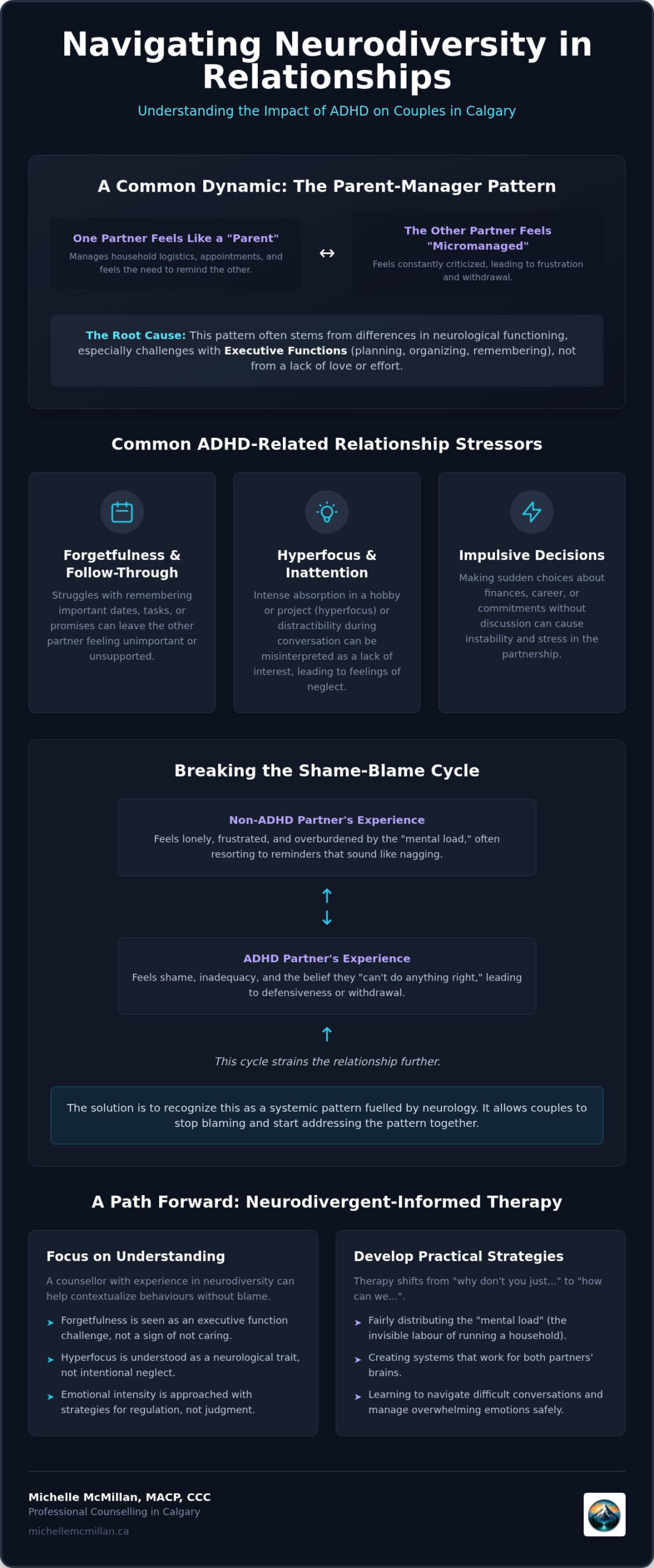
For example, a common dynamic that some neurodivergent couples report is one partner feeling like a “parent” who manages household logistics, while the other feels micromanaged or constantly criticized. These feelings often stem from challenges with executive functions—the brain’s management system for tasks like planning, organizing, and remembering. Recognizing that these patterns may be linked to neurodevelopmental differences, rather than personal failings, can be a crucial first step for partners seeking to understand each other better.
Common Signs of ADHD-Related Relationship Stress
While every relationship is different, some couples affected by ADHD may recognize specific recurring stressors. These are not character flaws but potential manifestations of ADHD traits within a partnership. Some of these might include:
- Forgetfulness and Follow-Through: One partner may struggle with remembering household responsibilities, important dates, or verbal agreements, which can leave the other partner feeling unsupported or unimportant.
- Hyperfocus and Inattention: The partner with ADHD might become deeply absorbed in a work project or hobby for hours, a state known as hyperfocus. While productive, this can sometimes leave the other partner feeling neglected or lonely. Conversely, distractibility during conversations can be misinterpreted as a lack of interest.
- Impulsive Decisions: Impulsivity can sometimes affect financial decisions, career changes, or social commitments, potentially causing stress or instability within the partnership if not discussed beforehand.
The Shame-Blame Cycle in Neurodivergent Couples
Over time, these patterns can lead to a difficult cycle of shame and blame. The non-ADHD partner may feel lonely, overburdened by the “mental load” of managing the household, and frustrated that their efforts go unnoticed. They might resort to reminders that feel like nagging.
In response, the partner with ADHD may feel a deep sense of shame, inadequacy, and frustration, believing they can never do anything right. This can lead to defensiveness or withdrawal, further straining the relationship. Recognizing this dynamic as a systemic pattern—a cycle fuelled by the interplay of different neurological styles—is essential. It allows couples to stop blaming each other and start addressing the pattern together.
Common Communication Challenges in Neurodiverse Relationships
Communication is often at the heart of relationship counselling. For neurodivergent couples, standard communication advice may not always account for the nuances of how ADHD can influence interaction. Difficulties with executive function and emotional regulation can create persistent misunderstandings that require a more informed perspective.
For instance, a partner’s distractibility might not be a sign of disrespect but a genuine challenge with maintaining focus. Similarly, an intense emotional reaction may be related to difficulties with emotional regulation. Understanding these possibilities can help couples approach their communication challenges with more empathy and explore strategies that work for their specific needs.
Executive Function and the Mental Load
Executive functions are the cognitive skills that help us plan, organize, initiate tasks, and manage time. When a partner has challenges in these areas, simply being told to “try harder” or “just remember” is often not a helpful strategy. This can place a significant portion of the “mental load”—the invisible labour of running a household and family—onto the other partner.
In counselling, couples can explore how the mental load is distributed in their relationship and discuss strategies that honour both partners’ strengths and challenges. For more information on ADHD resources in Calgary, you can explore this guide to ADHD Support in Calgary.
Navigating Emotional Sensitivity
Some individuals with ADHD report experiencing emotions with great intensity. This can sometimes be challenging during disagreements, where conversations may escalate quickly. You may have heard the term Rejection Sensitive Dysphoria (RSD) used in online communities. It is important to note that RSD is not a formal medical diagnosis. It is an informal term used to describe a very strong emotional response to perceived rejection, criticism, or failure.
Whether this label resonates or not, many couples find it helpful to acknowledge the role of heightened emotional sensitivity in their dynamic. A counsellor can provide a supportive environment for partners to learn how to navigate difficult conversations and manage overwhelming emotions in a way that feels safer for both people.
Considerations for ADHD in Couples Therapy
All couples counselling aims to improve communication and connection. However, some couples where ADHD is a factor find that an approach that specifically considers neurodivergence is particularly helpful. Generic advice that works well for neurotypical couples may sometimes fall short if it doesn’t account for the influence of executive function challenges or emotional dysregulation.
For this reason, some partners seek a therapist who has experience working with adults with ADHD. A counsellor with this background can help contextualize certain behaviours and patterns, moving the focus away from blame and toward understanding and practical problem-solving. This doesn’t mean other forms of therapy are ineffective, but rather that a neurodivergent-informed perspective can be a valuable asset for some couples.
The Importance of a Neurodivergent-Informed Perspective
A counsellor with experience in neurodiversity understands that standard relationship advice may need adaptation. For example, they are less likely to interpret forgetfulness as a sign of a partner not caring, or to view hyperfocus as intentional neglect. Instead, they can help both partners understand the “why” behind these behaviours.
This perspective can help prevent a situation where one partner feels validated while the other feels pathologized or treated as the “problem” to be fixed. The goal is to create a balanced therapeutic environment where both partners’ experiences are validated and the focus is on improving the relationship system as a whole.
What an ADHD-Informed Approach May Involve
When seeking ADHD couples therapy in Calgary, you may find the approach includes several key elements:
- Education: A significant component is often psychoeducation, where both partners learn about ADHD, executive functions, and emotional regulation. This knowledge builds a foundation of shared understanding.
- Shifting Perspective: The focus often shifts from blaming an individual to understanding the impact of ADHD on the relationship. The couple learns to see themselves as a team addressing a shared challenge.
- Exploring Practical Strategies: Therapy can be a space to collaboratively explore practical, individualized strategies for managing daily life, from household chores to finances, in a way that works for both partners.
- Building Empathy: By understanding the neurological underpinnings of certain behaviours, the non-ADHD partner can develop greater empathy, while the partner with ADHD can feel more seen and less judged.
Finding the Right ADHD Couples Counsellor in Calgary
Choosing a therapist is a personal decision. When looking for support for your neurodivergent relationship in Calgary, it’s important to find a professional who feels like the right fit for both of you. This involves considering their credentials, their experience, and their approach to couples work.
Look for professionals with relevant credentials, such as a Master of Arts in Counselling Psychology (MACP) and a designation like Canadian Certified Counsellor (CCC). These indicate a level of education and adherence to professional standards. It’s also beneficial to find a Calgary-based professional who understands the local context and offers a format—virtual or in-person—that suits your family’s needs.
Key Questions for Your First Conversation
When you first connect with a potential therapist, it can be helpful to have some questions prepared to gauge their experience with neurodivergence. Consider asking:
- “What is your experience working with couples where one or both partners have ADHD?”
- “How do you incorporate education about ADHD and executive function into your work with couples?”
- “What is your approach to helping couples navigate dynamics where one partner feels like a parent and the other feels micromanaged?”
Their answers can give you a sense of their familiarity and comfort level with the specific challenges you are facing.
The Convenience of Virtual Counselling in Alberta
For many busy Calgary couples, virtual counselling offers a convenient and accessible option for support. Online sessions can reduce the friction of getting to an appointment, eliminating commute times and making it easier to fit therapy into packed schedules. It allows you to connect with a qualified professional from the comfort and privacy of your own home, not just in Calgary but across Alberta.
Michelle McMillan offers virtual counselling for couples throughout Alberta, British Columbia, Saskatchewan, and Manitoba. To learn more about the services available, you can visit the services page.
Support for Couples with Michelle McMillan, MACP, CCC
Michelle McMillan is a Canadian Certified Counsellor (CCC) with a Master of Arts in Counselling Psychology (MACP). She has extensive experience supporting individuals and couples navigating challenges related to ADHD and neurodivergence, anxiety, emotional regulation, and relationship dynamics.
Michelle provides a supportive, non-judgmental environment where Calgary couples can explore their relationship patterns and work toward a greater sense of mutual understanding. Her work is centred on providing a safe space where both partners can feel heard, respected, and supported as they navigate the complexities of their unique relationship.
A Compassionate Space for Relationship Exploration
In counselling with Michelle, the focus is on fostering a shared understanding of how neurodivergent traits may be influencing your relationship. It is a space to move away from frustration and blame, and toward curiosity and collaboration. Couples can explore their specific dynamics and communication patterns, gaining insight into the challenges they face. You can see related topics and areas of focus to understand the breadth of support available.
Taking the Next Step for Your Relationship
If recurring patterns of misunderstanding, frustration, or resentment are impacting your relationship, seeking professional support can be a valuable step. Exploring these challenges with a qualified counsellor can provide clarity and help you find a path forward together. If you would like to learn more about Michelle McMillan’s background and professional experience, you can visit her About page.
When you are ready to explore counselling, you can view services and book a session online. Taking this step can be an investment in the health and future of your partnership.
Ready to explore ADHD-informed couples therapy? View rates and book a session with Michelle McMillan, MACP, CCC.
Frequently Asked Questions About ADHD Couples Therapy
- Is ADHD couples therapy different from regular marriage counselling?
While both share the goal of improving a relationship, ADHD-informed couples therapy brings a specific focus on how neurodivergence—particularly challenges with executive function and emotional regulation—can impact relationship dynamics. A counsellor with this experience can provide context that might be missed in a more general approach, helping couples understand the “why” behind certain patterns. - Do we both need an ADHD diagnosis to start couples therapy in Calgary?
No, a formal diagnosis is not required. Many couples seek support because they suspect ADHD may be a factor in their challenges. Counselling can be a space to explore these patterns and their impact on your relationship, regardless of diagnostic status. - How long does it typically take to see changes in ADHD relationship patterns?
The timeline for counselling varies greatly for every couple. It depends on your specific goals, the complexity of the challenges you’re facing, and your engagement with the process. There is no set timeline, and the focus is on each couple’s unique pace. - What if my partner is reluctant to attend counselling?
This is a common concern. It can be helpful to approach the conversation with “I” statements, focusing on your own feelings and your desire for the relationship to feel better for both of you. Frame it as learning new tools together, rather than blaming one person. If your partner remains unwilling, individual counselling can still be a valuable resource for you to develop coping strategies and gain clarity. - Can virtual therapy be as effective as in-person for ADHD couples?
Virtual therapy is a convenient and accessible option that many couples find helpful. It eliminates travel time and allows for greater scheduling flexibility. The most important factor in any form of therapy is the quality of the therapeutic relationship you build with your counsellor. For many, this connection can be established just as strongly online as it can be in person. - How do we handle the “parent-child” dynamic in our relationship?
This dynamic, where one partner takes on a managerial role and the other feels managed, is a frequent topic in ADHD couples counselling. Therapy provides a neutral space to unpack this pattern without blame. The goal is to understand its origins and collaboratively explore ways to create a more balanced and adult-to-adult partnership. - What should we look for in an ADHD-informed therapist?
Look for a qualified professional (e.g., MACP, CCC) who explicitly mentions experience with adult ADHD, neurodivergence, or executive function challenges in their professional profile. During an initial conversation, ask about their approach to working with neurodivergent couples to ensure their perspective aligns with your needs.

Article by
Michelle McMillan, MACP, CCC
Michelle McMillan is a Canadian Certified Counsellor (CCC) with a Master of Arts in Counselling Psychology (MACP). She has extensive experience working with children and supporting clients with ADHD, neurodivergence, anxiety, emotional regulation, relationships and family challenges. Michelle provides virtual counselling for adults throughout Alberta, British Columbia, Saskatchewan and Manitoba and primarily in-person counselling for children and families in Calgary.
Important Information
This article is provided for general educational and informational purposes only and is not a substitute for professional counselling, psychological, medical or emergency services. Information shared here should not be considered a diagnosis or individualized treatment advice. If you are experiencing a mental health emergency or are in immediate danger, please contact appropriate emergency services in your area.