
Finding appropriate mental health support for your child is a meaningful step for any family. When searching for a child therapist Calgary NW parents often encounter a confusing array of titles, credentials, and therapeutic approaches. Northwest Calgary is home to active, family-dense communities such as Edgemont, Brentwood, Tuscany, Varsity, and Dalhousie. For parents residing in these neighbourhoods, navigating school demands, extracurricular commitments, and family life requires mental health care that is both clinically grounded and realistically accessible.
This guide offers an educational overview to help Calgary parents evaluate mental health professionals, understand professional designations in Alberta, prepare their children for the therapeutic process, and make informed choices tailored to their family’s needs.
—
Understanding the Landscape of Child Counselling in Calgary NW
When seeking therapeutic support for a child or adolescent in Calgary, parents quickly realize that the term “therapist” is used broadly. In Alberta, mental health care spans several distinct professions, each with its own educational requirements, regulatory bodies, and professional designations. Understanding these differences allows families to select a practitioner whose scope of practice aligns with their child’s specific circumstances.
The CCC Designation: What Parents Should Know
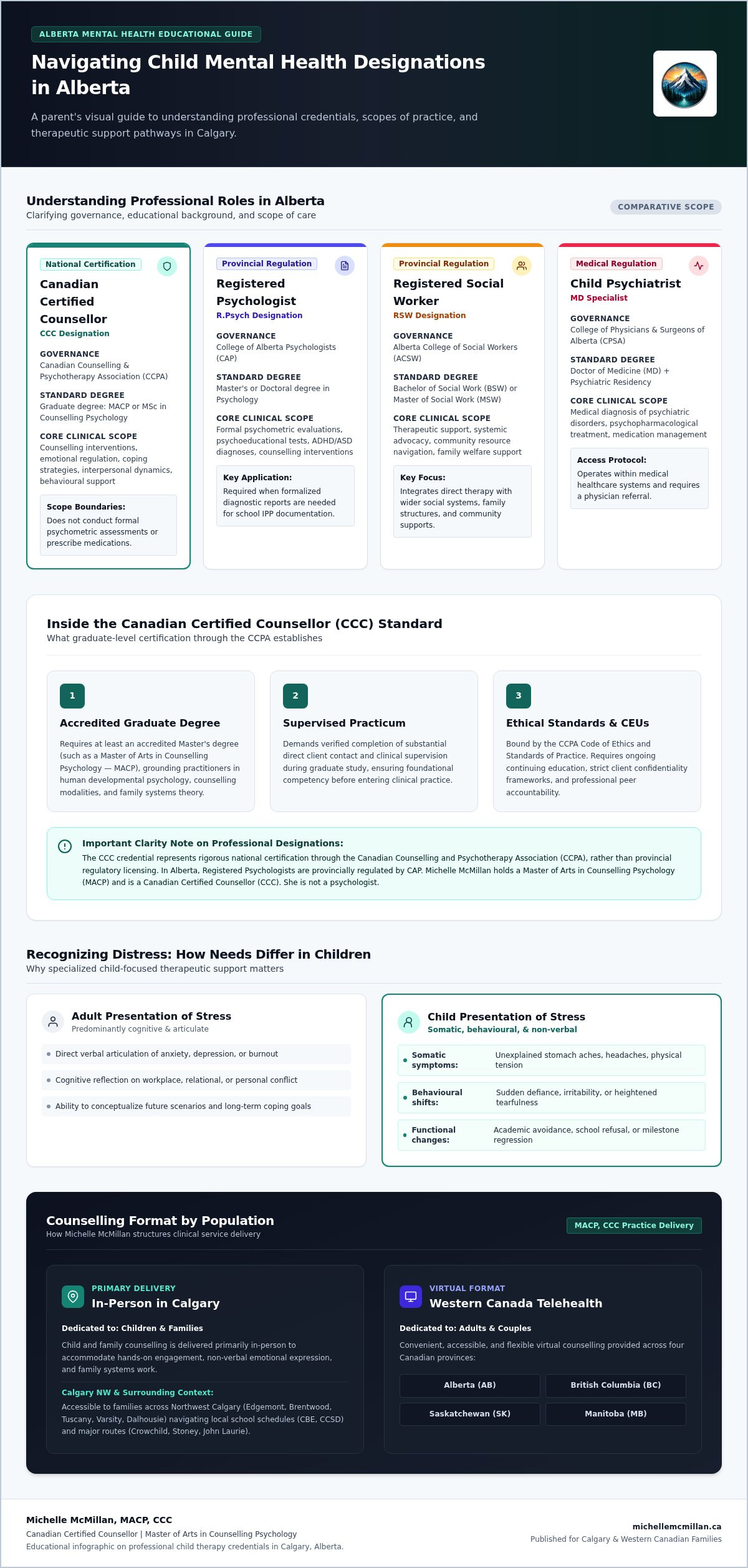
One of the common professional credentials parents encounter is the Canadian Certified Counsellor (CCC), granted by the Canadian Counselling and Psychotherapy Association (CCPA). While parents often begin their search using terms like “child psychologist,” professional counsellors holding the CCC credential represent an established and rigorous branch of mental health care in Canada.
- National Accreditation: The CCC designation is a national certification that verifies a practitioner has met comprehensive educational and clinical training standards. It confirms that the professional holds at least a recognized graduate degree (such as a Master of Arts or Master of Science in Counselling Psychology).
- Supervised Clinical Hours: Obtaining certification requires the completion of substantial supervised direct client contact and clinical supervision during graduate coursework.
- Ethical Standards and Accountability: CCPA members are bound by a strict Code of Ethics and Standards of Practice, which mandate ongoing continuing education, protection of client confidentiality, and professional accountability.
- Distinction from Provincial Regulation: It is important for parents to note that the CCC designation is a national professional certification rather than a provincial regulatory licence. In Alberta, professional counsellors, registered social workers, and registered psychologists operate under distinct professional frameworks. While registered psychologists are regulated provincially by the College of Alberta Psychologists (CAP), Canadian Certified Counsellors hold national certification through the CCPA.
Practitioners holding a Master of Arts in Counselling Psychology (MACP) combined with a CCC certification possess extensive post-graduate education in human development, therapeutic theories, ethical care, and family systems. For many children and families, working with a certified counsellor provides dedicated, evidence-informed support for developmental transitions, stress, communication challenges, and emotional growth.
Distinguishing Professional Titles in Alberta
To avoid confusion during your search, it helps to delineate the primary mental health roles available across Calgary:
- Canadian Certified Counsellors (CCC): Mental health professionals with master’s-level training in counselling psychology or related fields. They focus on counselling interventions, emotional expression, interpersonal dynamics, behavioural support, and coping strategies. They do not perform formal psychoeducational assessments or prescribe medication.
- Registered Psychologists (R.Psych): Regulated provincially by the College of Alberta Psychologists. In addition to counselling, psychologists may administer formalized psychometric testing, formal diagnostic assessments (such as comprehensive assessments for learning disorders, autism spectrum disorder, or ADHD), and specialized diagnostic reports for schools. Michelle McMillan is a Canadian Certified Counsellor, not a psychologist.
- Registered Social Workers (RSW): Regulated by the Alberta College of Social Workers, clinical social workers offer therapy and often possess specialized knowledge in community resources, systemic advocacy, and family welfare.
- Psychiatrists: Medical doctors who have specialized in psychiatry. They diagnose psychiatric disorders and are authorized to prescribe and manage medications. They generally work by physician referral.
Why Local Context Matters for Northwest Calgary Families
Families searching within Northwest Calgary often face unique scheduling pressures. Balancing school calendars across the Calgary Board of Education or Calgary Catholic School District, sports practices at WinSport or local community arenas, and long commutes along Crowchild Trail, John Laurie Boulevard, or Stoney Trail means that mental health support must integrate smoothly into real life.
When selecting care, Northwest Calgary parents often consider accessibility across the broader city. A centrally located or easily accessible practice within Calgary allows families to commute without undue friction. Choosing a professional who understands the local Calgary environment—such as the pressures of school transitions, winter activity adjustments, and local academic systems—ensures that recommendations and support strategies remain practical and contextually grounded.
—
Key Criteria for Selecting a Professional Child Therapist
Children experience and express emotional distress differently than adults. Where an adult may articulate feelings of anxiety or exhaustion, a child might present with somatic complaints (like unexplained stomach aches), behavioural defiance, increased tearfulness, regression in developmental milestones, or academic avoidance. Choosing an appropriate provider requires looking closely at experience, communication styles, and the therapeutic setting.
Evaluating Professional Experience and Education
Not every therapist who works with adults is equipped to work with children or adolescents. When reviewing prospective practitioners, consider the following educational and professional criteria:
- Graduate-Level Training: Look for a professional with a relevant master’s degree, such as an MACP. Graduate training ensures a grounded foundation in developmental psychology, attachment, family dynamics, and ethical considerations specific to minors.
- Focus on Youth and Family Support: Inquire about how much of the professional’s practice involves children, adolescents, and parenting support. Understanding age-appropriate interventions is essential when engaging younger clients.
- Collaborative Communication: A practitioner working with children must be able to communicate complex psychological concepts simply and transparently to parents, while maintaining an approachable, validating relationship with the young person.
- Professional Boundaries: Ethical practitioners establish clear boundaries regarding confidentiality, parental updates, and informed consent. In Alberta, mature minors have specific legal rights regarding their medical and mental health information, and a qualified therapist will clearly explain how privacy is handled between parent and child.
If you are exploring the foundation of youth mental health services, reviewing our resource on child counselling for Calgary parents provides further insight into how therapeutic support is structured.
The Therapeutic Alliance and Psychological Safety
The therapeutic alliance—the cooperative relationship established between the client and the practitioner—is a recognized foundational component of therapy. For children, this alliance depends entirely on feeling safe, accepted, and unpressured.
Children often enter therapy with apprehension, worrying that they are in trouble, that they are “broken,” or that the counsellor will report everything back to their parents or teachers. A professional child therapist takes time to build trust. They do not rush a child into deep emotional disclosure before establishing comfort and security. Rather than adopting an authoritarian stance, the practitioner creates a neutral space where the child’s perspective is validated.
During initial consultations, observe how the professional speaks to and about your child. Do they speak with curiosity and respect? Do they recognize your child’s strengths rather than solely cataloguing problematic behaviours? A child-centred professional acknowledges the child’s world while maintaining clear, supportive communication with the family.
—
Supporting Specific Needs: ADHD and Emotional Regulation
Many parents searching for a child therapist Calgary NW are navigating neurodivergence, particularly Attention-Deficit/Hyperactivity Disorder (ADHD), alongside co-occurring emotional regulation challenges. Therapeutic support for neurodivergent youth requires a nuanced, individualized framework that avoids oversimplified biological claims or punitive behavioral expectations.
Approaching ADHD with Professional Nuance
ADHD is a complex neurodevelopmental profile characterized by differences in executive functioning, attention regulation, impulse moderation, and working memory. When exploring counselling for a child with ADHD, it is vital to avoid reductionist explanations. The lived experience of ADHD cannot be reduced simply to a “dopamine deficiency” or simple behavioural disobedience.
Each child with ADHD experiences a unique profile of strengths and friction points:
- Inattentive Traits: Difficulty initiating tasks, internal distractibility, organizational challenges, or frequent daydreaming, which can often be overlooked in classroom settings.
- Hyperactive/Impulsive Traits: Physical restlessness, difficulty sitting still, interrupting conversations, or rushing through tasks without reviewing details.
- Combined Presentations: Experiencing elements of both inattention and impulsivity across academic, social, and domestic environments.
Parents often encounter informal terminology online, such as Rejection Sensitive Dysphoria (RSD). It is clinically important to understand that RSD is not an official diagnostic category in the DSM-5; rather, it is a descriptive term used colloquially to describe the intense emotional sensitivity and pain some neurodivergent individuals feel when experiencing real or perceived criticism, rejection, or failure. A qualified counsellor can acknowledge the validity of these intense emotional experiences without misrepresenting them as standalone clinical diagnoses.
For more detailed information regarding community resources and neurodivergent supports in our city, read our comprehensive overview of ADHD support for Calgary families and individuals.
Understanding Emotional Regulation in Childhood
Emotional regulation refers to an individual’s ability to monitor, evaluate, and modify their emotional reactions to accomplish goals and adapt to environments. In children, the capacity for self-regulation is still developing. Neurodivergent children, in particular, may experience heightened emotional intensity and lower thresholds for frustration.
A supportive counselling environment approaches emotional regulation through an educational and developmental lens:
- Emotional Literacy: Helping children expand their emotional vocabulary beyond basic categories like “mad” or “bad,” identifying nuanced states like overwhelmed, embarrassed, left out, or fatigued.
- Somatic Awareness: Guiding young people to notice the physical cues that precede an emotional reaction, such as a racing heart, clenched fists, or muscle tension.
- Collaborative Family Strategies: Because young children regulate best within safe relationships (often referred to developmentally as co-regulation), counselling frequently involves parents in learning de-escalation techniques, predictable routines, and empathetic listening habits at home.
It is crucial to recognize that therapy is not a guaranteed fix or an overnight intervention. Developing emotional awareness and functional coping strategies is an iterative developmental process that requires patience, consistency, and active collaboration between the child, the family, and the practitioner.
—
Practical Considerations for Calgary Families
Selecting the right practitioner involves balancing clinical alignment with logistical realities. Calgary is a sprawling city, and parents must weigh format, location, and scheduling to ensure that mental health care remains sustainable over time.
In-Person vs. Virtual Modalities
In recent years, the delivery of mental health services has evolved. Parents will find both in-person and virtual options across Alberta. Understanding the factual distinctions between these formats helps families decide what best fits their household.
| Modality | Primary Characteristics | Considerations for Families |
|---|---|---|
| In-Person Counselling |
|
|
| Virtual Counselling |
|
|
Neither format is inherently clinically superior; rather, each serves different client groups and logistical realities. For younger children, in-person engagement is generally the primary recommendation because physical presence facilitates non-verbal communication, play-based interaction, and sustained attention. For adults, couples, or older adolescents who are comfortable communicating through screens, virtual care provides an accessible, time-efficient option.
In the practice of Michelle McMillan, child and family counselling is offered primarily in-person in Calgary, while virtual counselling is available for adult individuals and couples across Alberta, British Columbia, Saskatchewan, and Manitoba.
Navigating Insurance and Extended Health Benefits
Mental health care in private practice is not covered by the Alberta Health Care Insurance Plan (AHCIP). Most families fund private therapy out-of-pocket or through private extended health insurance plans (e.g., Sun Life, Canada Life, Blue Cross, Manulife, Green Shield).
Because coverage terms vary widely depending on your employer or insurance contract, parents should take the following steps prior to the first session:
- Check Approved Designations: Contact your benefits provider and ask explicitly: “Does my plan cover counselling provided by a Canadian Certified Counsellor (CCC) through the Canadian Counselling and Psychotherapy Association?”
- Verify Provider Requirements: Some insurance plans specifically cover only “Registered Psychologists” or “Registered Social Workers,” while many modern plans encompass “Canadian Certified Counsellors” or “Licensed/Certified Counsellors.”
- Clarify Coverage Limits: Ask about your annual maximum dollar limit per family member, whether there is a per-session cap, and whether a medical referral from a family physician is required for reimbursement.
- Receipts and Direct Billing: Confirm how reimbursement is processed. Many private counselling practices provide detailed receipts after each paid session containing all requisite credential numbers, which you can submit directly to your insurer.
Preparing Your Child for the First Session
How parents introduce the idea of counselling can significantly influence a child’s openness to the experience. Framing therapy thoughtfully helps reduce anxiety and demystifies the process.
- Choose a Calm Moment: Avoid bringing up counselling during an active argument or immediately following a disciplinary incident. Discuss it when everyone is calm and relaxed.
- Normalize the Experience: Explain that many kids and adults talk with a counsellor. You might say: “A counsellor is a professional who talks with kids to help them figure out big feelings, school worries, or how to handle difficult situations.”
- Dispel Fear of Punishment: Reassure your child that seeing a therapist does not mean they are in trouble, bad, or broken. Emphasize that the counsellor is someone on their team.
- Describe What to Expect: Explain the practical setting—that they will be visiting a comfortable office, having a conversation, perhaps drawing or playing games, and getting to know the person without any tests or grades.
—
Evaluating the Right Fit: Questions Parents Should Ask
Before committing to ongoing therapy, many parents find it helpful to reach out to potential therapists for an initial conversation. Preparing targeted questions ensures you gather the information necessary to make a sound decision.
Questions Concerning Clinical Background
- “What is your professional designation and educational background?”
- “What experience do you have working with children of my child’s specific age group?”
- “How do you approach working with neurodivergence, such as ADHD, in children and families?”
- “Are your services for children delivered primarily in-person or virtually?”
Questions Concerning the Family’s Involvement
- “How do you involve parents in the counselling process?”
- “How do you handle confidentiality and updates regarding my child’s progress?”
- “What does a typical initial consultation or intake session look like?”
Therapy is a collaborative process. A qualified professional will welcome these inquiries, providing clear, straightforward answers that respect your role as a parent.
—
Starting the Process with Michelle McMillan Counselling
When seeking a thoughtful, grounded practitioner to support your child and family in Calgary, learning about a provider’s background and service scope is a natural first step.
Professional Background and Focus
Michelle McMillan is a Canadian Certified Counsellor (CCC) holding a Master of Arts in Counselling Psychology (MACP). Operating her private practice in Calgary, Alberta, Michelle offers professional counselling focused on helping individuals, children, youth, and families navigate complex life challenges.
Areas of focus within the practice include:
- ADHD and neurodivergence-related challenges
- Emotional regulation and stress management
- Children and youth navigating difficult life situations
- Parenting support and family dynamics
- Communication challenges and relationship difficulties
- Life transitions, self-esteem, and personal growth
Michelle’s work with children and families is offered primarily in-person in Calgary, providing a dedicated therapeutic setting where young clients and their families can work together. For adult individuals and couples, virtual counselling services are available across Alberta, British Columbia, Saskatchewan, and Manitoba.
To learn more about her credentials, educational foundations, and professional background, visit the About Michelle McMillan page.
A Grounded, Realistic Framework
Counselling is not an automatic solution, and ethical care means avoiding unrealistic promises. Every child develops at their own pace, and changes in emotional coping, family communication, and self-awareness take time and continuous practice.
Michelle McMillan Counselling provides a professional, non-judgmental environment where young people and parents can explore challenges openly, examine behavioral patterns, and develop practical strategies tailored to their unique household circumstances.
—
Frequently Asked Questions About Child Counselling
Is Michelle McMillan a child psychologist in Calgary NW?
No. Michelle McMillan is a Canadian Certified Counsellor (CCC) holding a Master of Arts in Counselling Psychology (MACP). She is not a registered psychologist or psychiatrist. In Alberta, certified counsellors provide master’s-level therapeutic counselling and emotional support, but they do not conduct formal psychological evaluations, psychometric testing, or prescribe medication. While many families in Northwest Calgary search for support, her practice serves clients across the city of Calgary.
What is the difference between a CCC and a Registered Psychologist in Alberta?
A Canadian Certified Counsellor (CCC) holds national certification through the Canadian Counselling and Psychotherapy Association (CCPA), requiring a recognized graduate degree (such as an MACP) and adherence to national standards of ethical practice. A Registered Psychologist (R.Psych) is regulated at the provincial level by the College of Alberta Psychologists (CAP). Both professionals provide counselling, but only psychologists are authorized to administer formal standardized psychological assessments and diagnose specific learning disorders in Alberta.
Are child counselling sessions offered in-person or virtually?
For children and families, counselling with Michelle McMillan is offered primarily in-person in Calgary. In-person meetings are generally better suited for younger clients who benefit from shared physical space and expressive communication. Virtual counselling is available for adult individuals and couples residing in Alberta, British Columbia, Saskatchewan, and Manitoba.
How many sessions will my child need before we notice changes?
Therapy does not follow a fixed timeline, and predictable outcomes or specific session counts cannot be guaranteed. Some families find that a few sessions provide helpful clarity and initial coping ideas, while others engage in therapy over several months to navigate deeper developmental, emotional, or family transitions. Progress depends on numerous individual factors, including the child’s readiness, the complexity of the challenges, and consistent reinforcement of strategies at home.
Can virtual counselling work for my teenager?
Virtual counselling can be a practical option for some older adolescents who possess the maturity, attention, and desire to engage through a video platform. However, its appropriateness depends entirely on the individual teen’s comfort level, the nature of their concerns, and their ability to access a private, confidential space at home. Families are encouraged to discuss whether virtual or in-person care is the most suitable format for their adolescent.
What should I look for in a therapist if my child has ADHD?
Look for a professional who demonstrates a balanced, non-judgmental understanding of neurodivergence. An experienced therapist recognizes that ADHD presents differently in every individual and avoids oversimplified biological narratives. They should focus on practical tools for executive functioning, emotional awareness, and collaborative family communication, while working cooperatively with parents to understand the child’s unique environment.
How do I explain counselling to my child for the first time?
Introduce the idea during a relaxed, non-conflict moment. Explain that a counsellor is a friendly professional whose job is to help kids talk through feelings, learn how to handle stress, and solve problems. Reassure them that they are not in trouble, that there are no tests or wrong answers, and that counselling is a safe place to talk about everyday challenges.
Does extended health insurance cover Canadian Certified Counsellors?
Many private health insurance plans in Alberta provide coverage for Canadian Certified Counsellors (CCC), but policies differ widely. Because coverage depends on your specific employer or benefits contract, you should verify directly with your insurance provider prior to booking to confirm whether your plan reimburses services provided by a CCC through the CCPA.
—
Taking the Next Step
Navigating childhood challenges, emotional shifts, or neurodivergence can feel demanding for parents. Professional counselling offers a structured, supportive setting to help children explore their experiences, build self-awareness, and develop practical strategies for everyday life.
If you are a Calgary parent seeking dedicated in-person counselling for your child or family, or if you are an adult seeking virtual counselling services in Alberta, support is accessible. To review session details, professional credentials, and current availability, please visit the Rates and Booking page.

Article by
Michelle McMillan, MACP, CCC
Michelle McMillan is a Canadian Certified Counsellor (CCC) with a Master of Arts in Counselling Psychology (MACP). She has extensive experience working with children and supporting clients with ADHD, neurodivergence, anxiety, emotional regulation, relationships and family challenges. Michelle offers both virtual and in-person counselling, with virtual counselling available throughout Alberta, British Columbia, Saskatchewan and Manitoba and in-person appointments available in Calgary.
Important Information
This article is provided for general educational and informational purposes only and is not a substitute for professional counselling, psychological, medical or emergency services. Information shared here should not be considered a diagnosis or individualized treatment advice. If you are experiencing a mental health emergency or are in immediate danger, please contact appropriate emergency services in your area.