
Accessing mental health support has evolved significantly across Canada over the past decade. For individuals and couples seeking professional support in Alberta, virtual counselling has become a standard, practical method for engaging with qualified practitioners. Whether managing personal stress, navigating complex relationship dynamics, or seeking strategies for neurodivergent experiences such as Attention Deficit Hyperactivity Disorder (ADHD), virtual care provides direct access to professional guidance without the necessity of travelling to a physical office.
Choosing to begin counselling is an important personal step. Prospective clients frequently face questions regarding how remote appointments operate, what qualifications a counsellor holds, and how virtual sessions differ practically from traditional in-person office visits. Understanding these factors makes it easier to evaluate whether online therapy in Alberta aligns with your schedule, personal needs, and practical circumstances.
Understanding Virtual Counselling Across Alberta: How It Operates
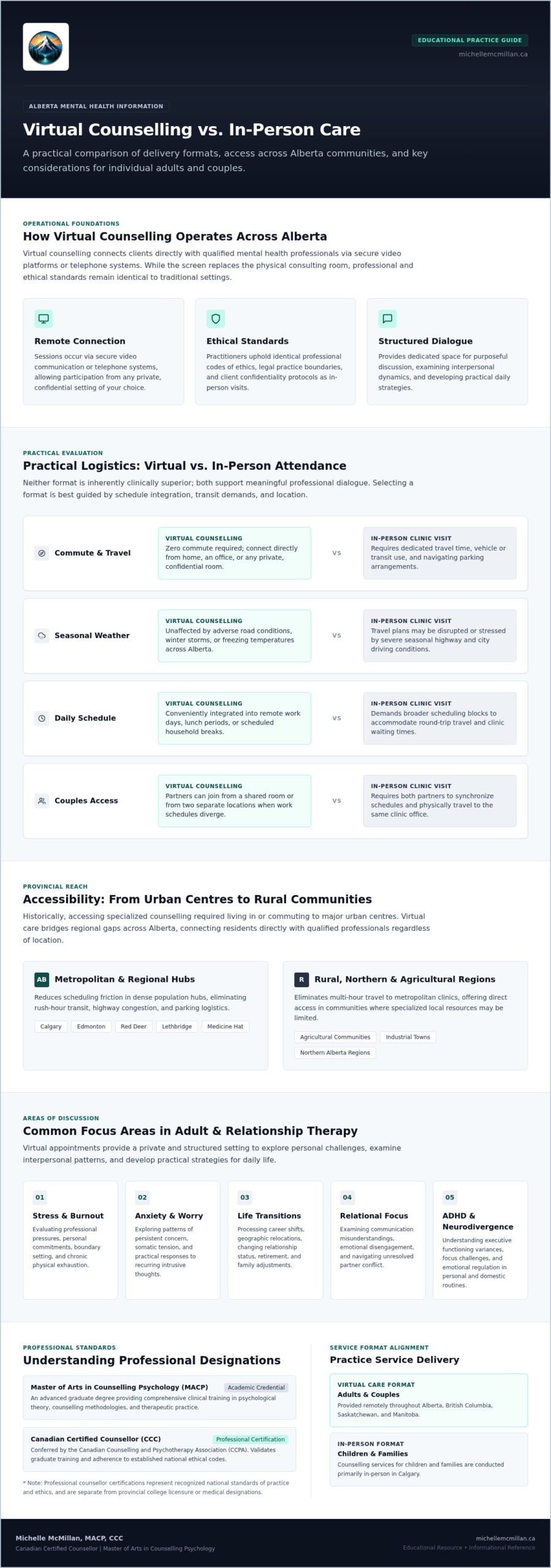
Virtual counselling, often referred to as online therapy, telehealth, or telecounselling, connects clients with qualified mental health professionals using secure video communication platforms or phone systems. Rather than attending appointments in a physical clinic, clients participate from private spaces of their choosing, such as a home office, a private room, or another confidential setting.
At its core, virtual therapy follows the same fundamental professional standards as in-person care. Practitioners adhere to established professional codes of ethics, maintain client confidentiality, and operate within the legal boundaries of their respective designations. The primary difference lies in the mode of delivery: the screen replaces the physical consulting room, allowing for dialogue, reflection, and collaboration across geographic distances.
Province-Wide Access from Urban Centres to Rural Communities
One of the clearest practical advantages of virtual care is geographic accessibility. Alberta is characterized by diverse communities, ranging from large urban centres such as Calgary and Edmonton to smaller cities like Red Deer, Lethbridge, and Medicine Hat, as well as expansive rural and northern regions.
Historically, accessing specialized counselling services required residing near major metropolitan centres or undertaking substantial travel. For individuals living in agricultural areas, industrial communities, or smaller towns, local mental health resources can be limited or subject to extended wait times. Virtual counselling allows residents across Alberta to connect directly with specialized practitioners regardless of where they reside within the province.
For individuals in urban settings, virtual appointments remove the logistical friction of commuting, navigating high-traffic corridors, finding parking, or arranging extensive time away from work. Appointments can be scheduled to fit around professional obligations, caregiving responsibilities, and household routines, offering a functional option for busy adults.
Common Focus Areas for Adult and Relationship Support
Virtual counselling provides a confidential setting for individual adults and couples to discuss a wide variety of personal and interpersonal matters. While therapy does not offer guaranteed outcomes or quick fixes, it offers structured professional space to explore experiences, examine patterns, and consider new strategies for daily life.
Common themes explored in adult virtual counselling include:
- Stress and Burnout: Identifying professional and personal pressures, evaluating boundary-setting strategies, and addressing ongoing exhaustion.
- Anxiety and Worry: Exploring patterns of persistent worry, somatic tension, and practical ways to manage intrusive thoughts in everyday settings.
- Life Transitions: Processing career changes, relocations, entering or leaving long-term relationships, retirement, or shifts in family responsibilities.
- Relational Challenges: Exploring communication patterns, ongoing misunderstandings, emotional disengagement, or unresolved disagreements between partners.
- Neurodivergence and ADHD: Examining how executive functioning differences, focus challenges, and emotional regulation factors influence daily adult life and domestic partnerships.
Couples frequently choose virtual counselling because it allows both partners to participate from a shared home setting or even from separate locations within the province when work schedules necessitate flexibility.
Evaluating Online Therapy vs. In-Person Visits: Practical Considerations
When deciding between online counselling and in-person visits, individuals often wonder which format is more appropriate. Rather than viewing one delivery method as inherently clinically superior to the other, it is more practical to evaluate both based on logistical fit, comfort with technology, and personal circumstances.
Both formats offer opportunities for professional connection and meaningful dialogue. Selecting the appropriate option involves assessing how practical considerations intersect with your lifestyle.
Practical and Scheduling Factors of Remote Sessions
The decision to attend therapy online is often guided by convenience, accessibility, and time management. The following table provides an objective comparison of common practical factors between virtual counselling and in-person clinic visits:
| Practical Consideration | Virtual Counselling | In-Person Clinic Visits |
|---|---|---|
| Commute and Travel | Zero commute time; access appointments from home or any private location. | Requires dedicated travel time, vehicle or transit use, and parking management. |
| Weather Considerations | Unaffected by adverse road or winter weather conditions across Alberta. | Appointments may be disrupted or stressed by severe seasonal driving conditions. |
| Scheduling Integration | Easier to integrate into lunch breaks, remote work days, or between family commitments. | Requires broader scheduling buffers before and after sessions for transit and check-in. |
| Physical Environment | Client is responsible for creating and maintaining a private, distraction-free room. | Clinic provides a controlled, dedicated physical environment away from home or work. |
| Technology Requirements | Requires a dependable internet connection, updated device, camera, and microphone. | No personal technological setup required during appointments. |
| Geographic Flexibility | Allows connection with practitioners located in other cities across the province. | Limited to practitioners located within realistic driving or transit distance. |
For many adults and couples, eliminating travel time is the deciding factor that allows regular attendance to fit sustainably into a demanding schedule. For others, physically leaving the home or office creates an intentional transition period that supports their focus.
Service Delivery Formats Across Different Populations
Different populations and life stages often benefit from different delivery formats. Practical considerations, developmental needs, and the specific dynamics of therapy play important roles in determining whether virtual or in-person care is appropriate.
- Individual Adults: Adults frequently find virtual care convenient and practical, integrating sessions seamlessly into their personal and professional routines.
- Couples: Many couples appreciate attending sessions together from home, although in-person options also offer a dedicated neutral setting outside the household.
- Children and Families: Working with younger children often relies on tactile interactions, non-verbal cues, play-based strategies, and in-room behavioural observation. Because of these factors, counselling support for younger children and family units is frequently conducted in-person. In the practice of Michelle McMillan, counselling work with children and families is primarily delivered in-person in Calgary, while services for individual adults and couples are offered virtually.
- Adolescents and Teens: Service formats for teenagers vary based on individual maturity, comfort with video communication, privacy at home, and family preference. Some teens engage readily through video screens, whereas others benefit from an in-person environment away from their domestic space.
Evaluating these factors with a prospective counsellor during an initial inquiry helps ensure the selected format supports your goals.
Understanding Professional Credentials: CCC and Academic Backgrounds
Navigating the mental health landscape in Alberta can sometimes feel confusing due to the variety of titles, academic degrees, and professional associations. When searching for a counsellor, understanding what specific credentials represent helps you make informed choices about your care.
In Canada, mental health professionals come from various educational backgrounds, including counselling psychology, clinical social work, psychiatry, and psychology. Each profession is defined by specific standards of training, regulatory oversight, and professional certification.
The Canadian Certified Counsellor (CCC) Designation Explained
The Canadian Certified Counsellor (CCC) designation is a national professional certification issued by the Canadian Counselling and Psychotherapy Association (CCPA). The CCPA is the largest national bilingual association representing professional counsellors and psychotherapists in Canada.
To obtain and hold the CCC credential, a practitioner must meet comprehensive professional standards, including:
- Graduate-Level Education: Completion of an approved master’s or doctoral degree in counselling psychology or a related field from an accredited university.
- Supervised Clinical Experience: Documented hours of supervised direct client contact and clinical supervision during graduate training.
- Ethical Standards and Discipline: Formal commitment to abide by the CCPA Code of Ethics and Standards of Practice, which govern client confidentiality, professional boundaries, and informed consent.
- Continuing Education: Ongoing participation in professional development to maintain current knowledge and ethical competence.
It is important to understand that the CCC designation is a national professional certification rather than a provincial statutory license. While regulated health professions (such as registered psychologists or social workers) are governed by provincial colleges under provincial legislation, certified counsellors hold credentials verified by their national professional body. The CCC credential assures the public that the counsellor has completed graduate-level clinical training and adheres to established national ethical benchmarks.
Academic Foundation: Master of Arts in Counselling Psychology (MACP)
Academic degrees reflect the theoretical grounding and research foundation of a practitioner. A Master of Arts in Counselling Psychology (MACP) is a dedicated graduate degree designed to prepare clinicians for direct counselling practice.
Graduate coursework within an MACP program generally includes:
- Theories of counselling and psychotherapy
- Human development across the lifespan
- Ethical and legal issues in clinical practice
- Assessment techniques and psychological appraisal
- Counselling interventions for individuals, couples, and groups
- Culturally responsive and socially just counselling practices
- Clinical practicums involving direct client work under direct supervision
Michelle McMillan holds a Master of Arts in Counselling Psychology (MACP) and is a Canadian Certified Counsellor (CCC). These credentials reflect extensive graduate education and national professional certification. Michelle is a professional counsellor; she is not a psychologist, registered psychologist, psychiatrist, physician, or medical provider. She does not offer medical advice, medical diagnoses, or prescription medications. To learn more about her professional background, you can read the about Michelle McMillan page.
Preparing for Your Virtual Session: A Practical Guide
Engaging in virtual therapy requires intentional practical preparation. While the counsellor provides the professional framework for the session, the client is responsible for setting up their personal environment. Taking simple, thoughtful steps before your appointment helps create a smooth, focused experience.
Technical Setup and Securing a Confidential Environment
Technological disruptions or concerns about being overheard can detract from your ability to focus during an appointment. Preparing your technology and setting in advance allows you to participate without avoidable friction.
Here are practical recommendations for setting up your virtual session:
- Verify Device and Connection: Use a computer, laptop, or tablet with an updated operating system and web browser. Connecting to a stable, high-speed Wi-Fi network or an Ethernet cable helps prevent video latency and dropped calls.
- Check Audio and Video Equipment: Test your microphone and webcam a few minutes before the scheduled start time. Using wired or wireless headphones often enhances audio clarity and prevents sound from echoing in the room.
- Ensure Private Surroundings: Choose a room with a door that closes securely. If you share a home or office space with family members, roommates, or colleagues, let them know in advance that you will be unavailable and require uninterrupted privacy for the duration of the appointment.
- Manage Ambient Sound: If sound travels easily through doors or walls, placing a white-noise machine, a small fan, or playing soft ambient sound outside the doorway can help prevent voices from carrying to adjacent rooms.
- Minimize Digital Distractions: Close extra browser tabs, email clients, and workplace communication tools. Place mobile phones on silent or “Do Not Disturb” mode to preserve your attention during the discussion.
Practical Preparation and Scheduling Around Appointments
Because virtual appointments do not involve travel, it can be tempting to transition straight from an intense work meeting or household task into a therapy session, and immediately back into high-demand activities afterward. However, building small scheduling buffers can make the experience more manageable.
Consider giving yourself five to ten minutes of quiet time before your session begins. This window allows you to step away from current tasks, review any topics or observations you wish to discuss, and settle into the space. Similarly, planning a short buffer after your appointment provides time to process the conversation, jot down personal reflections, or take a brief break before resuming domestic or professional responsibilities.
Accessing Virtual Care Across Alberta with Michelle McMillan
Michelle McMillan Counselling provides professional virtual counselling to individual adults and couples throughout Alberta, as well as in British Columbia, Saskatchewan, and Manitoba where she is eligible to practise. Sessions are conducted remotely, allowing clients across urban and rural regions to access care from home.
Counselling provides an objective, collaborative setting where clients can speak openly about personal hurdles, explore communication challenges, and evaluate options for positive personal change. For details on services offered, explore the services overview.
Practice Focus: Neurodivergence, Relationships, and Life Transitions
Counselling support through Michelle McMillan Counselling focuses on several primary areas of personal and relational well-being:
ADHD and Neurodivergence Support
Living with Attention Deficit Hyperactivity Disorder (ADHD) or other neurodivergent traits shapes how individuals interact with organizational systems, time management, emotional experiences, and interpersonal relationships. ADHD experiences vary significantly from person to person; there is no universal profile of how neurodivergence manifests in adulthood.
In counselling, adult clients have space to explore:
- Strategies for managing executive functioning demands, planning, and task initiation.
- Emotional regulation considerations, including understanding personal responses to sensory input or frustration.
- Communication dynamics in neurodiverse relationships, where partners may have differing processing styles, communication preferences, or organizational habits.
- Concepts such as Rejection Sensitive Dysphoria (RSD). RSD is an informal descriptive term commonly used in neurodivergent communities to characterize intense emotional responses to perceived rejection, criticism, or failure. While it is not a formal clinical diagnosis in diagnostic manuals, exploring these emotional sensitivities can provide helpful context for personal reactions.
For additional resources and context, you can read more about ADHD support in Calgary.
Couples and Relationship Counselling
Relationships experience periods of disconnection, conflict, or transitional strain. Virtual couples counselling provides a structured setting for partners to examine recurring arguments, evaluate communication styles, and discuss unaddressed needs.
Therapy does not guarantee specific relational outcomes, such as guaranteed reconciliation or the complete elimination of disagreements. Rather, it offers a collaborative setting where couples can clarify their perspectives, identify unhelpful behavioural cycles, and practice more transparent ways of relating to one another.
Anxiety, Stress, and Emotional Regulation
Chronic stress and persistent anxiety can impact professional effectiveness, physical health, and emotional availability. Counselling offers a space to identify specific stressors, examine thought patterns that exacerbate worry, and explore practical coping strategies. For a broader look at this topic, read about online therapy for stress.
You can review a full list of clinical topics by visiting the areas of focus page.
How to Take the Next Step
Deciding to work with a counsellor involves choosing someone whose professional background, communication style, and scheduling match your specific situation. Engaging in therapy is a collaborative process that relies on mutual trust and clear communication.
If you are an individual adult or couple residing in Alberta considering virtual therapy, reaching out to learn more about availability and practical arrangements is a practical starting point. Clients with questions regarding services or suitability are encouraged to visit the contact page to send a direct inquiry.
Frequently Asked Questions About Online Therapy in Alberta
Is online therapy as effective as in-person counselling?
Both online therapy and in-person counselling provide meaningful opportunities for therapeutic dialogue, exploration, and support. Rather than viewing one as objectively superior or clinically equivalent for every individual, suitability depends on personal needs, comfort with technology, the topics being addressed, and individual learning or processing styles. Many adults find virtual therapy highly accessible and practical, while others prefer the physical boundary and presence of an in-person clinic setting.
Can residents living outside major Alberta cities access virtual counselling?
Yes. Because sessions are conducted virtually, residents living anywhere in Alberta—including rural farming communities, northern regions, and smaller municipalities—can connect with practitioners who are certified to offer services within the province. This provides access to specialized support that may not be available locally.
What is the difference between a Canadian Certified Counsellor and a registered psychologist in Alberta?
A Canadian Certified Counsellor (CCC) holds a graduate master’s or doctoral degree in counselling psychology or a related field and is certified nationally by the Canadian Counselling and Psychotherapy Association (CCPA). A registered psychologist holds a graduate degree and is licensed provincially by the College of Alberta Psychologists under provincial health legislation. While both professionals provide counselling and therapeutic support, psychologists may also conduct formal psychological assessments and diagnostic evaluations. Michelle McMillan is a Canadian Certified Counsellor; she is not a psychologist.
Does Michelle McMillan offer virtual sessions for children and families?
Michelle McMillan’s counselling work with children and families is primarily delivered in-person in Calgary. Virtual services are specifically structured for individual adults and couples throughout Alberta, British Columbia, Saskatchewan, and Manitoba. For teens, delivery formats are evaluated based on individual circumstances and family preferences.
How do I ensure privacy if I share a home with other people?
Maintaining privacy during virtual sessions can be achieved through practical steps: choosing a private room with a closed door, using headphones so the counsellor’s voice cannot be overheard, running a fan or white-noise machine outside the doorway, and letting household members know that you are unavailable for the duration of your appointment.
What equipment do I need to attend an online counselling session?
To participate in virtual counselling, you generally need a dependable internet connection, a quiet and private space, and an updated device such as a desktop computer, laptop, tablet, or smartphone equipped with a functional camera, microphone, and speakers or headphones.
Can couples attend online therapy from separate locations?
Yes. When work commitments, travel, or scheduling constraints prevent partners from being in the same room, virtual platforms typically accommodate multi-location logins, provided both individuals are within a jurisdiction where the practitioner is certified to provide services.
If you are an individual adult or couple seeking dedicated professional support through online therapy in Alberta, you can review session rates, learn more about appointment options, and take the next step by visiting the Rates and Booking page.

Article by
Michelle McMillan, MACP, CCC
Michelle McMillan is a Canadian Certified Counsellor (CCC) with a Master of Arts in Counselling Psychology (MACP). She has extensive experience working with children and supporting clients with ADHD, neurodivergence, anxiety, emotional regulation, relationships and family challenges. Michelle offers both virtual and in-person counselling, with virtual counselling available throughout Alberta, British Columbia, Saskatchewan and Manitoba and in-person appointments available in Calgary.
Important Information
This article is provided for general educational and informational purposes only and is not a substitute for professional counselling, psychological, medical or emergency services. Information shared here should not be considered a diagnosis or individualized treatment advice. If you are experiencing a mental health emergency or are in immediate danger, please contact appropriate emergency services in your area.