
What if the recurring arguments in your home aren’t proof of an irreparable divide, but simply a sign that your current communication tools have run out of room? When persistent disputes leave everyone feeling defensive and unheard, seeking family conflict resolution counseling Calgary offers can provide a structured, neutral setting to reset. It’s exhausting to live through repetitive cycles of tension, especially when you carry the quiet worry that a loved one might refuse to participate or feel unfairly singled out.
Sorting through support shouldn’t add to your stress, nor should you have to guess between differing professional designations like a Canadian Certified Counsellor (CCC) or a registered psychologist in Alberta. In this guide, you will learn practical criteria to evaluate and select a qualified family counsellor, weigh the benefits of in-person Calgary sessions versus virtual dialogue, and prepare for your first appointments. We will preview the essential steps to help your household establish a constructive, balanced conversation.
Key Takeaways
- Discover how relational family counselling shifts attention away from blaming an individual and focuses instead on recurring communication patterns.
- Demystify mental health credentials across Alberta by learning how Canadian Certified Counsellors (CCC) and registered psychologists differ in their professional associations and background.
- Weigh the practical benefits of in-person Calgary appointments versus virtual sessions when choosing family conflict resolution counseling Calgary options for your household.
- Identify crucial questions to ask prospective therapists regarding their experience with specific family structures, youth, and neurodivergent communication needs.
- Prepare hesitant family members thoughtfully by introducing initial sessions as a neutral space for shared dialogue rather than an effort to correct behaviour.
Understanding Family Conflict Resolution Counselling in Calgary
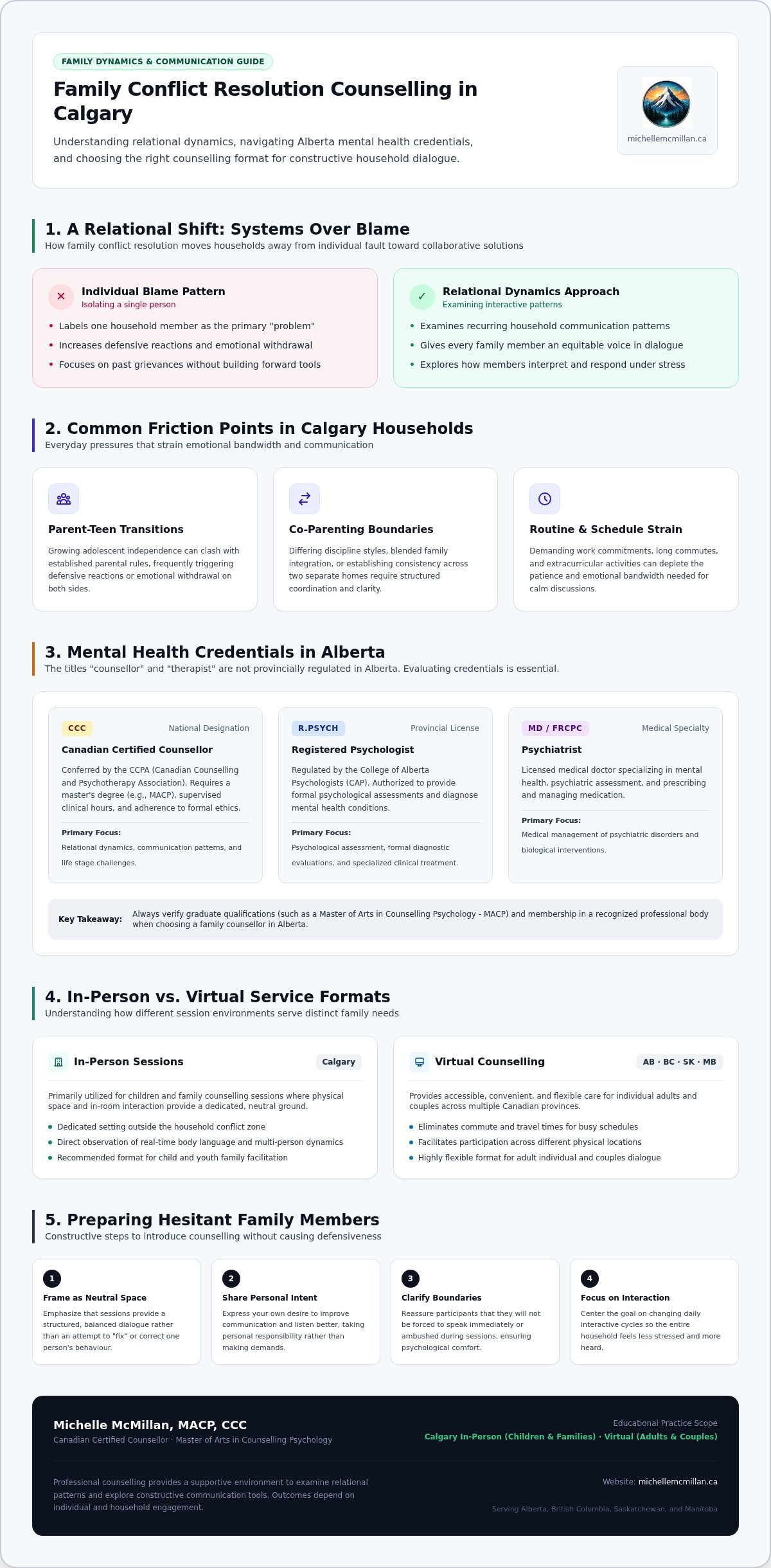
When tension builds at home, families often get caught in exhausting cycles of blame. Professional family conflict resolution counseling Calgary providers offer a structured space to look past individual fault and explore the broader relational dynamics at play. Understanding what family therapy is helps clarify this shift: rather than labelling one family member as the “problem,” counselling examines how household members interact, interpret one another, and respond under stress.
This approach emphasizes collaborative dialogue and active listening. It gives family members an equitable opportunity to share their perspectives, helping households adapt to developmental milestones, blended family adjustments, and evolving parenting expectations.
Common Triggers for Family Conflict in Calgary Households
Tension rarely develops in isolation. Daily household demands, academic pressures, and shifting routines frequently strain emotional bandwidth. Common friction points include:
- Parent-teen transitions: Growing adolescent independence often clashes with established parental rules, leading to defensive reactions or emotional withdrawal.
- Co-parenting boundaries: Differing discipline styles, managing blended family dynamics, or establishing consistency across two homes require careful coordination. Families navigating these transitions often benefit from dedicated parenting support.
- Routine and schedule strain: Juggling demanding work commitments, long commutes, and extracurricular activities can deplete the patience needed for thoughtful conversation.
Individual Therapy versus Family Counselling Approaches
Determining the right therapeutic path depends on your household’s immediate needs. Individual therapy focuses on personal processing, emotional regulation, and working through past experiences in a confidential, one-on-one setting. It helps a single person build coping tools and self-awareness.
Family counselling evaluates systemic interactions, unspoken expectations, and recurring communication patterns between relatives. When appropriate, combining individual reflection with joint family conflict resolution counseling Calgary sessions creates practical opportunities to test constructive communication tools together in a neutral environment.
Professional Qualifications: Evaluating Counsellors and Therapists in Alberta
Sorting through therapeutic titles in Alberta can feel confusing because the province does not currently regulate the terms “counsellor” or “therapist.” Without mandatory provincial licensure, the responsibility falls on families to carefully evaluate a practitioner’s education and oversight. Graduate training, such as a Master of Arts in Counselling Psychology (MACP), ensures a clinician has completed rigorous academic study in human development, ethics, and relational systems. When seeking family conflict resolution counseling Calgary households can trust, verifying that a practitioner belongs to an established professional association offers valuable reassurance that they remain bound to high ethical codes and continuous professional accountability.
Understanding the Canadian Certified Counsellor (CCC) Designation
The Canadian Certified Counsellor (CCC) credential is awarded by the Canadian Counselling and Psychotherapy Association (CCPA). While voluntary rather than a provincial license, this national designation confirms that a practitioner holds a master’s degree in counselling or a related field, completed supervised clinical practicum hours, and abides by a formal ethical code. Reviewing a clinician’s professional background, such as the details on the about Michelle McMillan page, helps confirm their foundational graduate training before you invite them into your family’s personal discussions.
Distinguishing Counsellors from Psychologists and Psychiatrists
Understanding the distinct roles of mental health professionals ensures your family chooses the appropriate level of support:
- Certified Counsellors: Concentrate on relational dynamics, healthy communication patterns, and developmental life challenges. They work collaboratively with families to build practical dialogue tools without focusing primarily on psychiatric diagnoses.
- Registered Psychologists: Regulated healthcare professionals who provide therapy and are licensed to administer formal psychoeducational testing and psychiatric assessments under the professional standards for Alberta psychologists.
- Psychiatrists: Medical doctors specializing in the biological and pharmacological treatment of complex mental health disorders.
Clarifying these credentials helps ensure your chosen family conflict resolution counseling Calgary specialist aligns with your goals for constructive conversation. If you are unsure which level of support fits your current circumstances, you can ask clarifying questions through the practice’s contact page to determine the best path forward.
Comparing Service Formats: In-Person Calgary Sessions versus Virtual Care
Choosing the right format for therapy often comes down to household dynamics, scheduling realities, and the ages of participants. Provincial health resources discussing how to choose a therapist suggest evaluating logistical fit alongside professional expertise. For families exploring family conflict resolution counseling Calgary practices, determining whether to meet face to face or online plays a practical role in how conversations unfold. Counselling for children and families is primarily provided in-person in Calgary, while virtual options offer distinct benefits for adult family members managing scattered schedules.
Why In-Person Settings Benefit Multi-Member Family Dialogue
Gathering together in a dedicated physical office offers clear practical advantages when multiple household members attend. A shared room allows a counsellor to observe posture, subtle eye contact, and shifts in physical tension that web cameras easily miss. Stepping outside the house also removes immediate domestic triggers, such as unfinished chores, ringing phones, and personal devices. In a neutral physical space, turn-taking remains balanced, which helps prevent louder voices from overpowering quieter youth or children.
When Virtual Counselling Serves Adult Family Discussions
Virtual appointments provide flexible options for adult relatives who need to coordinate across distances or around intense work commitments:
- Geographically separated relatives: Adult siblings discussing eldercare, estate matters, or family boundaries can meet together even if they reside in different Alberta cities.
- Demanding work routines: Parents balancing split shifts or corporate obligations can join joint discussions without adding cross-town commutes to their day.
- Seasonal travel challenges: Secure online video meetings ensure consistent appointments when severe winter driving conditions disrupt travel plans across Calgary.
Evaluating these practical factors helps your household select a family conflict resolution counseling Calgary format that supports consistent participation from everyone involved.
Key Criteria for Selecting a Family Conflict Counsellor
Selecting a practitioner requires more than simply checking calendar availability. Finding the right clinical fit involves identifying someone with direct experience in your household’s unique structure, whether you are organizing blended family routines or parenting adolescents through major transitions. A skilled counsellor maintains a balanced, non-judgmental stance toward everyone in the room, ensuring that no single member feels alienated or defensive. Reviewing prospective practitioners and exploring their clinical areas of focus helps confirm their experience aligns directly with your family’s needs.
Experience with Neurodivergence and ADHD in Family Dynamics
Neurodivergence can influence household dialogue in distinct ways. Variations in executive functioning, communication styles, and sensory processing frequently affect how everyday requests are interpreted and carried out. When sensory overload or emotional regulation challenges arise, discussions can escalate quickly if family members misinterpret these experiences as deliberate disrespect. An experienced professional recognizes these nuances and helps the household build shared understanding without treating individual differences as character flaws. For deeper insight into these considerations, explore our detailed resource on ADHD support Calgary.
Essential Questions to Ask During an Initial Inquiry
Taking time to ask practical questions before booking your first appointment clarifies whether a clinician’s communication style matches your family’s expectations. Helpful questions include:
- Group facilitation experience: How much of your practice involves facilitating multi-person family sessions and parent-teen dialogue?
- Managing competing perspectives: How do you structure family conflict resolution counseling Calgary sessions when relatives hold strongly conflicting views about the root problem?
- Confidentiality boundaries: What is your policy regarding individual disclosures, and how do you handle private information when transitioning into joint discussions?
Clear administrative systems, transparent policies, and thoughtful intake procedures reflect a well-grounded practice. If you want to assess whether this collaborative setting fits your family’s goals, reach out through the practice contact page to discuss your situation.
Preparing Your Family for the Counselling Process
Stepping into a counselling office can stir up understandable hesitation, particularly when interactions at home have felt tense for months. Preparing your household thoughtfully helps establish realistic expectations and lowers interpersonal anxiety before the first session begins. Rather than presenting therapy as an intervention to correct someone’s behaviour, frame it as an opportunity to build mutual understanding. Professional family conflict resolution counseling Calgary services provide a structured, balanced setting where each individual receives dedicated space to share their perspective without fear of interruption.
Engaging Hesitant or Reluctant Family Members
It’s completely normal for someone in the household to feel uneasy about participating. Adolescents often worry their parents are bringing them in to be “fixed,” while partners may fear being blamed for ongoing arguments. You can help ease this defensiveness by describing counselling as a collaborative effort to lower household stress rather than an admission of personal fault. Invite reluctant members to identify what frustrates them about current communication patterns and what changes they would like to experience. Respecting individual boundaries and listening to their reservations builds far more willingness than issuing ultimatums.
What to Expect During the Initial Family Consultation
Initial appointments centre on establishing safety, clarity, and conversational pacing. Your clinician will typically review standard consent forms, outline the practical limits of confidentiality, and set collaborative ground rules for respectful dialogue. Early discussions allow each person an equitable opportunity to explain current household tensions from their own viewpoint:
- Establishing shared ground rules: Setting agreements on respectful speaking and active listening so everyone feels protected.
- Identifying competing perspectives: Giving each participant room to voice their experiences without debate or immediate rebuttal.
- Clarifying collaborative goals: Focusing on mutual priorities for communication rather than rushing to solve complex history in one sitting.
Recognizing that early meetings are designed to understand relational patterns helps lower performance pressure for everyone involved. If you have practical questions about introductory sessions or want to discuss intake arrangements for family conflict resolution counseling Calgary appointments, connect directly through the practice contact page.
Moving Forward with Balanced Family Support
Navigating recurring disputes doesn’t mean your household is permanently fractured. By shifting attention toward interactive communication patterns, verifying graduate-level qualifications like the Canadian Certified Counsellor (CCC) designation, and choosing between in-person sessions or virtual care, you establish a solid foundation for constructive dialogue. Thoughtfully preparing your relatives helps lower initial apprehension and ensures every voice is respected from the very first meeting.
Seeking family conflict resolution counseling Calgary families rely on provides an intentional setting to address persistent tension, whether you are managing adolescent life stages, co-parenting logistics, or neurodivergence within the home. Michelle McMillan holds a Master of Arts in Counselling Psychology (MACP) and is a Canadian Certified Counsellor (CCC). Her practice offers in-person Calgary appointments primarily for children and families, alongside flexible virtual care for adults and couples across Alberta.
When you are ready to explore collaborative support and build practical communication tools, review service details and book an initial consultation to begin your family’s conversation.
Frequently Asked Questions
What is the primary role of a family conflict resolution counsellor?
A family conflict resolution counsellor acts as a neutral facilitator who examines interpersonal patterns rather than assigning blame to an individual. Their role is to establish a calm, structured space where everyone feels heard, clarify competing viewpoints, and help households practice constructive communication tools. By focusing on how family members interact under stress, the counsellor guides conversations toward shared understanding and collaborative problem-solving.
How does family counselling differ from individual therapy?
Individual therapy focuses on personal self-reflection, private history, and developing personal coping strategies in a confidential setting. In contrast, family conflict resolution counseling Calgary sessions address the entire relational system. The work evaluates how household members interact, interpret each other’s actions, and respond to tension. The family unit and its communicative dynamics become the primary focus of exploration, rather than one person’s internal processing alone.
What should we do if one family member refuses to attend counselling?
If a family member hesitates or refuses to attend, avoid issuing ultimatums or forcing participation. Instead, invite them to share what feels uncomfortable or frustrating about household interactions. You can also begin counselling with the members who are willing to attend. Exploring your own communication habits and boundaries often shifts relational dynamics at home, which may gradually encourage reluctant relatives to participate when they see a non-judgmental environment in practice.
Is family counselling in Calgary provided in-person or virtually?
Service delivery depends on the household’s structure and the age of participants. Professional counselling for children and families is primarily provided in-person in Calgary, offering a neutral physical setting to observe non-verbal communication and facilitate balanced discussion away from home distractions. Virtual sessions are also available throughout Alberta, which provides flexible scheduling when coordinating adult family members, busy co-parents, or relatives living in different cities.
What qualifications should I look for in a Calgary family counsellor?
Look for practitioners with graduate-level clinical training, such as a Master of Arts in Counselling Psychology (MACP). Because counselling is not currently regulated by the Alberta government, verifying professional credentials like the Canadian Certified Counsellor (CCC) designation ensures your practitioner meets rigorous educational, practicum, and ethical standards. You should also confirm they have direct experience facilitating multi-member family discussions and understand the unique developmental stages within your household.
Can family counselling help households navigating ADHD or neurodivergence?
Yes. ADHD and differences in executive functioning or sensory processing can significantly influence daily household communication. Family conflict resolution counseling Calgary practices help relatives understand how fatigue, overwhelm, and differing cognitive processing styles trigger friction. Rather than treating neurodivergent traits as deliberate disrespect or behavioural flaws, sessions provide an objective setting to adjust household expectations, clarify misunderstandings, and build sustainable routines that support every member’s regulatory needs.
How should parents introduce the idea of family counselling to a teenager?
Approach the conversation by validating their feelings and acknowledging that current household tension is stressful for everyone. Reassure your teen that counselling isn’t an attempt to get them “fixed” or scolded by an authority figure. Instead, describe it as an opportunity for them to voice their opinions openly in a neutral room. Giving them agency over their goals and respecting their perspective helps reduce defensiveness and fosters genuine participation.

Article by
Michelle McMillan, MACP, CCC
Michelle McMillan is a Canadian Certified Counsellor (CCC) with a Master of Arts in Counselling Psychology (MACP). She has extensive experience working with children and supporting clients with ADHD, neurodivergence, anxiety, emotional regulation, relationships and family challenges. Michelle offers both virtual and in-person counselling, with virtual counselling available throughout Alberta, British Columbia, Saskatchewan and Manitoba and in-person appointments available in Calgary.
Important Information
This article is provided for general educational and informational purposes only and is not a substitute for professional counselling, psychological, medical or emergency services. Information shared here should not be considered a diagnosis or individualized treatment advice. If you are experiencing a mental health emergency or are in immediate danger, please contact appropriate emergency services in your area.