
What if a difficult moment is less about your child refusing and more about something making the next step hard? A rushed morning, an unexpected change or a familiar bedtime routine can become tense, leaving you unsure whether you’re seeing difficulty, choice or a response to the situation. If you’re a Calgary parent searching for guidance on parenting a child with ADHD, it can help to begin with curiosity rather than blame.
A strategy that works one day may not work the next. ADHD experiences differ from child to child, and behaviour can be shaped by what’s happening around them. This guide looks at common parenting challenges and practical ways to reflect on family situations and describe support needs. It also explains what counselling may offer a child, parent or family. Counselling is different from ADHD assessment and diagnosis: Michelle McMillan provides counselling, not ADHD assessments, diagnoses or medication recommendations.
Key Takeaways
- Everyday struggles with routines or transitions can have different explanations. Pause before treating a difficult moment as proof of defiance.
- ADHD experiences vary, so consider the child and situation rather than relying on assumptions about what ADHD “looks like.”
- Describe a concern by noting the situation, what you observed, its impact and what you’d like to understand.
- For Calgary families parenting a child with ADHD, noticing patterns and communicating specific support needs can be a useful starting point.
- Counselling offers a professional setting to discuss child, parenting or family concerns. It does not provide an ADHD assessment or diagnosis.
Parenting a child with ADHD in Calgary: begin with curiosity, not blame
When everyday moments keep turning into points of tension, it’s understandable to feel worried, frustrated or unsure what to make of them. You might wonder whether your child is having difficulty, making a choice or responding to something in the situation. Those questions don’t make you a bad parent. They’re a reason to pause and look more closely, without rushing to blame your child or yourself.
ADHD is a neurodevelopmental condition that can affect attention, activity and impulse control. It provides context, but it doesn’t explain everything about a child or why they acted a certain way. Children with ADHD aren’t all alike; their experiences and support needs differ, and the same child may respond differently across situations. For Calgary parents, the more useful question may be: what could be happening for this child, in this moment?
What parents may notice in everyday family life
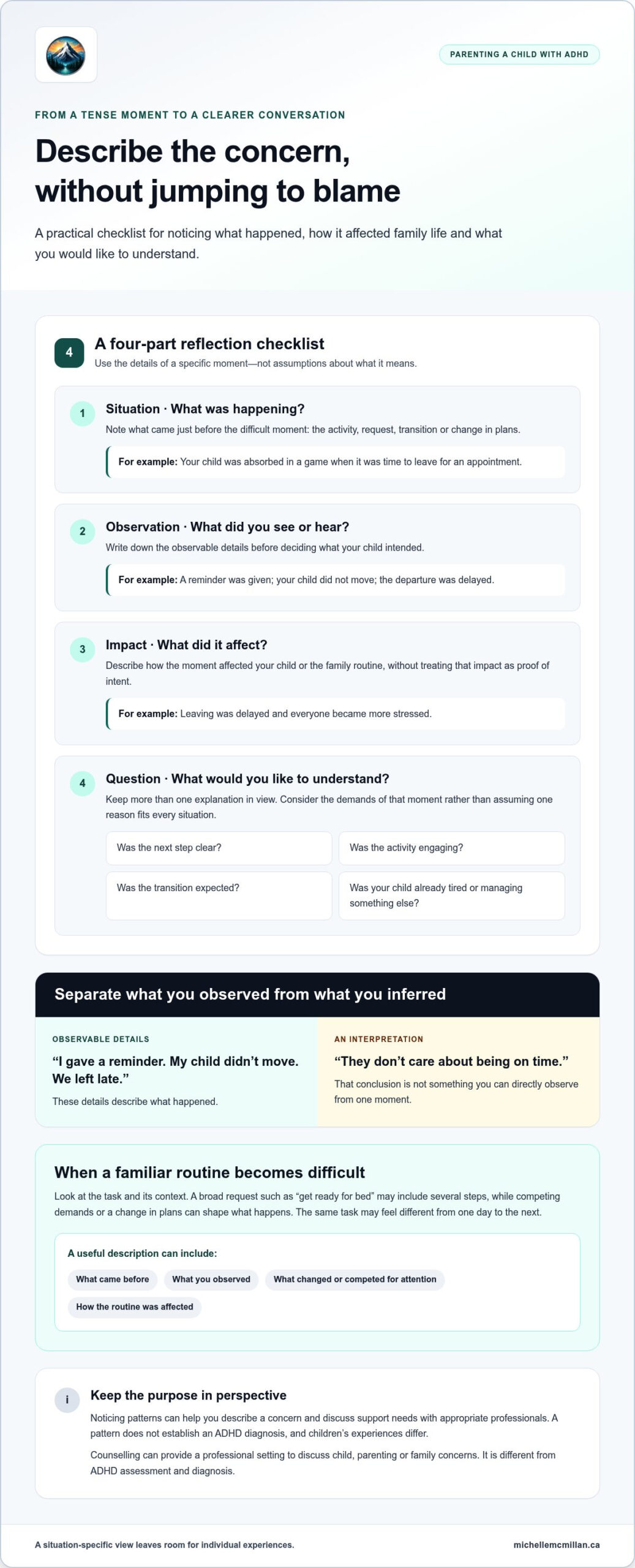
Picture a child absorbed in a game when it’s time to leave for an appointment. A reminder is given, the child doesn’t move, and the departure is delayed while everyone grows more stressed. The observable details are the reminder, the lack of movement and the delay. “They don’t care about being on time” is an interpretation, not something the parent can directly observe.
That distinction matters. A missed task, a strong reaction or an argument can affect the whole household without revealing what a child intended. You can recognize the impact on family routines while staying open to other explanations. Curiosity doesn’t mean ignoring limits or pretending a hard moment didn’t happen. It means describing what happened before deciding what it says about your child’s character or motivation.
Why context matters more than a single behaviour
The same behaviour can have different meanings in different circumstances. A child who doesn’t begin a task might be unsure of the first step, still focused on something else, tired or responding to a change in plans. None of these possibilities should be assumed from one incident. The point is to keep more than one explanation in view.
If a concern recurs, notice the circumstances so you can describe it clearly: what was happening beforehand, what you observed and how it affected your child or family routine. Look for context, not proof of a diagnosis. Patterns can be useful information to discuss with appropriate professionals, but they don’t establish a diagnosis on their own.
ADHD and neurodivergence can be part of a broader conversation about a child’s experiences and support needs. Keeping the focus on the individual child leaves room to consider what a particular situation may be asking of them and the people around them.
Everyday ADHD parenting challenges: understand routines, transitions, and expectations
Routines can look straightforward on paper and still become difficult in a busy household. For Calgary parents supporting a child with ADHD, it may help to look at the demands of a specific moment rather than assume one explanation fits every struggle. Timing, competing needs and how clearly a task is described can all shape what happens next.
Making sense of difficult transitions
Imagine a child building a detailed project when the family needs to sit down for dinner. The request to stop comes just as the child is concentrating on a tricky part. They may protest, keep working or have difficulty shifting attention. The family waits, dinner gets cold and frustration rises. This is a real disruption, but it doesn’t by itself tell you why the change was difficult or what the child intended.
Consider what happened just before and after the tense moment. Was the activity engaging? Was the transition expected, or did another demand arrive at the same time? Was the child already tired or managing something else? These are questions to explore, not a checklist that produces a definitive answer. Children differ, and a response that seems helpful in one situation may not suit another.
Expectations, tasks, and family routines
“Get ready for bed” can mean several things: put away a book, find pyjamas, brush teeth and get into bed. An adult may picture the whole routine, while a child hears a broad request and isn’t sure where to begin. That difference doesn’t prove unwillingness. It may point to a mismatch between the words used and what the moment requires.
Competing demands can also affect how easy it is to complete a task. A child asked to pack a school bag while a sibling is asking questions and a parent is preparing to leave may experience the request differently than during a quieter part of the day. The task hasn’t changed, but the context has.
As you reflect, consider whether the expectation is clear, whether it contains several steps and what else is happening at that time. This isn’t about lowering every expectation or finding a perfect routine. It’s a way to understand what may be making a familiar task harder, while recognizing that household needs and a child’s capacity can vary from day to day.
Changing expectations within the family
Plans can shift: a quick errand takes longer, a usual activity is cancelled or a sibling needs attention first. A child’s response may reflect that particular change rather than a fixed pattern or attitude. Noticing what changed can help you describe the concern without labelling the child. If your questions extend beyond routines to your child’s wider feelings or experiences, child and adolescent counselling services are one option for professional support.
For families in Calgary, there isn’t one script for every transition or task. Paying attention to timing, clarity and competing demands can offer a fuller picture of everyday friction and help keep the focus on the situation, not blame.
ADHD parenting misconceptions: separate support needs from assumptions about behaviour
A tense interaction can leave you wondering whether your child is choosing not to cooperate, having difficulty with the situation or responding to something else entirely. Challenging behaviour doesn’t automatically mean defiance, and it doesn’t prove that you’ve failed as a parent. At the same time, understanding context doesn’t mean ignoring harm or giving up reasonable boundaries. You can take the impact seriously while remaining curious about what contributed to the moment.
If you’re parenting a child with ADHD in Calgary, it may help to separate what you saw from the explanation you’re tempted to attach to it. The table offers possibilities to consider, not conclusions about any particular child.
| Common assumption | A more curious interpretation |
|---|---|
| “They ignored me because they don’t care.” | “I gave a direction, and they didn’t respond. I wonder what else was happening or whether they understood what I was asking.” |
| “They’re being difficult on purpose.” | “They’re having trouble with this request right now. I can consider the circumstances without deciding their intention.” |
| “If I were a better parent, this wouldn’t happen.” | “This moment is hard for our family. I can reflect on what’s contributing without treating it as proof that I’ve failed.” |
| “That reaction is just ADHD.” | “ADHD may be relevant, but this one event doesn’t explain everything about my child or the situation.” |
Is a challenging moment always a choice or a parenting failure?
One incident doesn’t provide a reliable yes-or-no answer. You can observe that a child shouted, didn’t begin a task or left a room; you can’t directly see their motivation. Family stress, timing, the request itself and what happened earlier may all be part of the picture. These factors don’t assign blame, and ADHD doesn’t explain every disagreement. Boundaries can still be clear: curiosity helps you consider the circumstances, not dismiss the effects of someone’s actions.
ADHD doesn’t look or feel the same for every child, so no single behaviour is universal or explains a whole person.
How to discuss concerns without labelling a child
Describe an event in neutral, specific terms: “After I asked them to put away the game, they continued playing, and we were late leaving.” That gives another person something concrete to understand without calling the child lazy, careless or defiant. One event, or even a recurring concern, doesn’t prove ADHD. It can still be useful to explain what you’ve noticed and how it affects family life. If counselling becomes relevant, ADHD and neurodivergence counselling can provide a professional setting to discuss related concerns.
Practical ways Calgary parents can reflect, communicate, and seek support
When a family concern feels tangled, a few clear details can make it easier to talk about. Rather than describing a child as “uncooperative” or “always distracted,” explain one situation in terms another person can understand. This can help you separate what you observed from what you’re still trying to make sense of, whether you’re speaking with a family member, a school support person or a counsellor.
A simple sequence can help organize your thoughts. It’s a reflection tool, not a formula or a way to identify ADHD:
- Situation: What was happening, and when?
- Observable event: What did you see or hear, without adding an explanation?
- Impact: What effect did it have on your child, another family member or the routine?
- Question: What would you like to understand or discuss?
For example: “During the evening routine, I asked Sam to pack their school bag. They stayed in the living room, and we left later than planned. I’m not sure whether the request was clear or what was getting in the way. How can we understand what happened?” A concrete example leaves room for context and conversation. It doesn’t label the child or assume their reason.
Describe a concern clearly and without judgement
If it’s helpful, jot down a specific example while it’s still fresh. Keep it brief: what was going on, what you noticed and what followed. You might also note what you don’t know. Perhaps you didn’t hear what happened just before the interaction, or you’re unsure how your child understood the request. Acknowledging uncertainty isn’t evidence of a diagnosis; it keeps your account grounded in what you actually observed.
Clear observations can also help when you share a concern with relevant family or school supports. Focus on the situation and its effect rather than asking others to accept a broad conclusion about your child. That gives people a more useful starting point for discussing what they’ve noticed and what information may still be missing.
Include the child and family perspective
When it suits the child’s age and the moment, invite them to describe what the situation was like for them. A child may remember feeling rushed, confused or focused on something else; a parent may recall the pressure of keeping the household on schedule. Those accounts can differ without either person’s view capturing the whole picture. Making space for both can add context while keeping the conversation respectful and specific.
This guide offers ideas for parenting a child with ADHD that Calgary families may find useful, but each child’s circumstances are individual. If professional support would help you discuss family or parenting concerns, explore counselling services. For families considering support specifically for an adolescent, teen ADHD counselling in Calgary can help clarify what a teen or family might bring to counselling and how to include the young person’s perspective.
When ADHD-related parenting concerns may lead Calgary families to counselling
Parenting questions can be difficult to hold on your own, especially when family routines, relationships or a child’s needs are weighing on you. Counselling offers a professional setting to discuss what’s happening, consider different perspectives and explore the concerns that feel most important to your family. You don’t need a complete explanation before seeking support.
You might consider counselling when you want space to discuss recurring tension, parenting decisions, ADHD emotional regulation in adults or how ADHD-related challenges are affecting family life. The focus can be on the concerns you bring, whether you’re seeking support for yourself as a parent, your child or your family.
What counselling can address when parenting feels difficult
ADHD and neurodivergence can be part of a broader family conversation, alongside parenting concerns, emotional regulation and relationships. The purpose isn’t to reduce a child to a diagnosis or assume ADHD explains every difficulty. Counselling can provide professional support for discussing experiences and family concerns in their own context.
Michelle McMillan holds a Master of Arts in Counselling Psychology (MACP) and is a Canadian Certified Counsellor (CCC). These are separate credentials. The CCC is a national professional certification through the Canadian Counselling and Psychotherapy Association (CCPA). Michelle also has 16 years of education experience, including work in specialized mental-health and intensive behavioural-support settings with children, teens and families.
Virtual and in-person counselling options in Calgary
Michelle offers both virtual and in-person counselling, with in-person appointments available in Calgary. Virtual counselling is available in Alberta, British Columbia, Saskatchewan and Manitoba. Michelle prefers to provide much of her counselling virtually; both formats are available options, and neither is presented as a better fit for every family.
You don’t need to settle on a label or reach a particular conclusion before discussing parenting concerns with a counsellor. You can begin with the questions you have and the situations you’d like to talk through. For Calgary families parenting a child with ADHD, counselling is one professional support option to consider alongside other supports.
If you’re considering counselling for parenting, child or family concerns, you can review the Rates and Booking page at your own pace.
Choose one thoughtful next step for your family
You don’t need to resolve every question before deciding what would be useful next. For Calgary families parenting a child with ADHD, a starting point could be one concern they want to understand more clearly or one conversation they’re ready to have. The aim isn’t to find a perfect response for every situation. It’s to make room for your child’s individual experience and your family’s needs as they are now.
If professional support feels like a useful option, take the time you need to consider what you’d like to discuss. Counselling can be a place to bring questions about parenting or family life without having everything figured out first.
View rates and booking information if you’d like to explore counselling with Michelle McMillan.
Frequently Asked Questions
Does every child with ADHD need counselling?
No. Counselling is an option, not a requirement attached to an ADHD diagnosis. A family might consider it if a child wants a place to discuss concerns, or if parenting or family issues feel difficult to manage alone. Other children may not need counselling at a particular time. The decision can reflect the child’s circumstances and the questions the family wants to address.
Can a child have ADHD-related challenges even when school is going well?
Yes. A child may manage school expectations while still finding other parts of daily life challenging, or difficulties may be more noticeable in some settings than others. For example, a child may complete classroom work but struggle with the demands of an after-school routine. Strong grades or positive school feedback don’t describe every part of a child’s experience, and neither alone confirms or rules out ADHD.
How can parents talk with a child about ADHD without making them feel blamed?
Use calm, age-appropriate language that treats ADHD as one part of understanding a person, not as a fault. You might explain that people can learn and experience everyday demands differently, then make room for your child’s questions and perspective. Avoid presenting ADHD as the reason for every disagreement or difficulty. A child should hear that support is about understanding needs, not assigning blame.
Can ADHD affect siblings and family relationships differently?
Family members can experience the same situation in different ways. A sibling may feel interrupted by a conflict, while a parent is focused on keeping the household routine moving and the child is upset about what happened. These perspectives can coexist. Rather than assuming ADHD affects every relationship in the same way, notice what each person says they need and how a particular family situation affects them.
What if my child has not received an ADHD diagnosis?
You can still take note of concerns and seek support for the effects they’re having on your child or family. A diagnosis isn’t needed to describe a difficult routine, a relationship concern or a parenting question. Keep observations separate from conclusions, and discuss diagnostic questions with an appropriate health professional. Counselling can provide a place to discuss concerns, but it isn’t an ADHD assessment or diagnosis.
Can parents seek counselling about ADHD-related family concerns?
Yes. Parents can seek counselling to discuss parenting questions or family concerns, whether or not a child attends. You might want space to talk about how a recurring disagreement affects the household or how to communicate a support need. For Calgary parents considering counselling while parenting a child with ADHD, it can offer a professional setting to explore concerns without assuming every family’s experience is the same.
If you’re considering counselling for parenting, child or family concerns, review the Rates and Booking page to explore the next step at your own pace.

Article by
Michelle McMillan, MACP, CCC
Michelle McMillan is a Canadian Certified Counsellor (CCC) with a Master of Arts in Counselling Psychology (MACP). She has extensive experience working with children and supporting clients with ADHD, neurodivergence, anxiety, emotional regulation, relationships and family challenges. Michelle offers both virtual and in-person counselling, with virtual counselling available throughout Alberta, British Columbia, Saskatchewan and Manitoba and in-person appointments available in Calgary.
Important Information
This article is provided for general educational and informational purposes only and is not a substitute for professional counselling, psychological, medical or emergency services. Information shared here should not be considered a diagnosis or individualized treatment advice. If you are experiencing a mental health emergency or are in immediate danger, please contact appropriate emergency services in your area.