
What if a strong reaction is a pattern to understand, not a personal failing to judge? If emotions rise quickly or shift suddenly, the moments afterward can bring regret, self-criticism, or tension with people you care about. It’s understandable to wonder whether ADHD may be part of the picture. For adults exploring ADHD emotional regulation, the details of when a reaction happens and how it affects daily life matter more than any single moment.
Emotional regulation in adults with ADHD can vary widely. Difficulties are discussed in relation to ADHD, but they aren’t a formal diagnostic criterion or a universal part of the condition. Stress, relationships, and other factors can also shape what you’re feeling, so one reaction alone can’t tell you why it happened.
This article explores how ADHD may relate to emotional regulation, and how noticing when and where difficult reactions occur can offer useful context without turning that observation into a self-diagnosis. You’ll also find optional prompts for reflecting on your experiences and learn what professional counselling can offer as a place to discuss concerns. Counselling is not an ADHD assessment or diagnosis.
Key Takeaways
- ADHD emotional regulation in adults can differ widely; strong emotions alone don’t define you or confirm ADHD.
- Emotional regulation involves noticing, understanding, and responding to feelings, with context shaping how reactions unfold.
- Explore patterns across work, relationships, and everyday decisions without assuming the same explanation applies to every situation.
- Reflecting on what happened, what you felt, and how you interpreted the moment can offer context without self-blame. You don’t need to track every reaction.
- Counselling can provide space to discuss emotional concerns and their context. Michelle offers counselling, not ADHD assessments, diagnoses, or medication recommendations.
What ADHD Emotional Regulation Can Mean for Adults
An emotion can feel powerful before you’ve had time to understand what brought it up. You might feel irritated after a short exchange at work, then replay it later and wonder why it affected you so much. That experience can be confusing, but it isn’t a measure of your character or how much you care about other people.
Emotional regulation is the process of noticing what you feel, making sense of it, and responding in a way that fits the situation and your needs. It doesn’t mean staying calm all the time or pushing feelings away. Emotions can signal that something matters to you; the difficulty may be understanding the signal or deciding what to do while the feeling is strong.
Emotional regulation and emotional dysregulation, explained
“Emotional regulation” refers to how a person recognizes, understands, and responds to emotions. “Emotional dysregulation” describes difficulty with some part of that process. It isn’t a character flaw, and it doesn’t mean every feeling is excessive or wrong. For example, after receiving critical feedback, an adult might feel hurt and need time to work out what the comments mean before replying.
Emotional regulation difficulties are discussed in relation to ADHD, but they aren’t a formal diagnostic criterion and aren’t experienced by every adult with ADHD. The impact can vary, too. One person may find certain conversations hard to process, while another may notice little difficulty with emotional responses but have concerns in a different area of daily life.
An emotional-regulation difficulty describes an experience; by itself, it doesn’t diagnose ADHD. A reaction, even one that feels intense or surprising, can’t establish its cause on its own. Context matters, including what was happening, whether a similar pattern recurs, and how it affects daily life. This distinction makes room for curiosity without rushing to label yourself.
Why adult experiences with ADHD can differ
Adults may notice different emotions, triggers, and effects. A delayed reply from a colleague might leave one person feeling uneasy, while someone else barely notices it. The same person might respond differently depending on the day or situation. These examples illustrate individual variation; none is evidence that a person has ADHD.
Questions about ADHD emotional regulation in adults are best considered alongside the broader picture, rather than through one moment or a familiar-sounding example. For further context, see this guide to ADHD in women and Calgary support options. Emotional responses can have more than one possible influence, and similar reactions can happen for different reasons. ADHD and emotional regulation are among Michelle McMillan’s areas of focus in counselling. Understanding your own experience starts with the patterns and context that matter to you, not judging yourself for having a feeling.
How ADHD and Emotional Regulation May Relate
Attention, emotion, and interpretation can be useful areas to consider together when you’re trying to understand a difficult moment. For example, after receiving a brief message from a manager, you might focus on its wording, feel uneasy about what it means, and find it harder to return to another task. That sequence is one way the experience could unfold, not a fixed chain or an explanation that applies to everyone.
The surrounding circumstances matter, too. A demanding week, tension in a relationship, or a major life change may shape what you notice and how a situation feels. These details don’t point to one cause. They describe the context around an experience, which can be more informative than looking at a reaction in isolation.
What the ADHD connection does, and does not, tell you
Emotional-regulation concerns are discussed in relation to ADHD, but that connection doesn’t explain every emotional response. A feeling might draw your attention to a situation, while your interpretation of that situation may shape what happens next. These elements can influence one another, but there isn’t one simple sequence that accounts for everyone’s experience.
It may be more useful to consider what was happening before and after a reaction than to treat the emotion as an explanation by itself. Did a task change unexpectedly? Were you already managing several demands? What did you understand a comment to mean? The answers can help make the moment more specific without assuming its cause.
Other context can matter too
The same event can feel different depending on what else is going on. A short reply from a colleague might seem neutral when you’re focused on a project, but feel difficult to interpret during a stressful week. A missed plan could bring disappointment, relief, or little reaction at all. These responses may reflect personal circumstances and meaning, rather than a single predictable ADHD pattern.
If you’re curious about a recurring concern, consider the situation, your interpretation, and its effect on your day or relationships. Formal diagnostic questions are separate from exploring an emotional concern. Michelle’s areas of focus in emotional regulation and ADHD include counselling support related to these experiences.
How Emotional Regulation Challenges Can Show Up in Adult Life
Emotional experiences can touch several parts of adult life, but they don’t look the same from person to person. A strong feeling may be easy to name but hard to respond to in the moment. For someone else, the feeling may be less intense, while uncertainty about what it means lingers. The people involved, what else is happening, and how the situation is interpreted can all shape its impact.
Emotions, conversations, and relationships
Imagine a partner says, “Can we talk about how we’re sharing the chores?” One person might hear a practical invitation and feel ready to discuss it. Another might worry the comment means they’ve let their partner down, while a third may feel frustrated because they thought they’d already agreed on a plan. Any of these responses could lead to a different conversation, and none points to a single explanation.
If a feeling is hard to sort through, someone might pause before replying, ask what the other person meant, or return to the conversation later. Another person may be comfortable responding right away. These differences can affect how an exchange unfolds, but they don’t mean ADHD is causing conflict or that someone is uncaring or unable to maintain relationships. A challenging conversation can be shaped by its subject, each person’s expectations, and circumstances outside the relationship.
Emotions, work, and everyday decisions
At work, a manager might change a project’s priorities near a deadline. One employee may feel disappointed but quickly refocus; another may feel unsettled and need time to work out what the change means for their workload. For some, emotion may temporarily make it harder to concentrate on the next task. Others may notice no effect on their focus. The same person may respond differently depending on the demands of that day.
Everyday decisions can carry feelings, too. Consider deciding whether to accept an invitation when you’re already tired. You might feel pulled between wanting to see friends and wanting a quiet evening. That tension could make the decision take longer, or it may not feel difficult at all. It doesn’t reveal whether you have ADHD.
These examples are possibilities for reflection, not a checklist for identifying ADHD. The emotional regulation experiences adults with ADHD may have vary, so an isolated reaction offers limited information. Rather than asking whether a moment matches a label, notice what was happening, what the emotion seemed connected to, and whether a similar pattern appears in different situations. That context can help you describe your experience without turning it into a judgement about yourself or a diagnosis.
Ways to Understand Your Patterns Without Blaming Yourself
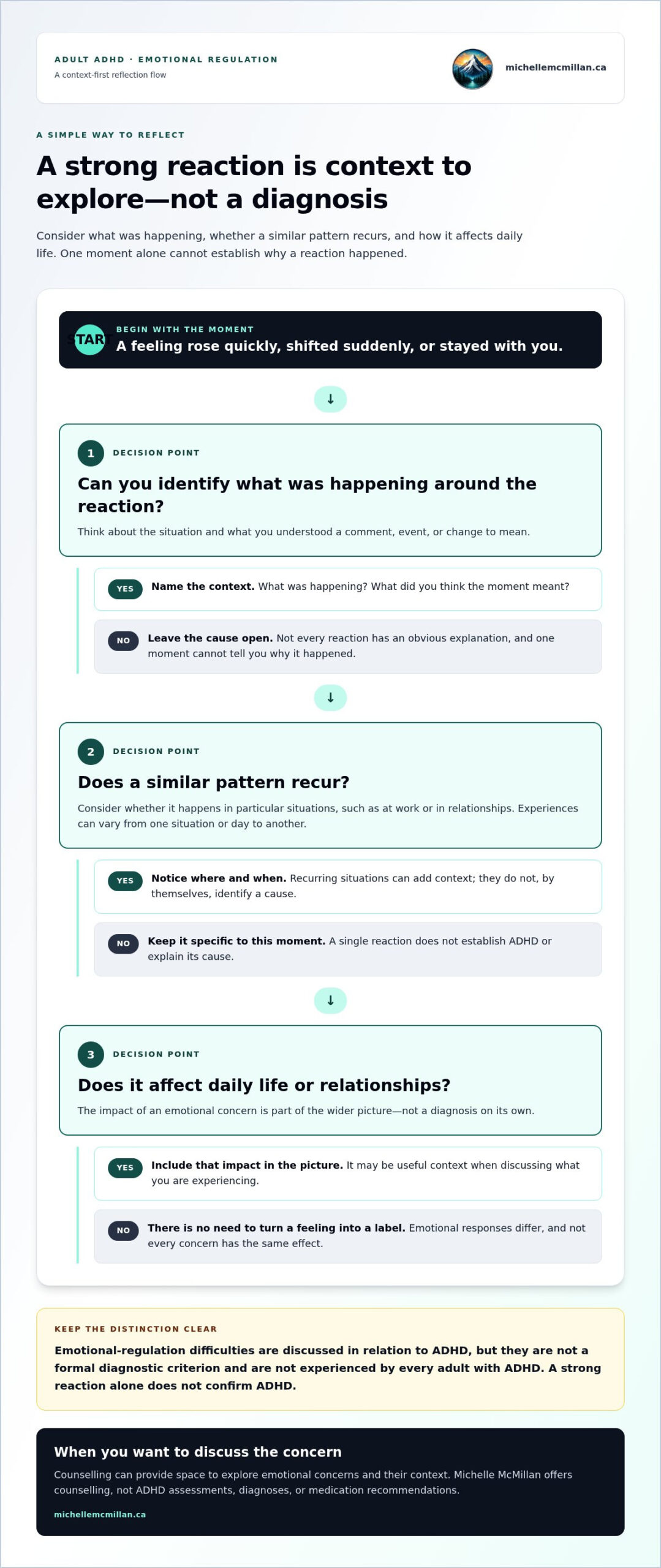
Reflection can help you put words to an experience, but it doesn’t need to become a project or a test. You don’t have to record every emotional shift or find a single explanation. If it feels useful, you might consider one recent moment: what happened, what you felt, what you thought it meant, and how it affected you. These are optional prompts, not a required sequence or a way to diagnose yourself.
Notice patterns while keeping context in view
A single difficult moment may stand out, but it can’t show whether something is a recurring pattern. You might notice whether similar situations come up over time, while leaving room for differences in people, demands, and circumstances. For example, a tense conversation might feel manageable one day and harder on another. Neither response needs to be judged.
If you choose to make a brief note, keep it in your own words and at a level that feels manageable. You could consider:
- The situation: What happened, as you might describe it to someone else?
- The feeling: What emotion did you notice, if you can name it?
- Your interpretation: What did you think the moment meant at the time?
- The impact: Did it affect your focus, a conversation, or something you needed to do?
Separating what happened from what you thought it meant doesn’t invalidate either part. It simply makes room to see which details are clear and where you’re still making sense of them. Writing things down is optional; a brief mental note or conversation may suit you better. For broader information, see this ADHD support resource for Calgary families and individuals.
Decide what you want to discuss with a counsellor
If you speak with a counsellor, one recent example can be a starting point. You might describe what was happening, what you noticed emotionally, and whether it affected a relationship or daily responsibility. You don’t need to arrive with a complete explanation. It’s also okay to say that you’re unsure what the experience means.
Your questions can be in your own words: “Why does this conversation stay with me?” or “How can I understand the difference between what was said and what I feared it meant?” You might want space to discuss a recurring concern, its context, or the kind of support you’re seeking. Reflection doesn’t guarantee a particular outcome; it can simply help you describe what matters to you.
For more context about counselling support related to ADHD, see this information about ADHD counselling. Understanding emotional regulation in adults with ADHD can begin with specific, personal observations, without turning them into a diagnosis or a judgement about yourself.
When ADHD Emotional Regulation Concerns Lead You to Counselling
You don’t need to be certain why a feeling is difficult before talking about it. If emotional experiences are affecting your relationships, work, or daily life, counselling can offer professional support and a place to discuss what’s happening. The focus can be on your concerns and their personal context, rather than assuming that one explanation fits every experience.
Michelle McMillan provides counselling for adults, including support related to ADHD, neurodivergence, and emotional regulation. She provides counselling, not ADHD assessments, diagnoses, or medication recommendations. Counselling can address your concerns and questions, while assessment and diagnosis are separate matters.
What counselling can offer when emotions feel difficult
Emotional concerns don’t always arrive as a clear question. You might want to talk about a reaction that surprised you, a conversation that keeps coming to mind, or a recurring tension between what you feel and how you respond. Counselling offers a setting to describe these experiences, consider how they relate to other parts of your life, and express what you’re hoping to understand. You can bring uncertainty, too. There’s no need to have the right words ready.
People’s concerns vary. One adult may want to discuss how emotions affect communication with a partner; another may be more concerned about focus at work or the effect of stress on everyday decisions. Counselling doesn’t guarantee a particular result, but it can provide professional support for exploring the questions that matter to you. Michelle’s areas of focus in ADHD, neurodivergence, and emotional regulation include concerns that may overlap with relationships, anxiety, and life transitions.
Considering counselling with Michelle in Calgary or virtually
Michelle holds a Master of Arts in Counselling Psychology (MACP) and is a Canadian Certified Counsellor (CCC). The CCC is a national professional certification through the Canadian Counselling and Psychotherapy Association (CCPA). Separately, she has 16 years of education experience, including work in specialized mental-health and intensive behavioural-support settings with children, teens, and families.
Michelle offers both virtual and in-person counselling. Virtual counselling is available in Alberta, British Columbia, Saskatchewan, and Manitoba; in-person appointments are available in Calgary. She prefers to provide much of her counselling virtually, and both formats are available options.
You don’t need to arrive with a diagnosis or a complete account of what you’re experiencing. You might begin with one concern you’d like to discuss. To explore counselling options and next steps with Michelle, visit the Rates and Booking page.
Take Your Next Step at Your Own Pace
Understanding emotional regulation in adults with ADHD doesn’t require you to settle on one explanation straight away. You can notice what feels difficult, what matters to you, and what questions remain. A clearer sense of what you want to discuss can be a meaningful next step, even if you’re still unsure how the pieces fit together.
If professional support feels relevant, counselling can offer space to talk through emotional concerns in the context of your life. You can consider it at your own pace, without needing to have everything figured out first.
If you’re ready to explore counselling with Michelle McMillan, visit the Rates and Booking page to review next steps.
Frequently Asked Questions
Is emotional dysregulation a formal ADHD diagnosis?
No. It’s a term for difficulties with emotional responses, not a diagnosis in itself. If you’re considering an ADHD assessment, think about what you want clarified and how the concern affects different parts of your life. That can help you explain what you’re looking for when discussing assessment with a qualified health professional, without needing to arrive with a conclusion.
Does every adult with ADHD experience emotional regulation challenges?
No. Some adults with ADHD may consider emotional regulation a concern, while others may not. There’s no need to measure your experience against someone else’s or treat a difference as evidence for or against ADHD. Focus on the experiences and questions that matter to you rather than trying to match a standard profile.
Can someone experience intense emotions without having ADHD?
Yes. An intense emotional experience doesn’t point to one explanation on its own. If you’re seeking support, you can start with the part that feels most important, such as how the experience affects work or a relationship. You don’t have to determine its cause before seeking help with the concern itself.
Is Rejection Sensitive Dysphoria a formal ADHD diagnosis?
No. Rejection Sensitive Dysphoria, or RSD, is an informal term, not a formal diagnosis or a universal feature of ADHD. People may use it to describe a painful response to perceived rejection, but it isn’t a diagnostic test. If the term resonates with you, it may be more useful to describe what you experience in your own words than to rely on the label alone.
Can counselling diagnose ADHD or provide an ADHD assessment?
No. Michelle McMillan provides counselling, not ADHD assessments, diagnoses, or medication recommendations. If you’re looking for an assessment, keep that question separate from what you might want to discuss in counselling. You can bring questions about emotional concerns to counselling without expecting it to determine whether you have ADHD.
What can I bring up in counselling about emotional regulation?
You can bring questions, concerns, or priorities in whatever form feels manageable. For example, you might say that you’re unsure where to begin, or that one area of life feels more affected than others. You don’t need to prepare a detailed record or use clinical terms. It’s reasonable to share what feels relevant and take time to put your concerns into words.

Article by
Michelle McMillan, MACP, CCC
Michelle McMillan is a Canadian Certified Counsellor (CCC) with a Master of Arts in Counselling Psychology (MACP). She has extensive experience working with children and supporting clients with ADHD, neurodivergence, anxiety, emotional regulation, relationships and family challenges. Michelle offers both virtual and in-person counselling, with virtual counselling available throughout Alberta, British Columbia, Saskatchewan and Manitoba and in-person appointments available in Calgary.
Important Information
This article is provided for general educational and informational purposes only and is not a substitute for professional counselling, psychological, medical or emergency services. Information shared here should not be considered a diagnosis or individualized treatment advice. If you are experiencing a mental health emergency or are in immediate danger, please contact appropriate emergency services in your area.