
Understanding the Need for Family Counselling in Calgary
Family counselling is a collaborative process where families work with a trained professional to improve relationships, resolve conflicts, and navigate challenging situations together. In a dynamic city like Calgary, families face a unique set of pressures, from balancing demanding careers with home life to helping children manage school transitions and social expectations. The well-being of a family is interconnected; when one person is struggling, the entire family system can feel the impact.
Recognizing this and seeking support is not a sign of failure but a proactive and courageous step toward building a healthier, more resilient family unit. It creates a dedicated space to untangle complex dynamics, learn new communication skills, and strengthen the bonds that hold you together.
Common Challenges Calgary Families Face
Every family is unique, but many find themselves navigating similar hurdles. Professional counselling can provide guidance and support when you are dealing with:
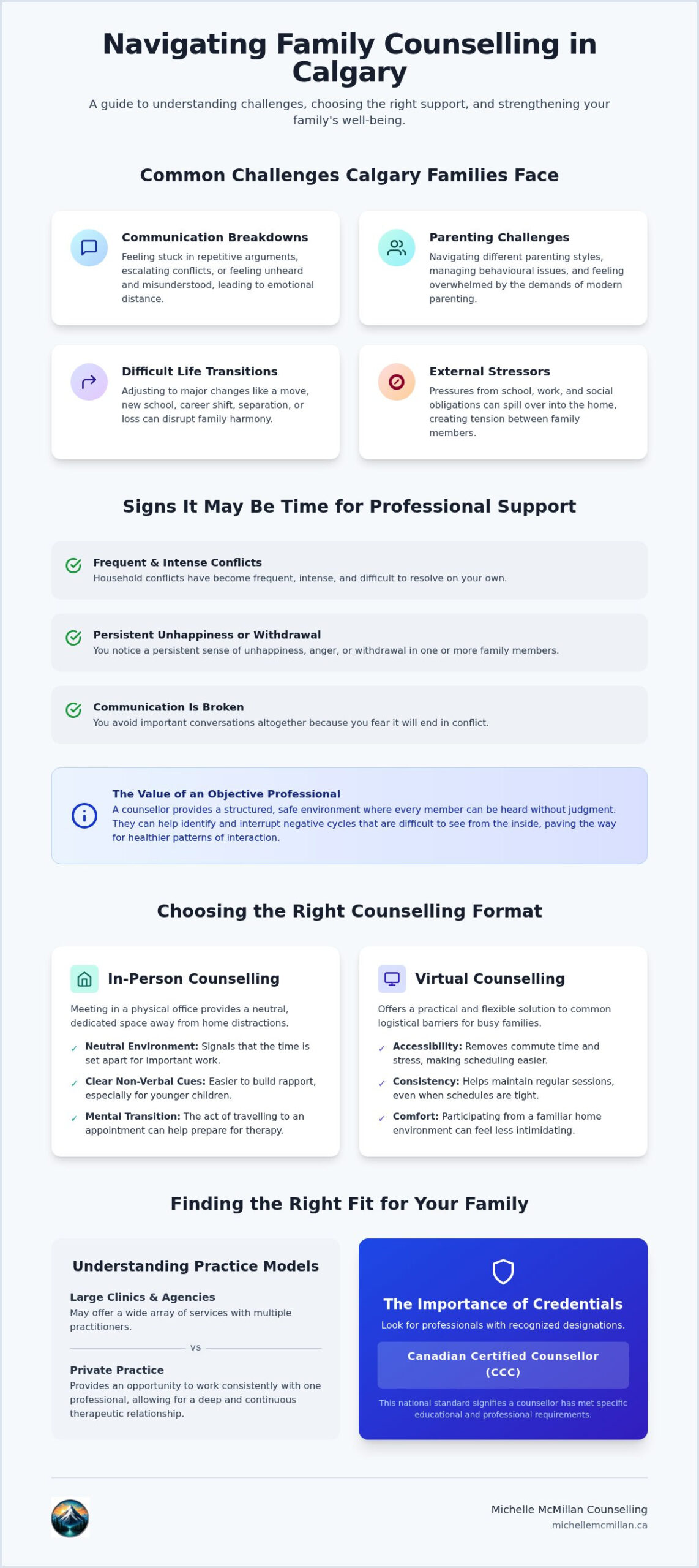
- Communication Breakdowns: Feeling stuck in repetitive arguments or finding that conversations quickly escalate into conflict. Many families report feeling unheard or misunderstood, leading to emotional distance.
- Parenting Challenges: Navigating different parenting styles, managing behavioural issues, or feeling overwhelmed by the demands of raising children and teens in today’s world.
- Difficult Life Transitions: Adjusting to major life changes such as a move, a new school, a career change, separation, or loss can create stress and disrupt family harmony.
- External Stressors: The pressures of school, work, and social obligations can spill over into the home, creating tension and impacting how family members interact with one another.
When to Transition from Self-Help to Professional Support
While books, articles, and advice from friends can be helpful, there are times when professional support is needed to create lasting change. It might be time to consider family counselling when:
- Household conflicts have become frequent, intense, and difficult to resolve on your own.
- You notice a persistent sense of unhappiness, anger, or withdrawal in one or more family members.
- Communication has broken down to the point where you avoid important conversations altogether.
- An objective, impartial professional can help identify and interrupt negative cycles that are hard to see from the inside. A counsellor provides a structured, safe environment where every member has a chance to be heard without judgment, facilitating understanding and paving the way for new, healthier patterns of interaction. This is particularly valuable for families navigating the complexities of neurodivergence or ADHD, where specialized strategies can make a significant difference.
Choosing the Right Counselling Format for Your Family in Calgary
When seeking family counselling in Calgary, one of the first decisions is choosing the format that best suits your needs. Both in-person and virtual counselling offer distinct advantages, and the right choice depends on your family’s specific circumstances, comfort level, and logistical needs.
The Role of In-Person Family Counselling
For many families, meeting a counsellor in a physical office is the preferred approach. In-person therapy provides a neutral, dedicated space away from the distractions and routines of home. This change of environment can signal to all members that this time is set apart for a specific, important purpose. Some people find it easier to read non-verbal cues and build a rapport when they are in the same room, which can be particularly helpful for younger children or those who are more comfortable with face-to-face interaction. The act of travelling to an appointment can also help create a mental transition into the therapeutic work ahead.
The Convenience of Virtual Family Counselling
Virtual counselling has become an important option for many Calgary families, offering a practical solution to common logistical barriers. For those juggling busy work schedules, school, and extracurricular activities, online sessions can provide much-needed flexibility.
- Accessibility: It removes the time and stress associated with commuting and finding parking, making it easier to fit sessions into a packed week.
- Consistency: Virtual appointments can help families maintain regular sessions, even if a family member is travelling for work or away at university within a province where the counsellor is licensed to practise.
- Comfort: For some, participating from the familiar environment of home can feel more approachable and less intimidating than a clinical setting.
Michelle McMillan Counselling offers professional virtual therapy services to families in Calgary and across Alberta, providing a flexible and accessible way to receive support.
Finding the Right Fit: Counsellors, Psychologists, and Clinics in Calgary
The success of family counselling often hinges on the therapeutic relationship—the sense of trust, safety, and connection you feel with your counsellor. It’s essential to find a professional whose approach aligns with your family’s goals and values. In Calgary, you will find a range of options, from private practitioners to larger clinics and community agencies.
Understanding Different Practice Models
When you begin your search, you’ll encounter different types of counselling practices. Some are large, multi-practitioner clinics or non-profit agencies that may offer a wide array of services, while others are smaller private practices run by an individual counsellor. A private practice often provides the opportunity to work consistently with the same professional throughout your therapeutic journey, allowing for a deep and continuous therapeutic relationship. It’s important to research and ask questions to understand which model feels like the best fit for your family’s needs and preferences.
The Role of a Canadian Certified Counsellor (CCC)
When choosing a professional, it’s helpful to understand their credentials. In Canada, the Canadian Certified Counsellor (CCC) designation is a national service and certification mark. It is granted by the Canadian Counselling and Psychotherapy Association (CCPA) to counsellors who have met specific standards of education, supervised practice, and professional conduct. Holding this designation indicates a commitment to ethical practice and ongoing professional development.
Many qualified counsellors also hold graduate-level degrees, such as a Master of Arts in Counselling Psychology (MACP), which provides a comprehensive foundation in therapeutic theories and practices. You can learn more about these credentials and the person behind the practice on a counsellor’s about page, which can help you determine if they are the right professional for your family.
How to Prepare for Your Family’s First Counselling Session
It’s completely normal for family members—parents, teens, and children alike—to feel nervous, skeptical, or uncertain before the first counselling session. Acknowledging these feelings is the first step. The goal of the initial meeting is not to solve every problem but to begin building a trusting relationship with the counsellor and each other.
Setting Realistic Goals for Your Family Dynamics
Lasting change in family dynamics happens incrementally. Rather than aiming to “fix” everything at once, it’s more effective to focus on small, achievable goals. Before your first session, it can be helpful for parents to reflect on one or two primary hopes for the process.
- Focus on Communication: A realistic starting goal could be learning to have difficult conversations without them ending in a fight.
- Acknowledge Different Perspectives: Recognize that each family member experiences the challenges differently. The counsellor’s role is to help bridge those gaps in understanding.
- Practice Patience: It took time for your family’s current patterns to develop, and it will take time to learn new ways of interacting. Patience and consistency are key.
When talking to children or teens about starting counselling, it’s best to be open and transparent. You can frame it as a way for the family to get better at talking and listening to each other, with the help of someone who is trained to guide those conversations.
Navigating Emotional Regulation and Neurodivergence
For families where one or more members are neurodivergent or have ADHD, counselling can provide a space to develop shared strategies that benefit everyone. A key focus is often on emotional regulation—the ability to manage and respond to emotional experiences.
Family counselling can help all members understand how ADHD or other forms of neurodivergence can impact communication, executive functioning, and emotional responses. By learning co-regulation techniques and creating a more predictable and supportive home environment, families can reduce conflict and foster a greater sense of connection and understanding. For a deeper look into this topic, you can explore resources on ADHD support in Calgary.
Professional Family Support with Michelle McMillan
Michelle McMillan Counselling is a virtual practice offering warm, professional, and compassionate support to families in Calgary and throughout Alberta. The focus is on building a partnership with your family, using evidence-based strategies to help you navigate conflict, improve communication, and grow stronger together—all without clinical jargon.
The virtual format is designed to fit into the reality of modern family life, providing flexible and accessible care that helps you build a more connected and harmonious home.
A Collaborative Approach to Family Conflict and Growth
This practice works alongside your family to identify your unique strengths and build resilience. By focusing on relationship difficulties, communication patterns, and navigating life’s transitions, counselling can help you create a family environment where everyone feels valued and understood. You can explore specific areas of focus to see how professional support can align with your family’s needs.
How to Get Started with Virtual Counselling
Taking the first step is often the most challenging part. The process for starting virtual counselling is straightforward and designed to be as low-pressure as possible. It begins with an initial consultation to ensure it’s the right fit for your family. If you’re ready to explore how professional support can help your family thrive, you can reach out through the contact page to begin the conversation.
[Connect with Michelle McMillan for professional family counselling in Calgary](https://michellemcmillan.ca/contact/)
Frequently Asked Questions About Family Counselling
How long does family counselling usually take?
The duration of family counselling varies widely depending on a family’s specific goals, the complexity of the challenges, and the pace at which they wish to work. Some families may find that a few sessions are enough to resolve a specific issue, while others may benefit from longer-term support to address more deep-seated patterns.
Can we do family counselling if one member is reluctant to join?
Yes. While it’s ideal for all members to participate, counselling can still be beneficial even if one person is hesitant. Sometimes, starting the process with the willing members can create positive shifts that encourage the reluctant individual to join later. A counsellor can also provide strategies for communicating with the hesitant family member.
What is the difference between a counsellor and a psychologist in Calgary?
In Alberta, both counsellors and psychologists can provide therapy, but their training and regulatory oversight differ. Psychologists are regulated health professionals who often have doctoral-level training and can provide psychological assessments and diagnoses. Counsellors and therapists, who often have master’s-level training, focus on providing talk therapy to help clients with emotional, relational, and behavioural challenges. Designations like Canadian Certified Counsellor (CCC) indicate that a counsellor has met national standards for education and practice.
How do I know if we need family therapy or individual therapy for my child?
This is a great question to discuss during an initial consultation. If a child’s challenges are closely linked to family dynamics, communication issues, or parenting strategies, family therapy is often recommended. If the child’s struggles are more internal, such as with anxiety or self-esteem that is not primarily rooted in family interactions, individual therapy may be more appropriate. In many cases, a combination of both can be effective.

Article by
Michelle McMillan, MACP, CCC
Michelle McMillan is a Canadian Certified Counsellor (CCC) with a Master of Arts in Counselling Psychology (MACP). She has extensive experience working with children and supporting clients with ADHD, neurodivergence, anxiety, emotional regulation, relationships and family challenges. Michelle provides virtual counselling for adults throughout Alberta, British Columbia, Saskatchewan and Manitoba and primarily in-person counselling for children and families in Calgary.
Important Information
This article is provided for general educational and informational purposes only and is not a substitute for professional counselling, psychological, medical or emergency services. Information shared here should not be considered a diagnosis or individualized treatment advice. If you are experiencing a mental health emergency or are in immediate danger, please contact appropriate emergency services in your area.