
For many women, an ADHD diagnosis in adulthood can feel like finding a missing piece of a puzzle they didn’t know they were solving. The persistent feelings of being overwhelmed, the constant struggle to keep up with invisible labour, and the quiet sense of being “not enough” finally have a name. However, understanding the “why” is only the first step. Navigating life with this new awareness requires more than just organizational tips; it often involves addressing the deep emotional impact of years spent masking and misunderstanding your own brain.
Professional ADHD counselling for women provides a dedicated space to explore these complexities. It moves beyond simple symptom management to focus on the psychological and emotional experiences that are common for women with neurodivergence. In a supportive therapeutic environment, you can begin to untangle years of internalized criticism and develop a more compassionate understanding of yourself.
What is ADHD Counselling for Women and How Can it Help?
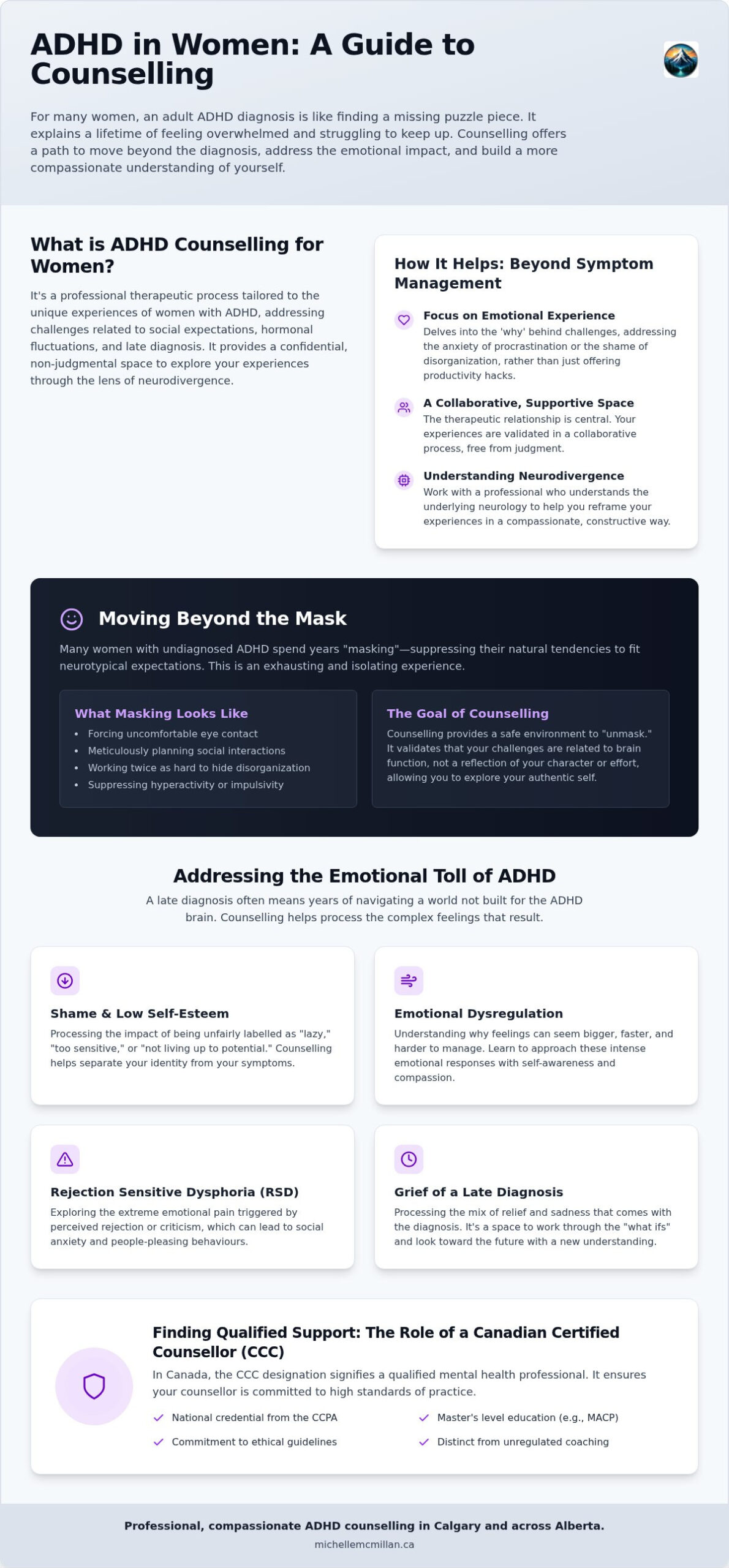
ADHD counselling is a professional therapeutic process designed to help individuals address the psychological, emotional, and relational challenges associated with Attention-Deficit/Hyperactivity Disorder. When tailored for women, this type of counselling specifically acknowledges the unique ways ADHD can present due to social expectations, hormonal fluctuations, and the common experience of a late diagnosis.
Led by a qualified professional, such as a Canadian Certified Counsellor (CCC), this process offers a confidential, non-judgmental space to explore your personal history and current struggles through the lens of neurodivergence.
- A Focus on Emotional Experience: Unlike task-based coaching that often centres on productivity hacks, counselling delves into the “why” behind the challenges. It addresses the emotional toll of executive function difficulties, such as the anxiety of procrastination or the shame associated with disorganization.
- A Collaborative and Supportive Space: The therapeutic relationship is central to counselling. It is a collaborative process where your experiences are validated, and you can explore your thoughts and feelings without fear of judgment.
- Understanding Neurodivergence: Working with a counsellor experienced in neurodivergence-related challenges means you are working with someone who understands the underlying neurology and can help you reframe your experiences in a more constructive and compassionate way.
The Role of a Canadian Certified Counsellor (CCC)
In Canada, finding a qualified mental health professional involves understanding different credentials. The Canadian Certified Counsellor (CCC) designation is a national service and credential recognized across the country. It is granted by the Canadian Counselling and Psychotherapy Association (CCPA) to counsellors who have met specific standards for education and professional development.
Holding a Master of Arts in Counselling Psychology (MACP) provides a strong educational foundation in therapeutic principles and practices. When you choose a CCC with an MACP, you are choosing a professional committed to ethical guidelines and ongoing education. This is distinct from life coaching or other unregulated fields, ensuring you receive support grounded in established psychological principles.
Moving Beyond the Mask: Validating Your Experience
Many women with undiagnosed ADHD spend years “masking”—consciously or unconsciously suppressing their natural tendencies to fit in with neurotypical expectations. This can look like forcing eye contact even when it’s uncomfortable, meticulously planning every social interaction to avoid saying the “wrong thing,” or working twice as hard to hide organizational struggles.
Masking is an exhausting and often isolating experience. Counselling provides a safe environment to begin to “unmask” and explore who you are without the constant pressure to perform. A key part of this process is having your experiences validated by a professional who recognizes that the challenges you face are related to regulation and brain function, not a reflection of your character or effort.
Addressing the Emotional Toll: Shame, Overwhelm, and Self-Esteem
Living in a world not built for the ADHD brain can have a significant impact on self-worth. For women who were not diagnosed as children, a lifetime of being told they are “lazy,” “too sensitive,” or “not living up to their potential” can create deep-seated feelings of shame and inadequacy.
Counselling for ADHD offers a space to process these painful narratives. It helps individuals explore the origins of these beliefs and begin to separate their identity from their symptoms. A central theme in this work is often emotional dysregulation—the experience of having feelings that seem bigger, faster, and more difficult to manage than those of peers. A counsellor can support you in understanding these intense emotional responses without judgment, fostering greater self-awareness and compassion.
For those seeking broader community context, understanding local resources can also be an important part of the picture. Exploring ADHD support in Calgary can provide additional layers of connection and understanding.
Unpacking Intense Emotional Sensitivity
The term Rejection Sensitive Dysphoria (RSD) is sometimes used to describe an extreme emotional sensitivity and pain triggered by the perception of being rejected, teased, or criticized. While not a formal medical diagnosis, this concept resonates with many people with ADHD who experience intense emotional reactions to real or imagined social slights.
For women, this can manifest as severe social anxiety, people-pleasing tendencies, or a pattern of avoiding situations where they might be judged. In a therapeutic setting, you can explore the impact of this emotional sensitivity on your life and relationships. Counselling may help you examine your reactions to perceived criticism and develop a stronger sense of self-worth that is less dependent on external validation.
Processing the Grief of a Late Diagnosis
Receiving an ADHD diagnosis as an adult can bring a wave of conflicting emotions. There is often immense relief in finally having an explanation for lifelong struggles. At the same time, many women experience a profound sense of grief.
Thoughts of “what if” can be consuming: “What if I had known this in university?” “How might my career have been different?” “Could I have avoided so much conflict in my relationships?” This grief for the past and the person you might have been with proper support is valid and real. Counselling provides a space to honour these feelings, process the anger or sadness that may arise, and begin to reframe your life story through a new lens of understanding and self-compassion.
Navigating Life Transitions and Relationship Dynamics
The demands of modern life can be challenging for anyone, but for women with ADHD, managing the “invisible labour” of running a household, coordinating family schedules, and meeting professional expectations can feel monumental. Executive function challenges related to planning, organizing, and initiating tasks can make these responsibilities a constant source of stress and burnout.
Furthermore, ADHD traits like forgetfulness, time blindness, or verbal impulsivity can create friction in partnerships and friendships. A partner may feel hurt by a forgotten anniversary, or a friend may misinterpret an interruption as a lack of interest. Counselling can provide a space to explore these dynamics, supporting you in developing strategies for clearer communication and setting more realistic expectations for yourself and others.
For mothers, navigating these challenges while also supporting their children is an added layer of complexity. Learning more about resources like child counselling can be a helpful step for those parenting neurodivergent children.
ADHD and the Parenting Journey
Being a parent with ADHD presents a unique set of challenges, particularly when your children are also neurodivergent. Managing your own emotional regulation while trying to co-regulate with a child can be incredibly difficult. The daily demands of parenting—from remembering appointments to managing homework—can tax already strained executive functions.
Professional support can be invaluable for neurodivergent mothers. Counselling can offer a space to process parenting-related stress, explore your own emotional triggers, and identify ways to create a more supportive and compassionate family environment. By tending to your own needs, you can better model self-awareness and emotional understanding for your children.
Career Transitions and Workplace Overwhelm
The professional world is often structured around neurotypical standards of productivity, organization, and communication. This can create significant hurdles for women with ADHD. Challenges with time management, difficulty sustaining focus on mundane tasks, and sensitivity to noisy open-plan offices can lead to chronic stress and feelings of professional inadequacy.
Counselling can be a place to explore these workplace challenges. It can help you identify your unique strengths—such as creativity, hyperfocus on subjects of interest, and crisis-response skills—and discuss ways to advocate for accommodations or find roles that better align with your cognitive style. During periods of career change or uncertainty, having professional support can provide stability and perspective.
Finding the Right Support: ADHD Counselling in Calgary and Alberta
Choosing a counsellor is a personal decision, and finding the right fit is essential for a positive therapeutic experience. When searching for ADHD counselling for women in Calgary or across Alberta, consider the following factors:
- Credentials: Look for a professional with a relevant Master’s degree, such as a Master of Arts in Counselling Psychology (MACP), and a respected professional designation, like Canadian Certified Counsellor (CCC).
- Approach: Seek a counsellor who has experience with ADHD and neurodivergence and who uses a warm, non-judgmental, and neurodiversity-affirming approach. Their perspective should be that your brain is different, not broken.
- Format: Consider whether virtual or in-person sessions are a better fit for your life. Online counselling can offer significant flexibility and convenience, removing barriers like travel and scheduling.
- Connection: Perhaps the most crucial factor is the therapeutic alliance. You should feel that your counsellor listens to you, respects your experience, and creates a space where you feel seen and understood.
The Benefits of Virtual Counselling for Busy Women
For many women juggling work, family, and personal responsibilities, adding another appointment to the schedule can feel impossible. Virtual counselling offers a practical and accessible solution. Online sessions eliminate the “friction” of commuting and parking in a city like Calgary, saving valuable time and energy.
This format also expands access to specialized care. Women living anywhere in Alberta, as well as in other eligible provinces like British Columbia, Saskatchewan, and Manitoba, can connect with a qualified counsellor without geographic limitation. Receiving professional support from the comfort and privacy of your own home can make it easier to commit to the process.
What to Expect in Counselling
Starting counselling can feel intimidating, especially if you are not sure what to expect. Generally, the initial sessions are an opportunity for you to share your story and what brought you to seek support. It is a time for you and the counsellor to determine if you are a good fit for working together.
You do not need to have everything figured out before your first appointment. A professional counsellor’s role is to provide a structured and supportive environment where you can explore your concerns at a pace that feels comfortable for you. The process is collaborative and tailored to your unique circumstances and goals.
Professional ADHD Counselling with Michelle McMillan
Michelle McMillan, MACP, CCC, is a Canadian Certified Counsellor with extensive experience supporting women and families navigating the complexities of neurodivergence. Her practice provides a compassionate and understanding environment for those looking to explore the emotional and psychological impacts of ADHD.
With a focus on individual counselling, Michelle supports clients dealing with ADHD-related challenges, anxiety, and stress. Her approach is grounded in creating a supportive space where individual strengths are recognized and a person’s lived experience is honoured. Seeking professional support is a significant step, and Michelle is committed to providing a respectful and validating process.
A Supportive and Collaborative Approach
The focus of counselling with Michelle McMillan is on a collaborative exploration of your experience. The process emphasizes understanding emotional responses and exploring self-perception as core pillars of the work. By examining the patterns and beliefs that have shaped your life, you can begin to foster a more compassionate relationship with yourself. Virtual sessions are available for women in Calgary and throughout Alberta, providing a flexible and accessible option for professional support.
Taking the Next Step
If you have been wondering if counselling could help you better understand your experience with ADHD, reaching out to a professional is a positive step. Professional support can provide a dedicated space to process your diagnosis, explore its impact on your life, and work toward a greater sense of self-understanding. For those interested in local services, further information on ADHD counselling in Calgary is available.
Frequently Asked Questions
- What is the difference between ADHD counselling and traditional therapy?
-
ADHD counselling applies established therapeutic principles specifically through the lens of neurodivergence. An ADHD-informed counsellor understands how executive function challenges and emotional dysregulation can impact a person’s mental health and relationships, and they tailor their approach to be mindful of these factors.
- How can a counsellor help me with emotional overwhelm and “big feelings”?
-
A counsellor can provide a safe, non-judgmental space to explore the roots of intense emotions. In counselling, you can talk through your experiences of overwhelm, identify potential triggers, and develop a greater understanding of your personal emotional patterns without pressure or criticism.
- Is virtual ADHD counselling as effective as in-person sessions for women?
-
The effectiveness of virtual versus in-person counselling often comes down to individual preference and circumstances. Many people find virtual sessions to be highly effective and appreciate the practical benefits of convenience, accessibility, and comfort. The most important factor is the quality of the therapeutic relationship with your counsellor.
- What credentials should I look for in an ADHD counsellor in Calgary?
-
In Alberta, it is wise to look for a counsellor with a relevant graduate degree (such as a Master of Arts in Counselling Psychology) and a professional designation from a recognized Canadian association, like the Canadian Certified Counsellor (CCC) credential from the CCPA.
- Can counselling help with the shame I feel about my late ADHD diagnosis?
-
Counselling can offer a supportive environment to process the complex feelings, including shame and grief, that may accompany a late diagnosis. It provides a dedicated space to explore past experiences and work toward reframing your personal narrative with more self-compassion.
- Does Michelle McMillan provide ADHD support for both women and children?
-
Yes, Michelle McMillan has extensive experience supporting clients with ADHD-related challenges, including adults, children, and families. Her counselling for adults is offered virtually, while her work with children and families is primarily conducted in person in Calgary.
- How many sessions will I need?
-
The duration of counselling is unique to each individual and depends on their specific needs, goals, and circumstances. There is no set number of sessions, as the process is tailored to you. This is something you can discuss with your counsellor as you work together.
- What should I do if I am not sure if I have ADHD but feel overwhelmed?
-
You do not need a formal diagnosis to benefit from counselling. If you are struggling with feelings of overwhelm, disorganization, or emotional intensity, speaking with a professional counsellor can be a valuable step. It offers a confidential space to explore your challenges and find support.
If you are considering how professional support could assist you in navigating the challenges associated with ADHD, you can explore your options by booking a session with Michelle McMillan, MACP, CCC.

Article by
Michelle McMillan, MACP, CCC
Michelle McMillan is a Canadian Certified Counsellor (CCC) with a Master of Arts in Counselling Psychology (MACP). She has extensive experience working with children and supporting clients with ADHD, neurodivergence, anxiety, emotional regulation, relationships and family challenges. Michelle provides virtual counselling for adults throughout Alberta, British Columbia, Saskatchewan and Manitoba and primarily in-person counselling for children and families in Calgary.
Important Information
This article is provided for general educational and informational purposes only and is not a substitute for professional counselling, psychological, medical or emergency services. Information shared here should not be considered a diagnosis or individualized treatment advice. If you are experiencing a mental health emergency or are in immediate danger, please contact appropriate emergency services in your area.