
Understanding Emotional Regulation: More Than Just “Calming Down”
Emotional regulation is the ability to monitor, understand, and manage the intensity and duration of your emotional responses in a way that helps you function in daily life. It isn’t about suppressing feelings or forcing yourself to be calm. Instead, it’s about developing the awareness to notice what you’re feeling and the capacity to choose how you respond.
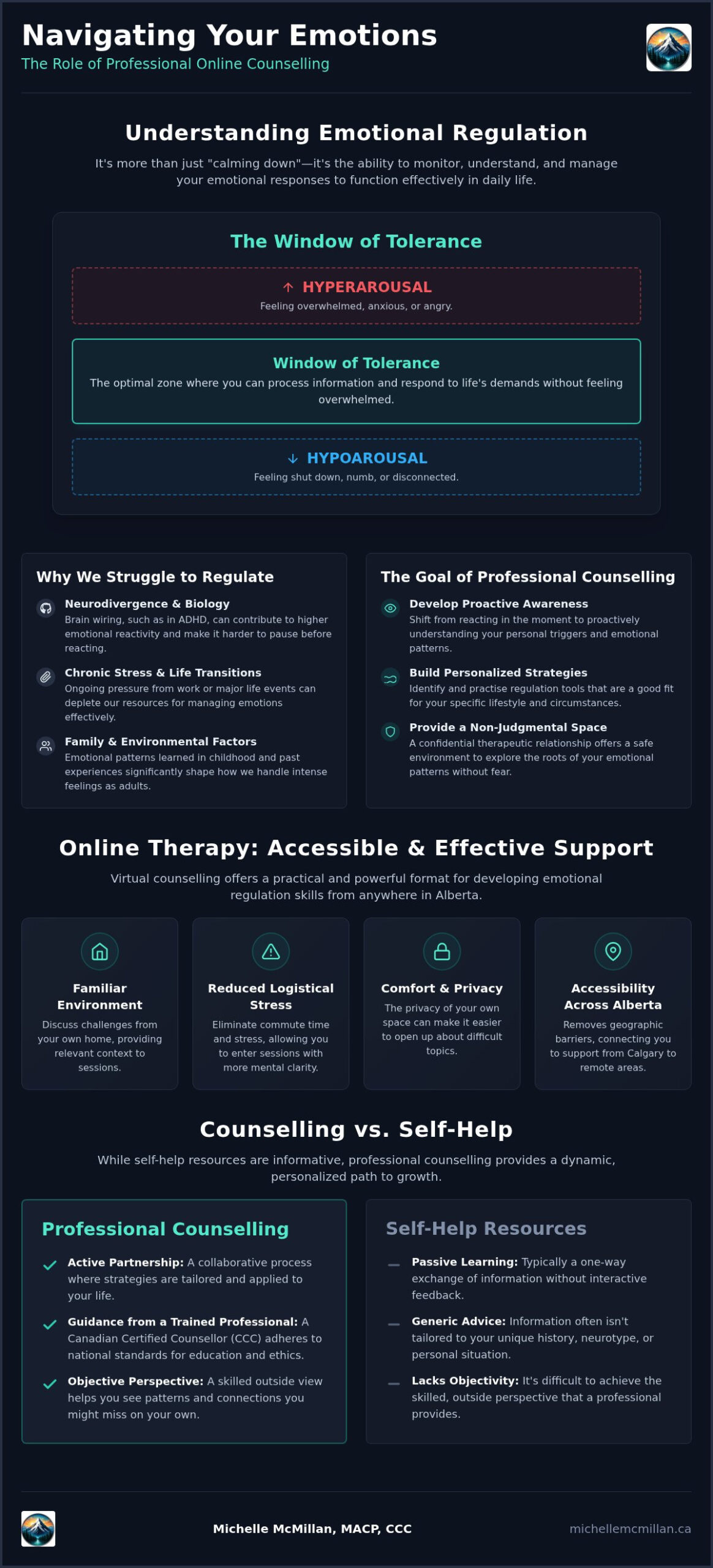
A concept often used in therapy to describe this capacity is the “Window of Tolerance.” When you are within this window, you can process information and respond to the demands of everyday life without feeling overwhelmed. When emotional dysregulation occurs, you might find yourself pushed outside this window, leading to reactions of intense anxiety, anger, or feeling completely numb and shut down. Professional counselling supports the development of skills to recognize and manage these emotional states.
Why We Struggle to Regulate
- Neurodivergence and Biology: For individuals with neurodivergent profiles, such as ADHD, the brain’s wiring can contribute to higher emotional reactivity. This can make it more challenging to pause between a feeling and a reaction.
- Chronic Stress and Life Transitions: Major life events, ongoing work pressure, or significant changes can shrink our capacity to cope. When we are consistently under stress, our resources for managing emotions become depleted.
- Family and Environmental Factors: The patterns of emotional expression we observed growing up often shape our own. Family dynamics and past experiences can influence how we learn to handle, or not handle, intense feelings.
The Goal of Professional Counselling
- Developing Proactive Awareness: The focus of therapy is often to shift from reacting to emotions as they happen to proactively understanding your personal triggers and patterns.
- Building Personalized Strategies: Professional support helps you identify and practise emotional regulation tools that are a good fit for your specific circumstances and lifestyle.
- Providing a Non-Judgmental Space: A confidential therapeutic relationship offers a safe environment to explore the roots of your emotional patterns without fear of judgment, which is a crucial part of the process.
The Benefits of Online Therapy for Emotional Regulation
For many adults in Calgary and across Alberta, virtual counselling offers a practical and accessible format for seeking support. The online model presents several potential benefits for those working on emotional regulation.
- Familiar Environment: Discussing challenges from your own home means you are in the environment where emotional triggers often occur, which can provide relevant context to your sessions.
- Reduced Logistical Stress: Eliminating the need to commute to an appointment can be a significant advantage. The time and stress saved by not dealing with traffic or weather can help you enter a session with more mental clarity.
- Comfort and Privacy: For some people, the privacy and comfort of their own space can make it easier to begin the therapeutic process and speak openly about difficult topics.
- Accessibility Across Alberta: Virtual therapy removes geographic barriers, making professional support accessible to individuals in both urban centres like Calgary and more remote areas of the province.
Real-Time Application of Strategies
- Contextual Discussions: Virtual sessions allow you to reference your physical environment during the therapeutic process. This can be useful when discussing situations that happen at home.
- Integrating Skills into Your Space: Working with a counsellor online provides an opportunity to talk through how you might apply grounding techniques or other strategies within your own living space.
- Creating a Designated Space for Reflection: The act of setting up for a virtual session can help create a “safe centre” within your own house—a specific place and time dedicated to your emotional well-being.
Consistency and Flexibility
- Fewer Missed Appointments: Online counselling can support long-term progress by reducing appointments missed due to factors like Calgary’s unpredictable weather, traffic, or minor illnesses.
- Support for Neurodivergent Needs: For some neurodivergent individuals, the sensory experience of a new physical environment can be overstimulating. An online format can reduce this potential source of stress.
–Maintaining a Rhythm of Support: The flexibility of virtual sessions makes it easier to maintain a consistent schedule, which is often a key component of effective therapeutic work.
Counselling vs. Self-Help: Why Professional Support Matters
While self-help books, apps, and articles can provide valuable information, they often lack the key components that make professional therapy a unique and powerful tool for growth. When considering online therapy for emotional regulation, it’s helpful to understand the distinction.
- Active Partnership vs. Passive Learning: Reading a book is a one-way exchange of information. Counselling is an active, collaborative partnership where strategies are discussed, tailored, and applied to your life in real-time.
- Guidance from a Trained Professional: A Canadian Certified Counsellor (CCC) has met national standards for education, supervision, and ethical practice. This provides a foundation of professionalism for your work together.
- An Objective Perspective: A therapist provides a skilled, outside perspective that can help you see patterns or connections you might miss on your own. This objectivity is difficult to achieve through self-reflection alone.
- Addressing Specific Needs: Professional counsellors have experience working with a range of challenges, including those faced by individuals, couples, and families navigating difficult situations.
The Personalized Path to Regulation
- Beyond Generic Advice: Generic advice often fails because it doesn’t account for your unique history, neurotype, or personal circumstances. Therapy is a personalized process.
- Identifying Unique Triggers: A core part of counselling for emotional regulation is the collaborative work of identifying your specific emotional triggers and understanding their origins.
- Focusing on Deeper Understanding: The goal extends beyond simply “coping.” Professional support aims to foster a deeper understanding of your emotional landscape, exploring the “why” behind your feelings.
Accountability and Safety
- A Structured and Safe Space: Therapy provides a safe, confidential container for exploring intense emotions. Knowing you have a dedicated time and a trained professional to hold that space can make it easier to do the work.
- Applying Strategies Appropriately: A counsellor can help ensure that the regulation strategies you are developing are applied in a way that is effective and suitable for your situation. To learn more, you can explore specific areas of focus in counselling.
Choosing a Virtual Counsellor in Calgary and Alberta
Finding the right therapist is a critical step. When searching for online support for emotional regulation, especially in the Calgary and Alberta area, here are a few key factors to consider.
- Look for Professional Designations: Check for credentials such as Canadian Certified Counsellor (CCC). These designations indicate that the practitioner has met specific national standards of professionalism and ethics.
- Seek Relevant Experience: Prioritize therapists with experience in the areas that are most relevant to you, such as ADHD, anxiety, neurodivergence, or family dynamics.
- Consider the “Therapeutic Fit”: The connection you have with your counsellor is important. During an initial consultation or first session, ask yourself if you feel a sense of warmth, respect, and professional reassurance.
- Confirm Provincial Eligibility: In Canada, counsellors must be eligible to practise in the province where the client is located. Ensure the provider you choose is permitted to offer virtual counselling services in Alberta or your specific province.
Understanding Professional Designations
- Master of Arts in Counselling Psychology (MACP): This is a graduate-level academic degree that provides extensive training in psychological theories, therapeutic methods, and ethical practice.
- Canadian Certified Counsellor (CCC): This is a national professional certification from the Canadian Counselling and Psychotherapy Association (CCPA). It signifies that a counsellor has met specific requirements for education, supervised clinical experience, and adherence to a code of ethics.
- A Foundation of Trust: Professional credentials provide clients with a layer of trust and accountability, as certified counsellors are accountable to their professional associations.
Practical Considerations for Online Support
- Ease of Use: Evaluate the provider’s booking system and virtual platform. A straightforward and secure process can reduce stress and make it easier to focus on your sessions.
- Area of Focus: Check that the counsellor’s practice aligns with your needs, whether you are seeking individual support as an adult, or guidance for parenting or relationship challenges.
- Learning More: It’s always a good idea to review a potential counsellor’s background and approach to see if it resonates with you. You can learn more about Michelle McMillan’s background on her website.
How Michelle McMillan Counselling Supports Your Growth
Michelle McMillan is a Canadian Certified Counsellor with a Master of Arts in Counselling Psychology. Her practice provides a warm, professional, and non-judgmental approach to therapy for residents of Calgary and across Alberta.
The focus is on a partnership where clients are supported in exploring their challenges. Michelle has extensive experience supporting individuals and families navigating ADHD and neurodivergence-related emotional hurdles, anxiety, and relationship dynamics. Her practice offers flexible virtual counselling options for adults in Alberta and other eligible provinces.
A Compassionate Approach for Families and Individuals
- Supporting Children and Teens: Michelle McMillan has significant experience supporting children and teens as they navigate complex emotional landscapes. This work is primarily offered through in-person sessions in Calgary.
- Helping Adults and Couples: Counselling can help adults and couples work toward better communication and understanding by exploring emotional regulation.
- A Commitment to Psychological Safety: A central tenet of the practice is the commitment to creating a sense of psychological safety in every session, providing a secure base for therapeutic work.
Getting Started with Virtual Support
Recognizing a need for support is the first step. The next is exploring whether professional counselling is the right fit for you or your family. Information about services and the booking process is available to help you make an informed decision about moving forward.
If you are looking for professional support to better understand and manage your emotions, you can view rates and book your session with Michelle McMillan, MACP, CCC.
Frequently Asked Questions
- How does online therapy for emotional regulation work?
- Online therapy provides a structured, confidential space to meet with a professional counsellor through a secure video platform. Sessions focus on helping you understand your emotional patterns, identify triggers, and develop personalized strategies for managing your responses. The primary difference from in-person therapy is the format, offering accessibility and the convenience of attending from your own home.
- What do I need for a virtual counselling session in Alberta?
- To participate in a virtual counselling session, you will generally need three things: a reliable internet connection, a computer, tablet, or smartphone with a camera and microphone, and a private, quiet space where you can speak freely without being interrupted.
- What are the counselling options for children and teens in Calgary?
- Professional counselling can be very beneficial for children and teens facing emotional or behavioural challenges. At Michelle McMillan Counselling, services for children, teens, and families are primarily offered in-person in Calgary, as this format is often most effective for younger clients. Virtual options may be discussed as a possibility depending on the specific circumstances and age of the child.
- What is the focus of emotional regulation counselling?
- The focus is on building self-awareness and developing practical skills. Rather than aiming for a specific outcome on a fixed timeline, the process is collaborative and tailored to each individual. It involves exploring the “why” behind your emotional reactions and building a toolkit of strategies that feel authentic and manageable for you.
- Is virtual therapy covered by insurance in Canada?
- Many Canadian insurance providers offer coverage for counselling services, but plans vary widely. It is important to contact your insurance provider directly to confirm the details of your coverage. Be sure to ask if your plan covers services provided by a Canadian Certified Counsellor (CCC).
- What is the difference between a counsellor and a life coach for emotional support?
- A Canadian Certified Counsellor (CCC) has a graduate-level degree in counselling psychology or a related field and has met national standards for clinical experience and supervision. They are trained to work with a wide range of mental health and emotional challenges and are accountable to a professional code of ethics. The field of life coaching is unregulated, meaning there are no mandatory educational or training standards.
- Can online therapy help with ADHD-related emotional challenges?
- Online therapy can provide a supportive and accessible space for individuals with ADHD to explore the factors contributing to emotional dysregulation. A counsellor with experience in neurodivergence can help you understand the unique aspects of an ADHD brain and work with you to develop personalized strategies for managing intense emotional responses. For more information, you may find this resource on ADHD support in Calgary helpful.
- How do I know if I need professional help for my emotions?
- If you find that your emotional reactions are frequently causing distress, interfering with your work or school, straining your relationships, or making it difficult to enjoy daily life, it may be a good time to consider professional support. You don’t need to be in a crisis to benefit from counselling. Simply wanting to understand yourself better is a valid reason to reach out.

Article by
Michelle McMillan, MACP, CCC
Michelle McMillan is a Canadian Certified Counsellor (CCC) with a Master of Arts in Counselling Psychology (MACP). She has extensive experience working with children and supporting clients with ADHD, neurodivergence, anxiety, emotional regulation, relationships and family challenges. Michelle provides virtual counselling for adults throughout Alberta, British Columbia, Saskatchewan and Manitoba and primarily in-person counselling for children and families in Calgary.
Important Information
This article is provided for general educational and informational purposes only and is not a substitute for professional counselling, psychological, medical or emergency services. Information shared here should not be considered a diagnosis or individualized treatment advice. If you are experiencing a mental health emergency or are in immediate danger, please contact appropriate emergency services in your area.