
When family life feels more like a source of stress than support, the idea of counselling can seem both necessary and overwhelming. For parents in Calgary navigating constant arguments, emotional distance, or the complexities of a recent diagnosis like ADHD, the first question is often the most difficult: How do we even begin? The process of finding and starting professional support doesn’t have to be another source of family tension. It can be a structured, collaborative step toward building a calmer and more connected home environment.
This guide offers practical advice for Calgary families considering counselling. It explains how to recognize the signs that your family could benefit from professional support, how to talk to children and teens about the idea, and what to look for in a qualified counsellor. The goal is to demystify the process, helping you move from uncertainty to clear, actionable steps.
Recognizing When Your Family May Benefit from Professional Support
Family counselling is a collaborative process designed to improve communication, resolve persistent conflicts, and strengthen relationships between family members. It’s not about finding fault or placing blame; it’s about understanding the interconnected dynamics that shape your household. Seeking support is a sign of strength and a commitment to the well-being of the entire family.
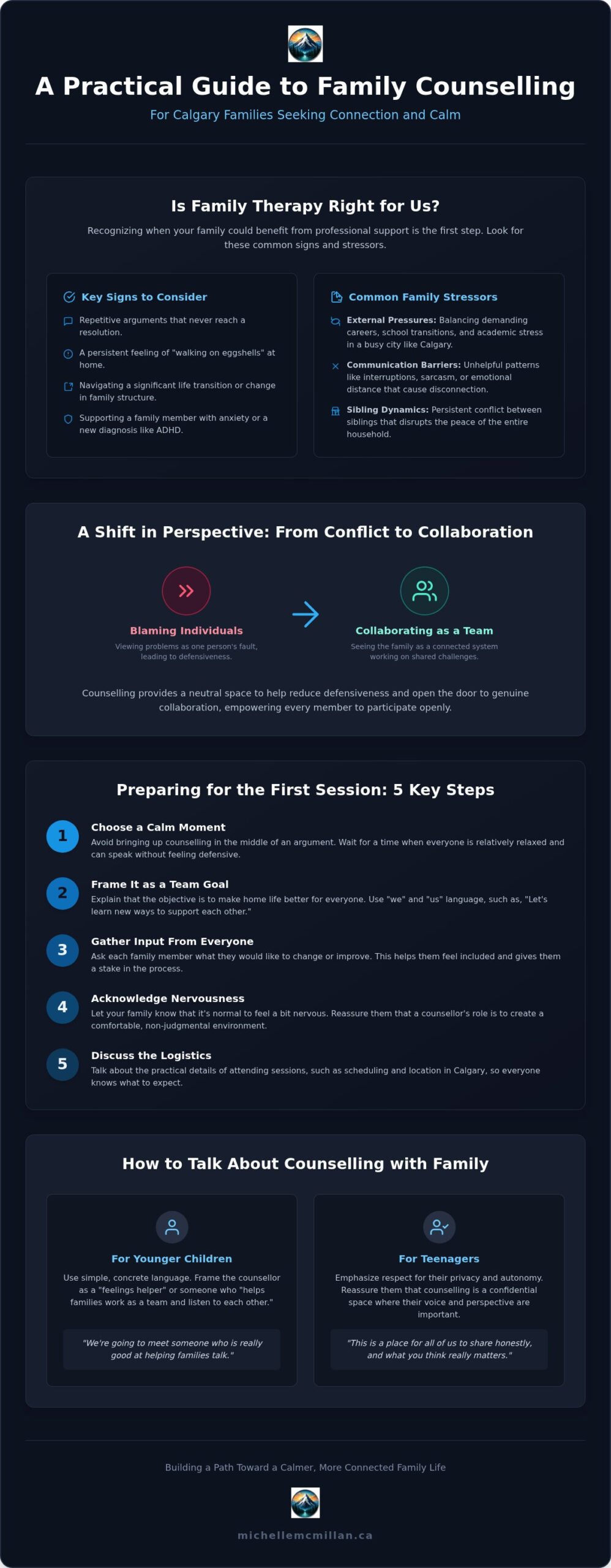
- Signs that your family might benefit from support include repetitive arguments that never reach a resolution or a persistent feeling of “walking on eggshells” at home.
- Professional support can be particularly helpful when a family member is navigating a significant life transition, such as a move, a change in family structure, or challenges at school.
- When a child or teen is struggling with anxiety, their distress can impact the entire family system. Family therapy for anxiety in Calgary provides a space to address these challenges together.
- Addressing neurodivergence-related challenges, such as an ADHD diagnosis, often requires a whole-family approach. Learning new communication and support strategies together can create a more understanding and effective home environment. For more information, you can explore resources on ADHD support for Calgary families.
Identifying Common Family Stressors in Calgary
Families today face a unique set of pressures. In a busy city like Calgary, the demands of work, school, and extracurricular activities can strain family connections. When stress is high, communication can break down, leading to misunderstandings and conflict.
- External Pressures: The balancing act between demanding careers and family life can leave parents feeling exhausted and children feeling overlooked. School transitions, peer pressure, and academic stress also contribute to tension at home.
- Communication Barriers: Over time, families can fall into unhelpful communication patterns. This might look like frequent interruptions, sarcastic comments, or an emotional distance that leaves parents and children feeling disconnected from one another.
- Deeper Sibling Dynamics: While some sibling rivalry is normal, persistent conflict that disrupts the peace of the household may point to deeper dynamic issues that a professional can help the family navigate more productively.
Shifting from Conflict to Collaboration
A key shift in family counselling is moving away from blaming one person for the family’s problems. Instead, the focus turns to the family as a connected system where each person’s actions and feelings affect everyone else. This perspective helps reduce defensiveness and opens the door to genuine collaboration.
- A counsellor provides a neutral space where difficult conversations can happen more safely and productively than they might at the kitchen table.
- The process encourages looking at problems as a shared challenge the family can work on together, rather than a failing of one individual.
- Understanding that seeking professional help is a proactive step toward building a healthier, more resilient family can empower every member to participate more openly.
How to Prepare Your Family for the First Counselling Session
Introducing the idea of counselling requires thoughtfulness and care. The way the conversation is framed can significantly impact how receptive your children or partner will be. The goal is to present it as a positive, team-oriented activity, not a punishment or a sign that someone is “in trouble.”
- Choose a calm moment. Avoid bringing up counselling in the middle of an argument. Wait for a time when everyone is relatively relaxed and can speak without feeling defensive.
- Frame it as a team goal. Explain that the objective is to make home life better for everyone. Use “we” and “us” language, such as, “I think it would be helpful for us to learn how to communicate better so we have fewer arguments.”
- Gather input from everyone. Ask each family member what they would like to change or improve. This helps them feel included and gives them a stake in the process. For example, a teen might want to be heard more, while a parent might want calmer mornings.
- Acknowledge nervousness. Let your family know that it’s normal to feel a bit nervous or awkward about talking to a stranger. Reassure them that a counsellor’s job is to create a comfortable and non-judgmental environment.
- Focus on practicalities. Discuss the logistics of attending in-person sessions in Calgary, such as scheduling and transportation, so everyone knows what to expect.
Talking to Children and Teens About Counselling
How you explain counselling should be tailored to your child’s age and developmental level. The key is to be honest, reassuring, and positive.
- For younger children, use simple, concrete language. You could describe a counsellor as a “feelings helper” or someone who “helps families work as a team.” You might say, “We’re going to meet someone who is really good at helping families talk and listen to each other.”
- For teenagers, emphasize respect for their privacy and autonomy. Reassure them that counselling is a confidential space where their voice matters. You could say, “This is a place for all of us to share our perspectives honestly, and your opinion is important. The goal is to find solutions that work for the whole family, including you.”
- Validate resistance. If a child or teen is skeptical or resistant, listen to their concerns without being dismissive. Acknowledge their feelings by saying, “I hear that you’re not sure about this, and I appreciate you telling me. Can we agree to try one or two sessions and see how it feels?”
Setting Collaborative Goals Together
Approaching counselling with shared goals can create a sense of unity from the very beginning. Before the first session, take some time to brainstorm what a “better” family life would look like to each person. These goals don’t need to be complex; in fact, simple and practical objectives are often the most effective starting point.
- Brainstorm shared objectives like “having calmer dinners,” “finding better ways to solve disagreements,” or “spending more positive time together.”
- Ensure every family member, including children, contributes to this list. This reinforces the idea that everyone’s needs are important.
- Try to summarize your shared goals in a single sentence that reflects a collective commitment, such as, “Our family’s goal is to listen with respect and support each other, even when things are difficult.”
Finding a Family Counsellor in Calgary That Fits Your Needs
Choosing the right professional is a critical step. You want someone who not only has the right credentials but also a professional style that resonates with your family. In Calgary, there are many options, so it’s important to know what to look for.
- Look for professionals with specific experience working with children, youth, and families in the Calgary area.
- Prioritize counsellors who have a focus in your specific areas of concern, whether it’s anxiety, ADHD, communication breakdowns, or parenting support.
- Consider the practical aspects, such as the counsellor’s location in Calgary and whether their office is accessible for your family.
- Ensure the practitioner holds recognized Canadian credentials and adheres to a professional code of ethics, which provides a standard of care and accountability.
Understanding Credentials and Designations (MACP, CCC)
Navigating the various titles and acronyms in the mental health field can be confusing. In Alberta, two common and important credentials for counsellors are the MACP and CCC.
- Master of Arts in Counselling Psychology (MACP): This is a graduate-level degree that provides the foundational academic and practical training for a career in counselling. It signifies that the professional has completed extensive education in psychological theory, ethics, and therapeutic techniques.
- Canadian Certified Counsellor (CCC): This designation is a national professional certification from the Canadian Counselling and Psychotherapy Association (CCPA). To earn the CCC, a counsellor must meet specific educational and supervised experience requirements and adhere to the CCPA’s Code of Ethics. It is a mark of professional quality and accountability.
- Choosing a certified professional like a CCC provides reassurance that the counsellor is committed to high standards of competence and ethical practice.
The Value of In-Person Family Sessions in Calgary
For families, especially those with younger children, meeting a counsellor in person can be particularly beneficial. A shared physical space provides a neutral ground away from the home environment where established patterns of interaction might be more difficult to break.
- In-person sessions allow a counsellor to observe non-verbal cues and family interactions in a way that can be more direct and immediate.
- For children and teens, being in the same room can help build rapport and trust with the counsellor more quickly. Activities and a shared physical space can make the experience feel more engaging.
- Attending sessions together at an office in Calgary reinforces the idea that counselling is a dedicated, intentional time for the family to focus on its relationships and well-being.
The First Session: What to Expect and How to Participate
The first family counselling session is primarily about building a foundation of safety and understanding. It’s an opportunity for your family and the counsellor to get to know each other and determine if it’s a good fit. The focus is less on immediate problem-solving and more on exploration and connection.
Generally, the initial meeting is a time for the counsellor to learn about your family’s unique history, its strengths, and the challenges that brought you to counselling. You might be asked about family routines, communication styles, and what each person hopes to get out of the process. This is also a time for the counsellor to observe how the family interacts in a supported setting. Everyone is invited to share their perspective in a non-judgmental environment, creating a space where each voice can be heard.
Creating a Safe Space for Every Voice
A key role of a family counsellor is to act as a facilitator, ensuring that conversations are respectful and productive. In the first session, a priority is establishing a sense of psychological safety so that even the quietest family members feel comfortable sharing.
- The counsellor helps ensure that parents and children have opportunities to be heard and understood without interruption.
- An emphasis on non-judgmental listening is crucial. The goal is to help family members listen to understand, rather than to respond or defend.
- The counsellor may help the family establish “ground rules” or shared agreements for respectful communication that can be used both in sessions and at home.
Managing Initial Discomfort or Resistance
It is completely normal if the first session feels a bit awkward or if some family members are hesitant to participate. Change can be uncomfortable, and it takes time to build trust with a new person. A skilled counsellor understands this and will work to ease the family into the process.
- Acknowledge that initial discomfort is a normal part of the process for many families.
- If a family member is quiet or reluctant to engage, it’s important not to pressure them. A counsellor will typically invite participation without demanding it, allowing individuals to join the conversation at their own pace.
- Progress in family counselling is often a gradual process. It involves building trust, learning new skills, and practising them over time. Patience and consistency are key.
Building a Path Forward with Michelle McMillan Counselling
For families seeking support in Calgary, finding a professional who understands their specific needs is essential. Michelle McMillan, MACP, CCC, offers a warm and professional environment for families looking to improve their communication and strengthen their relationships.
- Support is tailored to the unique dynamics of each household, with a focus on in-person sessions in Calgary.
- Michelle has extensive experience supporting families navigating the challenges associated with ADHD and neurodivergence.
- The focus is on developing practical tools for emotional regulation and improved communication within family relationships.
- To learn more about her background and approach, you can read about Michelle McMillan.
Supporting Family Dynamics and Communication
Professional family therapy can provide the structure and guidance needed to make lasting changes. The work focuses on creating a more harmonious and resilient family unit.
- Addressing parenting challenges with empathy and evidence-based perspectives.
- Helping families navigate life transitions with a sense of partnership and shared understanding.
- Integrating ADHD-specific awareness into the broader family support plan.
- For a deeper look at available services, you can explore family counselling services in Calgary.
Next Steps for Your Family’s Growth
Taking the first step is often the most challenging part. An initial session is an opportunity to see if a counsellor’s approach feels right for your family’s needs and personality. Lasting change comes from an ongoing commitment to the process from all family members, supported by professional guidance.
If you are ready to explore how professional support can help your family, you can view rates and book a session with Michelle McMillan, MACP, CCC.
Frequently Asked Questions
- What is the difference between family counselling and individual therapy?
- Individual therapy focuses on one person’s thoughts, feelings, and behaviours. Family counselling, on the other hand, views problems within the context of the family system. It focuses on relationships, communication patterns, and the dynamics between family members to resolve conflict and improve the functioning of the entire unit.
- How do I know if my family actually needs professional counselling?
- If you’re experiencing persistent conflict that you can’t resolve, feel emotionally disconnected from one another, are struggling to cope with a major life event or diagnosis, or if communication has broken down, professional counselling could be beneficial. If your current ways of solving problems aren’t working, a neutral third party can offer new perspectives and tools.
- Can family counselling help if only one person is willing to attend?
- While it’s ideal for all members to participate, family counselling can still be helpful even if not everyone attends at first. A change in one person’s behaviour or communication style can positively influence the entire family dynamic. Sometimes, reluctant members decide to join after seeing the positive changes in those who are attending.
- What happens if my teenager refuses to participate in the session?
- It’s not uncommon for teenagers to be resistant to counselling. A counsellor experienced with teens will typically not force participation but will work to build trust and validate their concerns. The focus might initially be on the family members who are present, with the hope that the teen will join when they feel more comfortable and see the value in the process.
- How long does the family counselling process usually take in Calgary?
- The duration of family counselling varies widely depending on the family’s specific goals, the complexity of the issues, and the engagement of its members. Some families may find resolution for a specific issue in a few months, while others with more deep-seated patterns may benefit from longer-term support.
- Is virtual family therapy as effective as in-person sessions for children?
- The effectiveness of virtual versus in-person therapy can depend on the family’s specific situation, particularly the age of the children. In-person sessions are often recommended for families with younger children, as it can be easier to build rapport and engage them in therapeutic activities in a shared physical space. Many practitioners specializing in family and child therapy in Calgary prioritize in-person services for this reason.
- What should we do if we feel nervous before our first appointment?
- Feeling nervous is completely normal. It can be helpful to talk about these feelings as a family beforehand. Remind yourselves of your shared goal—to make things better at home. It can also be reassuring to write down a few key points or questions you want to discuss so you feel more prepared.
- Are family counselling sessions confidential for every family member?
- Confidentiality is a cornerstone of counselling. A counsellor will explain the limits of confidentiality at the first session. In family therapy, the “client” is the family unit. While the counsellor maintains confidentiality for the family as a whole, they typically do not keep secrets between family members, as this can hinder the therapeutic process. Specific rules around privacy, especially for teens, will be discussed and agreed upon at the outset.

Article by
Michelle McMillan, MACP, CCC
Michelle McMillan is a Canadian Certified Counsellor (CCC) with a Master of Arts in Counselling Psychology (MACP). She has extensive experience working with children and supporting clients with ADHD, neurodivergence, anxiety, emotional regulation, relationships and family challenges. Michelle provides virtual counselling for adults throughout Alberta, British Columbia, Saskatchewan and Manitoba and primarily in-person counselling for children and families in Calgary.
Important Information
This article is provided for general educational and informational purposes only and is not a substitute for professional counselling, psychological, medical or emergency services. Information shared here should not be considered a diagnosis or individualized treatment advice. If you are experiencing a mental health emergency or are in immediate danger, please contact appropriate emergency services in your area.