
Navigating the search for an ADHD therapist in Calgary can feel overwhelming, especially when you or a family member needs support that understands the specific challenges associated with neurodivergence. Many individuals and families find that while general counselling is helpful, support from a professional with experience in ADHD can provide a more focused and validating experience. This guide explores what to look for in an ADHD counsellor, the types of support available, and how to find the right fit for your needs in Calgary.
Understanding the nuances of executive functioning, emotional regulation, and how ADHD can impact daily life is often a key consideration for those seeking therapy. A professional with a background in this area can offer a space to explore these challenges without judgment, helping clients build strategies that align with their personal goals.
What is an ADHD Therapist and Why Seek One in Calgary?
An ADHD therapist is a counselling professional who has experience and a particular interest in supporting clients with Attention-Deficit/Hyperactivity Disorder (ADHD) and other forms of neurodivergence. While many counsellors can assist with general mental health concerns, those who focus on ADHD are often more familiar with the specific ways it can affect a person’s life, from executive function challenges at work and school to difficulties with emotional regulation and interpersonal relationships.
Calgary residents often seek this specialized support because they are looking for a professional who understands the context behind their struggles. Rather than simply addressing symptoms like anxiety or stress, an ADHD-informed therapist can help explore how these may be connected to underlying neurodivergent traits. This approach can be deeply validating for individuals who have felt misunderstood in the past.
The Value of Experience in ADHD Support
Some individuals find that general talk therapy may not fully address the practical challenges of ADHD, such as time management, organization, and emotional intensity. A counsellor with experience in neurodivergence can provide a different perspective. They understand that difficulties with executive functions are not a matter of willpower, but a difference in brain-based processing. This understanding forms the foundation of a supportive therapeutic relationship where clients can feel seen and accepted.
Additionally, this type of specialized support acknowledges and validates the neurodivergent experience. For many, receiving an ADHD diagnosis later in life comes with a complex mix of relief and grief. A therapist experienced in this area can help navigate these emotions and reframe a lifetime of experiences through a new lens. To learn more about different areas of focus, you can explore various counselling services available.
Common Reasons Calgary Families and Individuals Seek ADHD Therapy
People in Calgary seek ADHD counselling for a wide range of reasons that span different life stages. The challenges associated with ADHD can manifest differently in children, teens, and adults, requiring a tailored approach.
- School-Related Challenges: Parents in Calgary often look for support for children and teens struggling with focus, organization, and social interactions at school. Therapy can provide a space for young people to build self-awareness and for parents to learn supportive strategies.
- Managing Adult ADHD: Many adults in Calgary’s professional environments seek support to manage workplace demands, prevent burnout, and improve productivity. Counselling can help with developing systems that work for their unique way of thinking.
- Improving Family Dynamics: When one or more family members are neurodivergent, communication and daily routines can be challenging. Family counselling can help improve understanding, reduce conflict, and foster a more supportive home environment. You can find more resources on ADHD support in Calgary here.
The Focus of ADHD-Informed Counselling
Counselling that is informed by an understanding of ADHD moves beyond a one-size-fits-all approach. It recognizes that strategies that work for neurotypical individuals may not be effective for those with ADHD. The focus is on collaboration and understanding, helping clients identify their strengths and build a life that accommodates their needs, rather than trying to force them into a mold that doesn’t fit.
This approach often involves exploring the concept of neuro-affirming care, which respects and validates the natural variations in human brains. Instead of viewing ADHD as a deficit to be corrected, a neuro-affirming therapist sees it as a different way of processing the world, with its own unique strengths and challenges.
Focusing on Emotional Regulation
For some people with ADHD, emotions can feel incredibly intense and overwhelming. This experience, sometimes described as emotional dysregulation, can be one of the most challenging aspects of living with ADHD. A counsellor with experience in this area can help individuals:
- Identify personal triggers and understand the patterns behind their emotional responses.
- Develop greater self-awareness around their emotional states without judgment.
- Explore the connection between ADHD and co-occurring challenges such as anxiety or stress, which are common for many neurodivergent individuals.
Moving Beyond “Try Harder” Strategies
Many individuals with ADHD have spent years being told to “just try harder,” “be more organized,” or “focus.” This advice, however well-intentioned, often overlooks the neurological basis of their challenges and can lead to feelings of shame and inadequacy. A key aspect of ADHD-informed therapy is unlearning this internalized shame.
The therapeutic space becomes a place to explore why conventional advice might not have worked and to develop personalized strategies instead. It’s about building self-compassion and recognizing that struggling with certain tasks is not a moral failing. The goal is to help clients build a life that fits their brain, honouring their natural rhythms and strengths.
Navigating In-Person and Virtual ADHD Support in Calgary and Alberta
When seeking an ADHD therapist in Calgary, you have options for how you connect. Both in-person and virtual counselling are available, and the best choice depends on your specific circumstances, particularly the age of the person seeking support.
For many, virtual counselling has become a valuable tool, reducing barriers like travel time and scheduling conflicts. This can be especially helpful for adults with ADHD, as it removes some of the executive function demands involved in getting to an appointment. However, the format of therapy is an important consideration, especially for children and families.
Support for Children and Families in Calgary
For children, teens, and families, in-person counselling is often a primary and effective option. Direct, face-to-face interaction can be particularly beneficial for building rapport with younger clients and for facilitating family therapy sessions where non-verbal cues and shared physical space are important. Many families in Calgary find that meeting with a therapist in an office setting provides a dedicated, neutral space to work through challenges together. If you are looking for support for your child, exploring child counselling in Calgary can provide more specific information.
Virtual Counselling for Adults in Alberta and Beyond
For adults seeking individual ADHD support, virtual therapy offers significant flexibility. It allows professionals in Calgary to fit sessions into a busy workday without commuting and makes support accessible to individuals in more remote parts of Alberta. Furthermore, virtual counselling allows adults to access specialized therapists from across the province and beyond. For example, some counsellors are able to provide virtual services to adults in other provinces, such as British Columbia, Saskatchewan, and Manitoba, expanding the options for finding the right professional.
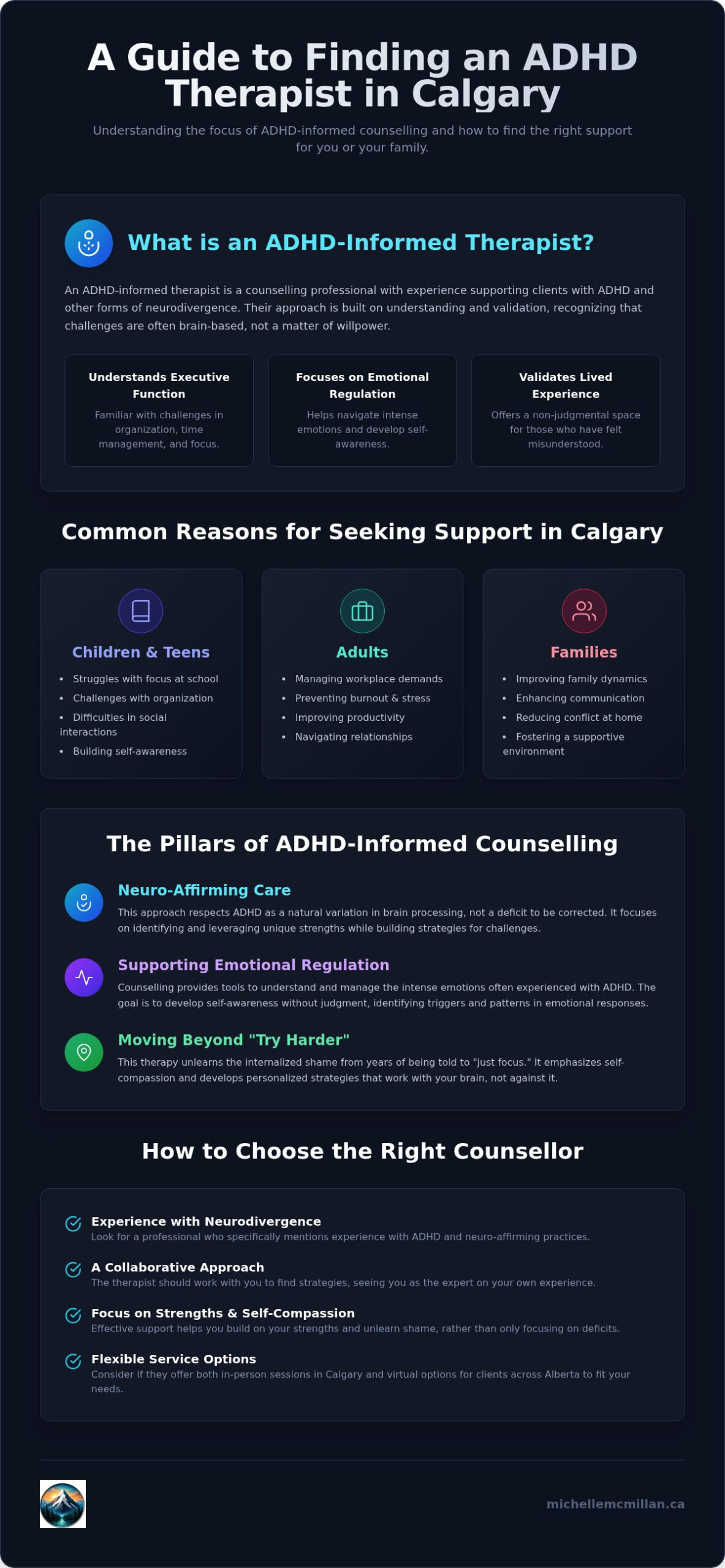
How to Choose the Right ADHD Counsellor for Your Needs
Finding the right ADHD therapist in Calgary is a personal process. The connection you have with your counsellor is one of the most important factors in a positive therapeutic experience. Here is a clear process to help you evaluate potential therapists and find a good fit.
- Clarify Your Needs: Are you seeking support for yourself, your child, or your family? Do you need help with emotional regulation, workplace strategies, or parenting? Knowing your goals will help you find a counsellor with relevant experience.
- Research and Shortlist: Look for counsellors in Calgary who specifically mention ADHD, neurodivergence, or executive functioning in their profiles. Read their websites to get a feel for their approach.
- Check Credentials: In Alberta, you will encounter professionals with various designations. Understanding what these mean can help you make an informed choice.
- Schedule a Consultation: Many therapists offer a brief, no-cost consultation call. This is an excellent opportunity to ask questions and see if you feel comfortable with their personality and communication style. Trust your intuition—a good “fit” is crucial.
Understanding Credentials and Designations
When searching for an ADHD therapist, you may see different titles and credentials. Here are two you might encounter in Canada:
- Master of Arts in Counselling Psychology (MACP): This is a graduate-level degree that provides comprehensive training in psychological theories, assessment, and counselling techniques. It signifies that the individual has completed advanced academic and practical training in the field of counselling.
- Canadian Certified Counsellor (CCC): This is a national certification provided by the Canadian Counselling and Psychotherapy Association (CCPA). To earn this designation, a counsellor must meet specific educational and supervised experience requirements. It indicates that they adhere to the CCPA’s professional standards and code of ethics.
While credentials provide a baseline of qualification, experience and specialization in ADHD are equally important. A therapist’s ability to connect with you and understand your unique experience often matters more than a specific title.
Questions to Ask a Potential ADHD Therapist
During an initial consultation, having a few questions prepared can help you determine if a therapist is the right fit. Consider asking:
- What is your experience working with clients with ADHD in my age group (child, teen, or adult)?
- How do you approach counselling for neurodivergent individuals and families?
- If I’m seeking support for my child, how do you typically involve parents or caregivers in the process?
- What does your availability look like for new clients in Calgary?
ADHD Support in Calgary with Michelle McMillan, MACP, CCC
Michelle McMillan is a Canadian Certified Counsellor with a Master of Arts in Counselling Psychology. She has extensive experience supporting individuals and families navigating challenges related to ADHD, neurodivergence, anxiety, and emotional regulation. Her work is centred on providing a supportive and non-judgmental space for clients to explore their experiences and develop personal insights.
Michelle offers different service formats based on client needs. For adults, she provides virtual counselling to individuals throughout Alberta, British Columbia, Saskatchewan, and Manitoba. For children and families in Calgary, she offers in-person support to facilitate direct and engaged therapeutic work.
A Personalized Path to Growth
Working with a counsellor like Michelle provides an opportunity to understand your unique strengths and challenges. The focus is on building self-awareness and developing practical skills in a collaborative environment. For neurodivergent individuals, this process can be instrumental in building self-esteem and confidence. The goal is not to “fix” ADHD, but to help clients learn to work with their brains and build a life that feels authentic and manageable.
Next Steps: Connecting for Support
If you are looking for an ADHD therapist in Calgary and feel that a supportive, experienced counsellor could be beneficial for you or your family, the next step is to gather more information. Exploring whether professional support is the right fit is a personal decision, and it’s important to find a professional whose approach resonates with you. To learn more about counselling options and the process for getting started, you can review rates and booking information.
Ready to explore specialized ADHD support? You can learn more by visiting the Rates and Booking page.
Frequently Asked Questions About ADHD Therapy in Calgary
- Is there a difference between an ADHD therapist and a psychologist in Calgary?
- Yes, there are differences in training, scope of practice, and regulation. Both therapists (often with titles like Canadian Certified Counsellor) and Registered Psychologists can provide therapy for ADHD. Psychologists are also qualified to provide formal psycho-educational assessments and diagnoses, while the primary focus of a counsellor or therapist is on providing therapeutic support. The best choice depends on your specific needs—whether you are seeking a formal diagnosis or ongoing counselling support.
- Can an ADHD counsellor help with emotional regulation and stress?
- Absolutely. Many people with ADHD experience challenges with emotional regulation, and this is a common focus in therapy. A counsellor can help you understand your emotional patterns, identify triggers, and develop strategies for managing stress and intense feelings in a way that feels supportive and non-judgmental.
- Do I need a formal diagnosis to see an ADHD therapist?
- No, a formal diagnosis is not typically required to begin counselling. Many people seek support because they suspect they have ADHD or are struggling with related challenges like disorganization, inattention, or emotional intensity. Therapy can be a valuable space to explore these experiences, whether you have a diagnosis or not.
- Are both in-person and virtual ADHD counselling available in Calgary?
- Yes, many practitioners offer both. The best format depends on the client. For adults, virtual counselling can be a highly convenient and accessible option. For children and families, in-person sessions are often a preferred format to support engagement and interaction.
- Does insurance cover counselling with a Canadian Certified Counsellor (CCC)?
- Coverage for counselling services varies widely between insurance plans. Many private health insurance plans do cover services provided by a Canadian Certified Counsellor (CCC), but not all do. It is always best to contact your insurance provider directly to confirm the details of your specific plan and understand what is covered.
- How can therapy help with adult ADHD in the workplace?
- For adults, the workplace can be a major source of stress. Therapy can help by providing a space to develop personalized strategies for time management, project organization, and managing deadlines. It can also help with challenges like professional communication, dealing with feedback, and advocating for your needs at work.

Article by
Michelle McMillan, MACP, CCC
Michelle McMillan is a Canadian Certified Counsellor (CCC) with a Master of Arts in Counselling Psychology (MACP). She has extensive experience working with children and supporting clients with ADHD, neurodivergence, anxiety, emotional regulation, relationships and family challenges. Michelle provides virtual counselling for adults throughout Alberta, British Columbia, Saskatchewan and Manitoba and primarily in-person counselling for children and families in Calgary.
Important Information
This article is provided for general educational and informational purposes only and is not a substitute for professional counselling, psychological, medical or emergency services. Information shared here should not be considered a diagnosis or individualized treatment advice. If you are experiencing a mental health emergency or are in immediate danger, please contact appropriate emergency services in your area.