
What if your child’s intense outbursts are not intentional misbehaviour, but signals of a nervous system that cannot yet manage distress alone? When you’re seeking to develop emotional regulation skills for kids Calgary family life can quickly feel overwhelming after a tearful morning or an unexpected episode at school pickup. If you feel drained from trying to de-escalate explosive moments calmly, you aren’t alone; it’s completely natural to worry about how these big feelings affect friendships, classroom focus, and everyday peace at home.
Real progress begins with connection rather than control. In this guide, you will learn practical, evidence-informed strategies to support your child’s emotional growth and explore local counselling options available in Calgary. We will examine how the co-regulation process teaches children to recognize their internal cues, share actionable steps to soothe difficult moments, and clarify when professional support can help your family thrive.
Key Takeaways
- Understand the difference between genuine emotional regulation and behavioural suppression, focusing on your child’s underlying emotional needs rather than just stopping an outburst.
- Discover why co-regulation is a necessary foundation for independent regulation, showing how your calm presence helps settle an overwhelmed nervous system.
- Learn a structured four-phase response framework (Notice, Validate, Regulate, Reflect) designed to strengthen emotional regulation skills for kids Calgary families can apply at home.
- Recognize the clear markers of frequency, intensity, and disruption to daily routines that distinguish normal developmental hurdles from deeper concerns.
- Explore how professional child and family counselling in Calgary provides an objective, supportive environment to explore emotional growth.
Understanding Emotional Regulation in Children: What Big Feelings Actually Mean
At its foundation, emotional regulation is the capacity to monitor, evaluate, and adjust emotional responses so a child can engage with the world constructively. Young children are not born with these complex neurological mechanisms in place. The regions of the brain responsible for impulse control, planning, and reasoned perspective develop gradually across childhood and into early adulthood. When children face intense frustration or excitement, their emotional centres readily take over before their logic can intervene. Developing genuine emotional regulation skills for kids Calgary families can rely on is therefore an active learning process rather than an innate trait.
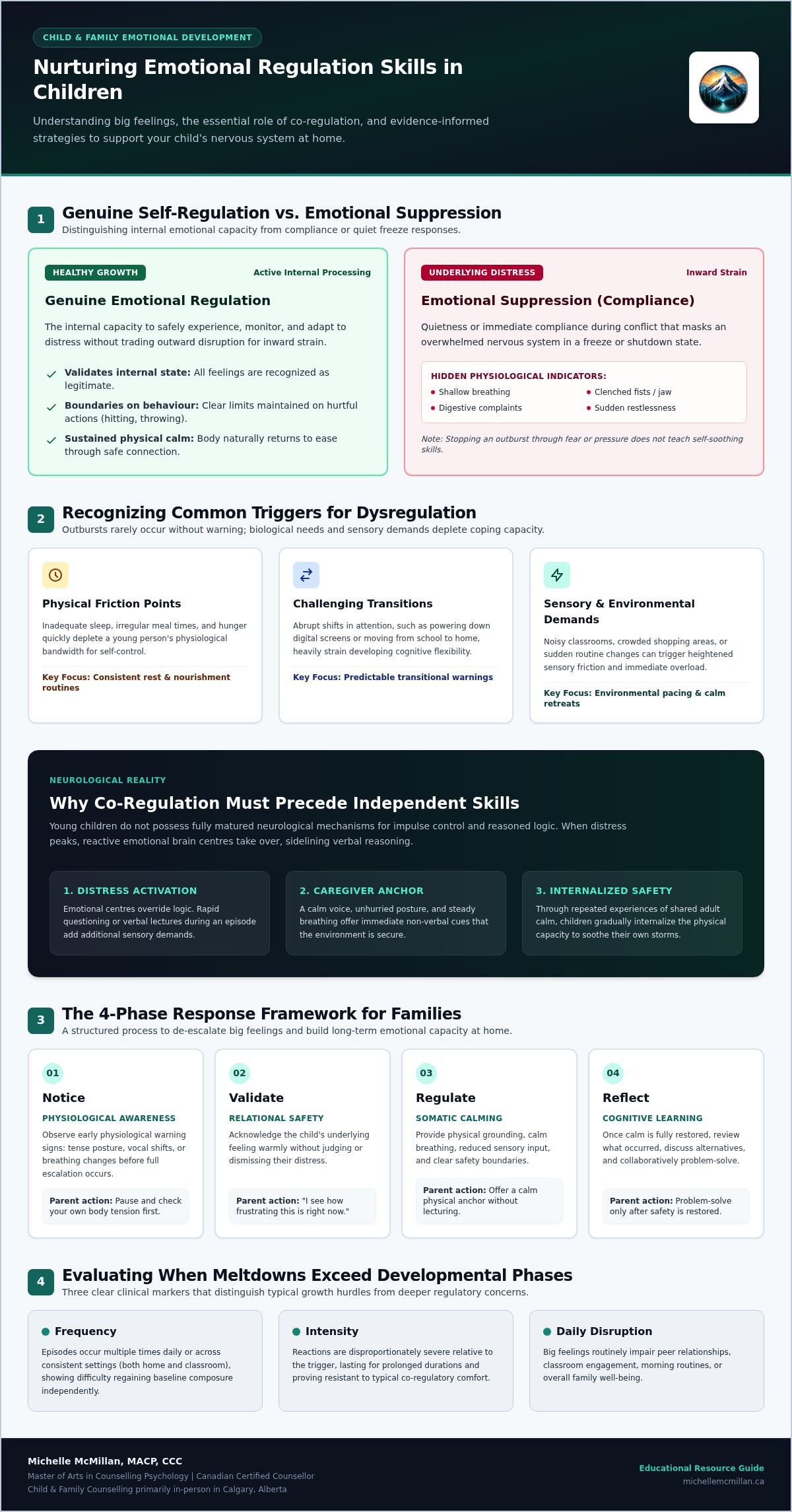
A grounded understanding of child development highlights an essential distinction: genuine regulation is the internal ability to safely experience and adapt to distress, whereas suppression simply trades outward disruption for inward strain. Helping children build this capacity requires looking past the surface reaction to understand the physiological state underneath.
Self-Regulation Versus Emotional Suppression
A child who immediately becomes quiet during conflict is not necessarily regulating their emotions. Compliance often looks like composure, but freezing or hiding feelings can indicate emotional shutdown rather than healthy coping. When distress is suppressed, the body keeps the score. You might notice physiological indicators such as shallow breathing, clenched fists, digestive complaints, or sudden restlessness.
Supporting emotional growth means distinguishing between internal feelings and external actions. All feelings are legitimate and deserve recognition, yet not every behaviour is constructive. Parents can warmly acknowledge deep sadness or intense anger while still maintaining clear boundaries around hitting, name-calling, or throwing objects.
Common Triggers for Emotional Dysregulation in Children
Emotional outbursts rarely occur without warning. They are often triggered when biological needs or sensory inputs exceed a child’s current bandwidth:
- Physical friction points: Inadequate sleep, irregular meal times, and hunger quickly deplete a young person’s coping capacity.
- Challenging transitions: Abrupt changes in focus, such as turning off digital devices or navigating the shift from school to home, place heavy demands on developing cognitive flexibility.
- Sensory and neurodivergent factors: For neurodivergent children, noisy classrooms, crowded spaces, or unexpected changes in routine can cause heightened sensory friction, leading to emotional overload.
Recognizing these patterns helps parents adjust everyday environments before stress turns into an unmanageable episode.
The Development of Self-Regulation: Why Co-Regulation Precedes Independent Skills
Children build the capacity to soothe themselves only after experiencing repeated comfort from a steady caregiver. Before a child can regulate independently, they rely on co-regulation: the interactive process where an adult’s calm presence helps anchor an overwhelmed nervous system. Through this shared safety, children gradually internalize the ability to calm their own storms.
Attempting to reason with a child during an intense emotional episode rarely succeeds. When distress peaks, the lower, reactive centres of the brain take over, temporarily sidelining logical reasoning and verbal processing. Lectures or rapid questions often feel like extra sensory demands. Real cognitive problem-solving only happens after the physical body returns to safety. Building reliable emotional regulation skills for kids Calgary families can practice at home begins with this relational foundation.
The Role of the Caregiver’s Calm Presence
Young people interpret non-verbal cues almost instantaneously. A quiet voice, unhurried posture, and relaxed shoulders quietly signal that the current environment is secure. Matching a child’s volume or intensity tends to escalate distress, while remaining steady offers a stabilizing anchor.
Parental frustration during difficult moments is completely natural. Recognizing your own rising tension and taking a deliberate breath allows you to pause, steadying your own response before offering reassurance to your child.
Developmental Milestones in Childhood Regulation
Emotional maturation unfolds across distinct stages, yet every young person moves at their own pace:
- Early childhood: Toddlers and preschoolers depend almost entirely on physical closeness and basic naming of feelings to move through distress.
- Middle childhood: Elementary-aged children begin experimenting with independent coping tools, though fatigue or sensory strain can quickly disrupt their progress.
- Adolescence: Rapid social changes and biological shifts can temporarily intensify emotional reactivity, requiring renewed co-regulation from parents.
Pacing varies widely across individuals. Neurodivergent young people, including those with ADHD, often display asynchronous development where cognitive abilities outstrip their emotional bandwidth. When you want extra guidance navigating these unique developmental curves, looking into child and family counselling services can provide a collaborative, practical setting to explore your family’s needs.
Practical Emotional Regulation Strategies at Home
Guiding a dysregulated child requires an adaptable, structured framework rather than guesswork. To cultivate sustainable emotional regulation skills for kids Calgary parents can use a four-phase response model: Notice, Validate, Regulate, and Reflect. This sequence works whether you are managing a frantic weekday morning rush or an overtired bedtime refusal. Naming an emotional experience accurately transforms a chaotic physical sensation into a manageable, shared reality.
Step 1 & 2: Noticing Early Cues and Validating the Feeling
Meltdowns rarely appear without warning signs. Early physical markers often include hunched shoulders, clenched fists, a sudden change in vocal pitch, or complete silence. Intervening at this threshold prevents emotional momentum from peaking.
Validating the feeling immediately lowers internal defensiveness without compromising household rules. You can validate the emotion while holding the boundary. For instance, you might say, “I see how disappointed you feel that we have to pack up the toys now. It’s tough to stop when you’re having fun, but it is time for dinner.”
Step 3 & 4: Regulating the Body and Collaborative Problem-Solving
Before any constructive learning can happen, the physical body must settle. Effective sensory regulation methods include sipping cold water through a straw, taking slow, prolonged exhales, or sitting quietly in a low-stimulus room.
Always delay logical discussions until physical equilibrium is fully restored. Once calm returns, engage your child with open, collaborative questions:
- “What did your body feel like right before you felt like screaming?”
- “What helped you feel a bit safer just now?”
- “What can we try together next time that feeling shows up?”
Proactive Daily Practices to Support Emotional Balance
Reactive strategies manage crises, but daily routines build resilience over time:
- Predictable daily rhythms: Consistent morning rituals and predictable evening wind-downs lower the anxiety created by sudden transitions.
- Sensory and physical discharge: Active outdoor play and physical movement give children a constructive outlet for accumulated physiological tension.
- Shared emotional literacy: Everyday conversations, family check-ins, and stories about handling frustration reinforce emotional regulation skills for kids Calgary caregivers can nurture naturally.
Recognizing When Meltdowns Exceed Typical Developmental Phases
Meltdowns are a normal part of early development, but persistent emotional turmoil in school-aged children often signals an unmet need. Distinguishing between an expected developmental phase and a deeper regulation challenge helps families take effective action. Frequent, overwhelming episodes place significant strain on parent mental health and overall household harmony. Seeking guidance is not a sign of parental inadequacy; it is an informed, proactive choice to support your child’s well-being.
Evaluating Duration, Frequency, and Intensity
While brief tears over a broken snack are typical in toddlerhood, prolonged distress in older children warrants a closer look. Clinical professionals generally evaluate three core dimensions:
- Duration: Emotional episodes lasting longer than thirty to forty-five minutes, where the child struggles to return to a calm baseline despite comforting support.
- Frequency: Meltdowns occurring several times each week, creating ongoing anticipation of the next conflict.
- Intensity: Reactions involving physical aggression, property damage, self-harming behaviours, or complete physical exhaustion afterward.
Keeping an objective behavioural log for one to two weeks helps identify recurring environmental triggers without relying on memory during high-stress moments.
Impact Across Multiple Settings
Emotional distress rarely remains isolated to the home. When a child experiences ongoing difficulties with peer relationships, withdraws from recreational activities, or struggles with academic engagement, their coping bandwidth is likely overextended. Maintaining regular, collaborative communication with classroom teachers and school resource teams can reveal whether distress peaks during unstructured times like recess or during academic transitions.
For some children, these intense reactions are closely tied to neurodivergent processing styles. Reviewing our guide on ADHD Support Calgary offers deeper context on how executive functioning and attention differences influence emotional expression.
If these patterns consistently disrupt your family life and at-home strategies feel insufficient, developing targeted emotional regulation skills for kids Calgary parents can rely on often requires structured external guidance. When you are ready to explore collaborative support, contact our Calgary practice to explore in-person child and family counselling options.
Navigating Professional Child and Family Counselling Options in Calgary
Seeking outside guidance offers a fresh perspective when emotional tension begins to overshadow daily family life. Professional child counselling provides a supportive, objective setting where young people can explore difficult feelings, understand bodily sensations, and build confidence. Many parents wonder whether their child requires formal psychological assessment or relational support. While comprehensive psychological testing evaluates diagnostic categories, relational child and family counselling focuses on day-to-day coping patterns, relational communication, and strengthening practical emotional regulation skills for kids Calgary families can use every day.
Understanding professional credentials helps parents make informed decisions for their child’s care. In Alberta, where the mental health landscape encompasses various backgrounds, designations indicate specific graduate education and professional standards. Michelle McMillan holds a Master of Arts in Counselling Psychology (MACP) and is a Canadian Certified Counsellor (CCC).
What to Expect in Child and Family Counselling
Sessions provide a welcoming, low-pressure environment for children to explore their emotional world safely. Active caregiver involvement is an essential component of this work. Rather than viewing a child’s struggles in isolation, bringing parents into the process ensures that helpful co-regulation approaches translate directly into home routines. You can learn more about how relational support is tailored to individual developmental needs by reviewing Michelle McMillan’s areas of focus.
Service Formats and Practical Considerations in Calgary
Counselling work with children and families is provided primarily in-person in Calgary. Meeting in person offers young people a physical setting dedicated entirely to communication, creative expression, and connection. For adults and couples, virtual counselling is available across Alberta, British Columbia, Saskatchewan, and Manitoba, providing flexible access to professional support.
Nurturing resilient emotional regulation skills for kids Calgary caregivers wish to support takes patience and steady guidance. When you feel ready to explore next steps, reviewing available child and family counselling services allows you to discover collaborative support tailored to your household’s unique rhythms.
Strengthening Emotional Growth for Your Child and Family
Supporting a child through intense feelings isn’t about enforcing quiet compliance; it’s about building a dependable foundation of safety. As young people experience steady co-regulation from a calm caregiver, they gradually learn to recognize their internal cues and soothe rising distress. Practising structured responses, empathetic validation, and predictable daily routines at home plays an essential role in nurturing practical emotional regulation skills for kids Calgary families can rely on during challenging moments.
When emotional turbulence persists across school and home, seeking objective guidance is an informed, proactive choice. Michelle McMillan holds a Master of Arts in Counselling Psychology (MACP) and is a Canadian Certified Counsellor (CCC). Her child and family counselling is provided primarily in-person in Calgary, offering a dedicated environment to explore emotional experiences together. To learn more about session availability and support options, visit the Rates and Booking page.
Frequently Asked Questions
What is the difference between a tantrum and an emotional meltdown?
A tantrum is goal-oriented behaviour where a child attempts to obtain a specific outcome, such as an extra treat or more playtime. Once the child gets what they want or realizes the boundary stands, the outburst typically subsides. A meltdown, however, is an involuntary neurological reaction to sensory or emotional overload. During a meltdown, the child loses conscious control over their responses and cannot simply stop on command.
At what age should a child be able to regulate their own emotions?
Self-regulation develops gradually throughout childhood and continues maturing well into early adulthood. While preschoolers begin identifying feelings with adult support, independent coping remains fragile in elementary years. Expecting total emotional self-sufficiency too early overlooks natural neurological pacing. Building dependable emotional regulation skills for kids Calgary parents foster requires consistent adult co-regulation across each developmental stage.
How can parents teach emotional regulation skills without using punishment?
Teaching regulation involves proactive instruction and relational connection rather than punitive measures. Punishments often increase a child’s physiological distress without teaching constructive replacement actions. Instead, parents can acknowledge the underlying emotion, provide physical reassurance to soothe the nervous system, and establish firm boundaries around physical safety. Collaborative problem-solving takes place only after the child returns to a receptive state.
Does my child need a formal psychological assessment for emotional outbursts?
Not every child who struggles with big feelings needs formal psychoeducational or diagnostic testing. Comprehensive psychological assessments are typically indicated when a child requires formal diagnosis for academic accommodations or complex developmental differences. Relational child counselling focuses on addressing day-to-day coping patterns, processing difficult feelings, and strengthening household communication without requiring formal testing first.
What credentials should I look for when choosing a child counsellor in Calgary?
Look for practitioners holding graduate-level education in counselling psychology and professional recognition from recognized governing bodies. In Canada, many qualified practitioners hold a Master of Arts in Counselling Psychology (MACP) and the Canadian Certified Counsellor (CCC) designation. These credentials verify that the professional has completed comprehensive academic coursework, supervised clinical practicum hours, and adheres to national ethical standards.
Is child and family counselling offered in-person or virtually at Michelle McMillan Counselling?
Child and family counselling is provided primarily in-person in Calgary, giving young people a dedicated physical space for communication and connection. Adult and couples counselling is available virtually across Alberta, British Columbia, Saskatchewan, and Manitoba. This structure ensures young clients receive focused in-person support while providing flexible access to care for adult services throughout Western Canada.
How are parents involved during their child’s counselling sessions?
Caregiver participation is a central element of effective child and family counselling. Parents often join portions of sessions to explore co-regulation techniques, discuss communication patterns, and align at-home routines with emerging skills. Collaborative involvement ensures that practical emotional regulation skills for kids Calgary families explore in therapy carry over naturally into everyday life at home and school.

Article by
Michelle McMillan, MACP, CCC
Michelle McMillan is a Canadian Certified Counsellor (CCC) with a Master of Arts in Counselling Psychology (MACP). She has extensive experience working with children and supporting clients with ADHD, neurodivergence, anxiety, emotional regulation, relationships and family challenges. Michelle offers both virtual and in-person counselling, with virtual counselling available throughout Alberta, British Columbia, Saskatchewan and Manitoba and in-person appointments available in Calgary.
Important Information
This article is provided for general educational and informational purposes only and is not a substitute for professional counselling, psychological, medical or emergency services. Information shared here should not be considered a diagnosis or individualized treatment advice. If you are experiencing a mental health emergency or are in immediate danger, please contact appropriate emergency services in your area.