
What if ADHD support didn’t ask you to fit a generic routine, but gave you room to explore what works for your circumstances? Planning everyday tasks, keeping track of responsibilities or managing shifting priorities can feel frustrating, especially when advice doesn’t reflect your experience. ADHD counselling Calgary can offer a place to discuss these concerns without assuming that everyone with ADHD faces the same challenges.
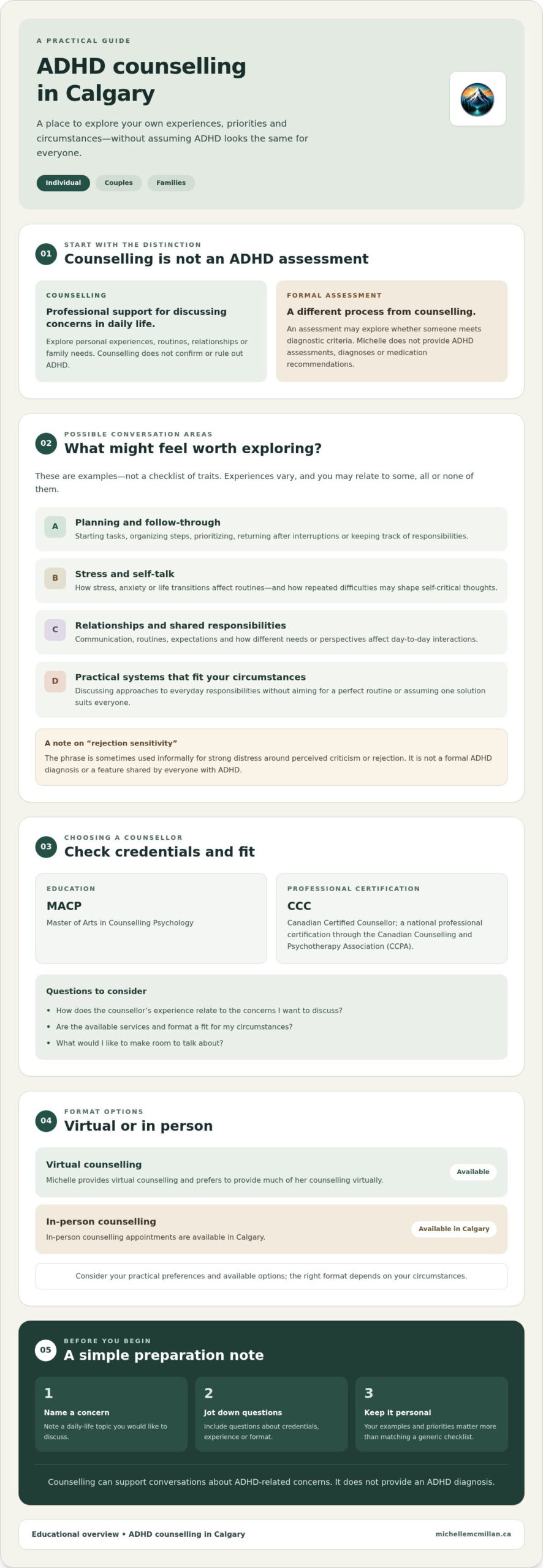
This guide explains how counselling differs from an ADHD assessment, what everyday topics you might choose to discuss, and how to evaluate a counsellor’s credentials. It also covers practical considerations for virtual counselling and how it may fit individual, couple or family needs. You’ll find questions to help you decide whether a counsellor’s experience and services align with what you’re seeking.
Michelle McMillan holds a Master of Arts in Counselling Psychology (MACP) and is a Canadian Certified Counsellor (CCC), a national professional certification through the Canadian Counselling and Psychotherapy Association. She offers in-person counselling in Calgary and virtual counselling across Alberta, British Columbia, Saskatchewan and Manitoba, for adults, couples, children, teens and families. Counselling can support conversations about ADHD-related concerns, but Michelle doesn’t provide ADHD assessments, diagnoses or medication recommendations. You can use the information ahead to consider what questions matter to you before taking a next step.
Key Takeaways
- ADHD counselling Calgary can offer space to explore daily challenges in the context of your individual, relationship or family needs.
- Counselling can support conversations about ADHD-related concerns, but it is distinct from an assessment or diagnosis.
- When comparing counsellors, review their credentials and ask how their experience relates to the concerns you want to discuss.
- Consider practical preferences when weighing virtual counselling against in-person services; the right format depends on your circumstances and available options.
- Preparing a few questions and noting what you hope to discuss can help you feel more ready to begin.
Understanding ADHD Counselling in Calgary: What It Is and How It Supports You
ADHD counselling Calgary can provide professional, collaborative support for exploring how attention-related challenges show up in everyday life. The focus is not on assuming every person with ADHD has the same needs. It’s an opportunity to discuss your own experiences, priorities and circumstances, including the practical demands of routines, work, relationships or family life.
Topics may include executive functioning, such as starting tasks, organizing steps or keeping track of responsibilities; emotional regulation; and communication with people close to you. Counselling can make room to consider what feels difficult and discuss practical strategies that fit your situation. It can also help individuals, couples or families talk about how different needs and perspectives affect day-to-day interactions, without assuming that ADHD affects every relationship in the same way.
The Distinct Role of Professional Counselling Beside Formal Diagnosis
Counselling and ADHD assessment serve different purposes. A formal assessment may explore whether someone meets diagnostic criteria, and psychologists are among the professionals who conduct ADHD assessments and diagnoses. Counsellors provide therapeutic conversations and support with concerns in daily life; counselling itself does not confirm or rule out ADHD.
You can seek counselling with a diagnosis or because you’re noticing attention-related concerns and want a place to explore them. If you’re unsure whether an assessment is also something to consider, you can raise that question with a qualified professional. Michelle McMillan provides counselling related to ADHD and neurodivergence, but she doesn’t provide assessments, diagnoses or medication recommendations. You can read more about her areas of counselling focus.
Recognizing the Diverse Ways ADHD Presents in Daily Life
Some people describe friction getting started on a task, difficulty returning to an activity after an interruption, or feeling overwhelmed when several demands arrive at once. Others may not relate to these examples, or may experience them only in certain settings. These experiences alone don’t establish an ADHD diagnosis.
Everyday challenges can affect confidence, workplace demands and personal relationships, especially when repeated misunderstandings or unmet expectations become a source of stress. A person might want to discuss how they communicate their needs, while a couple or family may want to consider how routines and responsibilities are shared. Counselling offers room to examine these specific experiences rather than treating them as character flaws or universal ADHD traits.
“Rejection sensitivity” is sometimes used informally to describe strong distress around perceived criticism or rejection. It is not a formal ADHD diagnosis or a feature shared by everyone with ADHD. If this language resonates, counselling can provide space to talk through what you experience without presuming a single explanation.
Key Areas Where ADHD Counselling Can Provide Practical Support
ADHD counselling Calgary can make room to look at the details of daily life, not just a diagnosis or a list of symptoms. The focus may be on understanding where routines become difficult, how stress affects attention, or what happens when expectations feel hard to meet. These conversations are personal: a strategy that suits one person may not suit another.
Navigating Executive Function and Everyday Organisation
Executive function can involve planning, prioritizing, starting tasks and keeping track of steps. Counselling may offer a place to explore practical systems for everyday responsibilities, such as breaking a large administrative task into smaller parts or deciding which reminders are useful. The aim isn’t to impose a perfect routine. It’s to consider what feels realistic in your circumstances, including how demands, surroundings and personal patterns affect follow-through.
Repeated difficulty can also feed self-critical thoughts, such as “I should be able to do this.” A collaborative discussion can help you examine those thoughts alongside the actual barriers, without treating a struggle as a character flaw. Stress, anxiety and life transitions may also affect how manageable routines feel.
Strengthening Communication in Relationships and Couples
In a relationship, one partner may experience a missed task as a sign of disregard, while the other may describe forgetting or distraction. That mismatch can lead to frustration, especially when household responsibilities are already a source of tension. Counselling can provide space for partners to discuss what each person notices, needs and understands, without placing all responsibility on one individual.
Michelle McMillan’s areas of focus include couples counselling, relationship difficulties and ADHD-related concerns. The Centers for Disease Control and Prevention also describes behavioural therapy as one ADHD treatment option; this general information doesn’t establish what support is right for a particular person or describe Michelle’s counselling methods. You can read the CDC’s overview of behaviour therapy as an ADHD treatment option.
Supporting Children, Teens and Parents Navigating ADHD
Parents may want to talk through recurring challenges at home, such as transitions between activities, household expectations or disagreements about routines. Family counselling can offer a setting to consider how different perspectives shape shared dynamics and what expectations feel clear and manageable for the family. Children and teens each have their own experiences, so conversations should not assume that one description or strategy applies to everyone.
Michelle provides counselling for children, youth and families virtually. For broader educational information, see this ADHD support resource for Calgary families and individuals.
How to Choose an ADHD Counsellor in Calgary: Credentials and Considerations
Choosing an ADHD counsellor is about more than finding someone who lists ADHD as an area of focus. You’ll want to understand their education and professional designation, ask about their experience with concerns like yours, and consider whether their way of communicating feels respectful and non-judgemental. ADHD counselling Calgary should leave room for individual differences, not assumptions about what every person needs.
Understanding Professional Designations in Alberta
A Master of Arts in Counselling Psychology (MACP) is a graduate degree in counselling psychology. It’s distinct from a professional designation. The Canadian Certified Counsellor (CCC) is a national professional certification awarded by the Canadian Counselling and Psychotherapy Association (CCPA); it is not a provincial regulatory licence. Michelle McMillan holds both an MACP and a CCC. These credentials describe separate aspects of her professional background.
If you’re comparing counsellors and psychologists, check each person’s specific designation and scope of service rather than assuming the titles mean the same thing. For general information about adult ADHD care, the Government of Alberta’s ADHD care instructions for adults include counselling among possible forms of treatment.
Questions to Ask a Potential Counsellor
A brief inquiry can help you understand whether a counsellor’s experience and services fit what you’re looking for. Consider asking:
- Experience: What experience do you have supporting neurodivergent adults, youth, couples or families with concerns like mine?
- Session style: How do you make room for focus shifts, pauses or different ways of processing information?
- Goals: How can we discuss what I’d like to focus on and revisit those priorities over time?
- Practical details: What are your communication and cancellation policies, and how can I review them before booking?
These questions aren’t a test with one correct answer. They’re a way to clarify expectations and notice whether you feel listened to. A respectful counsellor should be open to discussing how your circumstances and preferences might shape the work, without treating ADHD experiences as universal or framing challenges as personal failings.
Reading a practitioner’s about page and professional background can help you prepare questions before making contact. Michelle provides counselling related to ADHD and neurodivergence, but doesn’t provide ADHD assessments, diagnoses or medication recommendations. If you’re seeking a diagnosis, ask what assessment services you need and which qualified professional provides them.
Virtual vs. In-Person ADHD Counselling: Selecting the Right Delivery Model
Choosing between virtual and in-person counselling is a practical decision, not a test of how committed you are to support. Consider what each format involves, what fits your schedule and location, and whether you’ll have a suitable place to participate. The right option depends on your needs and the services available to you.
The Practical Realities of Virtual Counselling for Adults and Couples
For some adults, avoiding a trip across Calgary or fitting an appointment around work and family responsibilities can make virtual counselling a practical option. A place where you can speak comfortably may be useful; if that isn’t available at home, consider whether another suitable location is an option.
Michelle McMillan offers in-person counselling in Calgary and virtual counselling for adults and couples across Alberta, British Columbia, Saskatchewan and Manitoba, where she is eligible to practise. Couples can ask about connecting from the same location or separate locations, or meeting in person. The right format is one to weigh against your preferences and circumstances, not a promise of a particular experience.
To see what support is available, review Michelle’s counselling services for adults, couples, children and families.
When In-Person Sessions Support Children and Family Dynamics
Some people prefer in-person counselling, while others find virtual support more practical. Michelle McMillan offers in-person sessions in Calgary and virtual sessions across Alberta, British Columbia, Saskatchewan and Manitoba, for children, teens and families as well as adults and couples. You can ask about either format and any practical questions before getting in touch.
In-person appointments bring participants together in the same physical setting; virtual appointments involve connecting remotely, either from separate locations or a shared one. When comparing formats, think about travel, scheduling, the preferences of each family member and what feels workable for your household. These are considerations for planning, not evidence that one format suits every child, teen or family better.
For ADHD counselling Calgary, the delivery format is one part of your decision. You can explore Michelle’s counselling services and consider which questions you’d like to ask about in-person or virtual options and fit.
Preparing for Your First Counselling Session: What to Expect
Starting counselling can bring up questions, especially if you’re unsure what to say or where to begin. You don’t need a complete history or a carefully organized list of concerns. A few words about what prompted you to seek support can be enough to open the conversation. With ADHD counselling Calgary, the focus should be on understanding your circumstances rather than arriving with everything already figured out.
The Initial Conversation
An initial appointment may include discussion of what’s been happening lately, relevant background, and what you hope to explore. You might mention a daily routine that feels hard to manage, stress at work, or tension around shared responsibilities. You can also ask practical questions about the counsellor’s services and what to expect. These early conversations can help clarify whether the service fits what you’re looking for.
If it helps, jot down a few reminders beforehand, such as:
- What made you consider counselling now?
- Which situations or concerns would you most like to discuss?
- What questions do you have about counselling or the format?
These notes are optional. It’s fine if your priorities feel unclear or change as you talk. If you have a specific logistical question before getting started, you can use the contact page to get in touch.
Collaborative Goals at Your Own Pace
Counselling conversations can help you identify what matters most to address. Goals don’t have to be fixed from the start; priorities may shift as circumstances change or new concerns come into view. Rather than a lecture with a prescribed answer, counselling is an opportunity to discuss your experiences and consider what might be useful to explore. The pace and focus are things you can talk about together.
It’s also reasonable to say if something feels unclear, too fast, or not relevant to what you hoped to discuss. Open communication gives you a way to clarify what feels supportive and what doesn’t. You can begin with one concern, then decide what you’d like to focus on next.
You don’t need to have the perfect words prepared before contacting a counsellor. Starting with a question about the service or virtual format can be enough.
Choose Support That Fits Your Needs
ADHD counselling Calgary can offer space to explore day-to-day concerns, relationships and family needs without assuming there’s one experience or solution that fits everyone. As you consider support, look at a counsellor’s credentials, ask about their experience with ADHD and neurodivergence, and consider whether virtual counselling works for your circumstances.
Michelle McMillan holds a Master of Arts in Counselling Psychology (MACP) and is a Canadian Certified Counsellor (CCC), a national certification through the Canadian Counselling and Psychotherapy Association. She offers in-person counselling in Calgary and virtual counselling across Alberta, British Columbia, Saskatchewan and Manitoba, for individuals, couples, children, teens and families. Counselling can support discussion of ADHD-related concerns, but Michelle doesn’t provide ADHD assessments, diagnoses or medication recommendations.
If you’re considering counselling, visit the Rates & Booking page to explore options at your own pace, or contact Michelle McMillan with any questions.
Frequently Asked Questions
What is the difference between ADHD counselling and an ADHD assessment?
ADHD counselling offers professional support for discussing everyday concerns, while an ADHD assessment evaluates whether someone meets diagnostic criteria. A qualified professional, such as a psychologist, may conduct an assessment; counselling does not confirm or rule out ADHD. Counselling can still be relevant after a diagnosis or while you’re deciding whether to seek an assessment. Michelle McMillan provides counselling but doesn’t provide ADHD assessments, diagnoses or medication recommendations.
Do I need an official ADHD diagnosis before starting counselling in Calgary?
No, you can seek counselling to discuss attention-related concerns without first having an ADHD diagnosis. You might want to talk about task planning, stress or how attention differences affect relationships, for example. These concerns don’t establish a diagnosis, and counselling isn’t a substitute for an assessment if you’re seeking one. ADHD counselling Calgary can focus on your concerns and circumstances, whether or not you have a formal diagnosis.
Is virtual ADHD counselling as valid as meeting in person?
Virtual and in-person counselling are different ways to meet, and neither should be described as automatically superior or as producing the same results for everyone. Consider practical factors such as travel, the setting where you’ll participate, scheduling and your preference for meeting remotely or face to face. Michelle offers in-person counselling in Calgary and virtual counselling across Alberta, British Columbia, Saskatchewan and Manitoba, where she is eligible to practise.
How does a Canadian Certified Counsellor (CCC) support individuals with ADHD?
A CCC provides counselling, which can offer a setting to discuss concerns and explore experiences related to ADHD. The designation is a national professional certification through the Canadian Counselling and Psychotherapy Association (CCPA), not a provincial licence. Michelle McMillan holds a CCC and a Master of Arts in Counselling Psychology (MACP). She provides counselling related to ADHD and neurodivergence, but doesn’t diagnose ADHD or recommend medication.
Can counselling cure or eliminate ADHD symptoms?
No. Counselling shouldn’t be presented as a cure for ADHD or as a guarantee that symptoms will disappear. It can provide professional support for exploring how attention-related concerns affect daily routines, stress or relationships. What someone chooses to discuss will depend on their circumstances and goals. If you’re looking for assessment or medical care, counselling is distinct from those services, and you can ask a qualified professional about appropriate options.
How do I know if ADHD counselling is appropriate for my child or teen?
Consider whether your child or teen, or your family, would benefit from a professional conversation about current concerns, such as routines, expectations or family interactions. These concerns don’t prove ADHD, and counselling isn’t an assessment. Michelle provides virtual counselling for children, youth and families. Ask about the available format and whether it fits the needs of the young person and family.
What happens during the very first counselling session?
The first conversation may include discussion of what brings you to counselling, relevant background and what you’d like to explore. The exact process can vary, so you can ask questions and clarify expectations. You don’t need a detailed history or polished notes to begin. If it helps, write down one or two concerns, such as a routine that feels difficult, and any practical questions you want answered.

Article by
Michelle McMillan, MACP, CCC
Michelle McMillan is a Canadian Certified Counsellor (CCC) with a Master of Arts in Counselling Psychology (MACP). She has extensive experience working with children and supporting clients with ADHD, neurodivergence, anxiety, emotional regulation, relationships and family challenges. Michelle offers both virtual and in-person counselling, with virtual counselling available throughout Alberta, British Columbia, Saskatchewan and Manitoba and in-person appointments available in Calgary.
Important Information
This article is provided for general educational and informational purposes only and is not a substitute for professional counselling, psychological, medical or emergency services. Information shared here should not be considered a diagnosis or individualized treatment advice. If you are experiencing a mental health emergency or are in immediate danger, please contact appropriate emergency services in your area.