
What if the challenges you’ve been working hard to manage have more than one possible explanation? If you’re looking for ADHD in women Calgary support, questions about focus, time, forgetfulness, overwhelm, or emotional intensity may bring a sense of recognition, along with uncertainty. ADHD experiences vary, and no single behaviour or difficulty confirms a diagnosis.
It can be hard to know what to make of patterns that have been present for years, especially when they’ve been misunderstood or are difficult to talk about. This guide explores why ADHD in women may be easy to miss, how individual experiences can differ, and what counselling can offer when you’re sorting through questions or seeking support.
You’ll also learn how counselling differs from ADHD assessment and diagnosis. Michelle McMillan offers ADHD-related counselling, with virtual appointments available in Alberta and in-person counselling appointments available in Calgary. The guide will help you understand these options and consider what kind of support may be useful to explore.
Key Takeaways
- ADHD experiences vary, and a familiar challenge on its own can’t confirm a diagnosis.
- Changing demands at work, home, or in relationships may shape which concerns feel most noticeable at different times.
- Learn how counselling, clinical assessment, and research participation differ, and what each can offer.
- Use a few reflection questions to clarify what you’d like to discuss when exploring ADHD in women Calgary support.
- Find out about Michelle McMillan’s ADHD and neurodivergence-related counselling, credentials, and virtual and Calgary in-person options.
ADHD in Women: Why Experiences Can Be Easy to Overlook
If you’re wondering whether ADHD could help explain parts of your experience, it’s understandable to feel uncertain. You may recognize a few descriptions, question whether they apply to you, or find that your difficulties are hard to put into words. None of those reactions, or any single challenge, confirms ADHD.
ADHD is a condition involving patterns of inattention and/or hyperactivity-impulsivity that can affect daily functioning. The way those patterns show up differs between people, and similar difficulties can have other explanations. A broad description may offer language to consider, but it can’t establish what’s happening for one person.
General information can help you ask questions; only an individual assessment can determine whether ADHD applies to you.
What might ADHD-related difficulties look like in everyday life?
For one person, attention may drift during routine tasks, while another may focus closely on an absorbing activity but find it difficult to switch to something less engaging. One person might rely on reminders to keep track of appointments; another may manage plans but find household tasks harder to organize. These are possibilities, not a shared profile.
Everyday demands matter, too. Forgetting an item, feeling overwhelmed by a busy week, or having a disorganized workspace can happen for many reasons. It may be useful to notice the broader context: how often a difficulty occurs, where it shows up, and whether it affects responsibilities or relationships. Those observations can help describe your concerns, but they aren’t a diagnostic checklist.
Why might a woman begin asking about ADHD later?
Some women may start asking about ADHD after a change in responsibilities makes familiar challenges more noticeable. A new role at work, managing a household, or balancing several commitments could prompt someone to reconsider patterns they previously understood as personal shortcomings. Others may have questions earlier, or may never relate to this experience.
Recognition and research into ADHD in girls and women continue to develop. That wider conversation can give people new language for questions they already have, but it shouldn’t be treated as proof that a particular person has ADHD or as a settled explanation of every experience. There are no Calgary-specific findings presented here that establish how women locally experience ADHD.
If you’re exploring ADHD in women Calgary support, you don’t need to arrive with a firm conclusion. Noticing what feels difficult, where it happens, and what you’d like help understanding can give you a starting point for a professional conversation.
How ADHD Experiences May Intersect With Different Life Stages
There isn’t one timetable for noticing or discussing ADHD-related concerns. What feels manageable in one setting may become harder to keep track of when expectations, routines, or available support change. A transition can bring old questions into focus, but the transition itself isn’t evidence of ADHD.
For general background, the National Institute of Mental Health’s overview of ADHD describes the condition broadly. Individual experiences still need to be understood in context. Research about ADHD and women is an evolving area, so claims about how experiences vary across life stages should be checked against current, authoritative sources rather than treated as a universal account.
When responsibilities or routines change
Imagine someone taking on new caregiving responsibilities while also adjusting to a different work schedule. They may find that planning, switching between tasks, or keeping track of commitments takes more effort than before. That change could prompt them to revisit questions about longstanding patterns. It doesn’t establish a cause, and it doesn’t mean that an ordinary transition is a symptom.
Context can make a difference to what someone wants to discuss. A person might be less concerned about organization when their week is predictable, then notice the strain when several schedules need coordinating. Another may have managed similar demands for years but now want to understand the effort involved. There’s no single way these changes unfold.
When stress or other concerns overlap
Attention and organization can be affected by different circumstances. A demanding period, disrupted routines, health concerns, or other personal challenges may be relevant, and more than one factor may be present. Feeling distracted or behind on tasks doesn’t, by itself, identify ADHD, anxiety, or any other condition.
A professional conversation can give you room to describe what you’ve noticed, when it tends to happen, and how it affects daily life. It can help you explore what you’d like support with, without treating a brief list of experiences as a diagnosis. If you’re considering counselling, Michelle McMillan’s ADHD and neurodivergence counselling focus may be relevant to the concerns you want to discuss.
ADHD Counselling and Assessment: What Each Can Offer
If you’re exploring ADHD in women Calgary support, it can help to separate three things that are sometimes discussed together: counselling, a clinical assessment, and taking part in research. Each has a different purpose. Knowing the distinction can help you decide what kind of conversation or next step you’re looking for.
Counselling offers support to discuss your experiences; an ADHD assessment evaluates whether diagnostic criteria are met.
| Option | What it can offer | What it doesn’t establish |
|---|---|---|
| Counselling | A professional setting to explore concerns, day-to-day experiences, relationships, or parenting challenges. | An ADHD diagnosis or assessment. |
| Clinical assessment | An individualized evaluation of relevant history and concerns to determine whether ADHD criteria are met. | Counselling or ongoing support by itself. |
| Research participation | An opportunity to contribute information to a research project, according to that project’s purpose and requirements. | An individual diagnosis or counselling. |
What counselling can make room to discuss
Counselling can provide space to talk through what you’ve noticed and what you’d like support discussing. You might want to explore how attention or organization concerns affect your routines, or how uncertainty about ADHD intersects with relationships or parenting. These conversations can focus on your own circumstances, without assuming that everyone experiences ADHD in the same way.
When someone is seeking an assessment or diagnosis
An assessment has a different purpose: it considers an individual’s history and concerns in relation to diagnostic criteria. Research participation is different again; a study may examine broader questions, but taking part doesn’t determine whether an individual has ADHD. For general information about women’s experiences, CHADD’s information on ADHD in women offers another perspective to explore.
Michelle McMillan provides ADHD and neurodivergence-related counselling, but doesn’t provide ADHD assessments, diagnoses, or medication recommendations. Counselling may still be relevant if you’re seeking a place to discuss personal concerns, whether or not you’re also considering an assessment. You can read about ADHD and neurodivergence as areas of focus to learn more about the counselling topics addressed.
It’s also reasonable not to know which option you need right away. You might begin by naming the questions that brought you here: Are you looking for support with current challenges, an assessment, or information about research? That distinction can make your next conversation more focused, without requiring you to reach a conclusion about ADHD first.
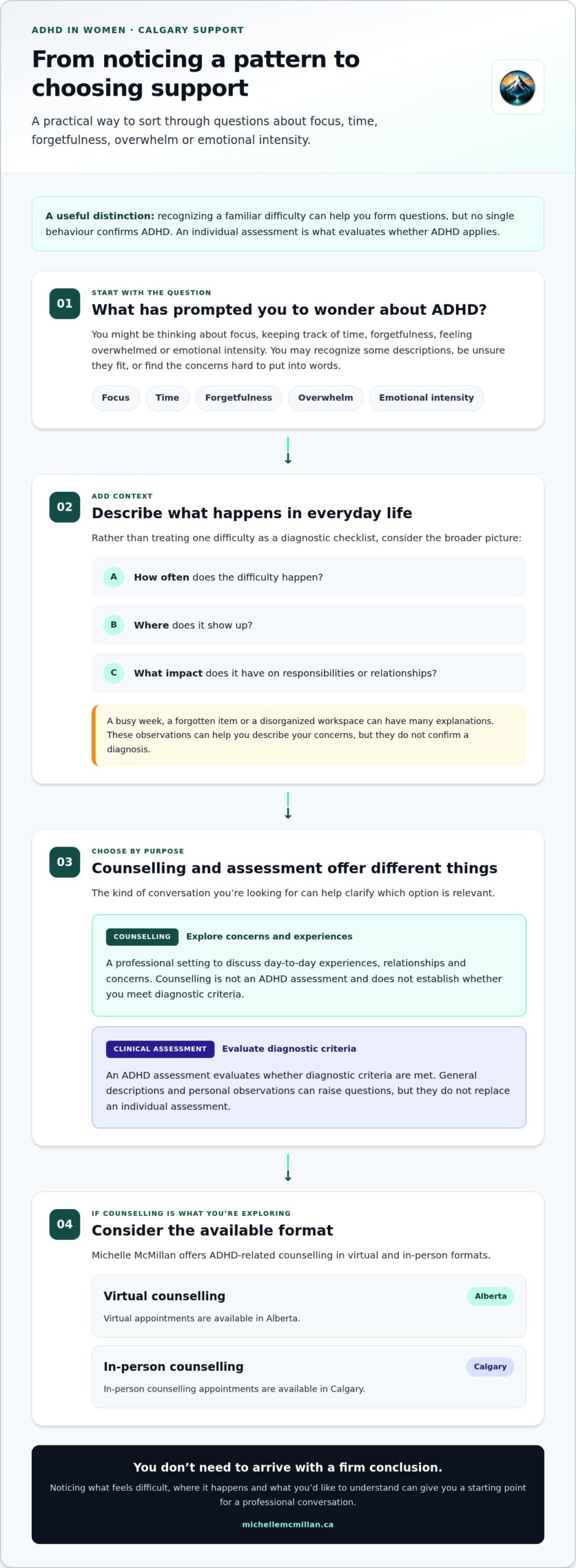
Considering ADHD Counselling in Calgary: Questions to Reflect On
You don’t need to arrive at counselling with a diagnosis, a complete history, or a certain conclusion. It may be enough to know that something has been taking up your attention and you’d like space to talk about it. A little reflection can help you name what matters to you, without turning the process into a test.
What would you like support discussing?
Consider what prompted you to look for support. Perhaps you’re carrying questions about focus at work, feeling stretched in a relationship, managing family responsibilities, or adjusting to a major change. You might be looking for a place to talk through how these experiences affect you, or you may still be unsure whether ADHD explains any part of them. You don’t have to settle that question before seeking a conversation.
If it helps, you could reflect on a few open questions:
- What concern feels most present for me right now?
- Are there particular settings or situations where I notice it?
- What kind of professional support am I hoping to explore?
These are invitations, not a diagnostic checklist. You can answer some, none, or different questions altogether. You can bring your questions, uncertainties, and hopes for support to counselling without needing to arrive with a diagnosis.
For someone exploring ADHD in women Calgary support, it can also help to consider what you want the conversation to focus on. For example, you may want to discuss how competing demands affect your routines, or how uncertainty about ADHD connects with family life. The details that matter are the ones that describe your experience, not whether they match someone else’s account.
Which counselling format is available in Calgary?
Michelle McMillan offers virtual and in-person counselling, with in-person appointments available in Calgary. Virtual counselling is available throughout Alberta, British Columbia, Saskatchewan, and Manitoba. Michelle prefers to provide much of her counselling virtually, while in-person counselling remains an available option in Calgary. Neither format is presented as better or more suitable for women with ADHD; these are options for accessing counselling.
As you consider what you’d like to discuss, practical preferences may matter too. You might consider whether virtual or in-person appointments better fit your location and day-to-day circumstances. There’s no need to decide that a particular format or topic defines your experience. A starting point can simply be the concern you want to bring into a professional conversation.
If you’re ready to explore ADHD counselling for women in Calgary, you can learn about counselling services with Michelle McMillan.
ADHD Counselling With Michelle McMillan in Calgary
Questions about ADHD can touch different parts of life, from routines and relationships to parenting and family responsibilities. Michelle McMillan’s counselling includes ADHD and neurodivergence-related concerns, with ADHD as a primary area of focus. Her work is not limited to women, and the experiences people bring to counselling can vary from person to person.
Michelle’s counselling experience and areas of focus
Michelle holds a Master of Arts in Counselling Psychology (MACP) and is a Canadian Certified Counsellor (CCC). Her CCC is a national professional certification through the Canadian Counselling and Psychotherapy Association (CCPA). These are separate credentials.
She has 16 years of education experience, including work with children, teens, and families in specialized mental-health and intensive behavioural-support settings. Her other confirmed areas of experience include anxiety, emotional regulation, relationships, parenting, family challenges, life transitions, self-esteem, and personal growth. These ADHD and neurodivergence areas of focus may be relevant when considering what you’d like to discuss.
Explore related Calgary ADHD support information
If you’re looking for broader context beyond individual counselling, the Calgary ADHD support guide covers resources for individuals and families. For more detail about the counselling service, see this information on ADHD counselling in Calgary. Readers seeking women-specific context may also find the guide to counselling for women in Calgary relevant.
If you’d like to consider counselling, you can review the rates and booking options at your own pace.
Take the Next Step at Your Own Pace
You don’t have to settle every question before deciding what kind of support you want. Perhaps you’re ready to talk about a concern that keeps coming up, or perhaps you’re still making sense of what you’ve noticed. Either is a reasonable place to begin. What matters is having room to speak about your own experience without needing it to match a particular story about ADHD.
If you’re considering ADHD in women Calgary counselling, you can focus on the questions that matter to you now. The next step doesn’t have to answer everything at once. It can simply help you decide whether counselling is something you’d like to explore.
Michelle McMillan offers counselling in Calgary, with virtual and in-person appointments. If you’d like to review the practical details before deciding, explore rates and booking options.
Take the time you need. Your questions are worth bringing forward, even if you’re still unsure what they mean.
Frequently Asked Questions
Can ADHD look different from one woman to another?
Yes. ADHD can affect people in different ways, and two women with the same diagnosis may have different concerns, strengths, and support needs. One might chiefly want to discuss managing competing demands, while another may have questions about restlessness or follow-through. These examples aren’t a profile everyone shares. Counselling can centre your circumstances rather than expecting you to match a standard description.
Can stress make it harder to understand whether ADHD is involved?
Yes. A stressful period can make it harder to sort out what’s contributing to changes in concentration, planning, or follow-through. Those experiences may relate to current demands, ADHD, another concern, or more than one factor. You can describe when you notice the difficulty and what’s happening around it in a professional conversation. That discussion can explore your concerns, but it can’t determine an ADHD diagnosis.
Can I seek counselling if I have not been diagnosed with ADHD?
Yes. You can seek counselling without an ADHD diagnosis. You might want support discussing a concern, such as how to talk with someone close to you about questions you’re considering. You don’t need to prove ADHD is the explanation before raising what’s on your mind. Counselling can focus on the concerns you want to discuss, while whether ADHD applies remains a separate question.
Does ADHD always involve difficulty with organization or attention?
No. ADHD doesn’t look like constant disorganization or obvious attention lapses for everyone. The combination and visibility of difficulties can vary, and concerns may be more noticeable in one setting than another. Someone who manages detailed work comfortably may still have questions about other aspects of daily functioning. A single strength or difficulty can’t confirm or rule out ADHD; diagnosis requires an individual assessment.
Can a woman discuss family or relationship concerns in ADHD counselling?
Yes. ADHD counselling can include family or relationship concerns if those are among the issues you want to discuss. For example, you might want to talk about sharing household responsibilities or explaining your questions about ADHD to someone close to you. The conversation doesn’t need to assume ADHD caused a disagreement. It can focus on the situation and what you hope to understand or discuss.
Is virtual counselling available to women in Calgary?
Yes. Virtual counselling is available to women in Calgary, and in-person counselling appointments are also available in the city. Both formats are options; neither is presented as more effective for women with ADHD. You can consider which setting fits your location and preferences. Counselling is available to individuals, families, and other client groups too, rather than being a women-only service.
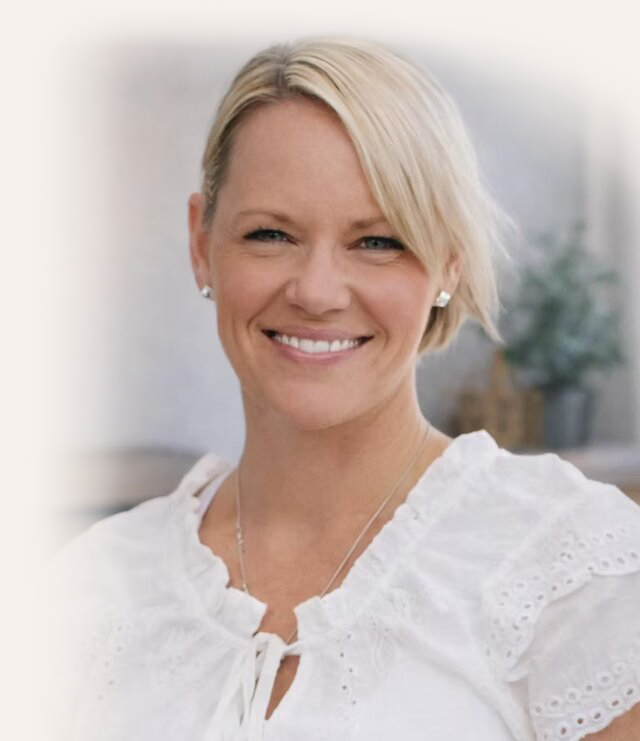
Article by
Michelle McMillan, MACP, CCC
Michelle McMillan is a Canadian Certified Counsellor (CCC) with a Master of Arts in Counselling Psychology (MACP). She has extensive experience working with children and supporting clients with ADHD, neurodivergence, anxiety, emotional regulation, relationships and family challenges. Michelle offers both virtual and in-person counselling, with virtual counselling available throughout Alberta, British Columbia, Saskatchewan and Manitoba and in-person appointments available in Calgary.
Important Information
This article is provided for general educational and informational purposes only and is not a substitute for professional counselling, psychological, medical or emergency services. Information shared here should not be considered a diagnosis or individualized treatment advice. If you are experiencing a mental health emergency or are in immediate danger, please contact appropriate emergency services in your area.