
Blended family life can mean several relationships adjusting at different paces. You may be sorting out stepparent roles, discipline disagreements, or how to support a child who feels caught between adults. Blended family counselling Calgary families turn to can offer a warm, professional space to talk it through.
If parenting disagreements keep returning, or a child seems to feel displaced in their own home, you haven’t failed as a family. These pressures often point to questions worth exploring: what children are experiencing, how adults understand their roles, and which conversations keep getting stuck.
This guide covers common stepfamily tensions, how couple, family and parenting concerns differ, and how to prepare for a first conversation, whether virtual or in person.
Key Takeaways
- Blended-family concerns can involve couple, parent-child, stepparent-child, sibling, or co-parenting relationships. One point of tension doesn’t define the whole family.
- Consider whether the concern centres on your relationship as a couple, wider family dynamics, or questions about parenting roles. These areas can overlap.
- Before counselling, identify one recent example, note who it affects, and write down questions you’d like to discuss.
- Blended family counselling Calgary families consider can offer professional support to explore stepfamily concerns in their specific context.
- Michelle McMillan offers family, couples, parenting, and individual counselling. Both virtual and in-person counselling are available, with in-person appointments in Calgary.
When blended family counselling in Calgary may be worth considering
Blended family counselling is professional support for concerns that arise within a stepfamily. It gives everyone room to talk about how they’re experiencing change and which relationships or expectations are involved. A parent may be wondering how responsibilities are shifting, while a teen is still getting used to sharing time and space. Their concerns are connected, though not identical.
What concerns can arise as families come together?
Several challenges come up often:
- Loyalty conflicts: A child may feel that warming to a stepparent betrays their other parent. Making room for both relationships, without asking the child to choose, can ease that pressure.
- Stepparent roles: Many stepparents are unsure whether guidance will be welcome. Building the relationship gradually, at the child’s pace, tends to feel safer than stepping in as an authority.
- Discipline disagreements: Partners often have different parenting styles. Agreeing on household expectations together, and letting the biological parent lead early on, can reduce friction.
- Children feeling displaced: New routines, shared rooms and divided attention can leave a child feeling less important. One-on-one time with a parent can help.
- Protecting the couple’s relationship: Partners need time together that isn’t only about logistics, so the relationship stays steady while the family finds its footing.
When might professional family support be considered?
Professional support may be worth considering if conflict keeps recurring, people feel uncertain about their roles, or family changes are hard to talk about. A disagreement isn’t a sign of failure. Counselling offers a place to describe concerns and explore different perspectives.
Michelle McMillan offers family counselling alongside her other services, so you can start with whatever feels most pressing.
Understand the different relationships within a blended family
A blended family includes several connected relationships, each with its own history and expectations. Looking at them separately can show where a concern is landing, without treating one disagreement as a verdict on the whole family.
- Couple relationship: Partners may be working out how to share decisions, make time for their relationship, or handle different expectations about family life.
- Parent-child relationship: A parent and child may be adapting to changes in attention, routines, or how family responsibilities are discussed.
- Stepparent-child relationship: The people involved may be finding a comfortable way to relate, including what responsibilities and boundaries make sense to them.
- Sibling relationships: Children may be adjusting to sharing space, belongings, family traditions, or time with a parent. Their relationships may develop at different paces.
- Co-parenting relationship: Parents in separate households may need to coordinate plans or communicate about changes. The level of cooperation and the concerns involved vary from family to family.
These relationships influence one another but aren’t interchangeable. A child’s discomfort with a stepparent entering their bedroom raises questions about privacy and boundaries, which differ from the couple’s disagreement about how to respond. Naming which relationship is most affected helps describe the issue without blame.
How can parents and step-parents experience different role expectations?
Parents and stepparents may have different ideas about authority, responsibility and belonging. One adult may expect a rule to apply to everyone, while another worries about how it’s introduced to a child. Talking through what each person understands their role to be can clarify where views differ.
It can take more than one conversation. A parent may be balancing a child’s needs with couple decisions; a stepparent may be unsure whether guidance will be welcome. Starting with one concrete decision is often easier than settling every question about roles at once.
How might children and co-parents experience family changes?
Children may have questions about routines, relationships or traditions. One may want to know how a holiday will work, while a sibling wonders whether a familiar ritual will continue. Each child needs time to adjust at their own pace. Co-parents may also disagree about plans, and blended family counselling Calgary families explore can address those concerns in their specific context.
Family counselling is one option when a concern touches more than one relationship. For younger children, child counselling may help, and for older kids, teen counselling offers a space of their own.
Couples or family counselling: which concern are you bringing?
It helps to ask where the concern is most present. Is it between partners, about a parent’s decisions, or part of a wider pattern? These areas overlap, so you don’t need a perfect label before seeking support.
Think of these as starting points. A disagreement about a child’s schedule might be about how partners make decisions, or about how the schedule affects the whole family. Describe what is happening first, and the focus can follow.
When might the main concern be between partners?
Couples counselling may fit when the concern centres on the partners, such as repeated disagreements about discipline, boundaries, or balancing couple time with family responsibilities.
Ask whether the concern would still matter if the wider family weren’t involved. If the question is how the two of you decide things together, a couple-centred discussion is a good place to begin.
When might the concern involve the wider family?
Family counselling may be relevant when the issue involves interactions beyond the couple, such as differing understandings of a shared expectation. Not every family member needs to attend.
Parenting support can focus on a parent’s questions about their role or a change in family life. Naming what feels most pressing makes a first conversation about blended family counselling Calgary more focused.
Ready to talk? Explore Family Counselling or Couples Counselling, then visit Rates & Booking to book your first appointment.
Prepare for blended family counselling in Calgary
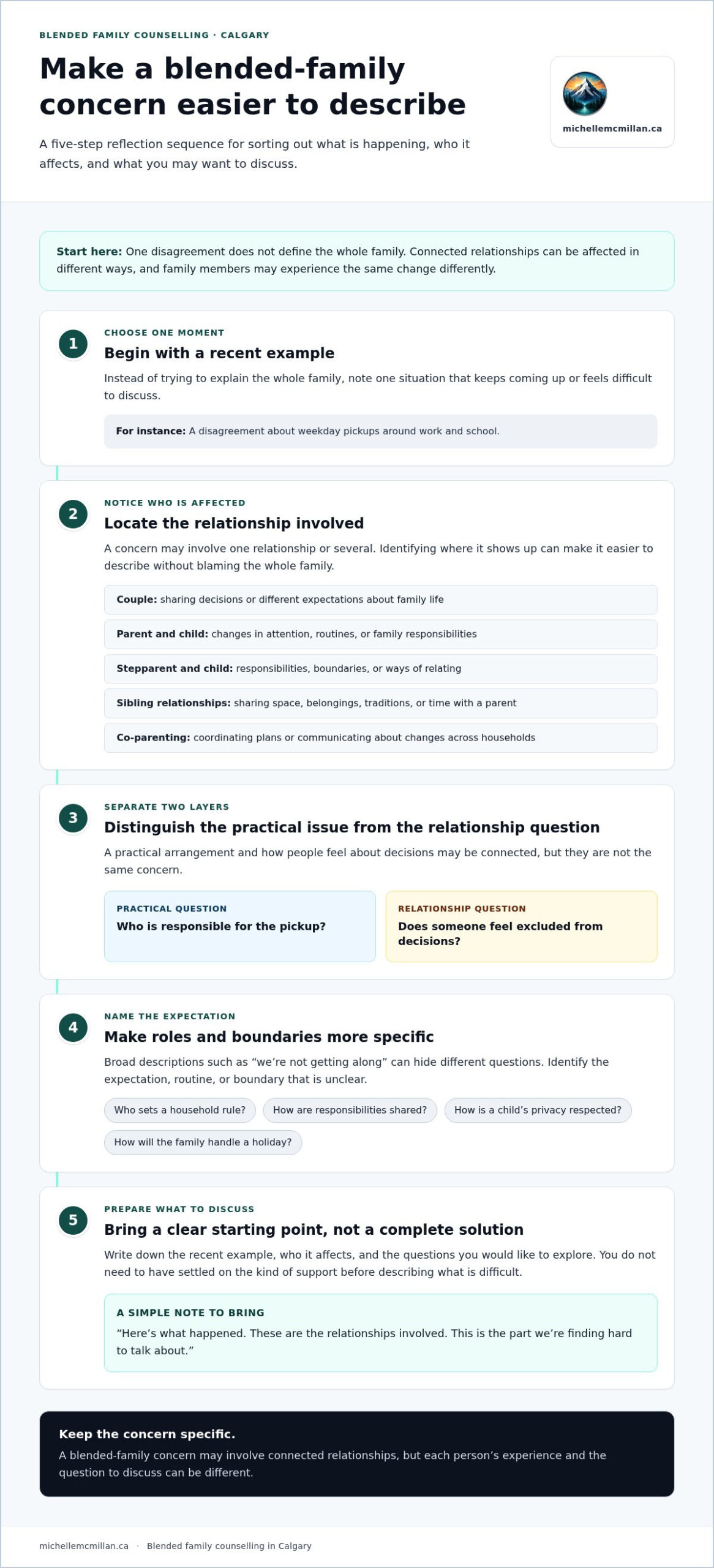
You don’t need a complete account of every relationship. A few clear notes help you describe what’s concerning you: one recent situation, who it affected, and what questions remain.
Try this short sequence:
- Name the concern. Is it about a household expectation, a parent’s role, a relationship, or a change in family routines?
- Note who it affects. Consider whose experience you’re aware of and whose perspective you may not know yet.
- Identify questions. Write down what you’d like professional support to help you discuss or understand.
What family concerns could you write down beforehand?
Choose a recent example rather than the entire family history. Note what happened, and separate it from an interpretation of intent. Write “the rule was different in each home” rather than assuming someone meant to be unfair.
How can children’s perspectives be considered respectfully?
Children’s responses to change are individual and can include mixed feelings or uncertainty. Make space for their perspective without assuming you know what they feel. Note what you’ve observed rather than putting words in a child’s mouth.
Michelle offers virtual and in-person counselling, with in-person appointments in Calgary and virtual counselling in Alberta, British Columbia, Saskatchewan and Manitoba.
Explore blended family counselling options with Michelle McMillan in Calgary
Michelle McMillan offers family, couples, parenting and individual counselling, so the concern you want to discuss can shape where the conversation begins.
In-person appointments are available in Calgary, and virtual counselling is available throughout Alberta, British Columbia, Saskatchewan and Manitoba. Michelle prefers to provide much of her counselling virtually. Couples may join virtual sessions from the same or separate locations.
What can readers know about Michelle McMillan’s background?
Michelle holds a Master of Arts in Counselling Psychology (MACP) and is a Canadian Certified Counsellor (CCC), a national certification through the Canadian Counselling and Psychotherapy Association (CCPA). She has 16 years of education experience, including work with children, teens and families in specialized mental-health and intensive behavioural-support settings. Her areas of experience include ADHD and neurodivergence, anxiety, emotional regulation, relationships, parenting, family challenges, life transitions and self-esteem.
How can you take a next step in Calgary?
Consider what you’d like to discuss, who the concern affects, and whether virtual or in-person suits you best. You don’t need every question settled first.
If you’re considering blended family counselling in Calgary, you can take a low-pressure next step by reviewing rates and booking information.
Make room for the conversation that matters
A blended family doesn’t have to agree on everything before it can talk about what feels difficult. Choose one concern to bring forward, knowing each person may see it differently.
If blended family counselling Calgary feels relevant to what your family is navigating, we’d be glad to hear from you.
Learn more about Family Counselling and Couples Counselling, then visit Rates & Booking to book.
Frequently Asked Questions
Is blended family counselling only for families in crisis?
No. Counselling can be considered before concerns reach a crisis point, such as when a new partner’s role is affecting household decisions.
Can one parent seek counselling if other family members are not ready?
Yes. A parent can seek individual counselling to explore their own questions and feelings about family changes, even if others aren’t ready to take part.
How long does it take a blended family to adjust?
There isn’t one timeline for every family. Rather than measuring progress in months or years, notice which tensions keep arising and bring those forward.
What if co-parents disagree about introducing a new partner?
Identify the specific issues, such as timing, communication or how the change will be explained to a child. Avoid asking a child to carry messages or choose sides. Counselling isn’t a substitute for legal advice about parenting arrangements.
How can I explain counselling to a child?
Use simple, honest language suited to the child’s age. Explain that counselling is a chance to talk about feelings and changes, and that they haven’t done anything wrong. Leave room for questions.
Can counselling help when children have different reactions to a family change?
Counselling can give space to discuss each child’s experience without expecting siblings to react alike. Different responses don’t mean one child is coping better than another.

Article by
Michelle McMillan, MACP, CCC
Michelle McMillan is a Canadian Certified Counsellor (CCC) with a Master of Arts in Counselling Psychology (MACP). She has extensive experience working with children and supporting clients with ADHD, neurodivergence, anxiety, emotional regulation, relationships and family challenges. Michelle offers both virtual and in-person counselling, with virtual counselling available throughout Alberta, British Columbia, Saskatchewan and Manitoba and in-person appointments available in Calgary.
Important Information
This article is provided for general educational and informational purposes only and is not a substitute for professional counselling, psychological, medical or emergency services. Information shared here should not be considered a diagnosis or individualized treatment advice. If you are experiencing a mental health emergency or are in immediate danger, please contact appropriate emergency services in your area.