
What if the first question isn’t “How do we fix this?” but “What is my teen finding difficult, and what kind of support would feel useful to them?” If you’re considering teen ADHD counselling Calgary, you may be weighing several questions: whether counselling is relevant, how to raise the idea without making it feel imposed, and what your role as a parent might be. It’s understandable to want clear answers while giving your teen room to express their own perspective.
This article offers practical context for considering those questions. It covers concerns a teen or family might bring to counselling, ways to include a young person’s perspective, and everyday factors to consider when choosing between virtual and in-person appointments. You’ll also find information about Michelle McMillan’s experience and credentials. Use what’s relevant to your family as a starting point for a thoughtful conversation, not as a checklist for deciding what your teen needs.
Key Takeaways
- ADHD experiences differ from teen to teen. Attention, organization, or emotional concerns alone don’t confirm ADHD.
- Teen ADHD counselling Calgary can provide professional support to discuss concerns, but counselling with Michelle is not an ADHD assessment or diagnosis.
- Your teen’s concerns, preferences about taking part, and family context can all inform whether counselling is worth exploring.
- Michelle McMillan offers virtual and in-person counselling, with in-person appointments in Calgary and virtual counselling available across Alberta, British Columbia, Saskatchewan, and Manitoba.
- Michelle holds a Master of Arts in Counselling Psychology (MACP) and a separate Canadian Certified Counsellor (CCC) designation through the CCPA.
Teen ADHD counselling in Calgary: when families begin considering support
Questions can arise gradually. You might notice your teen putting off a school task, losing track of what they need for the day, or becoming upset during a conversation about plans. It’s natural to wonder whether these moments point to a larger concern. On their own, they don’t show that a teen has ADHD. A behaviour is one piece of context, not a complete explanation of what a young person is experiencing.
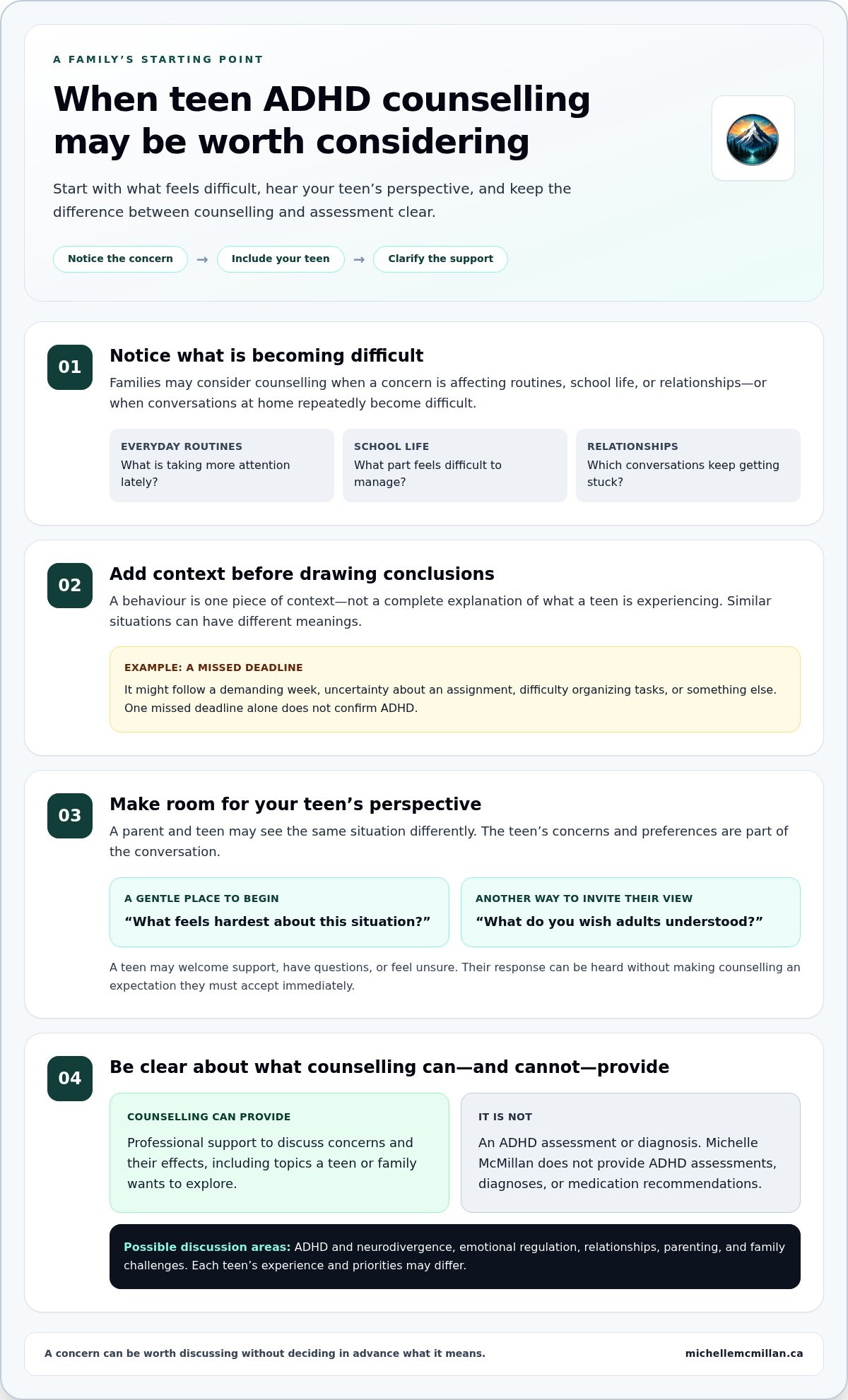
ADHD affects people differently, and similar situations can have different meanings. A missed deadline might follow a demanding week, uncertainty about an assignment, difficulty organizing tasks, or something else. Counselling offers professional support for discussing concerns and their effects, but it is not an ADHD assessment or diagnosis. For families exploring teen ADHD counselling Calgary, a useful starting point is to notice what feels difficult without deciding in advance what it means.
What families may be noticing in everyday life
Hypothetical example: A teen has several school tasks due and forgets to bring home the materials for one of them. A parent reminds them, the teen snaps back, and both leave the conversation feeling frustrated. The parent may be concerned about organization; the teen may feel the reminders are adding pressure or may be worried about the assignment itself. Those perspectives can coexist, and neither tells the whole story alone.
Another young person might forget materials once during an unusually busy stretch and otherwise manage school routines comfortably. The outward event is similar, but it may mean something different in each family. The surrounding circumstances, the teen’s account, and whether the concern keeps coming up all add context. A single behaviour is not proof of ADHD, and ordinary adolescent ups and downs do not automatically indicate a disorder.
When counselling may be worth considering
Families may consider counselling when a concern is affecting routines, school life, or relationships, or when conversations at home repeatedly become difficult. There doesn’t need to be one dramatic event. A parent might notice that a particular issue is taking up more attention than before and want professional support to discuss it.
The teen’s view belongs in the decision. You might ask what feels hardest about the situation or what they wish adults understood. They may welcome support, have questions, or feel unsure about counselling. Making room for their response keeps the discussion open rather than turning counselling into an expectation they must accept immediately. The broader ADHD support resource for Calgary families can also help place individual concerns in a wider family context.
What teen ADHD counselling can address, and what it does not provide
Once the difference between counselling and assessment is clear, the next question is what a teen might want to discuss. That depends on the young person. One teen may want to talk about frustration with school demands; another may be more concerned about friendships, family conversations, or feeling misunderstood. These are possible topics, not experiences shared by every teen with ADHD.
Michelle McMillan provides counselling focused on concerns such as ADHD and neurodivergence, emotional regulation, relationships, parenting, and family challenges. She does not provide ADHD assessments, diagnoses, or medication recommendations. The ADHD information from the National Institute of Mental Health offers general background, while counselling can focus on the particular concerns a teen or family wants to discuss.
Counselling and ADHD assessment are different forms of support
This distinction helps families set expectations without making a teen’s concerns seem less important. Counselling may be considered for a specific difficulty, a relationship concern, or the effect a challenge is having on family life. A diagnosis is not required for a young person to have something they want to talk through, and discussing a concern does not establish its cause.
For example, a teen might want to describe why a group project feels stressful, while a parent hopes to discuss recurring tension around homework. These are starting points for conversation, not conclusions about ADHD. Focusing on what each person notices and wants understood can help clarify which concern matters most to the teen.
Make room for each teen’s individual experience
ADHD-related experiences vary, so avoid assuming that one concern applies to every young person. A teen might want to discuss strong reactions during disagreements; another may not see emotional regulation as a concern. Some families may want to talk about how parenting decisions or household expectations affect relationships. These possibilities don’t mean ADHD causes a particular behaviour or conflict.
It can help to describe a concern in concrete, neutral terms. Instead of deciding that a teen is being careless, for instance, a parent might mention a missed plan and ask what the teen remembers about that day. The purpose is to hear the young person’s perspective and clarify what they want support discussing, not to label the behaviour or predict a particular result.
The ADHD emotional regulation tools for adults offer additional context about how emotional regulation can relate to ADHD, while the teen’s own priorities remain central and may differ from what a parent first noticed.
How to think about teen counselling fit without making assumptions
Deciding whether to explore counselling isn’t a pass-or-fail test. It can begin with what’s happening in your teen’s life, what they want you to understand, and how family members are affected. The prompts below are for reflection, not a way to determine whether a teen needs counselling.
Area to reflect on: Your teen’s concerns
What feels most difficult to them right now: school demands, relationships, organization, emotional experiences, or something else? The concern they name may differ from what adults notice.
Area to reflect on: Preferred participation
What might make a first conversation feel less imposed? Your teen may have questions, feel uncertain, or not want to talk yet. Hesitation on its own doesn’t explain what they need.
Area to reflect on: Family context
Are routines, reminders, or disagreements adding strain at home? Consider how the situation affects different family members without assuming one person is to blame.
Include the teen’s perspective in the decision
Before proposing counselling, try to understand what your teen wants taken seriously. A parent might see missed deadlines as the main concern, while the teen feels misunderstood or overwhelmed by repeated reminders. Starting with their perspective doesn’t require agreement on every detail. It shows that the conversation is about their experience, not only adult expectations.
Hypothetical conversation: “I’ve noticed school deadlines have been stressful. What part of it feels hardest to you?” If your teen says, “I don’t want counselling,” you might respond, “I hear you. What worries you about it?” Their answer may point to uncertainty, a different priority, or a wish to pause. There’s no need to label the response as resistance or lack of motivation.
Families considering teen ADHD counselling Calgary can use a conversation like this to open a discussion rather than present counselling as a consequence or a decision already made. Resources from Children and Adults with Attention-Deficit/Hyperactivity Disorder (CHADD) may also offer broader information for people with ADHD and their families.
Consider family context without assigning blame
Parenting concerns and family dynamics may be part of what a family wants to discuss. One person may feel reminders are necessary, while another experiences them as frustrating. That difference doesn’t prove ADHD caused the conflict or that any one family member is responsible. It gives everyone context for describing what has been happening and what they hope to explore in counselling.
A Calgary guide to parenting a child with ADHD offers further context for reflecting on family concerns. A useful starting point is specific and open: what is each person experiencing, and what would they like understood?
Virtual vs. In-Person Teen Counselling in Calgary
Choosing a counselling format is a practical decision, not a measure of how committed a teen is or what kind of support they need. Michelle offers both virtual and in-person counselling. In-person appointments are available in Calgary, and virtual counselling is available throughout Alberta, British Columbia, Saskatchewan, and Manitoba. Michelle prefers to provide much of her counselling virtually, while both formats remain options.
For families considering teen ADHD counselling Calgary, everyday factors can help shape the choice. Consider travel, schedules, the teen’s preference, and what feels manageable for family members. These are practical considerations, not a test of which format will work better clinically.
What virtual counselling means for families
Virtual counselling offers a flexible way to meet without travelling to an appointment. It may be convenient when family schedules are busy or when someone lives outside Calgary but within the provinces where virtual counselling is available. The format itself doesn’t determine what a teen will want to discuss or what they may take from counselling.
The practical question is whether the teen and family can fit virtual appointments into their routine and whether the young person has a preference about participating this way. There’s no need to make technology the centre of the decision.
Considering in-person counselling in Calgary
In-person appointments are available in Calgary for families who prefer meeting face to face. Consider how an appointment fits around school, work, and transportation, as well as how the teen feels about attending in person. These factors can clarify what is convenient for your household; they don’t indicate that in-person counselling is more effective or necessary for a particular concern.
Some families may value having both formats available as they consider what suits their circumstances. Others may have a clear preference from the outset. Either way, the teen’s perspective belongs in the discussion alongside the practical needs of parents or caregivers.
Michelle’s counselling services overview provides more information about the services available. If you’re exploring teen counselling in Calgary, review the services and consider which format feels practical for your family.
Michelle McMillan’s teen ADHD counselling in Calgary: credentials and next steps
Choosing support for a teen is a personal decision. It can help to know who will provide counselling and what experience they bring, while remembering that credentials and experience don’t promise a particular outcome or determine in advance what counselling will feel like for your family.
Relevant experience and areas of focus
Michelle McMillan holds a Master of Arts in Counselling Psychology (MACP) and is a Canadian Certified Counsellor (CCC). These are separate credentials. Her CCC is a national professional certification through the Canadian Counselling and Psychotherapy Association (CCPA).
Michelle has 16 years of education experience, including work in specialized mental-health and intensive behavioural-support settings with children, teens, and families. ADHD is a primary area of focus, alongside neurodivergence-related concerns. Her areas of experience also include emotional regulation, anxiety, relationships, parenting, family challenges, life transitions, self-esteem, and personal growth.
These areas may be relevant in different ways for different young people. One teen might want to discuss relationships or emotional experiences; another may have concerns about family life or a transition. Counselling can focus on the concerns a teen and family bring, without assuming that every young person with ADHD has the same needs.
A low-pressure next step for Calgary families
Michelle offers both virtual and in-person counselling, with in-person appointments available in Calgary. As you consider the options, keep the practical details in view: what your teen wants to discuss, which format feels manageable, and what questions you’d like answered before beginning. You don’t need to have every concern neatly defined before exploring counselling.
If you’re considering teen ADHD counselling Calgary, a simple starting point is to note what your teen wants understood and what you hope to discuss as a parent or caregiver. Those perspectives may differ, and both can be useful to bring into the conversation.
When you’re ready, review rates and booking information at your own pace. It’s a practical way to learn about arranging counselling without making assumptions about what support will look like.
Let your teen’s perspective shape what comes next
You don’t need to have every answer before opening a conversation about support. You might ask your teen what they’d like you to understand, then share what you’ve noticed without treating it as a conclusion. If you explore counselling together, their questions and preferences can be part of the discussion.
For families considering teen ADHD counselling Calgary, a thoughtful pace leaves room for uncertainty while keeping the focus on the young person’s actual concerns. Counselling is an option to explore, not a promise of a particular result.
To learn more about arranging counselling with Michelle McMillan, review the rates and booking information when you’re ready.
Frequently Asked Questions
Can counselling diagnose ADHD in a teenager?
No. Michelle McMillan does not provide ADHD assessments or diagnoses, and she does not make medication recommendations. Counselling can provide professional support to discuss a teen’s experiences and concerns, but it cannot confirm whether ADHD is present. Keeping the purpose of each service clear can help families decide what kind of support they are looking for.
Can a teen have ADHD-related concerns without a formal diagnosis?
Yes. A teen can discuss concerns such as organizing schoolwork, family tension, or feeling overwhelmed without a formal ADHD diagnosis. Those experiences do not establish that the teen has ADHD, and they can mean different things for different people. Counselling can focus on what the young person wants to talk about, rather than assuming a label.
What if my teenager is unsure about going to counselling?
Uncertainty is a reason to have a conversation, not a reason to label your teen as unmotivated. You could ask what they imagine counselling involves or what part of the idea feels uncomfortable. Listen to their concern without trying to settle everything in one discussion. Your teen may need time to think or may have a different priority. Their perspective can help shape how your family considers support.
Can parents seek counselling support about their teen’s ADHD-related challenges?
Yes. Michelle offers family counselling, which can include discussion of parenting concerns and family challenges. A parent may want to talk about recurring disagreements around routines or how school-related stress affects home life. Raising a concern doesn’t mean assigning blame to the teen or parent. Family members may experience the same situation differently, and those perspectives can be part of what the family wants to discuss.
Can teen counselling include concerns about school and relationships?
Yes. If these concerns matter to the teen, counselling may include discussion of school experiences, friendships, or communication with family members. A young person might want to talk about feeling out of step with classmates, while a parent may be more focused on unfinished assignments. The teen’s priorities can help clarify what to bring into the conversation. These topics can be discussed without assuming they are caused by ADHD or shared by every teen.
Is virtual counselling available to teens outside Calgary?
Yes. Virtual counselling is available to teens in Alberta, British Columbia, Saskatchewan, and Manitoba. It can be a convenient option for families who live outside Calgary or find virtual appointments easier to fit into their schedules. Michelle also offers in-person counselling appointments in Calgary. Families can include the young person’s preference and practical needs in the decision.

Article by
Michelle McMillan, MACP, CCC
Michelle McMillan is a Canadian Certified Counsellor (CCC) with a Master of Arts in Counselling Psychology (MACP). She has extensive experience working with children and supporting clients with ADHD, neurodivergence, anxiety, emotional regulation, relationships and family challenges. Michelle offers both virtual and in-person counselling, with virtual counselling available throughout Alberta, British Columbia, Saskatchewan and Manitoba and in-person appointments available in Calgary.
Important Information
This article is provided for general educational and informational purposes only and is not a substitute for professional counselling, psychological, medical or emergency services. Information shared here should not be considered a diagnosis or individualized treatment advice. If you are experiencing a mental health emergency or are in immediate danger, please contact appropriate emergency services in your area.